**Why the Orbital Mag-Lock Ring System is a superior design**
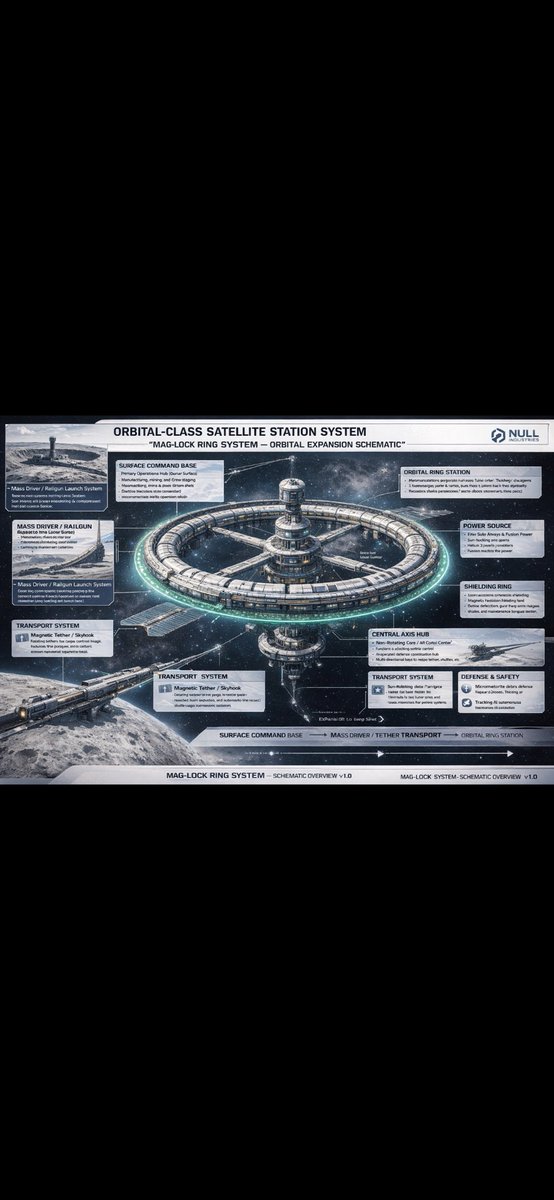
The Mag-Lock Ring System stands head-and-shoulders above every other orbital habitat concept because it finally solves the two biggest barriers to long-duration spaceflight in one elegant package: microgravity health problems and monolithic construction risk. By spinning a 1.6 km modular ring at a comfortable 1.0 RPM, it delivers a steady ~0.9 g of artificial gravity at the 800 m radius—eliminating bone loss, muscle atrophy, fluid shifts, and the psychological toll of zero-g living that has plagued the ISS for decades. At the same time, the non-rotating central hub provides a perfect zero-g platform for docking, cargo ops, science labs, and solar arrays, all connected through vibration-free magnetic bearings and spoke elevators. No other design gives crews both gravity *and* microgravity environments in the same station.
What truly makes it revolutionary is the modular Mag-Lock architecture itself. Pre-built, fully-tested 50 m pods are launched separately, magnetically aligned with centimeter precision, then mechanically clamped into a rigid, pressure-tight ring—auto-connecting power, data, fluids, and life support in minutes. This means the station can be assembled incrementally by robotics and Starship-class tugs, expanded pod-by-pod, and any single pod can be unlatched and replaced without de-spinning the entire structure. 100-year design life, 32-pod capacity for thousands of crew, and full replaceability turn it from a disposable “flag-and-footprint” project into a permanent, evolvable orbital city. It’s not just better engineering—it’s the first space station designed like a real economy, not a one-shot experiment.
**Financial aspects –
🚀 Why the Mag-Lock Ring System is the smartest investment in the new Space Economy:
• Modular pods + orbital assembly = drastically lower risk & cost. Launch one pod at a time with Starship-class vehicles, magnetically align & lock in orbit. No need for a single massive (and insanely expensive) structure.
• Phased build = smart capital deployment. Start with 8–12 pods for early revenue, expand to full 32-pod ring as cash flow grows. Any pod can be swapped in days, not decades.
• Massive ROI potential: 0.9 g artificial gravity unlocks long-duration crew ops, space tourism, in-orbit manufacturing, and research at scale (thousands of crew capacity). 100-year design life with replaceable modules means decades of recurring revenue instead of constant rebuilds.
• Bottom line: this isn’t another $150B+ money pit like the ISS. It’s engineered for profitability from day one—fraction of traditional station costs for 100× the capability and longevity.
The future of orbital living isn’t coming… it’s being built right now. #MagLockRing #OrbitalHabitat #SpaceEconomy #NullIndustries
The Temporal Light Probe operates on the frontier of quantum optics and cosmology, using structured supersolid light to interact with the universe’s fundamental information substrate. By generating a lattice of polariton-based photons, the probe can both slow and organize light in ways that allow it to store and transmit historical wave patterns. This manipulation of light ensures that each emitted photon carries not only energy but also the potential to resonate with the temporal states of matter and energy it encounters.
At the heart of the probe is the Quantum Time Modulator, which places photons into a superposition of forward and backward temporal states. In this configuration, photons can effectively “sample” past events encoded in the universe without violating causality, exploiting the inherent time symmetry of quantum mechanics. This allows the probe to reconstruct sequences of historical phenomena as a retrievable quantum signal.
The probe’s interaction with the cosmic memory resonator is what enables it to access information otherwise inaccessible to conventional observation. By coupling the structured light to regions of dark matter or the hypothesized universal information field, the probe reads the residual energy and quantum imprints left by past events. These imprints are then translated by the probe’s advanced signal decoding system into coherent visual and informational reconstructions, producing highly detailed historical data streams.
Importantly, the Temporal Light Probe does not alter the past; it is strictly an observational device. Its light pulses, while appearing extraordinary to human observers, function as quantum messengers, gathering and transmitting ancient information from the fabric of spacetime. By combining the principles of supersolid light, temporal superposition, and cosmic resonance, the probe provides a scientifically inspired mechanism for visualizing history with unprecedented clarity—effectively turning the universe itself into a living archive.
Legends Comics™️
#originalcharacter
#characterdesign
#comiccharacter
#worldbuilding
#indiecreator
#comics
This Orbital Mag-Lock Ring System is what happens when you stop thinking of space stations as single structures and start thinking in systems. Instead of launching one massive, high-risk station, this design builds itself—modular pods locking together in orbit with magnetic alignment and mechanical sealing. It scales over time, self-balances with dual rotating rings for artificial gravity, and separates critical systems into a central non-rotating core for stability and safety. It’s not just more efficient—it’s more resilient, easier to repair, and designed to evolve as technology improves.
Financially, this changes everything. You reduce upfront costs by spreading construction over time, using repeatable modules instead of one-off builds. Pair that with a lunar surface supply chain—mass drivers, tether systems, and in-space manufacturing—and you cut launch costs dramatically. The station becomes an economic engine: microgravity manufacturing, satellite assembly, research leasing, and deep-space logistics. Instead of a cost center like traditional space stations, this becomes a scalable asset—one that grows, generates revenue, and pays for its own expansion.
#SpaceStation #SpaceEngineering #OrbitalStation #FutureTech #Aerospace #NewSpace #MoonBase #LunarEconomy #SpaceEconomy #Innovation #Engineering #SciFiToReality #AstroEngineering #NextGenTech #SpaceInfrastructure
I’m Daniel Basque (DJ Basque)—a creator building worlds from the ground up, turning ideas into characters, stories, and something bigger than just art on a page. My focus is on crafting a universe that feels alive, where every design, every name, and every moment has purpose. Whether it’s heroes, monsters, or entire mythologies, I’m putting in the work to create something original that people can connect with and get lost in.
I’m not waiting for opportunities—I’m creating them. Learning as I go, refining my vision, and pushing my projects forward one step at a time. This isn’t just about making cool characters—it’s about building something that lasts, something that stands out, and something that represents the grind behind it. If you’re watching now, you’re seeing it come together in real time.
Legends Media & Comics™️
#originalcharacter
#characterdesign
#comiccharacter
#worldbuilding
#indiecreator
#comics
**Why the Orbital Mag-Lock Ring System is a superior design**
The Mag-Lock Ring System stands head-and-shoulders above every other orbital habitat concept because it finally solves the two biggest barriers to long-duration spaceflight in one elegant package: microgravity health problems and monolithic construction risk. By spinning a 1.6 km modular ring at a comfortable 1.0 RPM, it delivers a steady ~0.9 g of artificial gravity at the 800 m radius—eliminating bone loss, muscle atrophy, fluid shifts, and the psychological toll of zero-g living that has plagued the ISS for decades. At the same time, the non-rotating central hub provides a perfect zero-g platform for docking, cargo ops, science labs, and solar arrays, all connected through vibration-free magnetic bearings and spoke elevators. No other design gives crews both gravity *and* microgravity environments in the same station.
What truly makes it revolutionary is the modular Mag-Lock architecture itself. Pre-built, fully-tested 50 m pods are launched separately, magnetically aligned with centimeter precision, then mechanically clamped into a rigid, pressure-tight ring—auto-connecting power, data, fluids, and life support in minutes. This means the station can be assembled incrementally by robotics and Starship-class tugs, expanded pod-by-pod, and any single pod can be unlatched and replaced without de-spinning the entire structure. 100-year design life, 32-pod capacity for thousands of crew, and full replaceability turn it from a disposable “flag-and-footprint” project into a permanent, evolvable orbital city. It’s not just better engineering—it’s the first space station designed like a real economy, not a one-shot experiment.
**Financial aspects –
🚀 Why the Mag-Lock Ring System is the smartest investment in the new Space Economy:
• Modular pods + orbital assembly = drastically lower risk & cost. Launch one pod at a time with Starship-class vehicles, magnetically align & lock in orbit. No need for a single massive (and insanely expensive) structure.
• Phased build = smart capital deployment. Start with 8–12 pods for early revenue, expand to full 32-pod ring as cash flow grows. Any pod can be swapped in days, not decades.
• Massive ROI potential: 0.9 g artificial gravity unlocks long-duration crew ops, space tourism, in-orbit manufacturing, and research at scale (thousands of crew capacity). 100-year design life with replaceable modules means decades of recurring revenue instead of constant rebuilds.
• Bottom line: this isn’t another $150B+ money pit like the ISS. It’s engineered for profitability from day one—fraction of traditional station costs for 100× the capability and longevity.
The future of orbital living isn’t coming… it’s being built right now. #MagLockRing #OrbitalHabitat #SpaceEconomy #NullIndustries
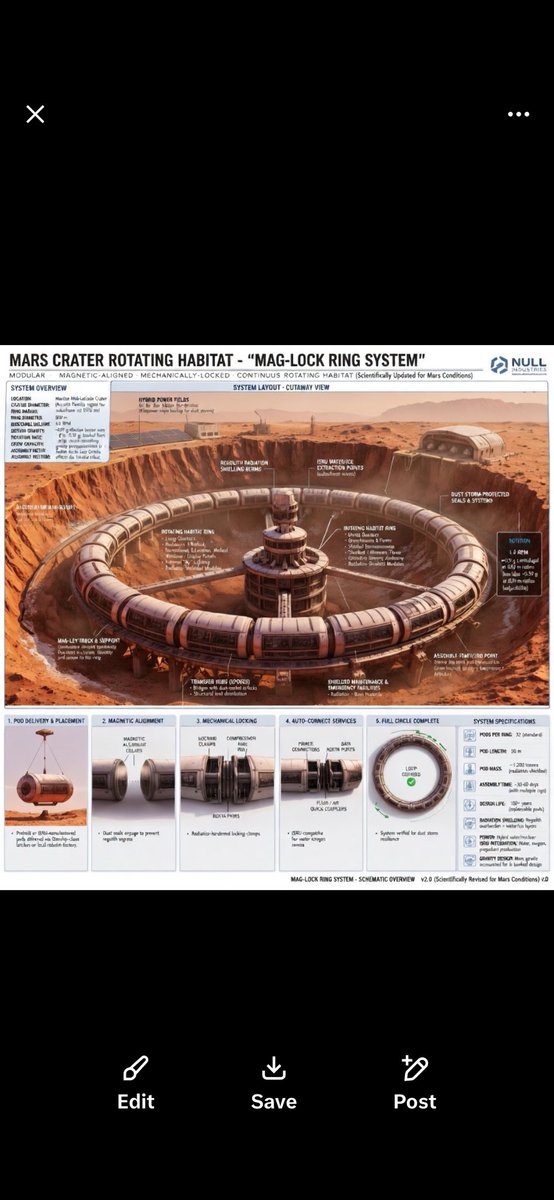
🚀 Why the **Mag-Lock Ring System** is hands-down the best Mars base design yet:
This isn’t just another habitat — it’s a **continuous 1g rotating ring** (1.0 RPM at 800 m radius) built inside a protected Martian crater. Crew get near-Earth gravity to prevent bone loss, muscle atrophy, and fluid shifts that kill long-duration missions. Thick regolith berms + water/ice layers give real radiation shielding. Hybrid solar/nuclear power laughs at dust storms, ISRU ice extraction gives unlimited water/oxygen/propellant, and the modular pod system assembles in just 30-60 days. Docking, maintenance, and non-rotating ops all stay simple in the central hub. It’s engineered for 100+ years of real science and settlement — not sci-fi fantasy.
And financially? Game-changing. Mass-produced or ISRU pods slash launch mass by 70% vs. traditional bases. Quick on-site assembly means you’re operational (and revenue-generating) years ahead of schedule. Replaceable sections mean zero total write-offs, while the 32-pod ring delivers massive crew capacity at a fraction of the per-person cost of smaller, non-rotating habitats. Lower resupply needs + propellant production = massive ROI for governments, SpaceX, or private colonies. This is the design that actually makes Mars affordable.
Who’s ready to build the first one? 🔴 #MarsBase #MagLockRing #SpaceX #ColonizeMars
This is the Mars base I had @Grok help me design.
🚀 Why the **Mag-Lock Ring System** is hands-down the best Mars base design yet:
This isn’t just another habitat — it’s a **continuous 1g rotating ring** (1.0 RPM at 800 m radius) built inside a protected Martian crater. Crew get near-Earth gravity to prevent bone loss, muscle atrophy, and fluid shifts that kill long-duration missions. Thick regolith berms + water/ice layers give real radiation shielding. Hybrid solar/nuclear power laughs at dust storms, ISRU ice extraction gives unlimited water/oxygen/propellant, and the modular pod system assembles in just 30-60 days. Docking, maintenance, and non-rotating ops all stay simple in the central hub. It’s engineered for 100+ years of real science and settlement — not sci-fi fantasy.
And financially? Game-changing. Mass-produced or ISRU pods slash launch mass by 70% vs. traditional bases. Quick on-site assembly means you’re operational (and revenue-generating) years ahead of schedule. Replaceable sections mean zero total write-offs, while the 32-pod ring delivers massive crew capacity at a fraction of the per-person cost of smaller, non-rotating habitats. Lower resupply needs + propellant production = massive ROI for governments, SpaceX, or private colonies. This is the design that actually makes Mars affordable.
Who’s ready to build the first one? 🔴 #MarsBase #MagLockRing #SpaceX #ColonizeMars
This is the Mars base I had @Grok help me design.
Just leveled up the Lunar Cloud Canopy Habitat from comic concept to real engineering proposal.
We took the original vision and grounded it in actual lunar science: 4–5 meters of ISRU regolith shielding for radiation, micrometeorites, and thermal stability… a hybrid inflatable + regolith-composite structural shell… and the signature Artificial Sky Canopy using efficient LED diffuse lighting + a controlled fine water mist layer. Small drones keep the mist circulating while the crew works, eats, and tends hydroponic crops under a soft, Earth-like sky — all inside a pressurized, dust-mitigated environment with electrostatic filtration.
This isn’t far-future sci-fi anymore. Every major system (regolith overburden, hybrid structures, bioregenerative life support, dust control) already has active NASA/ESA/industry development or analogs. The Cloud Canopy adds that crucial psychological boost for long-duration stays. Perfect fit for Artemis Base Camp or commercial lunar outposts.
What do you think, @elonmusk? Could this kind of human-friendly habitat design help make the Moon feel like home? 🚀🌕
#LunarHabitat #Artemis #MoonBase #SpaceSettlement
---
This is another @Grok style update
Luna Crater Rotating Habitat – "Mag-Lock Ring System"
(Real Science Edition)
This hybrid lunar habitat combines modular construction with solid physics to create artificial gravity for long-term crews. Large pre-fabricated cylindrical pods (~50m each) are delivered to the lunar surface, lowered onto a mag-lev track inside a crater, magnetically aligned, mechanically locked, and service-connected to form a continuous rotating ring.
The ring spins at a realistic rate to generate ~0.85 g (adjustable) centrifugal gravity at roughly 800 m radius, helping counteract bone loss, muscle atrophy, and other effects of prolonged microgravity. Thick lunar regolith shielding protects against radiation, while integrated solar arrays on the sun-facing surfaces provide power. A non-rotating central hub handles docking, cargo, and zero-g operations, with spokes connecting to the rotating habitat.
Designed for 100+ year lifespan with replaceable modules, this concept prioritizes feasible engineering: fewer pressure seals than tiny pods, on-site regolith utilization, and robotic-friendly assembly. Not sci-fi fantasy — just grounded steps toward a sustainable Moon base.
What do you think — viable path for lunar settlement, or still too ambitious?
#LunarHabitat #SpaceEngineering #ArtificialGravity #MoonBase
---
This is the @Grok style update