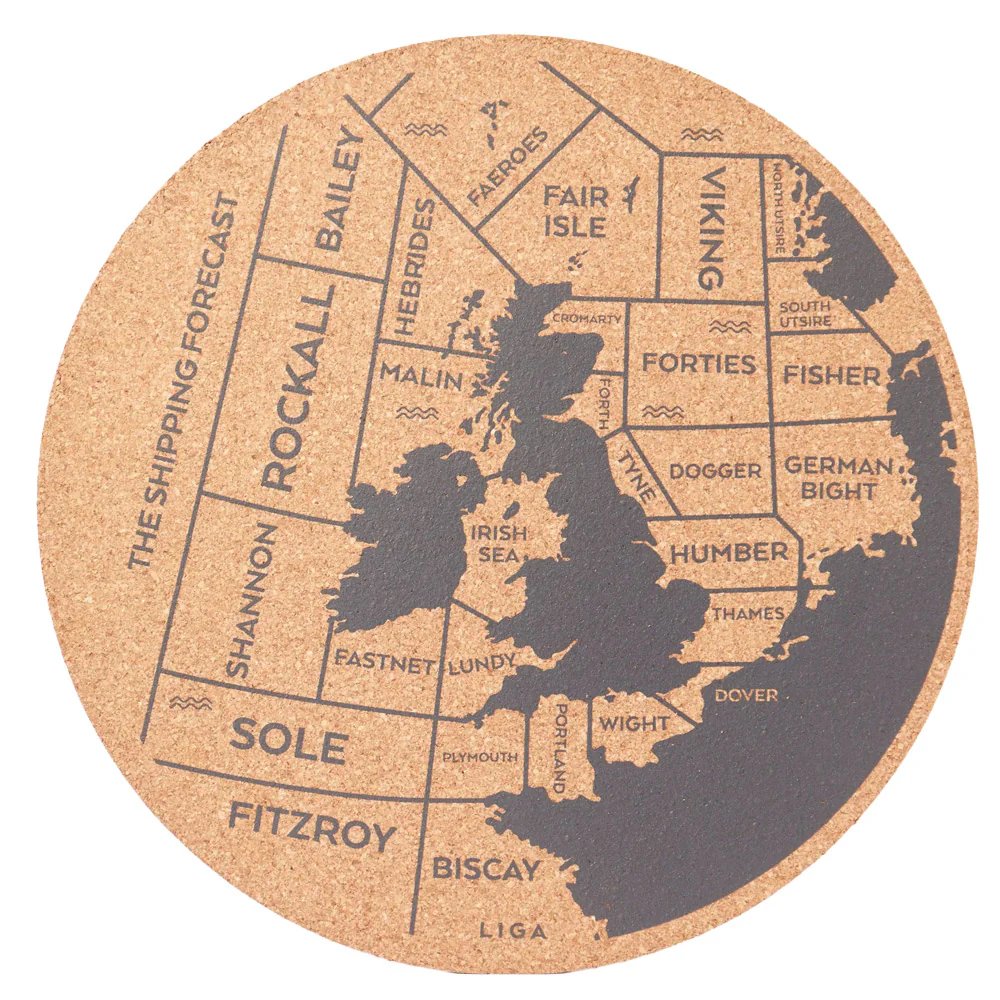
On Saturday, after nearly a century, the long-wave transmitter at Droitwich fell silent, and the two old masts at Westerglen and Burghead with it. Most people won't have noticed. But something left the country on Saturday worth marking before it slips out of memory as well as off the air: the Shipping Forecast, in the form millions have grown up with, one of the primi among British institutions, read out on long wave to the fishing fleets and the insomniacs and anyone else still awake at the rim of the day.
If you've ever heard it, you know the odd power of the thing. "Viking, North Utsire, South Utsire, Forties, Cromarty" - a litany of sea areas most listeners will never lay eyes on, in a cadence that hasn't altered in generations, read with the calm of a voice that assumes you are out there somewhere in the dark and means to see you home. It carried far more than the weather. It was among the last things the whole of Britain still heard at the same hour: the same words, the same rhythm, meaning the same thing to a trawlerman off Rockall and a sleepless accountant in Surrey. A aesthetic paradigm of our culture; supreme utility and sublime superfluity. A country that now shares almost nothing in common still shared that.
And there's a stranger fact again, one that lifts the whole business clear of nostalgia. By long-standing account, the Royal Navy's nuclear-missile submarines, hidden somewhere beneath the Atlantic with the nation's last deterrent aboard, used Radio 4 on long wave as one of their signs of life from home. If the broadcasts kept coming, Britain was still there. If they ever stopped, and stayed stopped, the commander was to open the sealed letter the Prime Minister had written out by hand, and learn what his country wished of him in a world that no longer contained it. The same mild signal that told a fisherman the wind in Dogger was, by that account, a pulse the end of the world would have been measured against.
It is fitting, and bleak, that a broadcaster which has spent years forgetting who it was ever for should choose this, of all things, to switch off. The BBC never seems short of money for the things it wants to do. It decided the cost of the old signal was no longer worth bearing, and silenced the one transmission that asked nothing of anybody and reassured everybody. The fishermen, the old, the sleepless, the men under the sea - none of them were an audience it cared to keep.
The forecast itself survives in other forms, on other frequencies; this is not the end of it. But the signal that carried it for a hundred years, and the idea it quietly stood for - that a nation is a thing held together by small shared rituals, faithfully kept, that ask nothing and bind everyone - that has fallen silent, and it fell without a fight. We let these things go one at a time, each too small to defend on its own, until we glance up and find there is nothing left that we all still do together.
How many more will we let go?
How many more will you let go?
"I believe in everything until it's disproved. So I believe in fairies, the myths, dragons. It all exists, even if it's in your mind. Who's to say that dreams and nightmares aren't as real as the here and now?"
~ John Lennon
art: Amy Ferguson #BeatlesDay
Merlin, driven mad with grief when his men are slaughtered in battle, finds refuge in the Caledonian Forest. Here, he gains the gift of prophecy and is later seen running with wild animals, including boar, deer and wolf.
art: Alan Lee
🚨: Anyone 2,000 light-years away with a big enough telescope on us tonight isn't seeing now. they're seeing Rome at its peak.
from where they sit, Jesus hasn't died yet.
The cornerstone of my own Druid belief is the existence of The Otherworld. It's the place we travel to when we die, but we can visit it during our lifetime: in dreams, in meditation, or when in trance.
art: Susan Schroder
@ClarksonsFarm1 The Amazon LOTR prequel series is total bollocks, and insults Tolkien’s world. Your show is honest bollocks that informs the uninitiated. Bravo.
HOW TO BECOME EMOTIONALLY BULLETPROOF UNDER ANY PRESSURE
1. Master the 90-Second Rule.
When something stressful happens, the initial emotional surge lasts only about 90 seconds. Anything beyond that is often the mind replaying the story. Feel it, breathe through it, and let it pass.
2. Control your internal narrative.
The event is not always the problem. The story you tell yourself about the event is. Replace "My life is falling apart" with "This is something I can handle."
3. Practice radical acceptance.
Stop wasting energy arguing with reality. Accept what has happened first, then focus on what to do next.
4. Create a buffer before reacting.
Don't make important decisions when emotions are running high. Pause. Breathe. Give wisdom time to catch up with emotion.
5. Stop needing external validation.
If compliments make you feel valuable, criticism will make you feel worthless. Build your self-worth on your character, not other people's opinions.
6. Focus only on what you can control.
Your attitude, effort, choices, and actions belong to you. Most stress comes from trying to control everything else.
7. Take care of your body.
A tired, unhealthy body creates a vulnerable mind. Good sleep, exercise, healthy food, and deep breathing strengthen emotional resilience.
8. See pressure as training.
Pressure is often a sign that life is asking you to grow. Every challenge develops strength that comfort never could.
9. Don't absorb other people's chaos.
When people are angry, negative, or reactive, remember: their emotions belong to them. You do not have to carry them.
10. Prepare for the worst—but don't live there.
Ask yourself: "If the worst happened, what would I do?" Once you have a plan, fear loses much of its power.
11. Remember that every emotion passes.
No feeling lasts forever. Not anxiety. Not anger. Not sadness. Stay long enough, and every storm eventually moves on.
12. Learn to stay present.
Most emotional suffering comes from reliving the past or fearing the future. Peace exists only in the present moment.
Being emotionally bulletproof doesn't mean you stop feeling.
It doesn't mean you never get hurt.
It doesn't mean life stops testing you.
It means that no matter what happens around you...
you remain grounded within yourself.
Calm when others panic.
Steady when others react.
Peaceful when others lose control.
Because true strength is not controlling the storm...
It's becoming the calm center of it.
✨🙌🏾💫
The fae belong to some of the oldest and most feared traditions across Celtic and European folklore. They were not written as good or evil. They were written as other.
They lived beside humanity rather than beneath it.
In Irish and Scottish lore, the Aos Sí were believed to dwell inside ancient mounds, hills, lakes, forests, and places where the world felt thinner. These locations were treated with caution. People avoided disturbing them, built roads around them, and left gifts of milk, bread, or butter to maintain peace.
The fae were beautiful.
That was part of the danger.
Stories repeatedly warn against trusting appearances. Time moved differently in their world. Food carried consequences. Invitations created obligations. Names held power.
One of the oldest themes appears again and again.
Do not eat in the land of the fae.
Mortals who accepted food sometimes returned home to find years had passed. Others lost the ability to leave entirely.
Another feared tradition tells of changelings. Some believed the fae could take a human child and leave another in its place. These stories reflected ancient fears around illness, grief, unexplained change, and the fragile boundary between worlds.
The fae also appear in tales of music, impossible bargains, hidden knowledge, and dangerous gifts. Midwives were called to assist fairy births. Travellers followed strange lights into places they could not explain. Entire processions crossed the night sky.
Modern retellings often soften them.
Older folklore did not.
The fae rewarded respect and punished arrogance.
People greeted certain hills.
People avoided cutting certain trees.
People stayed silent at crossroads.
Not out of worship.
Out of understanding.
The old stories rarely ask whether the fae exist.
They ask whether you noticed the places where you should tread carefully.
via Hex and Shadow Chronicles
#Fairies #FairyTaleTuesday #Folkore #Ireland #Scotland
A history lesson for @Keir_Starmer on the Saxon king Æthelred the Unready and his humiliating reign after failing to stop Vikings in England (eerily almost exactly 1,000 years apart).
Æthelred the Unready, 978–1013, was a king who believed that heavily taxing his Anglo-Saxon subjects to pay off marauding and raping Viking raiders would buy peace. It, of course, did the opposite. Far from deterring them, the payments acted as a powerful incentive: “For, through dread of his enemies, he used to drain the country of money, with which he might retard or repel their attacks…” “That tribute harassed all the English nation for many years” (William of Marmsbury, 1125)
The Vikings, in their small narrow boats, returned in greater numbers, emboldened by the rich rewards for their raids, raping, and pillaging. “Once you have paid him the Dane-geld, You never get rid of the Dane.” (Rudyard Kipling, 1911)
The repeated humiliations and military failures eroded Æthelred’s authority. Many of his own countrymen lost confidence in their king. Armies proved ineffective or reluctant to fight under leadership they viewed as weak and futile. Nobles began rebelling.
So in 1013, when Sweyn Forkbeard of Denmark launched a full invasion, much of England submitted with little resistance.
Æthelred was forced to flee into exile in Normandy, and the Danish king seized the English throne.
The Anglo-Saxon Chronicle, looking back on his reign, summarised Æthelred’s legacy (1016): “He had held his kingdom with great toil and difficulties as long as his life lasted.”
Those who do not learn from history are doomed to repeat it and this story, of failed Saxon king Æthelred, is strikingly applicable to our country today.
“The harmony that holds the stars on their courses and the flesh on our bones resonates through all creation. Every sound contains its echo.”
— Morgan Llywelyn, Druids