“To eliminate suffering entirely would mean, in the end, extinguishing love and desire as well. Those who love and desire cannot avoid passing through trial and suffering; and over the years, we carry within us lessons that leave their mark like scars, the memories of a journey shaped by freedom and failure, dreams and disappointments.
It is only thanks to the interplay of these elements that the wonders of the soul occur within us, allowing us to sense the richness of our humanity.
To renounce this adventure, both tragic and splendid, in the name of a presumed transcendence of all limits, could mean many things, but it would no longer be human.”
Pope Leo XIV, Magnifica Humanitas (par. 120) (May 15, 2026)
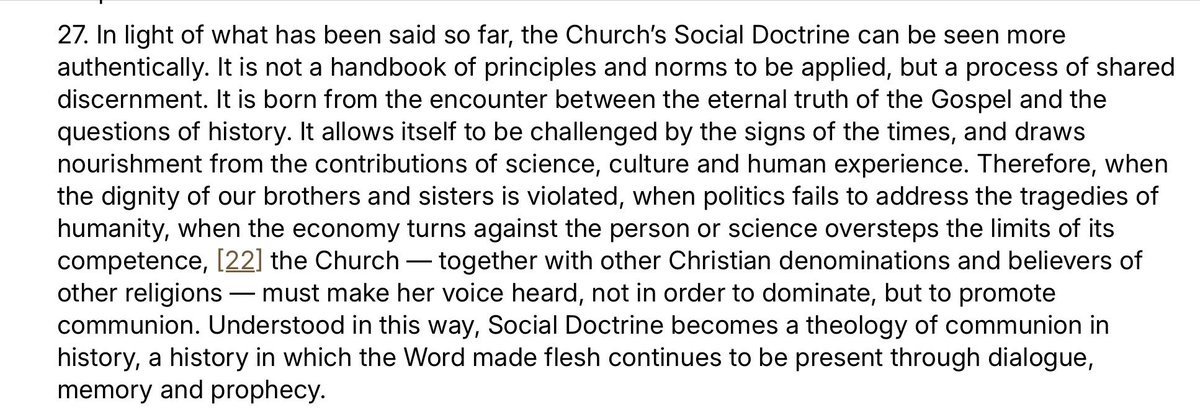
I am working my way through Magnifica Humanitas and can honestly say that the Holy Father may have permanently changed my understanding of the nature of Catholic social teaching. See, eg, paragraph 27. Though Pope Leo doesn’t cite him, this way of viewing Social Doctrine has obviously roots in Saint John Henry Newman’s (aka, Cardinal Newman) arguments on the development of doctrine. Without ever explicitly articulating it, I have always thought of Social Doctrine precisely as a set of “principles and norms to be applied.” But I now see that Leo (and Newman) offer a better way.
In this new piece we argue Pope Leo's critics on just war are wrong to claim he is overstating pacifism. Augustine's just war originates in debate with ancient critics of Christianity who claim New Testament's pacifist martyr (Christ) contradicts Old Testament soldiery (David)
Truth presents itself as a reality that precedes human beings. It challenges us and calls us out of ourselves. This is why truth can be sought with trust. Faith does not shut itself off from this search, but purifies it of self-sufficiency and opens it to a fullness towards which reason strives, even if it cannot fully embrace it. #ApostolicJourney #EquatorialGuinea https://t.co/Z4fsTHYyQO
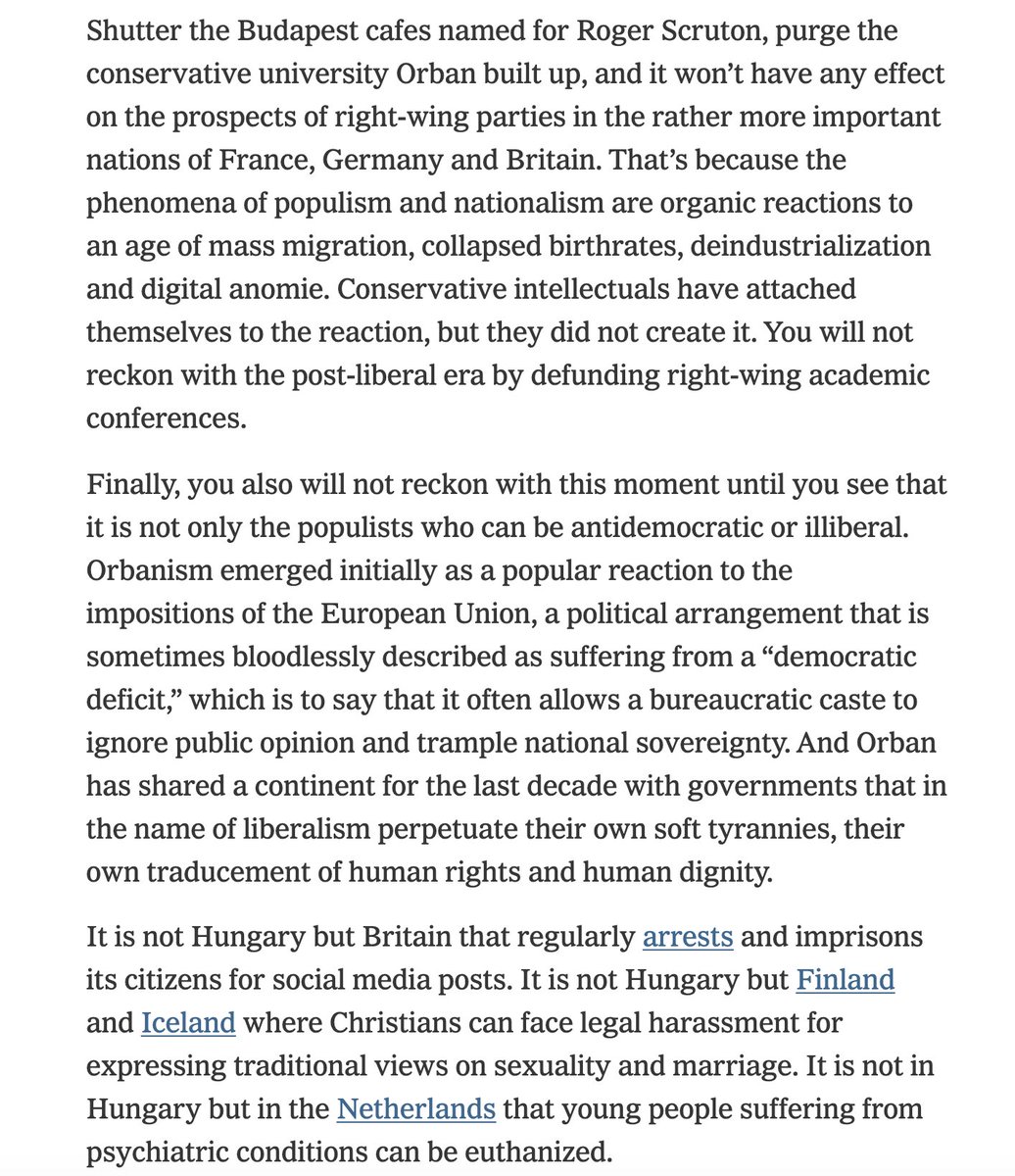
Ross Douthat (@DouthatNYT) could not possibly be better on the lessons for liberals from Viktor Orban's defeat. I've unlocked the whole column here, but note especially the attached.
https://t.co/ilk4mUHTd6
I love being Catholic *because* the edicts of my faith constantly challenge my political beliefs. I cannot imagine a religion that would pride itself on being a reliable voting bloc, because service to Christ is first, not service to some temporal political party.
Pope Leo XIV: “The mission of the Christian soldier is… defending the weak, protecting peaceful coexistence, intervening in disasters, operating in international missions to preserve peace and restore order. All this cannot be reduced to a mere profession: it is a vocation, a response to a call that challenges the conscience. The soldier’s identity is forged by generosity, a spirit of service, high aspirations and deep feelings. But these values require a foundation, a gift of Grace capable of fostering charity to the point of total self-sacrifice. It is therefore necessary to inspire the codes, norms and missions of military life with the lifeblood of the Gospel so that, in the service of security and peace, the common good of peoples is always the first priority” https://t.co/qAmOtkDu6b
Walker Percy, in a 1977 self-interview (emphasis mine).
Q: How is such a belief possible in this day and age?
A: What else is there?
Q: What do you mean, what else is there? There is humanism, atheism, agnosticism, Marxism, behaviorism, materialism, Buddhism, Muhammadanism, Sufism, astrology, occultism, theosophy.
A: That’s what I mean.
Q: I don’t understand. Would you exclude, for example, scientific humanism as a rational and honorable alternative?
A: Yes.
Q: Why?
A: It’s not good enough.
Q: Why not?
A: This life is too much trouble, far too strange, to arrive at the end of it and then to be asked what you make of it and have to answer “Scientific humanism.” That won’t do. A poor show. Life is a mystery, love is a delight. Therefore I take it as axiomatic that one should settle for nothing less than the infinite mystery and the infinite delight, i.e., God. In fact I demand it. I refuse to settle for anything less. I don’t see why anyone should settle for less than Jacob, who actually grabbed aholt of God and would not let go until God identified himself and blessed him.
The cross is part of the mission. The imperialist occupation of the world is disrupted from within; the violence that until now has been the law is unmasked. The poor, imprisoned, and rejected Messiah descends into the darkness of death, yet in so doing He brings a new creation to light. #HolyThursday
Cardinal Pierbattista Pizzaballa, the Latin Patriarch of Jerusalem, blessed the city with relics of the Holy Cross from the Mount of Olives on Palm Sunday morning after Israeli police blocked him from entering the Church of the Holy Sepulchre to celebrate Mass.
Video: Christian Media Center
Cardinal Pizzaballa on Palm Sunday: “In this afternoon of Palm Sunday we gather without a procession, without palms waving through the streets. This absence is not merely a matter of formalities. It is the war that has interrupted our festive journey, making even the simple joy of following our King difficult.”
“Today Jesus weeps once more over Jerusalem. He weeps over this city, which remains a sign of both hope and sorrow, of grace and suffering. He weeps over this Holy Land, still unable to recognize the gift of peace. He weeps for all the victims of a war that seems without end: for divided families, for shattered hopes. But the tears of Jesus are never fruitless. They open our eyes, challenge us, and reveal the truth.”
Each year, Cowboys & Indians Magazine readers select their favorite Western movies & TV shows. I'm very happy that AMERICANA has won for best movie, best supporting actor (Zahn McClarnon), best director (me), & best screenplay (also me).
https://t.co/HuPZUflrws
I know I keep going on about this, but glance at the comments here to see the future of social media: most of the comments are meaning-shaped, most are ultimately nonsense, and because LLMs are good at producing things that feel like they deserve attention, each one is a small tax on your concentration and a drowning out of conversation.
I suspect my posts attract more AI bots than most, but they are coming for you all. Social media is going to either blow up or transform, but until then: don't read the comments.
THE GEOMETRY OF CHRISTIAN CONTEMPLATION
Measure without Measure
David ALBERTSON
OXFORD UNIVERSITY PRESS, December 2025
https://t.co/yKV0JKd2wQ
Abstract
The writings of ancient and medieval Christian mystics were rediscovered in the twentieth century, and today they are read more widely than ever before. But do modern assumptions about religious experience influence how we hear those premodern voices? Do we do them justice by thinking of mysticism as interior and ineffable? Or can mystical experience intersect with the natural environment, and indeed the cosmos, which science calculates with precise quantities? David Albertson's The Geometry of Christian Contemplation: Measure without Measure suggests a fresh approach to the history of mystical theology that is oriented toward exteriority more than interiority, and toward the measurable world outside more than the invisible world within.
The ancient Greek philosopher Plotinus had taught contemplatives to close their eyes and withdraw into the soul. Most Christians followed his directions, but others dissented. In three critical episodes, an alternative model of Christian contemplation began to emerge: from Dionysius the Areopagite, to the Byzantine monks John of Damascus and Theodore the Studite, to eccentric humanists in medieval Paris. Together these episodes add up to a very different theological aesthetics, one that can enliven the modern study of mysticism and correct some of its imbalances. For in the centuries before the scientific revolution and the secularization of nature, Christians still saw God in the exterior world, not only the interior soul. God was not an ineffable and formless Absolute, immeasurable as the soul, but an infinite Measure who leaves behind geometrical traces in the figures of the world. The God who became a human body in the Incarnation not only entered time and matter, but also spatial extension, and with it the conditions of measure: points, lines, curves, shapes, planes, dimensions, and magnitudes.
Today the wisdom of this counter-tradition can strengthen the study of mysticism, not only by supplementing our contemporary fascination with negative theology by redefining what it means to name God positively, but by suggesting a new connection between Christian mysticism and the hyper-measured, hyper-technologized world that surrounds us.
Author
David Albertson is Associate Professor of Religion at the University of Southern California in Los Angeles, where he studies medieval Christianity and philosophy of religion and serves as Executive Director of the Nova Forum for Catholic Thought. He is the author of Cusanus Today: Thinking with Nicholas of Cusa Between Philosophy and Theology (CUA, 2024), Mathematical Theologies: Nicholas of Cusa and the Legacy of Thierry of Chartres (Oxford, 2014), and Without Nature? A New Condition for Theology (Fordham, 2009). His research is supported by the National Endowment for the Humanities and the Alexander von Humboldt Foundation.
University 'elites' right now are basically a few thousand people agreeing that fellow members of their group are good at their jobs. They give each other jobs, promotions, and prizes without any serious judgments of quality having being made, ever. There are a few exceptions, but not many.
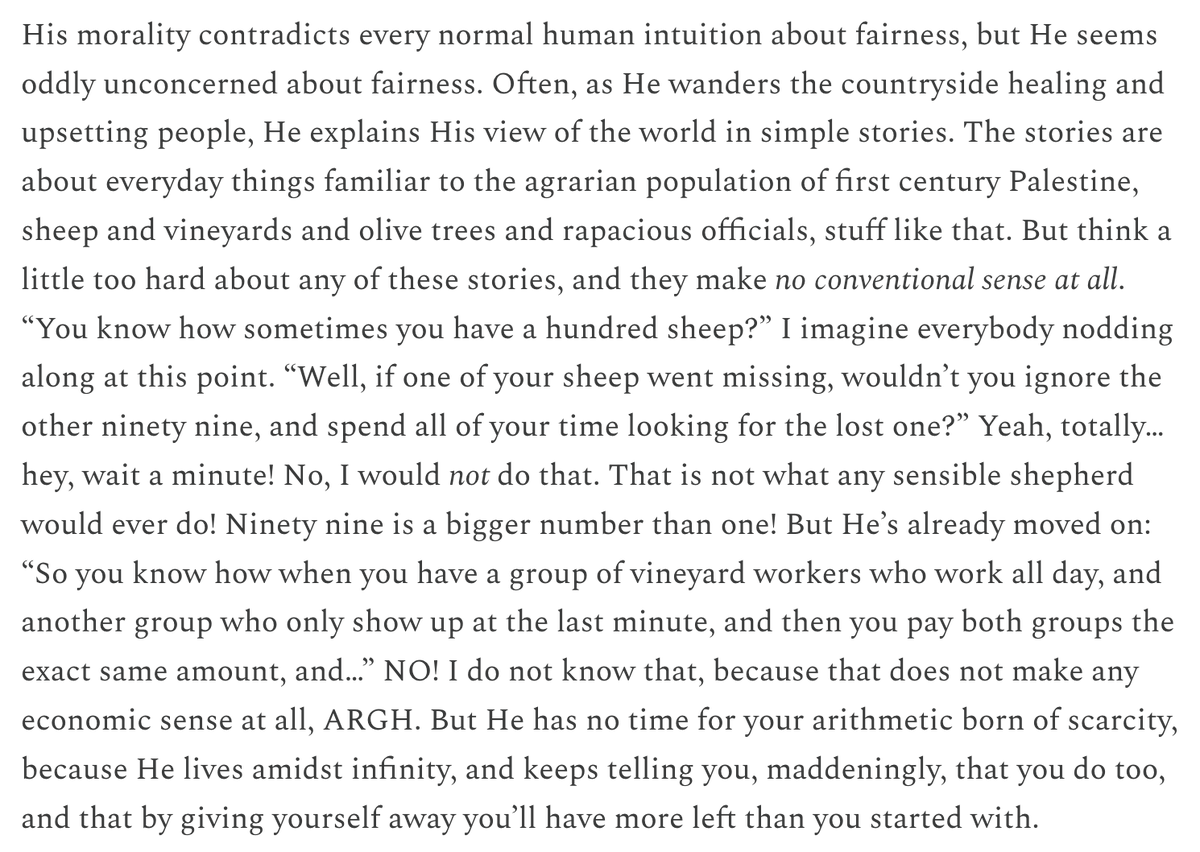
"If you persevere, in time you will have an entirely different problem - not that life is meaningless, but rather that life has almost too much meaning. […]
God runs like a helix through all things. The world awaits you, humming with meaning. You are alive with potential. You are not dead."












![leahprime's tweet photo. "If you persevere, in time you will have an entirely different problem - not that life is meaningless, but rather that life has almost too much meaning. […]
God runs like a helix through all things. The world awaits you, humming with meaning. You are alive with potential. You are not dead."](https://pbs.twimg.com/media/G6DcVONW8AAryrN.jpg)


