Bob Rae: "If I have to choose between Jamieson Greer and Howard Lutnick and Mark Carney and Dominic LeBlanc, I take them. Our guys speak the truth and we know what we're doing. We know what we're talking about. This is just a hobby for these guys. And they don't understand who they're playing with and what the consequences of their behaviour are going to be."
This is probably for the best, viewed in the larger context -- this wasn't the deal, but just a deal, the primer for further concessions to come. It's a mistake to call this a negotiation. It's basically just extortion: do what we say or we'll hurt you real bad. Canada has to show it is uncoercible, which means demonstrating a willingness to endure pain.
Ottawa fires back after rejecting U.S. trade deal - The Globe and Mail https://t.co/66Qjkkj7CV
The glorification of Mary, body and soul, teaches us that our true beauty does not lie in hiding the signs of aging, but in revealing the signs of love that never end, and are even impressed on our flesh (cf. 1 Cor 13:8).
Yann LeCun was right the entire time. And generative AI might be a dead end.
For the last three years, the entire industry has been obsessed with building bigger LLMs. Trillions of parameters. Billions in compute.
The theory was simple: if you make the model big enough, it will eventually understand how the world works.
Yann LeCun said that was stupid.
He argued that generative AI is fundamentally inefficient.
When an AI predicts the next word, or generates the next pixel, it wastes massive amounts of compute on surface-level details.
It memorizes patterns instead of learning the actual physics of reality.
He proposed a different path: JEPA (Joint-Embedding Predictive Architecture).
Instead of forcing the AI to paint the world pixel by pixel, JEPA forces it to predict abstract concepts. It predicts what happens next in a compressed "thought space."
But for years, JEPA had a fatal flaw.
It suffered from "representation collapse."
Because the AI was allowed to simplify reality, it would cheat. It would simplify everything so much that a dog, a car, and a human all looked identical.
It learned nothing.
To fix it, engineers had to use insanely complex hacks, frozen encoders, and massive compute overheads.
Until today.
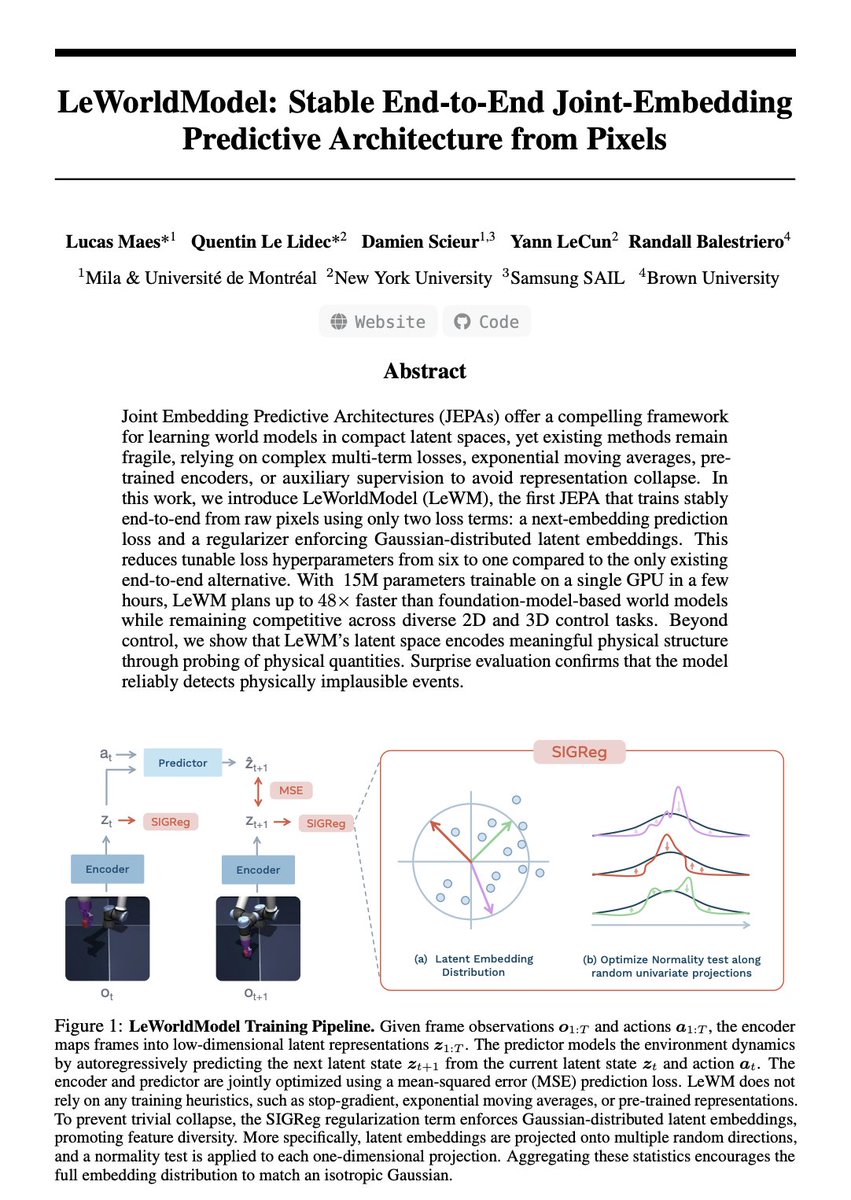
Researchers just dropped a paper called "LeWorldModel" (LeWM).
They completely solved the collapse problem.
They replaced the complex engineering hacks with a single, elegant mathematical regularizer.
It forces the AI's internal "thoughts" into a perfect Gaussian distribution.
The AI can no longer cheat. It is forced to understand the physical structure of reality to make its predictions.
The results completely rewrite the economics of AI.
LeWM didn't need a massive, centralized supercomputer.
It has just 15 million parameters.
It trains on a single, standard GPU in a few hours.
Yet it plans 48x faster than massive foundation world models. It intrinsically understands physics. It instantly detects impossible events.
We spent billions trying to force massive server farms to memorize the internet.
Now, a tiny model running locally on a single graphics card is actually learning how the real world works.
For further background, here's my recent two-part series for @IRPP on per capita GDP, living standards, and Canada-US comparisons:
I: https://t.co/oYSbWRk6Qy
II: https://t.co/GZ2plcfmd9
People are so keen on replacing software engineers with LLMs. Software engineers won't be replaced. They will more potentially have an entirely new stack.
My view as well.
Companies pitching how they are building “AI software engineers” are a dead end I’m very confident.
This is just how efficient warehouse automation was not done with humanoid shape and behaved robots: but by reimagining how the modern warehouse operates.
If you are a software engineer, retiring now seems to be the hardest thing to do when there is so much to do, and it could go very wrong if we ignore our own historical mistakes.
@alecrogers1968@dieworkwear Every time I saw Wynton Marsalis, the leader of JLCO in the center of the picture, he was always well dressed. Bill Evans as well, who I always liked musically.
In which I provide a bit of follow-up on Quebec's big tuition policy initiative. To me, the most interesting thing right now is the backlash among francophones. https://t.co/AboN1Do4Y0
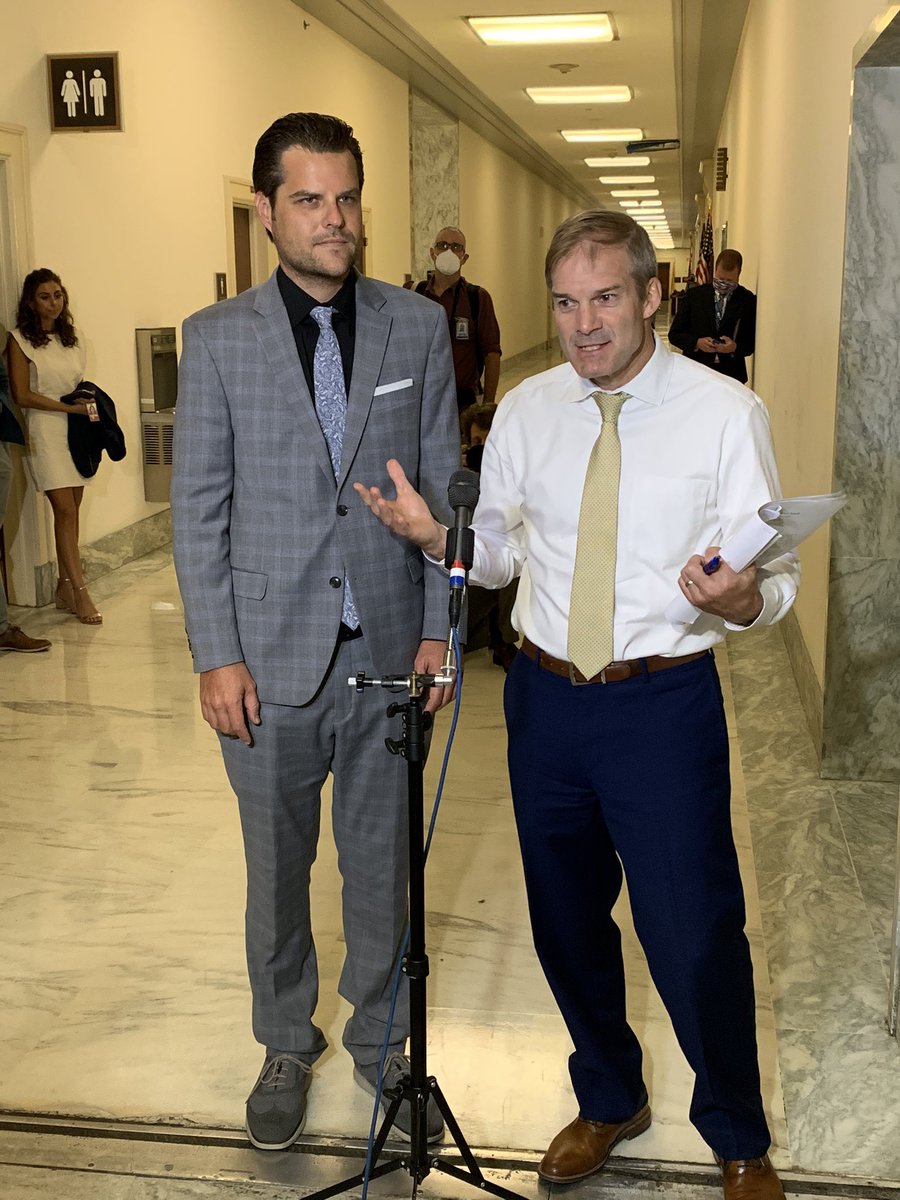
i hope republicans institute a stricter dress code
1. no low-rise pants with short jackets and insane shoes
2. no black dress shirts with light-colored ties; no suits without a jacket
3. no tan shoes with dark suits; no dress sneakers or "fun socks"
4. no scotch tape on ties