Sumitomo Mitsui DS AM sold its entire holdings of French government bonds amid concerns about the nation’s fiscal situation, shifting funds to German bunds and short-term Japanese government bonds https://t.co/VAlZW5d7Yz
Chaps, my data and my message below are very clear: Iran has lost control of Hormuz.
But careful with over-reading my message. I never said we have an oil bear market now. We are not there yet. For one, the Hormuz Shuttle needs to become more permanent and more efficient.
The Hormuz Shuttle creates enormous tanker inefficiencies, driving up landed costs for refineries, especially in Asia.
Just as importantly, product exports remain heavily disrupted because of Russia, the East–West pipeline, tanker inefficiencies and lower Chinese refinery runs.
That means cracks remain high — and diesel and gasoline prices remain high — even if crude falls below $100.
Next problem: the moment China starts buying nearer its 9–10mbpd seaborne import baseline, we still lack sufficient crude flows and face even greater tanker-rate stress, pushing both crude & product prices higher again.
Above all, Trump needs to stay the course if this regime is to break and flows are finally to normalise. If he goes for another Memorandum of Misunderstanding, all he does is hand the regime another lifeline and allow it to rinse and repeat the Q3 chapter.
Patience. This is not yet a deflationary signal for an equity rally. But we are making progress. Come Q1 2027, assuming Trump holds the line, this should get really interesting.
Once flows normalise and tanker inefficiencies ease, the market will front-run the balances and push crude significantly lower. The UAE will push production towards 5mbpd. What little remains of OPEC will produce flat out to regain market share. We may rediscover just how weak underlying Chinese crude consumption really is. Perhaps even an AI investment bust? All bearish.
Q2 2027? IDK.
But then we still need to refill some 1.5–2.0bn bbl of crude stocks lost globally. How quickly that happens — and at what price — will matter enormously.
Lots of moving parts. Let’s keep an open mind.
@LSREnergy
🦔Thomson Reuters just built its own AI model for about $40 million over two years. The final training run cost $450,000. They started with Qwen, an open-source model from China's Alibaba, and trained it on their own legal and news content from Westlaw, Practical Law, and Reuters. The company said the move is about reducing its dependence on Anthropic. Their CTO compared paying for outside AI to being a permanent tenant versus owning the building. Enterprise customers broadly have been cutting spending on OpenAI and Anthropic and switching to cheaper alternatives.
My Take
I covered the DeepSeek pricing collapse a few months ago and said the frontier labs would have a hard time defending premium API pricing once open-source got good enough. Thomson Reuters just did exactly what I expected someone to do. They grabbed a free model, trained it on their own stuff, and now they're pulling back from Anthropic. $40 million, done. Anthropic charges that in API fees from a handful of big customers in a year.
The $190 to $200 billion revenue projection Anthropic is selling to IPO investors assumes companies like Thomson Reuters keep paying. They just stopped. And Thomson Reuters put their model on Hugging Face for academics to use, which means the playbook is now public. I think the frontier API business has maybe two or three years before most large companies with good data figure out they can do this themselves, and the ones who move first are going to pressure the ones still paying full price to ask why.
Hedgie🤗
A busy day in the Gulf of Oman, where there are at least fifteen sets of STS transfer sessions taking place. We count 25 million barrels of crude oil; plus some refined products. The oil originates from almost every country in the region, minus Iran.
#OOTT#IranWar#Tankers
TotalEnergies CEO Patrick Pouyanne nails it, warning that some emerging nations are “losing trust” on LNG after two back-to-back price shocks (2022 and 2026). The result? “Back to coal.”
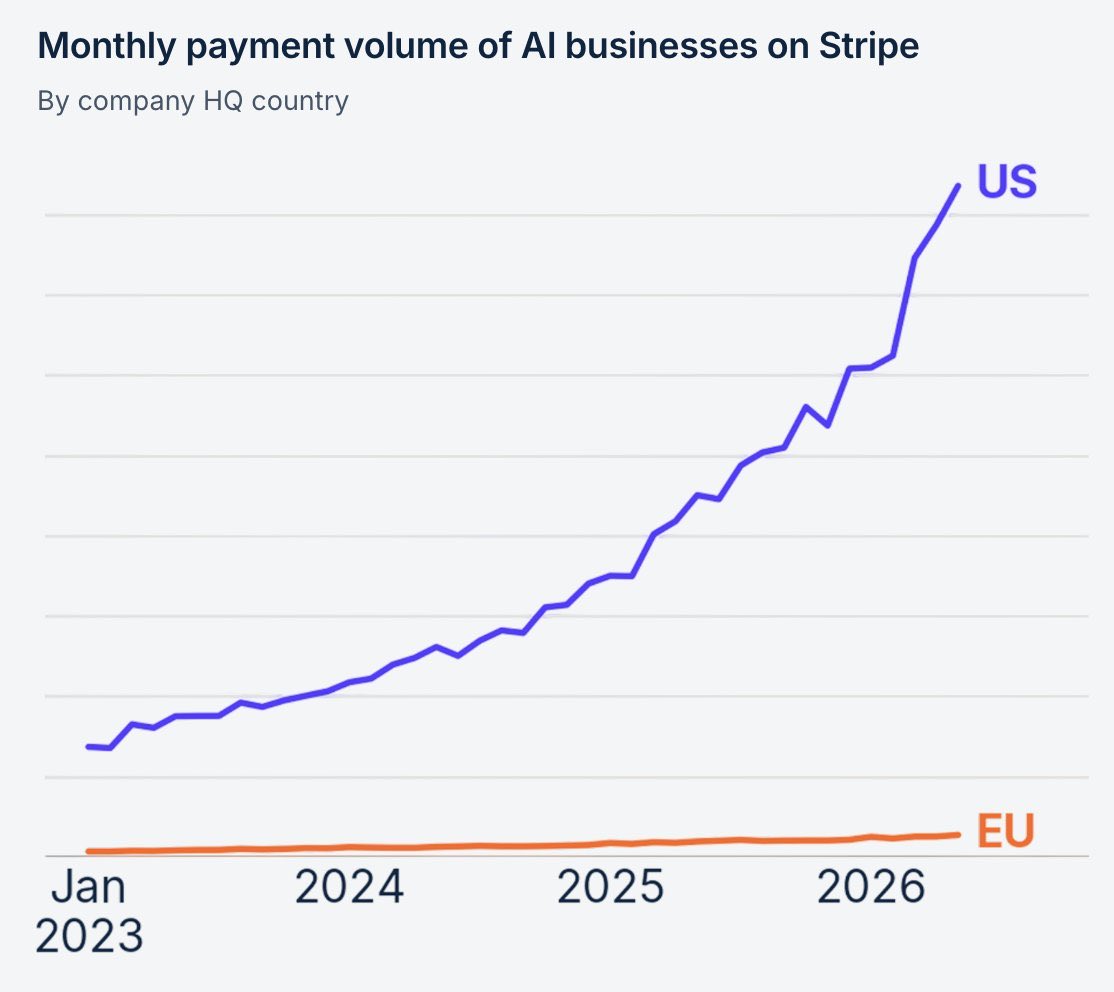
Good Morning from Germany, where business investment is the weakest in the entire G7. Since 2021, investment has essentially stagnated, while the US is powering ahead, driven by the AI boom. By 2028, US real business investment could be up 40%, while Germany remains the G7 laggard. Europe’s investment gap is becoming a growth gap. https://t.co/7eR7Vxulg8
NZZ-Analyse aus der Reihe «Der andere Blick mit Daten»: Wo lagen die Engpässe bei der Stromproduktion an den heissen Tagen? Statt des oft vermuteten Stillstands französischer Reaktoren rückte laut NZZ-Daten die heimische Windkraft in den Fokus. Zum ganzen Artikel: