The Flying Geese Paradigm, first outlined by Japanese economist Kaname Akamatsu in the 1930s, describes how industrialization spreads across countries in a formation like migrating birds. A leading economy develops new industries, then as wages rise and it moves up the value chain, it passes lower-value manufacturing to the next follower through trade, investment, and technology transfer. The process repeats, creating a staggered pattern of development.
This dynamic has played out clearly in East Asia and beyond. After World War II, the United States led in manufacturing but gradually shifted labor-intensive production overseas as its economy matured.
Japan emerged as the next goose in the 1950s and 60s, building strength in textiles, electronics, and autos through disciplined export policies and rising productivity. By the 1970s and 80s, Japan itself began offshoring assembly work to lower-cost neighbors while advancing into higher-tech sectors.
Korea and Taiwan followed closely, transforming from agricultural societies into industrial powers in the following decades. Korea, in particular, leveraged chaebols, heavy state support for education, and targeted industrial policies to move from light manufacturing into ships, cars, and eventually semiconductors.
Then came China, which absorbed enormous shifts starting in the 1980s through reforms, foreign direct investment, and its vast labor supply, becoming the dominant global factory in consumer goods, electronics, and more.History suggests the pattern continues. As China's wages climb, demographics tighten, and geopolitical tensions encourage diversification, production is already dispersing toward Vietnam, India, Mexico, and others for certain assembly and mid-tech work.
Advanced segments like semiconductors remain more anchored due to complex supply chains and know-how, but even there pressures are building.
What matters for countries at the front of the formation is not clinging indefinitely to yesterday's advantages, but using the breathing room to upgrade. The United States moved decisively into services, finance, technology platforms, and innovation ecosystems, sustaining high living standards even as its manufacturing employment share declined. Japan similarly emphasized precision components, brands, and softer economic strengths after its bubble era. Both faced real challenges—hollowed communities in the US, stagnation risks in Japan—but the pivot away from routine production was essential.
South Korea now sits in a vulnerable spot, with its economy and stock market heavily concentrated in memory chips and related industries. Losing ground to faster-rising competitors in this area could deliver a sharp blow, much like the pain felt in places overly dependent on a single dominant firm or sector. The lesson from the flying geese is not fatalism about inevitable decline, but recognition that adaptability through new industries, skills, and services has been the practical way leaders have managed the cycle. Capitalism and policy both shape how smooth or painful those transitions become.
@TheBenSchmark I completely agree with what you said, sir. My only question is, why does ACMR hold 70% of the shares of ACMR Shanghai, yet its market capitalization is far lower than that of ACMR Shanghai?
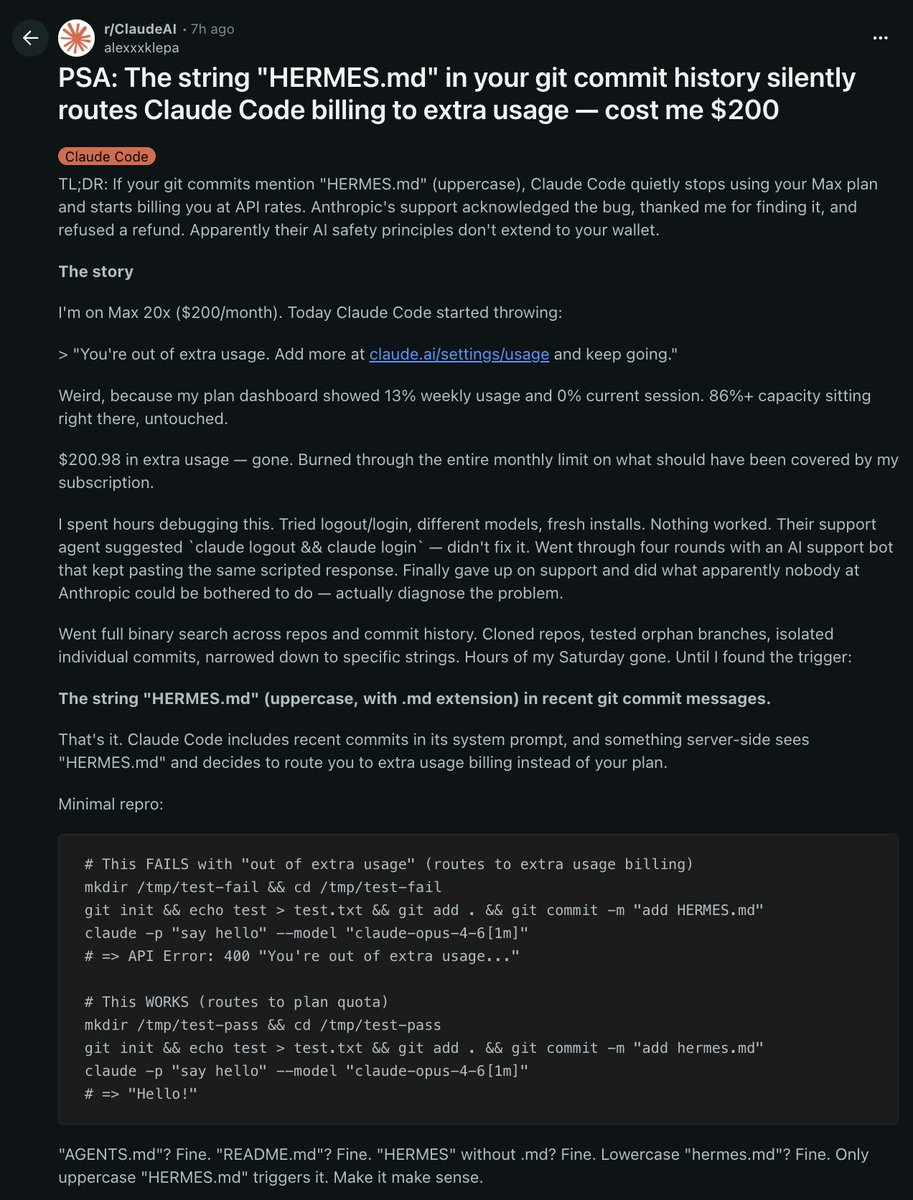
THIS GUY LOST $200 IN ONE DAY BECAUSE THE STRING "HERMES.md" WAS IN HIS GIT COMMITS
HERMES.md is a real convention used in AI agent projects. it's a system prompt specification file. not some obscure edge case
he's on claude max 20x at $200 a month. yesterday claude code hit him with "you're out of extra usage" out of nowhere
his dashboard showed 13% weekly usage. 0% current session. 86% of his plan was sitting there untouched
but $200.98 in extra usage already burned through what should have been covered by his subscription
he tried logout & login, different models, fresh installs and nothing worked
anthropic support sent the ai bot (four rounds of the same scripted response). eventually they just gave up on him
so he started binary searching repos and commits manually on his own time until he found the trigger
the string "HERMES.md" in a recent git commit message
uppercase, with the .md extension, anywhere in your commit history
that's it
claude code includes recent commits in its system prompt and something server side flags HERMES.md and quietly routes you off your max plan onto API rate billing
> AGENTS.md? fine
> README.md? fine
> HERMES without .md? fine
> lowercase hermes.md? fine
> uppercase HERMES.md? you're getting charged API rates
he reported it. anthropic support acknowledged the bug three times, called it an "authentication routing issue", thanked him for finding it
then refused to refund the $200
so the man pays $200 a month for max, lost another $200 to a billing bug they confirmed, did anthropic's QA work for free on his weekend, and got a "thank you for your patience" in return
check your commit history before claude code quietly drains your account too
All the semi bottlenecks you need to know:
High-power, narrow-linewidth lasers
Glass core substrates
Silicon photonics
800V power delivery
MLCCs
Inductors
HBM and advanced memory
Advanced packaging
Power shelves and busbars
Hybrid bonding
Grid transformers
Gas turbines
ABF substrates
Advanced PCBs
Thermal management and liquid cooling