Hi @LatinXChem, presenting my work "Optimization of the adsorption process of methylene blue dye (MBD) using banana peels treated with a deep eutectic solvent" at #LatinXChem24#LatinXChemGreen#Green34.
Congratulations to @JehovaniLazaro from @ComunicacionUV on winning an honorable mention in the #LatinXChemGreen category.🏆We congratulate Jehovani on this remarkable achievement.
@ceschnorr@LatinXChem It would be advisable to explore, with sufficient adsorbent material, whether after the third regeneration cycle the efficiency and adsorption capacity remain stable or decrease.
Hi @LatinXChem, presenting my work "Optimization of the adsorption process of methylene blue dye (MBD) using banana peels treated with a deep eutectic solvent" at #LatinXChem24#LatinXChemGreen#Green34.
@ceschnorr@LatinXChem Similarly, ensuring a sufficient quantity for each experiment is crucial to avoid losses during the drying, grinding, and sieving processes.
@jasp10agosto@LatinXChem On the other hand, scaling this adsorption process to an industrial level faces challenges such as adjusting optimal conditions for large treatment volumes and regenerating the adsorbent material after several cycles.
@jasp10agosto@LatinXChem Thank you very much. At the moment, the use of another dye has not been considered, but it would be relevant to evaluate the behavior of the adsorbent material with another contaminant.
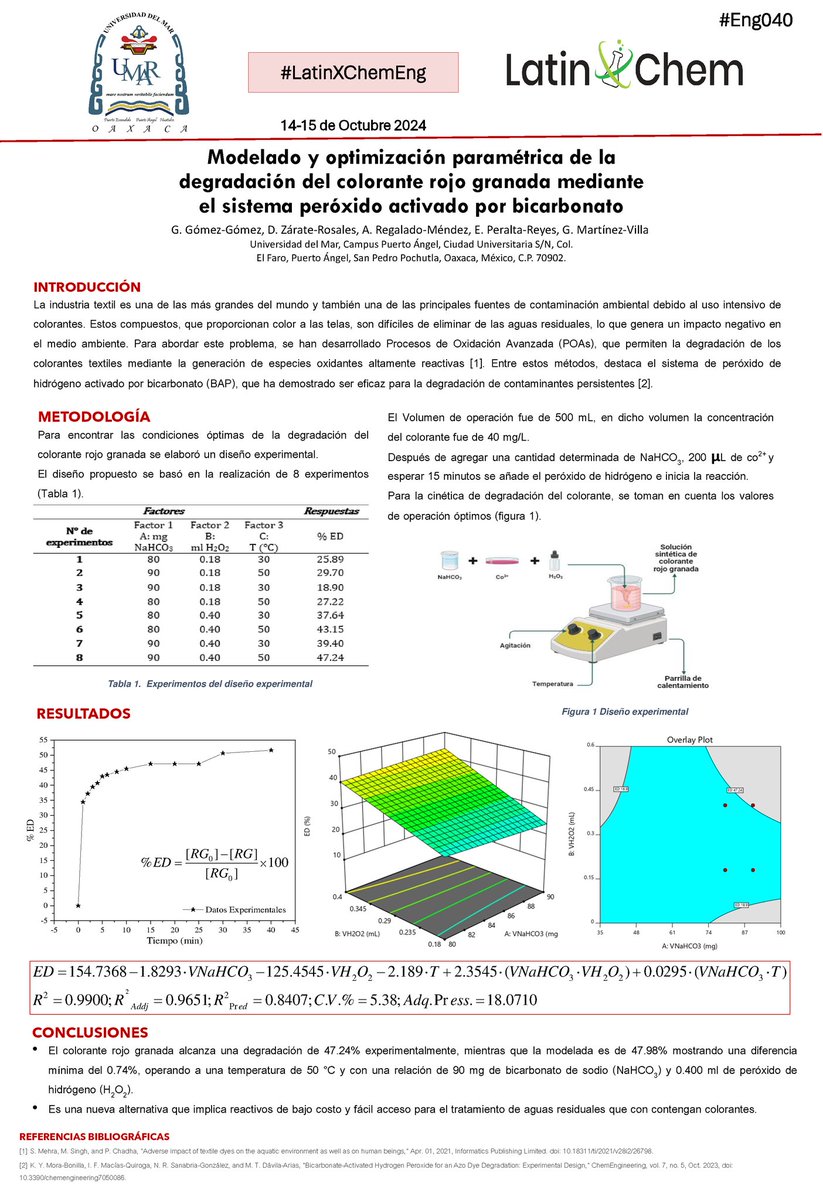
Hola @LatinXChem, les presento mi poster "Modelado y optimización paramétrica de la degradación del colorante rojo granada mediante el sistema peróxido activado por bicarbonato" #LatinXChem24 en la categoría #LatinXChemEng#Eng040
Hi @LatinXChem, presenting mi work "Obtaining functional compounds from bugambilia bracts (Bougainvillea glabra) using natural deep eutectic solvents (NADES) as extraction media" #LatinXChem24#LatinXChemEng#Eng021
Hola 🙋🏻♀️@LatinXChem, presento nuestro trabajo “Síntesis y evaluación de dihidro-jasmonoil-valina en jitomate: efecto sobre la resistencia contra el nemátodo Meloidogyne spp” en #LatinXChem24#LatinXChemBio#Bio49
@juliana_lvidal@LatinXChem Currently, we have not planned experiments with other contaminants, but it would be very interesting to see how our adsorbent material behaves.
@juliana_lvidal@LatinXChem Hi. Thanks. Methylene blue was chosen because it is commonly used in adsorption studies, making it easy to conduct representative tests. Additionally, it is easy to detect and measure, which allows us to obtain clear and comparable results.
@RocheVroche@LatinXChem@mafernan9@GeonelGattorno Hola, buen trabajo. Tengo una pregunta. ¿Qué propiedades de la hoja de Chaya la hacen un buen precursor para la obtención de materiales carbonosos en la remoción de colorantes?
@SRV6_12@LatinXChem Hello, your work is very interesting. I have a question, how do differences in the chemical structure of the dyes used (methylene blue, crystal violet) influence the adsorption mechanisms observed with bioadsorbents?
@FranklinCoell11@LatinXChem Hola, muy buen trabajo. Una pregunta. ¿Cuál fue el mecanismo de acción de las nanopartículas de cobre en la degradación de cada una de las moléculas estudiadas (ciprofloxacina, azul de metileno y metformina)?
@sug4rcube@LatinXChem Hello, good job. I have a question about it. How does the treatment with ZnCl₂ and CaCl₂ influence the effectiveness of biochar to adsorb phosphates