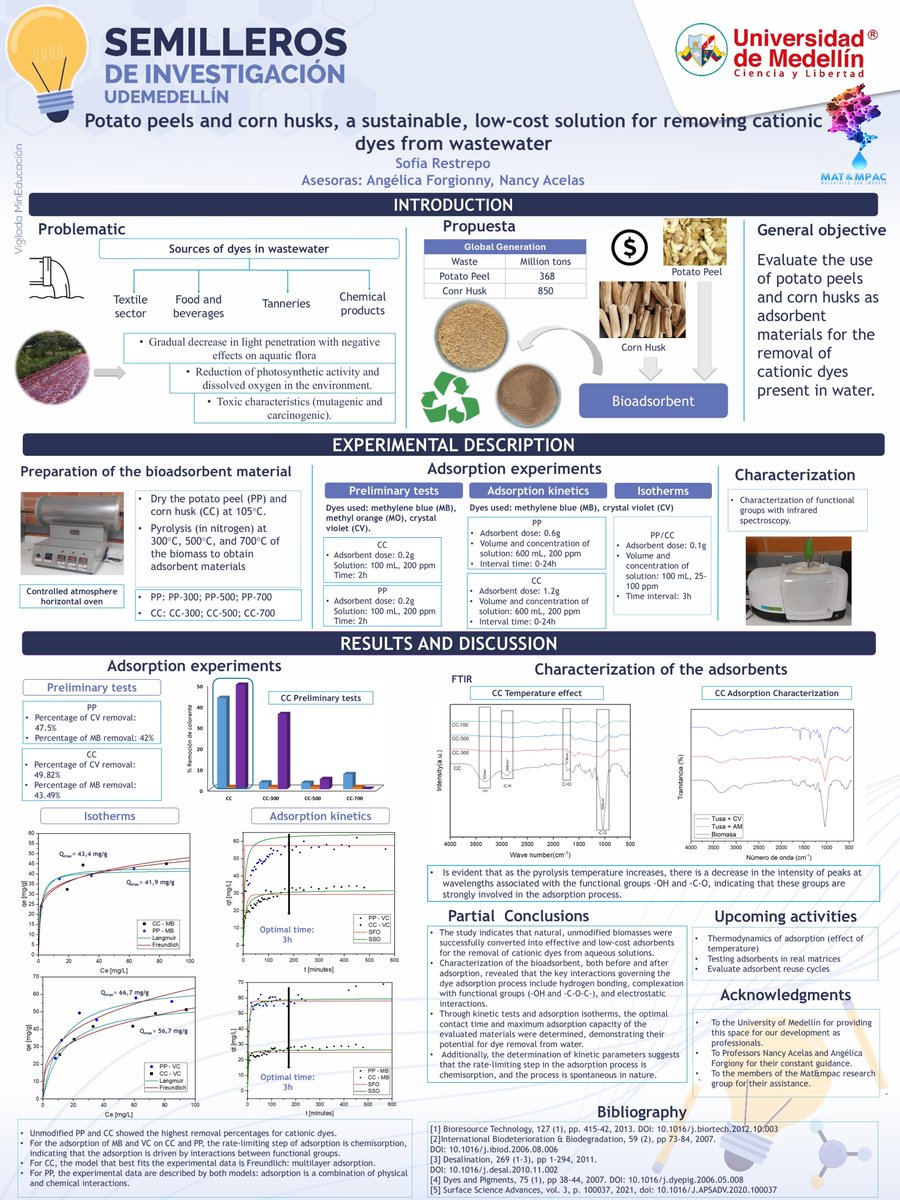
@myalemus23@LatinXChem And the difference in the dose of adsorbent in the kinetics is because the volume of the solution had to be increased to ensure that samples can be taken and still maintain more than 60% of the original volume
Hi @LatinXChem, I'm exited to share my work "Potato peels and corn husks, a sustainable, low-cost solution for removing cationic dyes from wastewater" at #LatinXChem24#LatinXChemEnv#Env063 🌽🥔
@JeremyMCarr@LatinXChem No they're not!, actually, one of the biggest results that we got was that the biomas free from any physical or chemical transformation works better for the adsorption process, here's what they look like :)
@LeonelGarMon@LatinXChem Some future activities include X-ray photoelectron spectroscopy and Raman spectroscopy, to delve deeper into the interactions governing the process and see if there is any influence from the chemical structure of the dye
@LeonelGarMon@LatinXChem However, it is still a work in progress, and we are still working on additional characterization of the material after adsorption
@LeonelGarMon@LatinXChem At the working pH, both dyes are cationic. FTIR characterization of the biomass after the adsorption process indicates that adsorption involves hydrogen bonding, electrostatic attraction, and complexation, according to the functional groups present on the material and the dyes