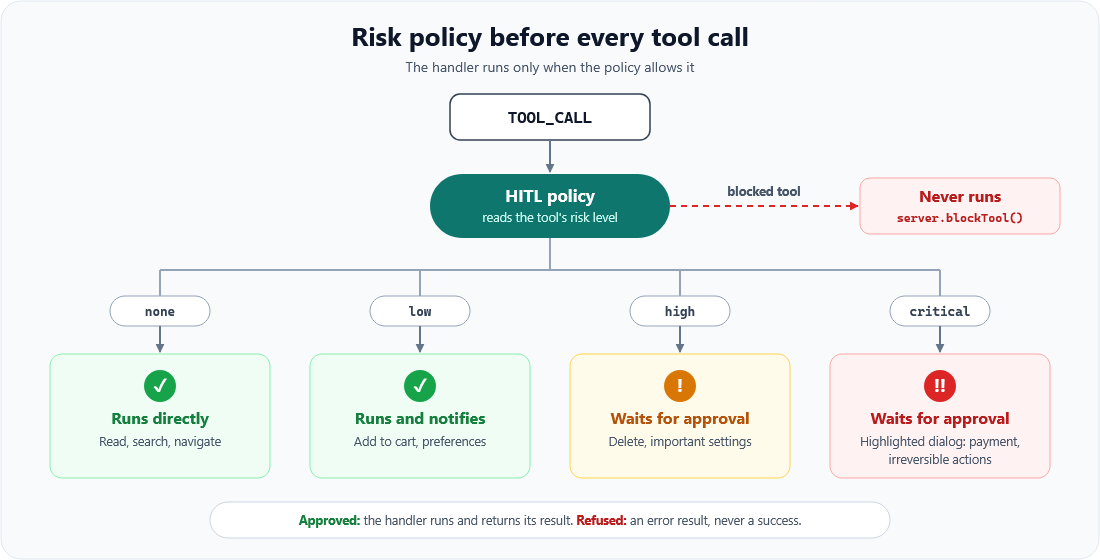
Security is a core design principle of OwlLayer. Because AI agents dynamically execute tools that manipulate client interfaces or database states, OwlLayer Server enforces a strict sandboxed safety model called Human-in-the-Loop (HITL).
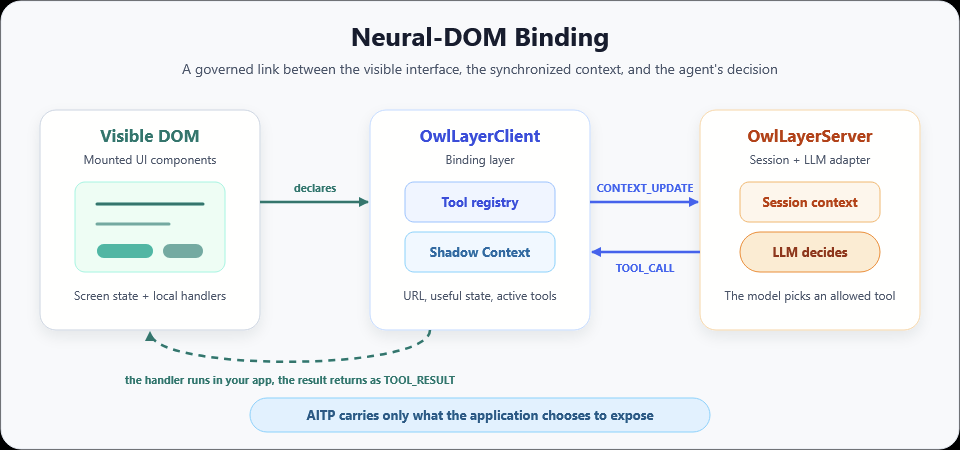
The Neural-DOM Binding is the central architectural concept of OwlLayer. It describes the controlled link between an existing interface, the context that interface agrees to share, and the reasoning of an AI agent.
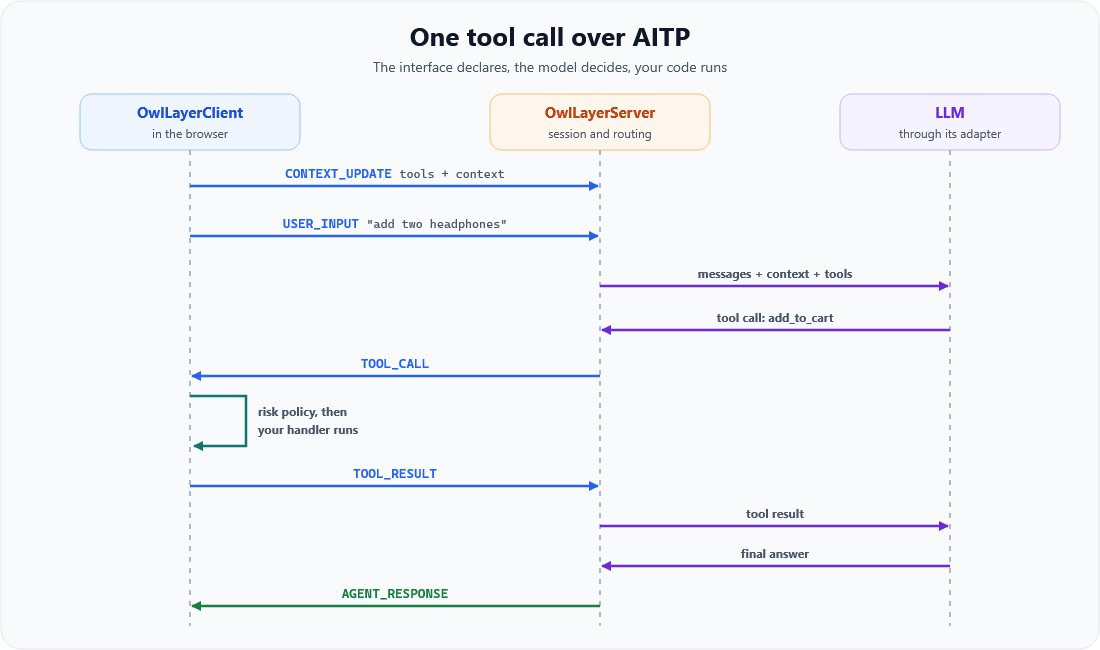
OwlLayer acts as a bridge between the Browser and the Server via AITP (Agent-to-Interface Transfer Protocol), a JSON-based protocol operating over WebSockets. AITP facilitates real-time bidirectional communication between the client and the server (OwlLayer Server layer & LLM)
Introducing OwlLayer: an open-source Agentic UI SDK designed to give AI models direct, secure, and real-time control over web applications.
Unlike generic chatbots or UI generation tools, OwlLayer connects an agent directly to the active elements of your existing application.
👇
An AI agent that can click "Pay" is a feature.
An AI agent that can click "Pay" without asking you is a liability.
In OwlLayer AI, every tool declares a risk level:
→ low: runs
→ high / critical: pauses for human approval
The approval prompt lives in an isolated Shadow DOM, so the page can't spoof or hide it.
Safety by construction, not by convention.
@OpenAIDevs Joining from Abidjan, Côte d'Ivoire 🇨🇮.
Building OwlLayer AI - an open-source Agentic UI SDK that lets AI agents act on an app's existing interface, with human approval on anything risky. https://t.co/z41LcQx4Cb