@sada03537696@KoppJacques@BFMTV Et pour ceux qui ont fait des études longues, genre doctorat, puis passé des années à l’étranger (obligatoire pour obtenir ce fameux concours de chercheur par exemple), on fait comment? La retraite à 102 ans pour avoir 45 ans d’annuité?
@limmorim@teamaaz Avantages délirants? J’ai du rater un truc, je ne suis pas au courant….a part la stabilité de l’emploi c’est certain, tellement stable que le salaire ne bouge ias pendant une décennie (et oui!), pour le reste des avantages je ne vois pas….
@jfg1605@teamaaz Parce qu’en fait 1) la retraite des fonctionnaires est calculée sir le salaire de base, les primes (25-35% du salaire) ne sont pas comptées comme dans le privé et 2) les évolutions de carrière dans la fonction publique sont hyper lentes. On passent des années à stagner.
@hubstu1@teamaaz Euh, bah non en fait. Pas de progression pour moi depuis 3 ans déjà. Je suis au denier échelon de mon corps donc pas de progression a venir dans les prochaines années, voir décennies. Mon seul espoir était l’augmentation du point d’indice…..
@dudu1111892@jesuisbaptiste@starks_ Mais de quoi parlez vous? Fonctionnaire ne veut rien dire, ça regroupe un nombre énorme d’activités! Le fonctionnariat n’est pas une profession mais un statut. Allez dans les hôpitaux ou bien d’autres institutions et vous verrez qu’ils sont surchargés de travail.
La Loi Duplomb via la Loi d'Urgence Agricole, c'est toujours NON ! - La Loi Duplomb via la Loi d'Urgence Agricole, c'est toujours NON ! https://t.co/H0bTJj032b
A fully iPS-cell-derived 3D model of the human blood–brain barrier for exploring neurovascular disease mechanisms and therapeutic interventions | Nature Neuroscience https://t.co/3GS4z2FjVo
Researchers have published the recipe for an artificial-intelligence model that reviews the scientific literature better than some major LLMs are able to, and gets the citations correct as often as human experts do
https://t.co/aKuv9XmpHc
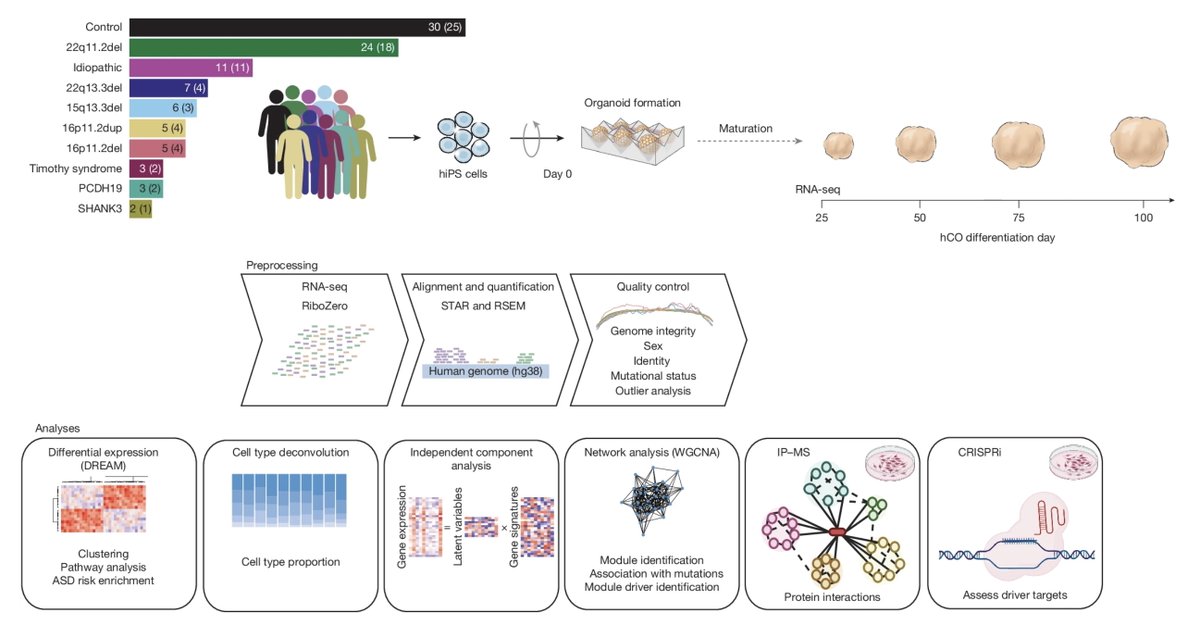
This week, we report in @Nature our effort to identify molecular convergence and divergence in #autism spectrum disorder (ASD) using human stem cell models.
In this collaborative study with Dan Geschwind's lab, spanning almost a decade, we derived 96 hiPS cell lines representing 8 genetic forms of ASD, idiopathic patients, and 20 controls, and after rigorous quality control differentiated 70 lines in more than 150 experiments into human cortical #organoids for 100 days.
Interestingly, early time points harbored the largest mutation-specific changes, but distinct mutations converged on shared transcriptional changes as development progressed.
This is just the beginning: we will need larger cohorts and more advanced cultures that capture cell diversity and interactions, such as #assembloids.
Still, this initial study illustrates how risk associated with genetically defined forms of ASD can propagate through transcriptional regulation, leading to convergent and divergent signaling defects.
This work was spearheaded by the heroic efforts of Aaron Gordon and Se-Jin Yoon, together with Lucy Bicks!
Online now in Stem Cell Reports! Human neuronal networks on micro-electrode arrays as a tool to assess genotype-phenotype correlation in CACNA1A-related disorders. https://t.co/RwuUNJxGos
@ISSCR@CellPressNews@GairdnerAwards@SickKidsNews
Dr. Volker Busskamp's lab at @UniklinikBonn used #endothelial cells to induce transient vascular support in retinal #organoids.
At later stages, these organoids displayed photoreceptor-driven light responses! 💡
📃 https://t.co/hUx1t4Yq4v
🗨️ https://t.co/OLtbeuoKTM
Exciting new paper on aging:
1. CRISPR-mediated DNA breaks cause heritable epigenetic changes
2. Changes occur genome-wide, not just at breaks
3. Natural DNA breaks also disrupt the epigenome
Strongly supports The Information Theory of Aging (ITOA)
https://t.co/Vw4veR0JV3
AAVs are crucial vectors for delivering biosensors into neurons! Using AAV delivery, we perform two-color imaging of calcium and potassium transients in neurons. These AAVs are now available from @brain_case40506 https://t.co/DOHnF3LxFf
1. Online now in Nature, we present our effort to understand the mechanistic basis of congenital heart defects in children with Down Syndrome. An overview thread below... @Nature
BIG ANNOUNCEMENT📣: I haven’t been this excited to be part of something new in 15 years… Thrilled to reveal the passion project I’ve been working on for the past year and a half!🙀🥳 It started from my frustration with the depressing effect that the current publishing system has on the well-being of myself, my team, and pretty much every scientist I know (maybe you’ve noticed from my stupid jokes… :) I was exhausted of dealing with the huge delays, reviewers that can be abusive, and how arbitrary it all is. Unfortunately, the most important factors are often WHO your reviewers are and who YOU are... It’s clear we need alternatives or at least ways to improve the situation. So, together with a really special and talented team we worked to develop this idea into “qed” a platform where you can get CONSTRUCTIVE feedback on your own work or CRITICALLY assess other people’s papers. It can be a real difference maker if many of you join us (thousands have tried it already, but today we release a NEW and much stronger version ;) Let’s harness qed to put the power back in the scientists’ hands, to do, to read & to publish science on our own terms. I’m dying for you to TRY IT, and it’s very simple - just drop a paper (the link to the website is in the replies👇) - it’s completely secure, private, and free, and you get results fast. Please show your support, SHARE, tell your friends, and let’s be the revolution 🫵!