@adamwathan I use it with Obsidian as my research and knowledge management ‘second brain’. I have a set of Claude Skills to automate many maintenance and research actions (e.g. one skill will review my https://t.co/ScMfnmmR1S bookmarks and create a corresponding research note.)
How is Vodafone transforming its I.T. architecture to be modular, open, and #AI-ready?
@Lester_Thomas shared all with @TelcoDR on the Telco in 20 podcast. Listen here ⤵️
@_avichawla I thought agentic RAG was just describing the Vector dB as a tool towards the LLM (so that it can choose whether or not to use it, and if it chooses to use it, it creates an appropriate payload for the Vector dB query). Am I missing something?
@DaleVince At the moment, the use of renewables is often curtailed due to transmission capacity. Would zonal pricing encourage certain high-power users to co-locate in high renewable generation areas. E.g. AI data centres in Scotland?
@MrGazEllis @g__j It encourages you (through agile pricing) to use electricity when renewables are abundant. Perfect for filling an EV or home battery. On a windy night you even get paid to fill your car with electrons.
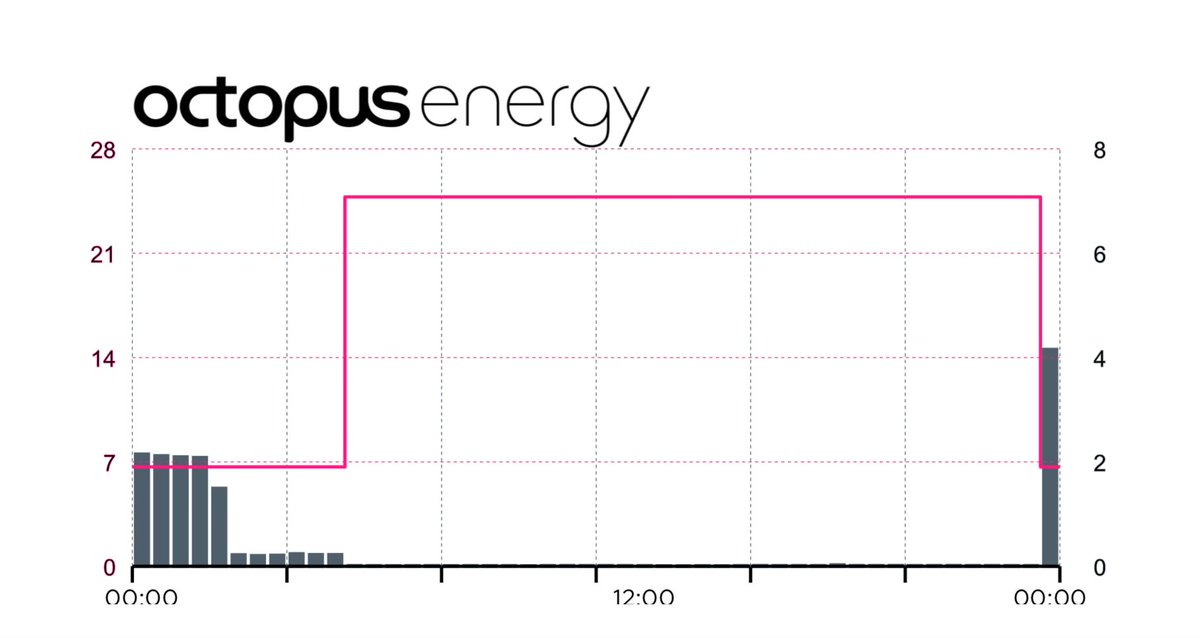
@latimeralder@calab1yau With intelligent octopus, I give them remote access to decide when to charge my car. Typically they will charge it in the early hours of the morning when the wind turbines are still producing electricity and most people are asleep. As a reward for this they only charge 7p per kWh
@half_tree@g__j Graph shows yesterday’s usage (pink line is rate, bars are my usage). 15.43 KwH cost just £1.03. Regional pricing would allow Scotland to become a data-centre superpower with all its abundance of wind and tidal power.
@half_tree@g__j I have a home battery - it allows me to only use electricity when it is abundant and cheap (overnight in winter, during middle of day in summer). 1/2
@DaleVince 2/2
These heat pumps should connect to the grid via APIs to optimize energy usage during periods of excess renewable power. This is the kind of forward-thinking regulation we need in 2024. #SmartGrid#EnergyEfficiency#NetZero