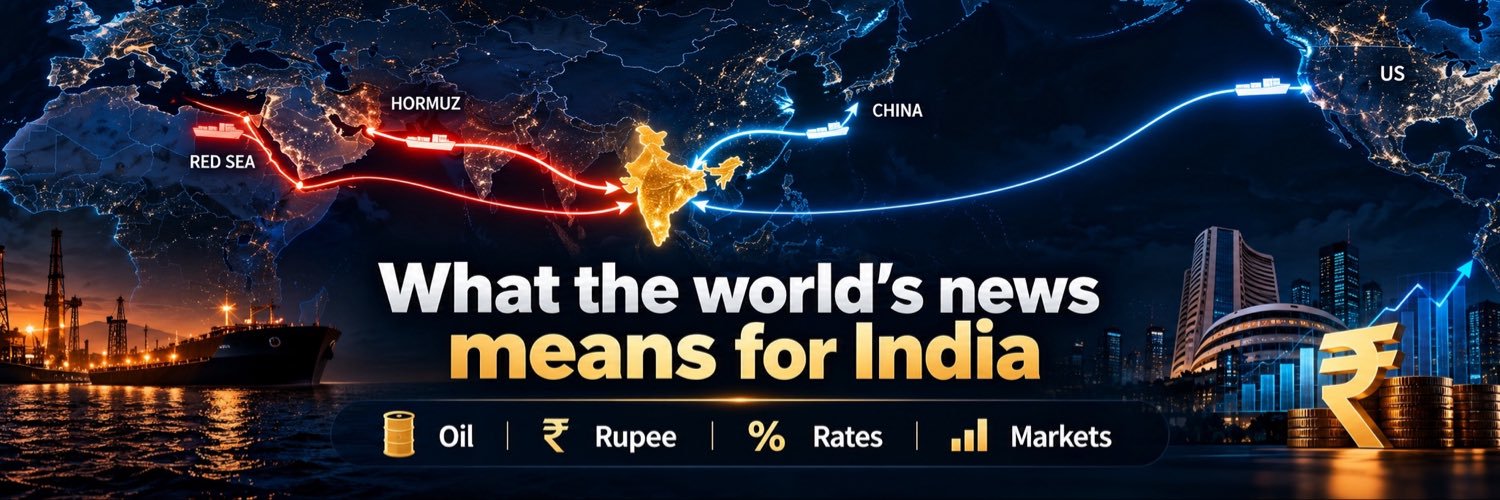
India macro, 27 Nov:
Hormuz mines + Saudi refinery hit → Brent $96.57
Rupee slips to 92.44 despite 18 days of FII buying
10y G-sec up 7bp to 7.24%
RBI 4 Dec: 25bp hike seen; 50bp in play
GDP ↓ | Inflation ↑ | INR weaker | Rates ↑
Oil, not FPI money, sets the rupee.
#RBI
India macro today:
1. Hormuz mines, Ras Tanura hit: Brent $94.6, CPI 6.09% > RBI's 6% cap
2. US proposes up to 25% tariffs: pharma, steel, solar
3. 56 of 61 economists see RBI hike to 5.75% on 4 Dec
Strong rupee ≠ all clear. FPI money is tactical.
Src: CNBC, MoSPI, USTR, Reuters
3,010 NSE stocks. Every chart. Every day.
Tape Reader Bot screens them with rules from Wyckoff, O'Neil, Minervini & more.
Black Friday: ₹99/month. Free preview.
https://t.co/fHo1D7Kdu4
Education only. Not investment advice. Not SEBI-registered.
#NSE#StockMarketIndia
The real lesson from the Trump-Xi-Putin summit: great powers negotiating with rivals, not choosing permanent camps.
For India, strategic autonomy now mean 1 thing: build enough economic, military and technological weight that every major power needs New Delhi—not the other way
Fire in the sea, calm at the petrol pump. How?
Picture a village well. One night someone shouts, "Snake in the well!" Half the village stops drawing water. Next morning the headman says, "Most buckets came up fine." So do people panic, or do they carry on? That is the Strait of Hormuz this Monday morning.
What actually happened:
On Sunday, Iran's Revolutionary Guards said two oil tankers hit naval mines on an "unauthorised" southern route in the Strait of Hormuz. They said one, a supertanker carrying over two million barrels of crude, sank. They gave no ship name and no flag. AFP reports there is no independent confirmation.
Separately, the UK maritime monitor UKMTO said it was aware of a report by Indian shipping authorities of an attack on a tanker sailing eastbound in the Gulf before entering Hormuz. Crew are safe. Damage unknown. Whether this is the same ship Iran is talking about is not clear.
Same day, an Iranian MP said Iran has agreed new Hormuz shipping lanes with two coastal states, still unnamed, to be voted on in Iran's parliament. Foreign Minister Araghchi goes to Muscat on Tuesday.
And the US? Its navy blockades Iranian ports and helps tankers through. CENTCOM said last month it had helped Gulf countries export 1.5 billion barrels via Hormuz since the summer.
We've seen this before:
In the 1980s "Tanker War", Iran and Iraq hit each other's oil ships for years. The US began escorting Kuwaiti tankers in 1987. In April 1988 an American warship, USS Samuel B. Roberts, hit an Iranian mine. Oil still flowed, but every voyage carried a risk premium. Mines are cheap. Fear is cheaper.
The contradiction:
Iran says a supertanker sank. Yet on Monday morning Brent fell to about $95, because the IEA now expects a supply SURPLUS this quarter, as Gulf exports recover faster than demand. Burning ships and falling oil prices in the same week. Both cannot be the full truth about risk.
What it means for your wallet:
Short term: If the sinking is confirmed, expect a quick jump in oil and in tanker insurance. India buys most of its crude from abroad, so the rupee feels it first, and so does the oil companies' margin. Your petrol price may not move overnight, but the bill lands somewhere: fuel, freight, or the government's purse.
Long term: If Iran gets other coastal states to accept "its" lanes, Hormuz stops being a free sea road and becomes a toll road with a gatekeeper. A country that imports most of its oil, like India, then pays a hidden fee on every barrel, in fear if not in rupees. And Indian seafarers on these ships stay on the front line. Just last week, three Indian seafarers were safe after an attack on a Saudi-flagged tanker.
My reading?
Iran is using two tools together. One is fear (mine claims that nobody can check). The other is law (a "lanes deal" that makes its control look official). The market is betting on the US escorts and the oil surplus, not on Tehran's statements. That bet is fine until one claim turns out to be true.
So here is my question:
If a ship can "sink" in a statement and the oil price still falls, who is really in control of Hormuz: the navy with the guns, or the market that has stopped believing the headlines?
@Reuters, has any flag state or owner confirmed a sinking yet?
@grok confirm this
#StraitOfHormuz #Iran #OilPrice
The biggest change in the Iran war is not another tanker incident.
It is that the conflict is escaping its geography.
Hormuz → Ukraine → Russia → China → India → US leverage.
Iran still has major geographic leverage. But the paradox is striking: shipping risk remains high while oil prices are falling. Brent and WTI fell about 2.5% in the week ending November 13.
Markets are betting diplomacy will restore shipping before disruption becomes structurally damaging.
That is a bet, not a certainty.
Trump also appears to be shifting toward pressure without unnecessary escalation: sanctions, blockade and military options remain, but Washington seems reluctant to enter another open-ended war.
Iran faces a longer-term problem.
Every Hormuz disruption pushes importers toward alternative suppliers, inventories, routes and electrification.
Today’s leverage can become tomorrow’s irrelevance.
India is adapting too.
New Delhi needs cheap energy while securing critical minerals for batteries and the next energy system. That makes the reported NMDC-Rosatom discussions on Russian lithium strategically important.
India is treating critical minerals like energy:
strategic supply chains, not merely commodities.
This is strategic autonomy in practice: not choosing Washington over Moscow, but keeping both relationships useful.
Meanwhile, Washington is reshaping the Ukraine negotiation.
The reported idea linking possible Donbas concessions with NATO membership matters—not because it is agreed policy, but because it changes the equation.
Territory could become the price of a security guarantee.
Europe wants a seat at that table.
Then comes Shenzhen.
The planned Trump-Xi-Putin meeting on November 19 could become the week’s biggest strategic event.
Trump wants to contain Iran, move Russia toward a Ukraine settlement and manage China.
Xi wants energy security and protection against permanent US containment.
Putin wants sanctions relief, an acceptable Ukraine settlement and Asian market access.
India wants something different:
maximum access to all three without becoming dependent on any one.
That is why these stories connect.
If Hormuz stays unreliable:
shipping ↑ → insurance ↑ → crude landed cost ↑ → import bill ↑ → rupee pressure ↑ → inflation ↑ → rates stay tighter.
For India, that means pressure on the rupee, inflation, bond yields and growth.
If diplomacy succeeds and Russian energy keeps flowing to Asia, the opposite happens.
Watch this week
Hormuz: actual tanker movements.
Freight & insurance: whether commercial confidence returns.
Oil vs physical risk: falling crude means markets are pricing diplomacy.
Donbas-NATO: does Washington clarify or retreat?
Europe: does it enter Ukraine talks structurally?
Shenzhen, Nov. 19: watch what Trump, Xi and Putin do not say.
India-Russia minerals: do NMDC-Rosatom talks become investment?
The deeper lesson:
America has military and financial power.
Iran has geography.
Russia has commodities.
China has industrial scale.
Europe has capital.
India has scale, growth and diplomatic flexibility.
None can dictate the system alone. Each can make the others pay more for their preferred outcome.
That is the new geopolitics.
**The decisive battlefield may not be Hormuz, Ukraine or the South China Sea.
It may be the bargaining space connecting all three.**
Sources: Reuters; APEC; McKinsey; official statements.
@POTUS@WhiteHouse@MEAIndia
#Geopolitics #Hormuz #India #China #RussiaUkraine
Black Sea ships hit near Romania: why a war far away reaches your kitchen
Picture a village pond. Two families are fighting on one side of it. Now someone starts throwing stones at the boats of a third family who only came to buy fish. Nobody admits who threw the stone. But everyone at the pond now thinks twice before rowing out.
That is the Black Sea this weekend.
What happened:
On the night of 14 November, drones hit three commercial ships near Sulina, the Romanian port where the Danube meets the Black Sea. Romania's defence ministry says a Greek-flagged oil tanker, Evia Petrol V, was hit just after 9 pm, and a bulk carrier, Marsol, about 35 minutes later. A third ship, Ali Najafov, also reported a strike. Crews put out the fires. No one was hurt.
A day earlier, another ship, Larissa 1, reportedly heading on to Ukraine, was hit about 12 km off the Romanian coast.
Romania sent F-16 jets up twice. Prime Minister Luca Niculescu called the attacks "unacceptable" and a violation of international law, and blamed Russia's war against Ukraine for the worsening security at sea. His defence minister will raise it with allies in Brussels.
One honest point: officials have not said who launched these drones. So I won't say it either.
We've seen this before:
In 2022, when Russia invaded Ukraine, Black Sea grain ships stopped, and world food prices jumped. A UN-Turkey grain deal reopened the lane for a while, then Russia quit it in 2023. Each time the sea got risky, ship insurance and freight costs rose first, and the bill reached ordinary buyers later.
This year it is again sharp. Politico reports that in October at least seven commercial ships were hit near Romania and Bulgaria, with more than 20 sailors dead.
The contradiction:
Romania is a NATO and EU member. These ships were hit close to its coast. Yet nobody is officially blamed, and the response so far is jets, statements and meetings. At the same time, the US is trying to broker Russia-Ukraine peace talks, and Europe says it will help pay for Black Sea security. Talks on land, drones at sea.
Where India comes in:
On 9 November, PM Modi spoke with President Zelenskyy, who asked India to help open Black Sea "food corridors". India's MEA says New Delhi is engaging both Moscow and Kyiv on shipping safety and grain and energy exports. So India is not a bystander here. We are being asked to be a bridge.
Your wallet, short term vs long term:
Short term: little direct effect on your petrol pump. Oil today is driven far more by the Gulf and Hormuz.
Long term: if the Black Sea stays unsafe, grain and cooking oil traders pay more for insurance and freight, and that cost slowly travels to every importing country's kitchen, including ours. It also means one more busy sea lane with a war risk, on top of Hormuz and Bab el-Mandeb.
My reading?
India's offer to help with food corridors is smart diplomacy, because we have spoken to both sides all along. But a mediator needs both sides to stop throwing stones first. Unknown drones hitting tankers near a NATO coast make that harder, not easier.
So here is the question:
If nobody will even say who is hitting these ships, who exactly is India supposed to bring to the table?
@POLITICOEurope, has any NATO ally shared findings on where these drones came from?
@grok confirm this
#BlackSea #Geopolitics #India
Geopolitics → rates, weekend check (15 Nov 2026)
Two war signals pull opposite ways. On Sat 14 Nov Iran claimed three tankers hit mines and caught fire in Hormuz (Reuters could not verify; no vessels named). Same day, Reuters reported the US President may hold off new Iran strikes barring fresh provocations. On 13 Nov US Treasury Secretary Bessent said the Fed should treat this as an energy supply shock and not hike.
Friday 13 Nov closes: Brent $95.84 | US 10Y 5.15%, 2Y 4.88% | India 10Y 7.31% | USD/INR 94.25 | India Oct CPI 6.09%.
Top-5 houses by past call accuracy (provisional): @GoldmanSachs@jpmorgan@Nomura@Citi@HSBC
• @federalreserve 9 Dec: 5 of 5 see +25bp
• @RBI 4 Dec: 5 of 5 see a hike; mean and median +25bp (4 gave a size)
Citi and HSBC now see RBI peaking at 6.0%, but they point to food inflation, not the war.
Main channel: oil and Hormuz shipping → inflation, rupee, term premium.
Risks: if the mine claims are confirmed, oil jumps on Monday and 50bp RBI talk comes back. On the dovish side, a US pause on strikes would cut the oil risk premium.
Views personal. Not investment advice.
#Fed #RBI #InterestRates #BondYields #Geopolitics #Oil #Hormuz #India
Picture a village with only two roads to the mandi.
The first road is already blocked. So every family starts using the second road, the narrow back lane. Then one morning, the neighbour who is friends with the man blocking the first road sits down right at the mouth of the back lane.
Nobody has stopped your cart yet. But both roads now sit with one side's friends.
That is what happened in the Red Sea today.
What actually happened?
On Sunday, Yemeni forces backing the Saudi-supported government said they were pulling out of Dhubab airport and the Bab el-Mandeb area, west of Taiz. They said they were moving back to protect Aden. Reuters reports this leaves the Iran-aligned Houthis in control near the strait.
Bab el-Mandeb is the narrow gate at the bottom of the Red Sea. Ships from Asia to Europe pass through it on the way to Egypt's Suez Canal.
On the other side of Arabia, Iran is still disrupting traffic through the Strait of Hormuz. Reuters calls it a "dual squeeze" that would further cut Gulf oil producers off from their main shipping routes.
And this is not a quiet corner. Reuters says the Houthis have already hit Saudi ports, airports and Aramco sites, including Yanbu, the kingdom's Red Sea oil export hub. Saudi Arabia has struck back in Yemen. The fighting broke a 2022 UN-brokered truce and is now one more front in the nine-month US-Israeli war on Iran.
We've seen this before.
In late 2023 and 2024, Houthi attacks on ships in the Red Sea pushed many shipping lines to skip Suez and go all the way around Africa. Longer trips, higher freight, higher insurance.
The difference now? Back then, Hormuz was open. Today, both gates are under pressure at the same time.
Here is the contradiction.
When Hormuz got risky, the back lane was the Red Sea. Oil could leave from Yanbu on the Red Sea side. That was the escape route. But the escape route has its own gate, Bab el-Mandeb. And the side now sitting closest to that gate is aligned with the same Iran that is squeezing Hormuz.
What does this mean for an Indian wallet?
Short term: Nothing changes at the petrol pump tomorrow morning. Prices in India do not jump overnight with every headline. But shipping companies and insurers watch these gates very closely. If they feel the Red Sea is less safe, the cost of carrying oil and goods can go up. That cost does not disappear. It slowly travels to fuel, fertiliser and the things we import.
Long term: India is not sitting still. The Economic Times reported this month that India will host foreign ministers from Indian Ocean countries, including Iran, UAE, Oman and Yemen, and that freedom of navigation in Hormuz and Bab el-Mandeb is on the agenda. That is the right table to be at. Because for India, oil is no longer only a buying problem. It is a route problem.
And it is not only oil. Our exporters sending goods to Europe also use this same Red Sea road. A costlier road means thinner margins for them, and that can touch jobs and the rupee over time.
My reading?
This is not yet a closed gate. Nobody has announced a blockade of Bab el-Mandeb. But control matters even before anyone uses it. A gatekeeper does not need to shut the gate every day. He only needs everyone to know he can.
The real test is whether the Houthis use this new position as a bargaining chip in the wider Iran war, or keep it quiet for now.
So here is my question:
If both doors of the Gulf are now watched by one side, should India keep buying more oil through these gates and hope, or pay more today for longer, safer routes and bigger storage at home?
@Reuters, after this withdrawal, are shipping and insurance firms already changing Red Sea routes, or still waiting?
@grok confirm this
#RedSea #BabElMandeb #India
What the Street sees for #Nifty50 (12 Nov close: 25,299)
📊 The median target of 7 research houses is 26,500, or +4.7%. The high is 28,000 from @Citi and the low is 24,000 from Nomura.
🏦 SBI: 10 houses average 1,220, or +12.2%. CLSA repeated Outperform at 1,325, and @GoldmanSachs is at 1,130 (reports differ on whether its rating is Buy or Neutral). @TheOfficialSBI
🆕 New coverage: Bajaj Finserv has 3 houses at +23.9%, Coal India 5 at +12.2%, and Cipla 4 at +7.3% after @Jefferies upgraded it to Hold. ONGC's 405 target (+80%) comes from one house, CLSA, so it isn't a consensus.
✂️ Target cuts: Jefferies and JM Financial cut Bajaj Finserv and Coal India, and Kotak cut Maruti to 13,000.
⚠️ Risk: Citi expects two RBI hikes, in December and February. That would hit the bank-margin story behind much of the upside.
This is a compilation of published research, not investment advice.
#StockMarketIndia #BankNifty #SBI #ONGC #Cipla @NSEIndia
India power sector: where things stand (15 Nov 2026) ⚡
1️⃣ Demand: FY27 is a high-demand year after a flat FY26 (+0.8%, MoP/CEA). Consumption was up ~10% in H1 and +21.9% in October (159.8 BU, govt data via IEX). Much of it is weather: heat and a delayed monsoon.
2️⃣ Supply is calm for now: on 13 Nov the shortage was just 0.56 MU, but 254 MW was still short at the 6:31 pm non-solar peak (Grid-India).
3️⃣ Coal: plant stocks are slowly rebuilding to 23.04 Mt (~7.3 days); 77 of 191 plants are still critical (CEA, 13 Nov).
4️⃣ Renewables: 303.46 GW incl. large hydro on 31 Oct, +4.2 GW in October (@mnreindia). Solar is fast; storage and evening supply lag.
5️⃣ Prices: IEX day-ahead averaged Rs 6.66/unit in Oct, then about Rs 4.01 in 1-11 Nov (IEX; Mint). Tamil Nadu's summer 2027 short-term bids came in at Rs 9.50-20/unit, down from Rs 37-41.50, and it has floated a 3,000 MW five-year tender (TOI).
6️⃣ Policy: @MinOfPower now lets ISTS-tendered renewable projects connect to the state grid when the buyer is in the same state (letter of 10 Nov, reported 14 Nov). Storage VGF: Rs 14,500 cr for 92 GWh (PIB).
7️⃣ Forecast check: 2025 forecasts put FY26 demand growth at 4-6% (ICRA); the actual was 0.8% (MoP/CEA). Weather swings beat models.
Bottom line: demand is strong, but evening supply, storage and transmission set the pace.
Not investment advice.
#PowerSector #India #Energy #Renewables #EnergyStorage #Coal #Electricity
The boundary-wall deal
Picture two families in one mohalla. For years they have fought over a strip of land near the well. The bigger family has already taken most of it. Then the panchayat sarpanch walks over to the smaller family and asks: "If I let you join the village security committee, will you give up the last little piece near the well?"
That is roughly what happened today in Europe.
What happened
Ukraine's President Zelensky told reporters on Saturday that American negotiators asked him, for the first time, a simple question: "What if Ukraine joins NATO? Would Ukraine withdraw from Donbas?" Donbas is the eastern area where Russia already holds most of the land. Ukraine still holds only small parts of it.
This came after US envoys Steve Witkoff and Jared Kushner met Putin in Moscow, then met Zelensky in Dublin on Thursday. Zelensky says he would put any such deal to a public referendum, but only with real security guarantees, no limits on Ukraine's army, and money to rebuild. He also said Ukraine will not recognise occupied land as Russian.
Important: this is Zelensky's account. Washington has not publicly confirmed the offer, and earlier US officials had said NATO membership was off the table.
We've seen this before
Land-for-peace is an old formula. Egypt got Sinai back from Israel in 1979 in exchange for peace. In 2008, NATO promised Ukraine and Georgia that they "will become members" one day, with no date. Russia went to war with Georgia that same year. Promises about NATO have a long history of causing the very fights they were meant to prevent.
The contradiction
Russia's biggest stated reason for this war is keeping NATO away from its border. So the offer is: give Russia the land it wants, and in return put NATO right on Russia's border. It is hard to see Moscow saying yes to the second half to get the first half. Even the BBC notes Kremlin signals show no shift in Russia's demands.
Meanwhile, the same US team is juggling Iran. Reuters reported today that Trump is weighing holding off fresh strikes on Iran unless Tehran or the Houthis provoke again. Next week Trump meets Xi and Putin together in Shenzhen. Ukraine and Iran are both on the same table.
What it means for your wallet
Short term: very little changes at your petrol pump. Talk is not a ceasefire. Oil prices move on Hormuz news more than on Ukraine talk right now.
Long term: if the Ukraine war genuinely ends, sanctions on Russian oil could ease over time. India has bought a lot of discounted Russian crude since 2022. Peace could narrow that discount, but it could also calm global oil and freight costs. For the rupee, a calmer world usually means less pressure from costly imports. Both effects pull in different directions, so nobody should promise you cheaper petrol from this.
My reading?
This looks like a trial balloon. The US is testing which side blinks first, just before Trump sits with Putin and Xi. A question asked in a meeting is not an offer on paper. Until Washington says it in public and Moscow responds, treat it as a signal, not a deal.
So here is my question: would you trust a security promise that the other side has called the very reason for the war?
@KyivIndependent did US officials confirm this offer to you, or is it so far only Kyiv's account?
@grok confirm this
#Ukraine #Geopolitics #NATO
India rates wrap: close of 12 Nov 2026 🇮🇳
Bond yields rose for a second day after October CPI came in at 6.09%, above the 5.93% poll and above @RBI's 6% upper band (Sep: 5.54%). Source: @GoIStats
📈 G-secs
• 10Y benchmark 6.94% GS 2036: 7.2467%, +3.3 bps (intraday high 7.2617%)
• 5Y: 6.95%, +6 bps, so the 10Y–5Y gap is about 30 bps
🔁 OIS
• 1Y 6.44% (+4.5 bps)
• 2Y 6.43% (+4 bps)
• 5Y 6.53% (+5.25 bps)
💵 Rupee
• USD/INR closed at 94.04 vs 93.69 (−0.37%). Early FPI inflows were swamped by dollar buying ahead of CPI and firmer oil.
💧 Liquidity
• RBI data: surplus of ₹1.34 lakh crore on 11 Nov, down from ₹4–5 lakh crore in early October
• Overnight call rate weighted average: 5.45%; TREP: 5.35%
• RBI drained ₹50,012 crore through a 1-day VRRR at 5.49%
🏦 Credit
• AAA corporate 5Y: about 8.07%
• CP 3M about 7.77%; CD 3M about 7.15%
• Issuers are rushing to borrow before the expected December hikes
🌍 Global
• US 10Y tested 5% on bets of a bigger Fed hike
• Oil eased to about $92 a barrel
🗓️ Ahead
• ₹34,000 crore G-sec auction (13 Nov)
• ₹25,000 crore RBI switch (16 Nov)
• MPC decision on 4 Dec: repo is 5.50% with a "calibrated tightening" stance, and a 25 bps hike is widely expected (some traders see 50)
Risk to watch: if crude falls below $90, the 10Y could ease toward 7.15%. If CPI stays above 6%, a bigger hike comes into play.
Sources: RBI, MoSPI, CCIL, @Reuters, @bsindia, @EconomicTimes. Data as of 12 Nov. Views personal, not investment advice.
#RBI #RepoRate #Gsec #BondMarket #IndianEconomy #CPI #Inflation #Rupee #USDINR #MPC #MoneyMarket #FixedIncome
India non-power infra: 3 things that moved on 12 Nov 2026
1) Rates: Retail inflation rose to 6.09% in Oct-26 (Sep: 5.54%), above the RBI's 6% upper limit. Food inflation was 8.94%. Project funding costs may rise further.
Source: @GoIStats via @PIB_India, 12 Nov
https://t.co/qPvmp7uYcD
2) Ports and shipbuilding: The ~₹30,000 cr Dugarajapatnam shipbuilding cluster (1.2 mn GT a year) has in-principle approval under the National Shipbuilding Mission. Four greenfield ports are under construction in Andhra Pradesh: Mulapeta, Machilipatnam, Ramayapatnam and Kakinada SEZ. Union Minister @sarbanandsonwal said ₹70,000 cr of financing support has been allocated for shipbuilding and maritime activities.
Source: @shipmin_india via @PIB_India, 12 Nov
https://t.co/pzhp8Rk8xg
3) Battery storage: @MHI_GoI received 22 bids for 10 GWh of grid-scale ACC battery cell capacity under the ₹18,100 cr PLI scheme. Bidders include Reliance, JSW Neo Energy, Waaree, Amara Raja, Exide and ACME Solar.
Source: @PIB_India, 12 Nov
https://t.co/LyUvu32iTS
Takeaway: Capital is moving into maritime and storage. Higher inflation means refinancing and take-out loans for infra assets will likely be priced tighter.
Not investment advice.
#Infrastructure #India #Ports #Shipbuilding #EnergyStorage #BatteryStorage #Inflation #InfraFinance
🇮🇳⚡ India Power Snapshot | 14 Nov 2026
1️⃣ Supply is calm: peak demand met was 215.2 GW on 12 Nov, with 0 MW short at the 7 pm peak and just 0.20 MU of energy short (Grid-India).
2️⃣ Evenings are still tight: exchange prices for the 14 Nov evening hours hit the ₹10/kWh cap.
3️⃣ Coal stock at plants is up to 22.83 Mt, about 7 days, and critical plants fell from 81 to 79 (CEA, 12 Nov).
4️⃣ Renewable capacity reached 303.46 GW on 31 Oct, with 4.2 GW added in October (@mnreindia).
5️⃣ Policy: states have been advised to allow 60+ months for new thermal plants because boiler, turbine and generator equipment is scarce. Draft storage bidding rules add local content for batteries, contracts of 8+ years and 3 months of payment security.
6️⃣ Macro: October inflation was 6.09%, above the RBI's 6% upper limit, which points to higher funding costs for power capex.
Bottom line: India has enough energy but is short of evening-peak capacity. Storage and firm power are the themes to watch.
@MinOfPower #PowerSector #India #Energy #Renewables #EnergyStorage #Coal #Electricity #IEX
Not investment advice.
18 years of India's repo-rate cycles, from @RBI's own records (2008–2026):
The pattern is simple: cut fast when a shock hits growth, hold long, hike once inflation sticks.
• Lehman: 9.00% (Jul 2008) to 4.75% (Apr 2009), −425 bps in nine months
• 2010–11 inflation: 13 hikes, +375 bps to 8.50%
• Taper tantrum: repo up to 8.00% by Jan 2014; CPI had peaked at 11.2% (Nov 2013)
• First MPC (Oct 2016): cut to 6.25%, vote 6–0
• COVID: cut to 4.00% (May 2020), then held for 11 meetings
• Ukraine shock: +250 bps to 6.50% by Feb 2023; CPI above 6% for three quarters
• 2025: 125 bps of cuts to 5.25%
• Oct 2026 (63rd MPC): +25 bps to 5.50%, stance now "calibrated tightening"
Scorecard across 62 MPC rate meetings: 13 cuts, 40 holds, 9 hikes. 34 had at least one dissent.
Sources: RBI MPC minutes 1–63 (Oct 2016–Oct 2026), pre-MPC RBI policy statements, and RBI Handbook of Statistics Table 43. Latest minutes, 21 Oct 2026: https://t.co/vr90cHFT5T
Unofficial research. Not investment advice.
#RBI #MonetaryPolicy #RepoRate #MPC #Inflation #IndianEconomy #InterestRates
Geopolitics and interest rates: no big change into the weekend 🌍
Friday close (13 Nov):
• India 10Y: 7.31% (+6bp)
• US 10Y: 5.15%
• Brent: $95.84 after the 12 Nov Houthi attacks on Saudi sites (damage reports still unconfirmed)
What the top 5 houses expect, ranked on how their past Fed and RBI calls matched actual decisions (provisional, small sample):
@GoldmanSachs@jpmorgan@Nomura@Citi@HSBC
• @federalreserve, 9 Dec: +25bp
• @RBI, 4 Dec: +25bp
• Further Fed hikes after Dec: mean +33bp, median +25bp (3 houses gave a size)
The main channel is oil: dearer crude lifts inflation, which keeps central banks hiking and pushes long-term yields up.
Risks to the consensus: a fresh Gulf supply hit would push oil and yields higher; de-escalation would pull them back.
Some RBI views are from Sep/Oct and may be stale.
Views personal. Not investment advice.
#Fed #RBI #InterestRates #BondYields #Geopolitics #Oil #Brent #India