New paper out in JPSP with @LohrErik, @PRASAC, & Thorvald Hærem! In a registered report replication and extension, we find that the desire for status is linked to greater overconfidence.
Pub: https://t.co/8oWVXVOrLR
OA: https://t.co/8AHmobHkrx
There is yet another debate about power posing
Amy Cuddy wrote a blog defending power posing: https://t.co/H5UCiDYiNo
Dan Lakens reviewed and critiqued her claims:
https://t.co/MIMSdm0xWh
1) some of the papers she cited seemed to be AI hallucinations
2) she cites evidence in favor of power posing that is actualy the complete opposite of power posing (!) or a total null effect (= .99)
3) she also cites a meta-analysis that shows there is no effect of high power poses (compared to neutral control conditions)
4) And the only robust effects seem to on self report items when their are clear demand effects
After reading these, the body of evidence for power posing is extremely weak (especially for increasing feelings of power on real behavior, which is what the original claims were all about).
But you should read it yourself and draw your own conclusions.
Hallucinate cites? Claims that contradict the content of the paper? Conspiratorial tone implying her program of research was silenced by shadow forces? Loose understanding of statistics?
How can a rigorous scientist show such lapses in judgment?
Unless...
⚡ Empowering researchers with AI: Tools, open platforms, & meta-science for credible science ⚡
A talk I gave at University of Vienna about my journey in developing science boosting platforms and tools is now online:
https://t.co/f9wmzfDf3l
🧵👇
New AMPPS paper introducing a new LIBRARY: the Language-Based Assessment Model (L-BAM) Library 📚 with 50+ open models for assessing mental health, well-being, implicit motives, and more 🧵
https://t.co/FBySYBMfhK
Considerable progress has been made in the field of leadership in recent years. However, this is undermined by a strong commitment to outdated ideas which have been repeatedly debunked but which nevertheless resolutely refuse to die--called "Zombie Leadership"
Zombie leadership lives on not because it has empirical support but because it flatters and appeals to elites, to the leadership industrial complex that supports them, and also to the anxieties of ordinary people in a world seemingly beyond their control. It is propagated in everyday discourse surrounding leadership but also by the media, popular books, consultants, HR
practices, policy makers, and academics who are adept at catering to the tastes of the powerful and telling them what they like to hear.
This review paper outlines eight core claims (axioms) of zombie leadership and how to finally put them to rest:
https://t.co/iojSAmJLaa
Attention @arxiv authors: Our Code of Conduct states that by signing your name as an author of a paper, each author takes full responsibility for all its contents, irrespective of how the contents were generated. 1/
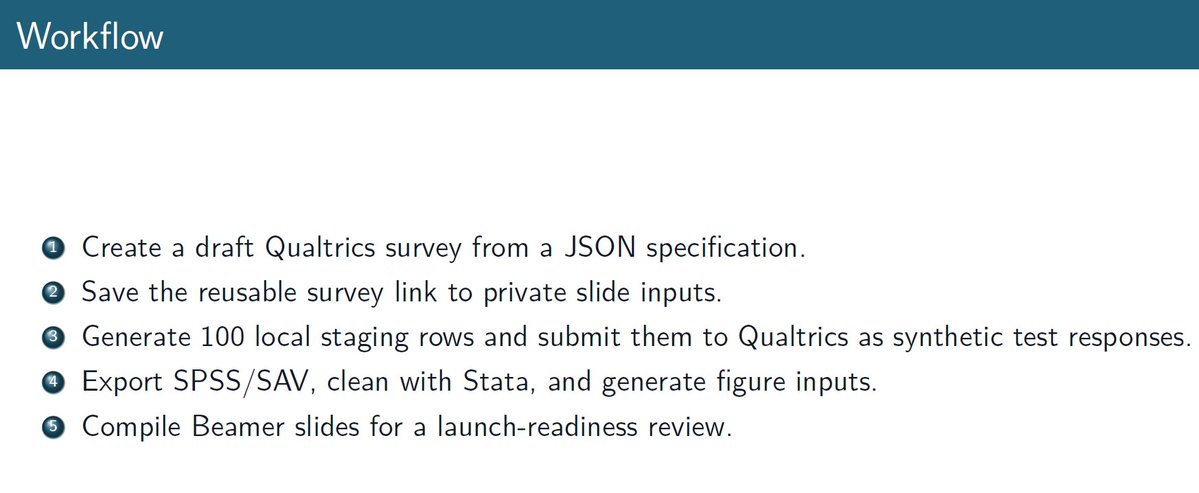
Do you run Qualtrics surveys? Then use my GitHub repo to automate the whole process with Codex! Tell Codex what you want to study, and it will create the survey, push to the survey to Qualtrics and generate synthetic responses, download and clean the data, and produce a set of slides summarizing the process.🧵with complete guided example!
1/ We've been measuring intellectual humility wrong. Most scales ask "are you intellectually humble?" but the people least humble are the most miscalibrated about it. They overclaim. The #humilityparadox. Out today in Behavior Research Methods. Here's what we did instead. 🧵
Imagine a 19-year-old scrolling TikTok. She watches a creator list five "signs you have undiagnosed anxiety." She recognizes three in herself. By the end of the week, she's describing herself as anxious to her friends. A month later, she's avoiding situations she used to handle fine.
What went wrong?
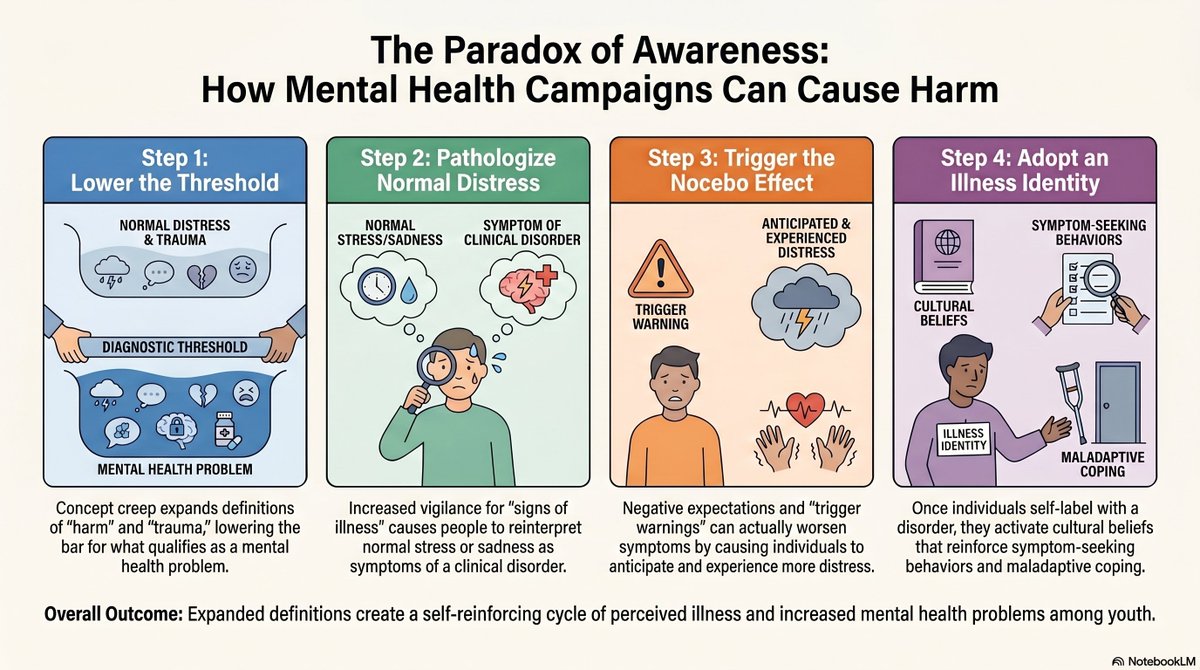
In a new paper by my PhD student Dasha Sandra, titled "Why mental health awareness can harm: Converging explanations for a societal problem", we argue that well-meaning mental health awareness can backfire, and we identify how. Four separate literatures (concept creep, nocebo effects, prevalence inflation, and illness self-labeling) have been circling the same problem from different angles. We show they converge on three mechanisms:
1.Awareness lowers the threshold for what counts as a disorder.
2. It trains people to scan their inner lives for symptoms and reinterpret normal distress as pathology.
3. Once someone adopts an illness identity, they behave in ways that confirm and deepen it.
The evidence is wide. Learning that loneliness is harmful makes solitude feel worse. Learning that stress is harmful worsens well-being and performance. Awareness videos about fake conditions like "wind turbine syndrome" produce real headaches. Trigger warnings raise anticipatory anxiety without reducing distress.
This does not mean awareness should stop. It means awareness can have unintended consequences, including manufacturing the suffering it tries to prevent. Inoculating people against these mechanisms works, and we already have evidence it does.
Link to paper: https://t.co/ucoGyhEuAj
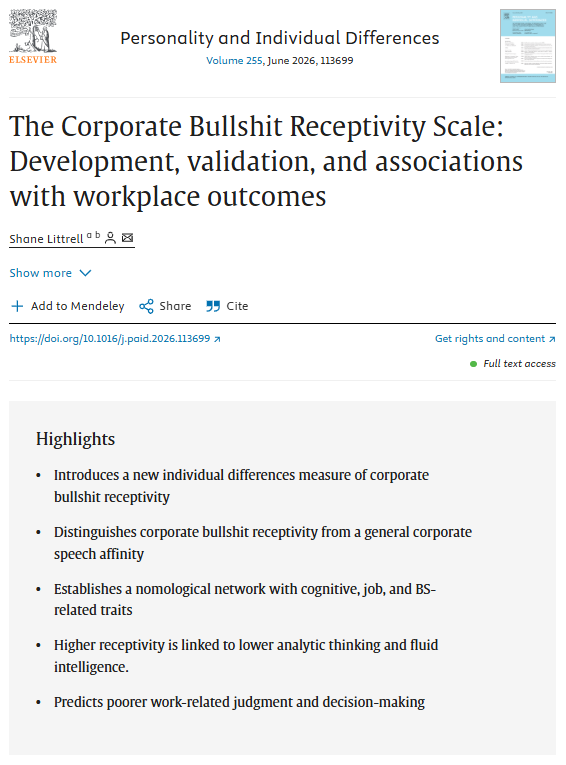
🧵Happy to announce that, "The Corporate Bullshit Receptivity Scale: Development, validation, and associations with workplace outcomes" is now published! 😀🥳 (see replies below for more info)
1) Official version: https://t.co/do9szjKnnB
2) Open access version: https://t.co/8AKtKqDhsQ
I am also hiring a PhD student (4-years, home student only to join the project, starting in September 2026🌏
Please share it widely!
https://t.co/H57fnkczKn
Our paper on national identity & voting in Kurdistan is now out in PSPB! A personally meaningful paper as it explores a familiar social psychological question in a unique context, Kurdistan, where I am from. And lucky to write this with my amazing mother https://t.co/5CusNV49dq
Nice summary of my first solo author and most rejected paper now out in @SocialPsychBull! No self-other differences in risky decision making among experts, but all were susceptible to gain and loss framing.
📊 Would you rather make risky decisions for yourself or for others? Which one would turn a possible loss into a much bigger issue than potential gains? Mayiwar (2025) tested groups of professional decision-makers, giving them hypothetical risky-choice tasks.
🧵 1/5
1/12 Finally out! 🎉 This project took a village to audit, analyze, and edit. It began with a simple worry: is Solomon’s paradox (https://t.co/0RXMhISKmN) too trivial? Doesn’t everyone know that stepping back (#selfdistancing) & getting outsider #advice helps us choose wiser?
1/8
New (and first) paper accepted at JEP:LMC 🎉 Ever fallen for this type of questions: "How many animals of each kind did Moses take on the Ark?" Most say "Two," forgetting it was Noah, and not Moses, who took the animals on the Ark. But what’s really going on here?🧵