"I just don't think we're being listened to"
Miscarriage rates are 40% higher in black women compared to white women in the US, one study found https://t.co/F3VNMhKV8Q
The social media claims didn’t mention that the study was on vaccinated people, which gave the misleading impression that CDC Director Rochelle Walensky was saying that overall deaths attributed to COVID-19 were largely due to other conditions. https://t.co/FEnMHrRh6i
It takes Neptune 164.8 Earth years to orbit the Sun. On 11 July 2011, Neptune completed its first full orbit since its discovery in 1846. This image of Neptune was taken by Voyager 2 less than five days before the probe's closest approach of the planet on Aug. 25, 1989.
"The diversity of the phenomena of nature is so great, and the treasures hidden in the heavens so rich, precisely in order that the human mind shall never be lacking in fresh nourishment." - Johannes Kepler
📷 Our #WeekInImages 13-17 September 2021 👉 https://t.co/KB6yRNDWiZ
@bobknar @239Pounds @ambers5309@arcanegoat@4YrsToday I've never seen a moderate use the term "trump derangement syndrome". The only people that use that phrase are Trump's cult, and people pretending to not be in Trump's cult but literally pushing every lie his cult embraces.
Anyhow, I'll join everyone else in ignoring you.
This striking @NASAHubble image features a relatively rare celestial phenomenon known as a Herbig-Haro object.
These amazing objects are formed when streams of ionized gas collide with clouds of gas and dust surrounding newly formed stars.
More: https://t.co/5RV5A4qBBD
Zoom in on the Andromeda Galaxy with Hubble. What looks like a smudge of light to the unaided eye is actually a vast galaxy containing an estimated 1 trillion stars.
Credit: ESA/Hubble & NASA
From the ancient Maya to Hubble, the Orion Nebula has fascinated astronomers and inspired theories about the nature of the cosmos. In this video, the first photograph of the nebula from 1880 transitions to Hubble’s 2005 image. Watch the full story: https://t.co/XLofm3h41g
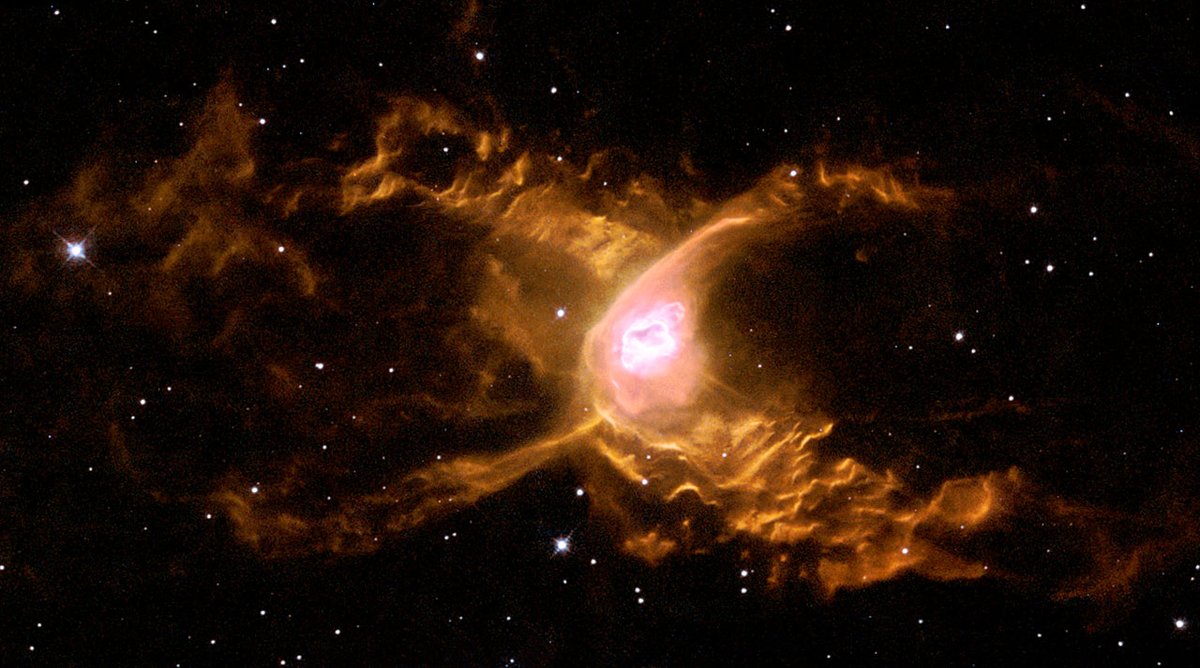
ESA/Hubble #Flashback: This warm planetary nebula, called the Red Spider Nebula, harbours one of the hottest stars known.
🔗 https://t.co/4eOqhKX7tl
Credit: @ESA / Garrelt Mellema (Leiden University, the Netherlands)