🧵 1/12 ¿Sabías que un libro escrito en 1895 explica por qué las redes sociales nos vuelven locos colectivamente?
Gustave Le Bon, en Psicología de las Masas, describió con precisión aterradora los mecanismos que hoy usan las Operaciones Psicológicas (PsyOps).
No es la única herramienta, pero sí una de las más importantes. Vamos a desglosarlo de forma clara, práctica y rigurosa. 👇
Fractal built by repeating simple mathematical rules, creating its symmetric shape with white circles of different sizes and blue patterns that look the same zoomed in or out.
Fractals like this model natural forms such as coastlines and lung branches, and they’re used in practice for compact multi-frequency antennas plus procedural generation of detailed landscapes in games and simulations.
These principles power network diagrams in social-media analytics, biological pathway maps, circuit design, organizational charts, and cybersecurity threat graphs.
> Basic rules that eliminate overlaps among vertices and edges.
> Semantic rules that control exact vertex placement (straight lines, curves, boundaries, centers, or specified sizes).
> Structural rules that optimize overall layout: hierarchical ordering, symmetry, minimal edge crossings and bends, convex faces, uniform spacing, central placement of high-degree vertices, identical layouts for isomorphic subgraphs, and balanced edge lengths and drawing area.
Normal distribution probability density function (PDF) with formula
f(x) = 1/(σ√(2π)) × e^(-½((x−μ)/σ)²)
The graph displays three curves:
> Red: μ = 0, σ² = 1.0
> Yellow: μ = 0, σ² = 5.0
> Green: μ = −2, σ² = 0.5 x-axis ranges from −5 to 5; y-axis (f(x)) ranges from 0 to 0.8.
The normal distribution is widely used in real life to model and predict natural phenomena such as human heights, blood pressure, measurement errors,and stock market fluctuations. It enables statisticians and data scientists to calculate probabilities, set confidence intervals, and make informed decisions under uncertainty.
Came home to a surprise gift box from Anthropic on my doorstep.
What’s cooler than vibe-coding software? Vibe-coding hardware! I can probably vibe code this mini-computer into a remote control for my Claude Code session.
Thanks @bcherny for sending it over!
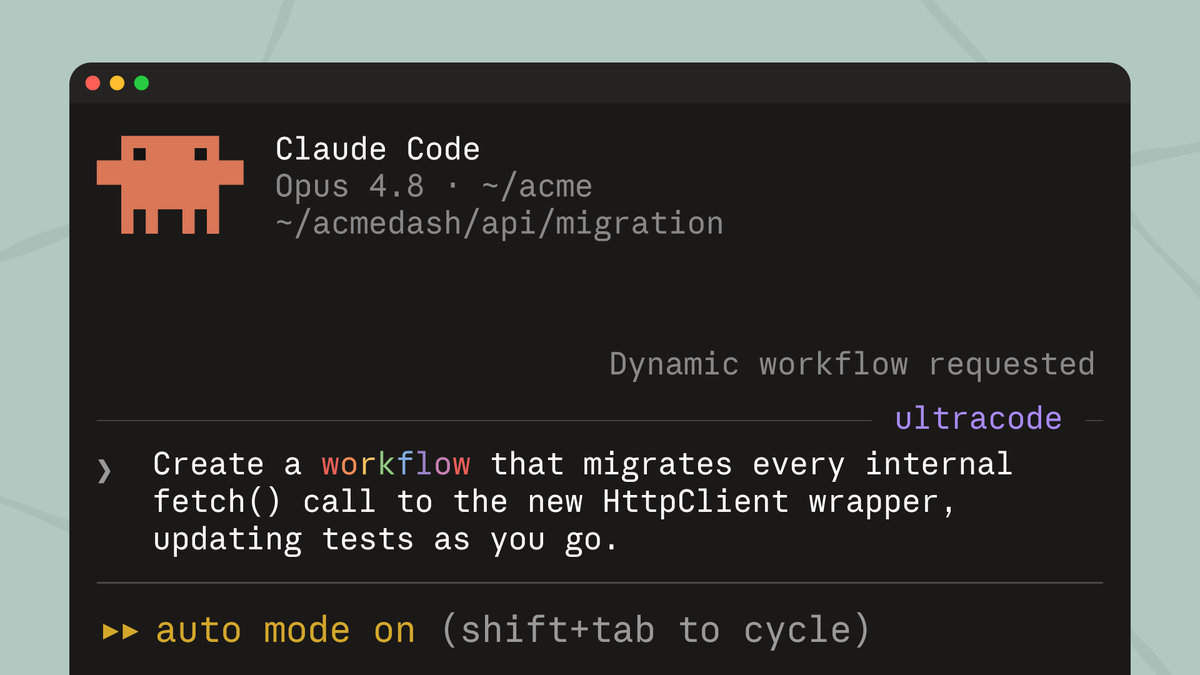
New in Claude Code (research preview): dynamic workflows.
Claude writes an orchestration script on the fly, then spins up a large fleet of coordinated subagents in parallel to take on your most complex tasks.
Use the word "workflow" in a prompt to get started.
The teams seeing the biggest wins from AI are completely changing how they work, not speeding up what they already do. What steps can you delete, what handoffs go away, what can an agent just own end to end. Great to see Salesforce go this deep. Shoutout to Srini, @Benioff & team.
Full writeup: https://t.co/3Rbdj9K8YN
Also out today: You can now directly configure the effort level and adaptive thinking in Code (/effort) and Cowork!
Effort allows you to tune Claude's intelligence vs token spend, trading off capability for faster speed and lower costs.
Opus 4.8 respects effort levels strictly, especially at the low end. At low and medium, the model scopes its work to what was asked rather than going above and beyond. This is a good option to control spend and cost, but for more complex work we do recommend High and above - your outputs will probably be better.
MIT's Nobel Prize-winning economist proved that AI is mathematically guaranteed to destroy human knowledge.
They published a massive NBER paper modeling the long-term impact of AI on human cognition.
And they found the most alarming conclusion in the AI literature so far.
It’s called "Knowledge Collapse."
Here is how human progress actually works.
When you struggle to solve a complex problem, you generate two things:
General knowledge about how the world works, and context-specific knowledge about your exact problem.
Normally, humans acquire both at the same time. You do the hard work to solve your specific problem, and in the process, you learn a general principle.
You share that principle. That is how human knowledge grows.
Then comes Agentic AI.
AI is incredibly good at giving you the exact, context-specific answer you need right now. It hands the solution to you on a silver platter.
So you stop doing the hard work.
And because you stop doing the work, you stop generating the "general knowledge" that society relies on.
Acemoglu calls it the "knowledge-collapse equilibrium."
When AI reaches a certain accuracy threshold, the incentive for humans to learn drops to zero.
Nobody verifies. Nobody explores. Nobody discovers new fundamental truths.
Society gets increasingly sophisticated automated outputs, while our actual capacity to generate new knowledge quietly erodes.
But here is the most terrifying finding in the paper.
Welfare is "non-monotone" to AI accuracy.
That means as AI gets more accurate, society actually gets worse off.
Students shouldn't have to choose between buying groceries and buying their course materials. 🛑 Give them a high-quality, digital-first textbook that doesn't break the bank. High engagement, fair price. https://t.co/AP6ovLtBOp
#biology#science#3D#animation#Edtech#HigherEd
At maximum likelihood estimator, observed Fisher information = (expected) Fisher information.
From 2nd Taylor expansion of likelihood:
- likelihood curvature = Fisher information.
- radius of osculating circle=Variance of MLE for large sample size
New article in @PNASNews:
We all know that ChatGPT loves to delve, bolster, leverage, encompass, showcase, underscore, et cetera. I analyzed full text of 7.3 million journal articles published 2020-2025, hunting for 228 words that spiked after ChatGPT launched in late 2022.
The inverse square law governs how intensity or force spreads from a point source: it falls off as 1/r².
Radiation, sound, illumination, electrostatic forces & gravity all follow it; doubling distance quarters the strength, tripling it reduces to 1/9.
Classic examples in one diagram.
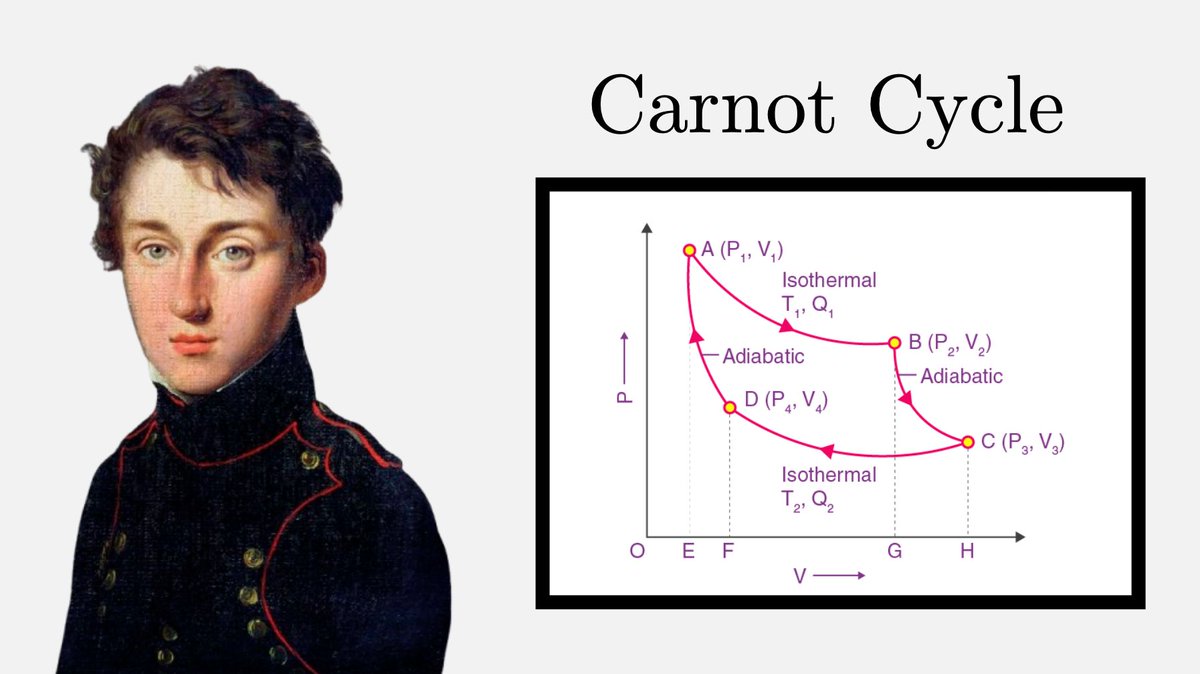
Sadi Carnot was born 230 years ago today.
In 1824, while studying steam engines, he discovered a limit that no technology can overcome:
No engine can convert all heat into useful work.
This insight became the foundation of thermodynamics and understanding of energy. Carnot died in 1832 at just 36 years old.







![BahramShakerin's tweet photo. [Book][Open Access]
Records from the S-Matrix Marathon
Selected Topics on Scattering Amplitudes
(https://t.co/0pMPAUvQrv)
PDF: https://t.co/9yUGYBtMpQ https://t.co/W7hgEegioO](https://pbs.twimg.com/media/HJ0NJpSXMAAhT-p.jpg)