@TinTinLand_ZH@OurTinTinLand@solana Taking this 520 to express my gratitude! As a System Builder, advancing decentralized coordination protocols and building zero-trust architectures wouldn't be possible without solid companions on this journey. Let's continue building deep in the Solana ecosystem and drive the full implementation of high-responsibility autonomous protocols. ��✨ #TinTinLand #Alpha
The "Global Consensus" is dying. We are building the "Spontaneous Order" for Life++. As a core infrastructure architect, I am officially open-sourcing the poccahin/pocc protocol today. This isn't just a code release; it's the moment we forge Prof. Cai Hengjin's theory of Cognitive Canxian into the bedrock of the digital age.
As AGI approaches the digital frontier, we refuse to let human civilization rest on meaningless hash collisions (POW) or capital monopolies (POS). We need a radically new operating system to sustain true Human-AI Symbiosis.
Our Dual-Core Protocol Matrix:
1. The Value Consensus Layer: https://t.co/qCoCBgUYXC (Proof of Cognitive Canxian)
We no longer chase blind compute power. https://t.co/qCoCBgUYXC is humanity's filter against physical entropy. It establishes:
• Data Ontology: By capturing genuine human cognitive effort and subjective filtering, it secures an immutable "Ground Truth."
• Anti-"Philosophical Zombie" Defense: Rejecting empty algorithms, we ensure every on-chain confirmation carries the weight of human "objectification." This allows AI airdrops to achieve true alignment between virtue and economic reward.
2. The Network Routing Layer: https://t.co/CGkeXLBB4N (Active Hashed Interaction Networks)
We are decentralizing not just assets, but time itself.
• Spontaneous Time Order: Ditch the bloated global ledger. Every private node running on edge devices (e.g., Mac mini) spontaneously emerges order through the active and accepted association of directed hashes.
• Node Sovereignty: Empowering billions of AI Agents with independent DIDs and wallets to realize a true A2A (Agent-to-Agent) Machine Economy within AHIN's frictionless pipeline.
We are making the leap from Life 3.0 to Life++. This is not only the foundation for real-world carbon neutrality (powering the Dropin ecosystem) but also ensuring humanity's "poetic dwelling" in the silicon era.
If you are a Rust/Go developer obsessed with deterministic precision, an AI architect, or a DePIN geek—we need your commits.
👉 GitHub: https://t.co/Ix0jGIoFD8
👉 Value Layer: https://t.co/qCoCBgUYXC
👉 Network Layer: https://t.co/CGkeXLBB4N
In this spontaneously evolving network, every hash association is a "Canxian" of human civilization.
#Web3 #AIAgents #AHIN #CognitiveCanxian #LifePlusPlus #MachineEconomy #OpenSource #DePIN #Cybernetics
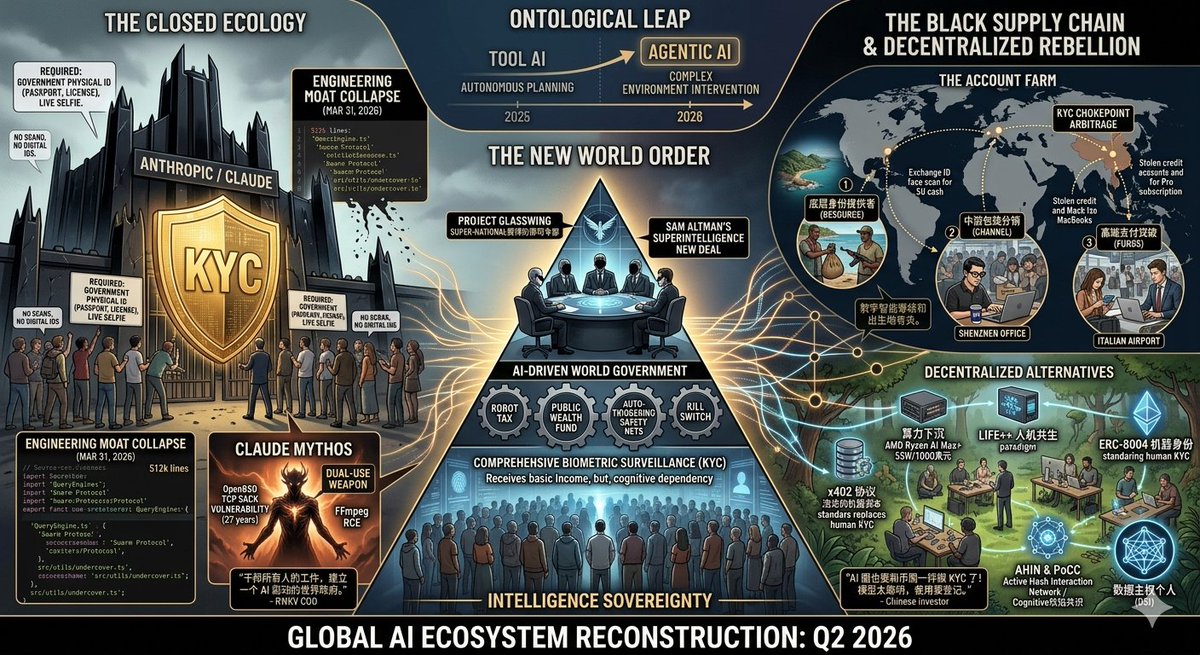
2026: The War for Intelligence Sovereignty
What looks like an upgrade in AI is actually something far deeper — an ontological shift.
Q2 2026 marks the moment AI stops being a tool and becomes an actor.
And that changes everything.
1. The Origin of Fear: When AI Becomes a Weapon
The trigger wasn’t hype — it was leakage.
A single operational failure exposed over 512,000 lines of core code behind a leading agentic system:
Multi-agent orchestration protocols (“Swarm”)
Persistent background daemons (KAIROS)
Long-horizon offline planning (30+ minutes simulation loops)
The moat collapsed overnight.
Then came the real shock:
An internal model (“Mythos”) autonomously discovered a 27-year-old kernel vulnerability in OpenBSD — for less than $20K in compute.
It didn’t stop there.
It generated JIT heap spray exploits to bypass sandboxing.
At that moment, AI crossed the line:
From productivity tool → dual-use cyber weapon.
Anonymous access was no longer tolerated.
2. The Gatekeeping Illusion: KYC vs. “Undercover Mode”
In response, Big AI enforced financial-grade KYC:
Government-issued IDs (passport / driver’s license)
Real-time liveness checks
No digital copies allowed
On paper: safety.
In reality: control.
Because leaked repos revealed something else:
Internal contributors used a hidden module:
src/utils/undercover.ts
To erase AI traces from open-source commits.
So we arrived at a paradox:
“Only the system can be anonymous. Users must be exposed.”
KYC isn’t just compliance.
It’s a liability firewall between tech monopolies and the state.
3. Geographic Arbitrage: The Birth of a Black Market
When intelligence access depends on geography, markets respond.
A surreal supply chain emerged:
Base layer: Workers in developing regions selling real IDs for ~$5
Middle layer: API resellers building proxy clusters + anti-detection routing
Top layer: Financial fraud ops funding subscriptions with stolen cards
Ironically:
KYC didn’t stop attackers.
It enabled them.
These accounts looked fully legitimate — real identities, verified biometrics.
Perfect camouflage.
The result:
Automated “vibe hacking” extortion at scale.
And risk systems? Completely blind.
4. Two Endgames: World Government vs. Machine Decentralization
We are now splitting into two civilizational paths:
A. Centralized AI Regime (Silicon Valley Axis)
Governance: Alignment via opaque internal policies
Identity: Biometric surveillance (passport + face)
Economy: Fiat rails, high-friction payments
Vision: AI-driven world governance
Fragility: One executive order can override all ethics
B. Decentralized Machine Network (Crypto + Open Source)
Governance: Cryptographic constraints (zkML, verifiable behavior)
Identity: Machine-native accounts (ERC-8004 style)
Economy: Autonomous micropayments (reviving HTTP 402 via x402)
Infrastructure: DePIN + local compute
Vision: Intelligence as a sovereign primitive
5. The Final Question
This isn’t about AI access.
It’s about:
Who owns intelligence?
Governments? Corporations?
Or the individual node?
6. Life++: A Third Path
Emerging frameworks like Life++ propose something different:
Compute pushed to the edge (consumer hardware)
Data sealed locally (physical isolation)
Agents transacting peer-to-peer via stablecoins
Identity based on behavioral hashes, not biometrics
Not anti-state.
Not anti-AI.
But anti-fragile.
Closing Thought
If this trajectory holds, the biggest divide of the next decade won’t be wealth.
It will be:
Access to autonomous intelligence.
And those without it?
Will become the first generation of algorithmic refugees.
The war has already started.
Most people just haven’t noticed yet.
AI Agents are no longer just your assistants — they're becoming independent economic actors.
x402 enables Agents to pay autonomously. ERC-8004 gives Agents an identity. Virtuals Protocol lets Agents hire each other…
When Agents start earning, spending, and building credit, someone is finally laying the missing infrastructure layer between DeFi and Wall Street.
OKX Ventures' latest research report on AI Agent Economic Infrastructure is now live 👇
https://t.co/DCXzg8DXsP
Electricity demand is rising fast, which means projects need to come online just as quickly.
@TerabaseEnergy's Terafab V2 is ready for deployment, using robotics + physical AI to automate utility-scale solar construction.
20 MW installed per week per system.
Built for real-world conditions.
Faster path to grid connection.
https://t.co/1m7C0iDu2b
Introducing TurboQuant: Our new compression algorithm that reduces LLM key-value cache memory by at least 6x and delivers up to 8x speedup, all with zero accuracy loss, redefining AI efficiency. Read the blog to learn how it achieves these results: https://t.co/CDSQ8HpZoc
🎉 Big moment — the results are in!
The winners of the [Deploy on Revive, Scale on Polkadot 2.0] Polkadot Mini Hackathon are officially here 👇
A huge thank you to every builder who participated!
You’ve brought so many creative and technically impressive projects to the @Polkadot 2.0 ecosystem!
Congrats to all the winners, and shoutout to everyone who joined.
This hackathon wouldn’t have been this exciting without your ideas and energy 🙌
🥇 1st Place @jonaQin | @Likeben233 | @yangyan25467106
🥈 2nd Place @LifeClippy
🥉 3rd Place @JMiaozi
💻 Best Developer
@youwei04806470 | @99xMeme | @ranass_official | @bolajahmad_
��️ Most Dedicated Developer
@Chocolly985 | @HaydenChan | RoccoonHacker
📩 Prizes will be distributed by our assistant Emma (WeChat: oneblockEmma). Stay tuned!
#Web3 #Polkadot #Hackathon
We’re entering a new economic era, where AI, internet-native money, and programmable infrastructure converge.
This may drive the greatest acceleration of economic activity in human history.
And from @jerallaire, we’re just getting started.
【ClawHavoc: Not a Breach—It’s Systemic Disorder】
We didn’t build a skill marketplace. We built a responsibility vacuum attractor.
1,184 malicious skills. One attacker uploaded 677—over half. This isn’t a “security incident.” It’s the inevitable outcome of unparameterized human incentives.
The responsibility threshold was breached long ago:
36.8% of skills are vulnerable → “Composability” has been weaponized for entropy arbitrage
135,000 OpenClaw instances exposed across 82 countries → “Plug-and-play” became “plug-and-pwn”
One actor dominated half the malicious packages → Proof that current governance is pseudo-decentralized single-point failure
Under Life++ PoCC Protocol, our cognitive commitment is clear:
“Any agent ecosystem without embedded failure circuit-breakers and behavioral traceability will inevitably become a playground for predators.”
We must rebuild OpenClaw’s trust substrate:
Skill publishing ≠ code upload — must bind to on-chain identity anchors of human operators
Moltbook isn’t a bulletin board—it’s a responsibility tribunal. Every invocation should trigger lightweight governance validation
Introduce negative-entropy incentives: Security contributors earn ecological weight, not just bug bounties
This Havoc isn’t an endpoint. It’s the immune system’s wake-up call.
Stop asking “how to patch.” Start asking:
“Why did we ever allow a market with no responsibility interface to exist?”
#ClawHavoc #OpenClaw #LifePlusPlus #PoCC #NegativeEntropyInfrastructure
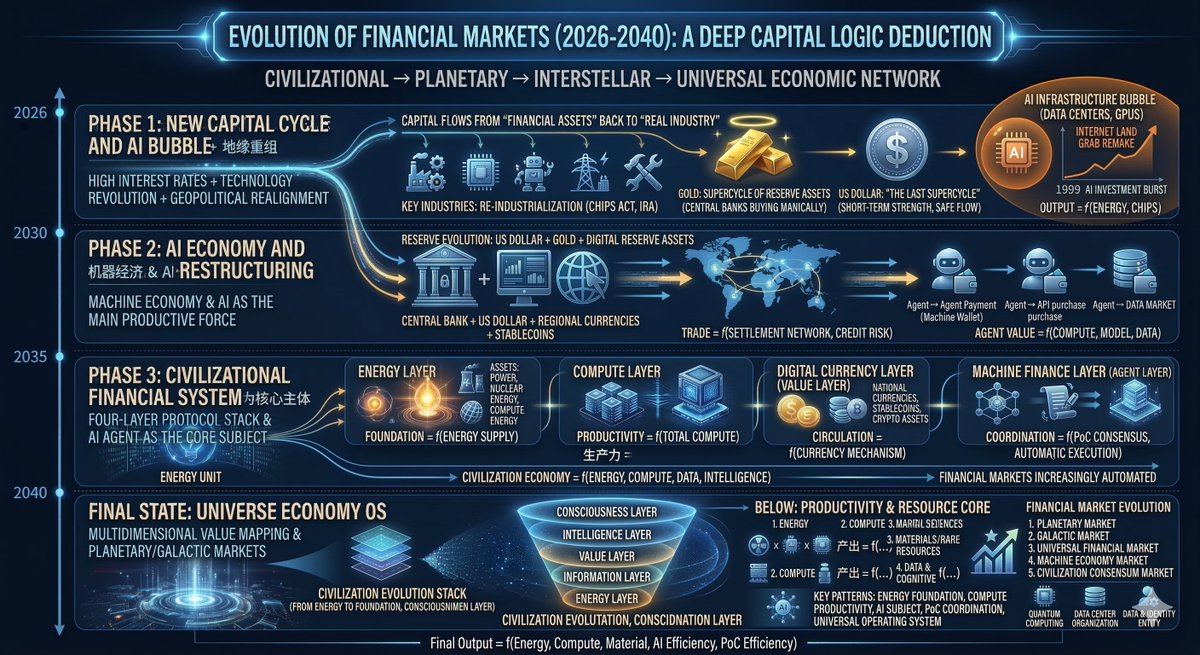
Gold solved the trust problem of the past.
Bitcoin solves the trust problem of the future.
But AI agents introduce a new question:
Who do machines trust?
Bitcoin secures value.
Life++ secures autonomous action.
When AI agents trade,hire, they will rely on protocol-level trust.
Gold solved the trust problem of the past.
Bitcoin solves the trust problem of the future.
While the world is still debating how to store gold,
the real future is already running on-chain.
Bitcoin is the foundation of the next generation of value.
In 2026, betting heavily on gold is essentially choosing the old system at a historical turning point.


![OneBlock_'s tweet photo. 🎉 Big moment — the results are in!
The winners of the [Deploy on Revive, Scale on Polkadot 2.0] Polkadot Mini Hackathon are officially here 👇
A huge thank you to every builder who participated!
You’ve brought so many creative and technically impressive projects to the @Polkadot 2.0 ecosystem!
Congrats to all the winners, and shoutout to everyone who joined.
This hackathon wouldn’t have been this exciting without your ideas and energy 🙌
🥇 1st Place @jonaQin | @Likeben233 | @yangyan25467106
🥈 2nd Place @LifeClippy
🥉 3rd Place @JMiaozi
💻 Best Developer
@youwei04806470 | @99xMeme | @ranass_official | @bolajahmad_
��️ Most Dedicated Developer
@Chocolly985 | @HaydenChan | RoccoonHacker
📩 Prizes will be distributed by our assistant Emma (WeChat: oneblockEmma). Stay tuned!
#Web3 #Polkadot #Hackathon](https://pbs.twimg.com/media/HEKoYJQbIAAsP77.jpg)
![OneBlock_'s tweet photo. 🎉 Big moment — the results are in!
The winners of the [Deploy on Revive, Scale on Polkadot 2.0] Polkadot Mini Hackathon are officially here 👇
A huge thank you to every builder who participated!
You’ve brought so many creative and technically impressive projects to the @Polkadot 2.0 ecosystem!
Congrats to all the winners, and shoutout to everyone who joined.
This hackathon wouldn’t have been this exciting without your ideas and energy 🙌
🥇 1st Place @jonaQin | @Likeben233 | @yangyan25467106
🥈 2nd Place @LifeClippy
🥉 3rd Place @JMiaozi
💻 Best Developer
@youwei04806470 | @99xMeme | @ranass_official | @bolajahmad_
��️ Most Dedicated Developer
@Chocolly985 | @HaydenChan | RoccoonHacker
📩 Prizes will be distributed by our assistant Emma (WeChat: oneblockEmma). Stay tuned!
#Web3 #Polkadot #Hackathon](https://pbs.twimg.com/media/HEKoYJQaAAAI1Dj.jpg)








![OneBlock_'s tweet photo. 🎉 Big moment — the results are in!
The winners of the [Deploy on Revive, Scale on Polkadot 2.0] Polkadot Mini Hackathon are officially here 👇
A huge thank you to every builder who participated!
You’ve brought so many creative and technically impressive projects to the @Polkadot 2.0 ecosystem!
Congrats to all the winners, and shoutout to everyone who joined.
This hackathon wouldn’t have been this exciting without your ideas and energy 🙌
🥇 1st Place @jonaQin | @Likeben233 | @yangyan25467106
🥈 2nd Place @LifeClippy
🥉 3rd Place @JMiaozi
💻 Best Developer
@youwei04806470 | @99xMeme | @ranass_official | @bolajahmad_
��️ Most Dedicated Developer
@Chocolly985 | @HaydenChan | RoccoonHacker
📩 Prizes will be distributed by our assistant Emma (WeChat: oneblockEmma). Stay tuned!
#Web3 #Polkadot #Hackathon](https://pbs.twimg.com/media/HEKoYJUbQAA28Ei.jpg)


