🇭🇺 An exciting day for Gen6 in Hungary!
Today, I visited the Hungarian Parliament together with Dr. Rita Halász, where we also had the opportunity to meet István Kapitány, Hungary’s Minister of Economy.
More exciting updates are coming!
Six will soon return to Hungary, and we’re planning an update video, a live session, and a more informal Gen6 community meetup toward the end of October. We’ll announce the exact date and details in advance.
🌐 Life in Gen6 — Social You Own.
Your identity. Your content. Your connections. Your control. 🔐
Discover our vision for a new kind of social experience, built around digital ownership, privacy, and trust.
📖 Read our latest article:
https://t.co/Ec44NPjOLy
💙 Thank you for being part of this journey and building the future of Gen6 with us!
🛡 “Don’t guess. Verify.”
At the Hungarian Academy of Sciences’ Veszprém Committee (MTA VEAB), Gen6 co-founder & CEO Dávid Pethes tackled the question he hears most in the AI era: “How do I still know what’s real?”
His answer: deepfake detectors always guess — and they’re always one step behind. Gen6 flips the approach: seal real content the moment it’s created, so anyone can verify it later. An anchor, not a magic fix.
Read the full recap 👉
https://t.co/kbTItYtuuJ
Gen6 Community Meetup – Budapest! 🇭🇺
We’re excited to invite you to our next Gen6 Community Meetup!
This time, we’re keeping things a little more casual. No formal presentations or packed agendas — just an opportunity to meet in person, have some great conversations, exchange ideas, and connect with fellow Gen6 community members.
Whether you’ve been with us from the beginning or recently joined the Gen6 ecosystem, you’re more than welcome!
📅 Date: October 29, 2026 (Thursday)
🕔 Time: 5:00 PM (CEST)
📍 Location: Local Korner
🏠 Address: 1052 Budapest, Semmelweis street 17.
💬 Let’s talk about Gen6, blockchain, upcoming developments, and whatever else comes up!
🤝 Good conversations, great company, and a relaxed atmosphere.
💙 We look forward to seeing you there!
See you in Budapest!
📣This is your reminder that the fight against #ChatControl is still NOT over yet📣
Last month the negotiations for ChatControl 2.0 failed. Thanks to your support #ChatControl 2.0 and #masssurveillance do not happen🥳
However, the battle is still NOT over yet as the threat remains to keep ChatControl 1.0 as a permanent legislation beyond April 2028😡
Negotiations for this are planned to continue in November which is why we at Tuta will continue our fight against #Chatcontrol because #privacymatters ✊
Find out more about how Big Tech already scans your messages here 👉 https://t.co/7PjSq6JciE
"KYC is for your protection."
Okay bro.
Show me exactly how collecting my face, passport and home address protects ME.
Then explain who carries the consequences when you lose them.
I'll wait.
Meanwhile, normalize staying safe from extortion, surveillance & data leaks by saying no to KYC.
So Google is killing Android Freedom but can't even keep its official Play Store safe?! 😡
A fake version of #Chrome app appeared on the Google Play Store above the real one - And Google is trying to stop you know side loading apps and only use its Play Store for 'Security reasons'. THIS DOES NOT MAKE SENSE.
Take action & sign the petition: https://t.co/KHXuoXhm2W
#Android is supposed to be open, & your phone should be yours → NOT GOOGLES.
DON’T upload your ID to YouTube.
DON’T upload your ID to Discord.
DON’T upload your ID to Reddit.
DON’T upload your ID to Meta.
DON’T upload your ID to Roblox.
DON’T upload your ID to Spotify.
DON’T upload your ID to ChatGPT.
DON’T upload your ID to TikTok.
I HAD ENOUGH OF WAITING AROUND TO GET MY MONEY BACK @BitMartExchange@sheldonbitmart FIX THIS NOW AND LET US WITHDRAW OUR MONEY OFF OF THE EXCHANGE YOU FRAUD!
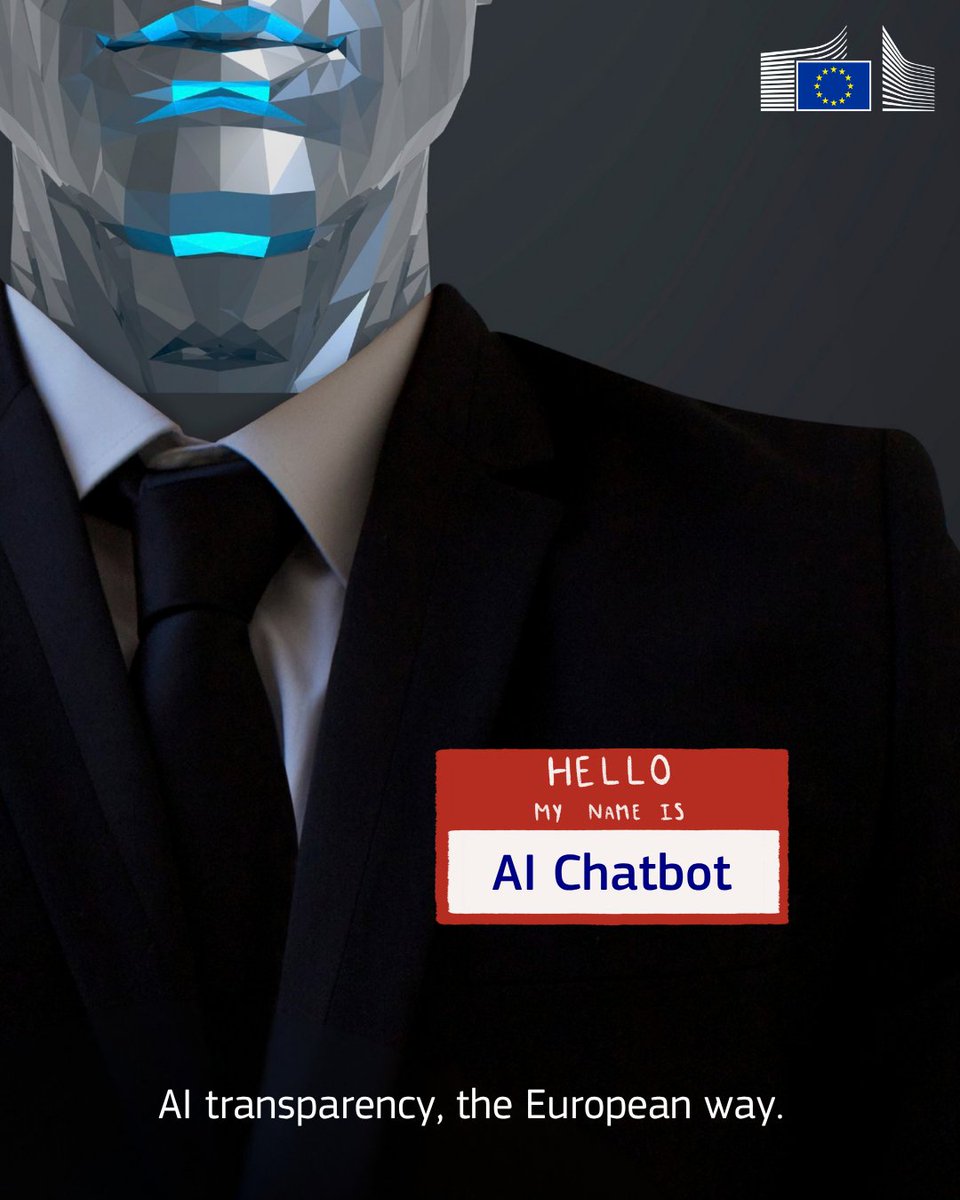
First impressions count. Especially with AI.
The EU rules on AI transparency are making it easier to know when AI is involved.
If you’re interacting with an AI agent, the system must let you know. If it’s a deepfake, it must carry a detectable mark.
🔗https://t.co/3XfPAz3S9W
@DigitalEU Yes, great! This is what we already built at Gen6, on verification level.
AI and machines are distinguished with Blue badges, while Human is green and Organizations are Gold.
Wanna have a look? We have what you are looking for and 100% EU built. Zero big tech👌🏼
I don't recommend anyone scramble to move their funds to new wallets today. But we should take the risks to cryptography from AI-accelerated math seriously, and minimize our exposure to not just quantum-vulnerable cryptography, but also potentially AI-vulnerable cryptography.
The core new area of risk from this viewpoint is, unfortunately, ML-DSA / FHE / lattices.
(and it's also another reason, along with quantum, why ECDSA might fall even faster than expected, hence the "fresh address" recommendation)
So far most people have been in the mode of thinking "elliptic curves broken, hashes safe, lattices safe". But there is a good chance that the concrete security of lattices will take serious hits from the next two years of AI math.
The basic threat model is: factoring is something that naively takes 2^(n/2) time, but over decades smart people have found and optimized number field sieves, and degraded that to 2^O(n^(1/3)), which is why RSA keys and signatures need to be ~400 bytes (and not 64 bytes). What if there are skeletons in the closet like that, both for elliptic curves and lattices, that we are simply not smart enough to discover - but bots soon will be?
This is a major part of the reason why for the past year ethereum's lean roadmap has been going in the "hash-only" direction: no lattices, no ML-DSA, no Falcon, no lattice-based commitments inside ZK proofs, etc. Signatures in lean ethereum are all hash-based, either WOTS or SPHINCS-.
For signatures and proofs, we already know how to go hash-only. The bigger challenge is for *public-key encryption* - and this goes far beyond blockchains. Secure communication, anonymizing protocols, lots of things need public-key encryption.
And unfortunately there are long-standing mathematical theorems showing why public-key encryption cannot be done with hashes alone. You have to have some kind of trapdoor object that has at least one form of usable "structure" - either group theory (incl. isogenies) or lattices or code-based or potentially in the future even more newfangled and spooky things (local mixing?). But for anything that has structure, you should assume that AI will make at least some progress in breaking that structure. Here, one reasonable inference is that if you want to make something plausibly long-term secure, multiply the key sizes by 10.
To me that's a very plausible world and something not at all extreme to predict. If AI will bring us 50 years of math in 2 years, then that 50 years of math may very plausibly include a "naive factoring -> GNFS" level of improvement to our ability to break lattices. In that world, lattices will still exist, but they will have to be significantly bigger to guarantee the same level of safety.
And at those new larger sizes, hash-based constructions will beat lattice-based constructions on concrete efficiency in every use case where hash-based constructions are possible at all.
Theoretically, of course it's possible that hashes are broken too (eg. P = NP would imply that). But I think P = NP is very unlikely. And intuitively, it's much more likely that a mathematical object has exactly no exploitable structure (like hashes are intended to), than that a mathematical object has exactly ~3 forms of exploitable structure (for elliptic curves: associativity, Schoof, pairings) and not some secret fourth form of structure we have not yet discovered that greatly degrades its security (for elliptic curves, ECDLP and pairing security). Similar for LWE, SVP, RLWE and the zoo of lattice problems.
For this reason, we do not yet see any reason to worry and start padding the byte size of hashes (if we start to worry more, we would pad the round count first before doing anything to the byte size).
Concrete TLDR, my own personal views:
* Hash-based > lattice-based, in those situations where hash-based is possible at all
* For anything lattice-based, be much more paranoid on param sizes. Remember that blockchains are only a small portion of the cryptography story; this point goes far beyond blockchains and applies to eg. access to websites, secure messaging, Tor / VPNs ...
* For privacy protocols, strongly favor NOT putting encrypted notes onchain. Instead, send them offchain through some third-party mechanism.
* If it's not difficult for you, keeping your funds in addresses which have not yet been used to make a transaction is a good idea. If it's easy for you, do it. **But be careful about migrations; I personally have lost more money in botched migrations than I have lost in all hacks combined**.
* For multisig wallets, doing confirmations offchain is better than onchain, because this way the signatures of signer wallets do not get exposed to the public, so if ECDSA falls to AI much faster than expected, at least the multisig "gracefully degrades" to a 1-of-1 where the 1 is whoever was gathering the signatures - a much better place to be than "anyone can take the money"
https://t.co/oVjwZog2lL