Simplifying a maligned product. It’s got an ugly name but lots of redeeming features. There are many different kinds which can be misleading. Maybe this helps?
@DataRepublican Higher rates still don’t provide enough after tax income. Higher rates HAVE enabled the life insurance companies to raise annuity payout rates. Every plan should have multiple sources of guaranteed income for life. This also removes volatility risk.
In brief, they been indoctrinated to chase rates of return and take on way too much risk.
Even though interest rates are higher the after tax spendable $ are still very low.
A robust plan has multiple sources of guaranteed income for life that eliminates volatility risk.
The higher rates have allowed the life insurance companies to raise their payout rates.
You will see record annuity sales the last few years which should continue as retirees and savers learn about what’s available.
Hope this helps.
No one needs it, but many want it, including younger families. Human life value first, so most should be in term. If cash flows allow, then some whole life is appropriate and prudent for long-term planning. Just the waiver of premium rider is why, let alone all the other reasons and advantages. You should not be so prescriptive as there is no blanket approach to life planning.
If you are considering buying an IUL, please make sure you FULLY understand precisely how it works. They are complicated, and many agents who sell them do not fully understand how to explain them to buyers.
#IUL#Lifeinsurance
https://t.co/gp19xCiOO8
@elonmusk@VivekGRamaswamy@america@DOGE
When you get time, maybe you can look into the oppressive regulations, rules, and repetitiveness in the financial advisory world. Many of these are actually layering in all kinds of unnecessary costs that we cannot absorb and, in many ways, preclude the public from getting advice.
Unfortunately, there will always be some rotten eggs and bad actors, BUT the overwhelming majority of us come to work every day to help clients achieve financial security. Despite all these onerous rules and regulations, people still commit fraud, etc.
New clients receive lengthy account opening forms that contain all kinds of disclosures that I am sure no one ever reads, and they cannot change them even if they want to. There is a better way.
In addition to this we have to make attestations to the same things every year. How many times should have to repeat AML, know your client and other training?
A streamlining of the process and compliance would help reduce BD overhead, which in turn helps keep costs down and also a better use of our time. Every hour we spend on repetitive training, and attestation is an hour that could have been better used to serve the public.
I am certainly NOT suggesting a reduction of penalties, BUT I strongly believe that the same thing could be achieved in about 10 sentences with the harshest penalties of you decide to do badness.
Thank you for all your dedication and hard work.
@sweatystartup This is just reckless and ignorant. Used responsibly as part of well diversified, risk managed plan it has many benefits. Find a planner who has a deep understanding of the why and then make a decision whether to buy.
@T_Gatzemeier Again, very misleading. There are many cases where whole life makes sense. Ignore the infinite banking shtick. There are much better and valuable reasons to own it.
That���s very misleading. I agree that IUL’s, VUL’s use rosy hypothetical illustrations and many people who sell them simply do not understand how they work. Gives the industry a bad name.
Whole life insurance is different. Has solid guarantees and if correctly used acts as a very low risk management tool with bind like qualities.
@baldguynp That is very misleading and inaccurate. Many reasons to own, starting with the fact that you are protecting your loved ones. There are also many benefits of life insurance. The key is to understand the 'Why' of ownership and how it works.
Number 2. Be very mindful of over-investing in tax-deferred accounts at a young age. You are likely in a low tax regime, which will rise over time. Look carefully at ROTH and regular taxable accounts as well as whole life.
Number 15. Self-insurance of earnings and life is a very risky proposition. Raise the deductibles on your car, and other things like that are okay. Make sure you have sufficient supplemental umbrella insurance as well.
Choosing beneficiaries for a Life Insurance policy. A 🧵
-When you apply for life insurance, they require you to nominate one or more primary beneficiaries, and you can add contingent beneficiaries.
-Most people make their spouse the primary and their kids the contingent.
-Be aware that minor children aged between 18 and 21, state-dependent, cannot receive the funds. The court will appoint a custodian.
-To avoid this and have the person you prefer manage the proceeds, you can establish various kinds of trusts. Please consult your advisor/lawyer as to the different choices.
-In more advanced planning, many buyers establish an ILIT, Irrevocable life insurance trust outside the estate to be the owner and beneficiary. This way, the proceeds are not included in the taxable estate.
-If you get divorced, a beneficiary dies, or you no longer want that person to be a beneficiary, you MUST change your election with the carrier. If you do not, they will pay whoever is listed at the time of death.
-In divorce, there may be a stipulation for each spouse to own and be beneficiary of each other's life insurance.
This is just an overview. Please always work with a knowledgeable advisor.
PS: Business-owned insurance has different rules.
#lifeinsurance
This is misleading and lacks enough data and facts to be so conclusive. It is also potentially lethal advice to young savers.
-Who is paying 2% on a 401K? The fiduciary could face a lawsuit from the savers.
-You used linear rates of return, no down years?
-IUL has a floor of 0% and a cap that can and does change. Caps have been coming down over the last few years. -What does this mean? If the market has a down year, the 0% floor kicks in, BUT policy fees are still charged, resulting in a negative year, say -3% or so.
-If the market recovers and has an up 15% year, the cap kicks in, limiting your participation to the cap, say 8%. 8% less fees = about 5%, and you started at -3%. Very little recovery and nowhere near 6.71%
-A few bad years, and you will NEVER recover. -You are NOT invested in the market. You own options based on an options budget, which is affected by interest rates and volatility.
-The carrier also has the right to change fees, although they try to avoid it, it is a risk factor.
-There is around a 0% chance of those withdrawals occurring due to the above, AND if there are down or low return years after premiums have stopped AND withdrawal is taking place, then the policy will likely lapse, causing a taxable event.
-If the 6.71% linear ROR does not happen for 30 years, then there could be further calls for premiums. -We wouldn't see headlines like the one below if it were so simple. There is also a bunch of lawsuits going on; just Google it!
-I am not saying don't do it, BUT work with an advisor who has a deep understanding of how these policies work and what the risk factors are.
-Buyers can also look at the regulations under AG-49 and wonder why they have to keep updating them to keep up with the challenges these policies are having.
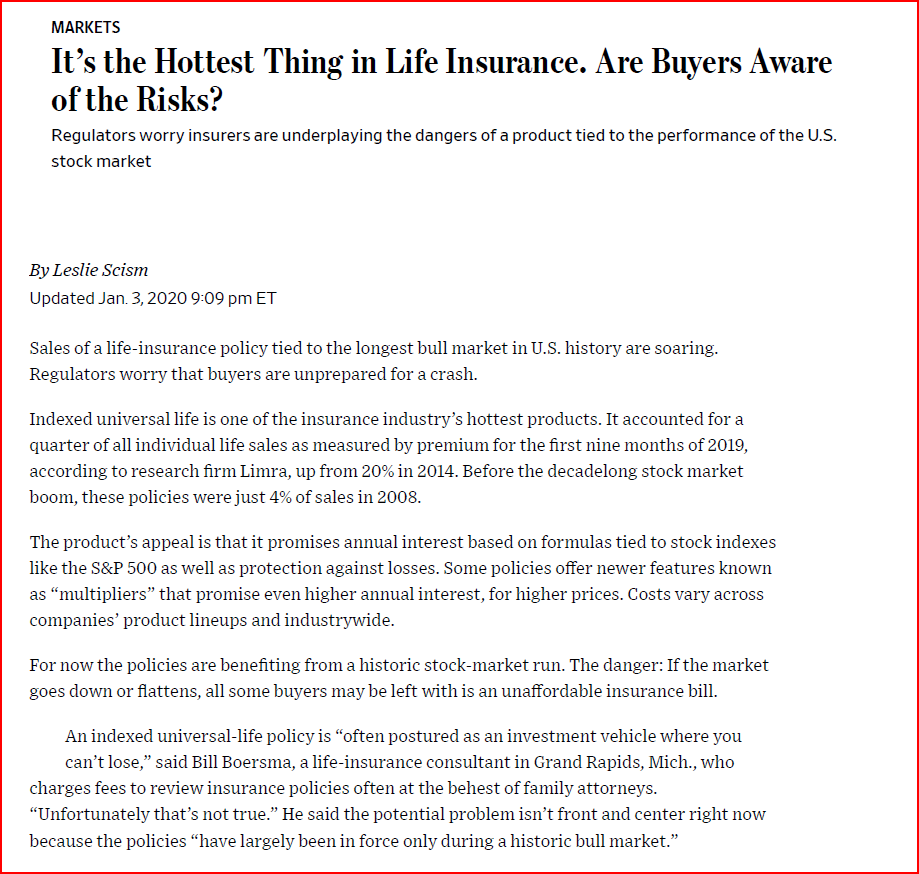
From the Wall St Journal. Try a Google search for similar from other media.
#Lifeinsurance #IUL