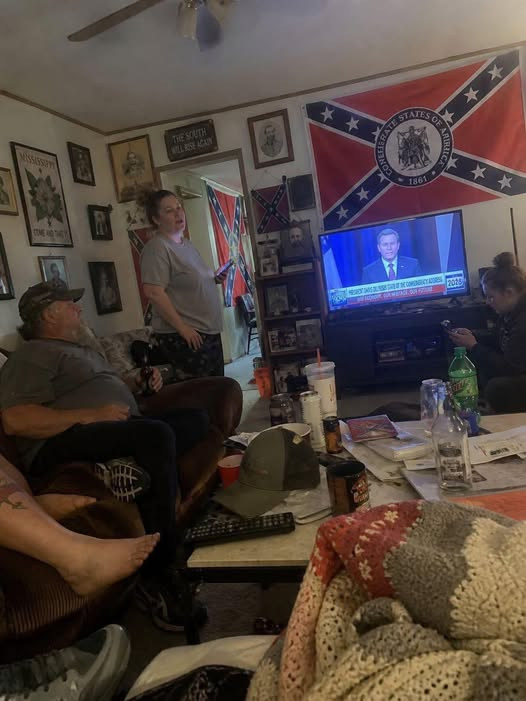
You see this kind of thing in struggling lower-income Southern households, and it tells a very specific story.
When life hasn't delivered much.... no wealth, no power, no real social standing.... some folks discover that white supremacy is basically a free membership card to a club that makes them feel superior without requiring any actual achievement.
It's the world's laziest status symbol.
The starter kit is always the same:
*A Confederate flag honoring a war their ancestors lost badly 160 years ago.
*A gun they'll never actually need.
*A Bible they've never actually read.
*And Fox News running 24/7 telling them they're REAL Americans.... unlike those fancy elitist Democrats who are secretly importing an army of replacement voters to steal their....
Their what exactly? Their Dollar General? Their 1987 Camaro on cinder blocks in the yard?
FOX found the formula, and they never let go of it: Take a man who has nothing, tell him the reason he has nothing is because those people are taking it.... and suddenly he's not a struggling nobody.
He's a soldier in a cultural war. He matters. He's relevant. He becomes a MAGA Warrior!
And THAT.... ladies and gentlemen.... is precisely how a twice-impeached, four-times-indicted, 34-time felon, bankrupt New York con man who golfs at his own resorts became the hero of the working man.
You genuinely cannot make this stuff up.
And I write this so that hopefully they will recognize what they have done and what they are doing and snap out of it.....
I was born and raised in Appalachia ... These very people could be my relatives ..... but ... I .... got common sense from my granny ----- "question everything". VIA~Lee Murphy
This couple dedicated over 60 years to creating animated content for Black children worldwide… ❤️
Meet Willie Hudlin and Leo Sullivan—two pioneers who helped shape representation in animation when it was nearly nonexistent for Black audiences.
Together, they worked behind the scenes to bring Black stories, characters, and culture to life through animation. When opportunities were limited, they built their own path.
🎬 Their work contributed to projects that:
• Showed Black families, humor, and everyday life
• Created characters kids could see themselves in
• Opened doors for future Black animators and creators
One of the most recognizable results is Fat Albert and the Cosby Kids—a show that entertained, educated, and uplifted.
💡 Why this matters:
Representation isn’t just about visibility—it’s about identity.
When children see themselves reflected in positive, creative ways:
• Confidence grows
• Possibilities expand
• Dreams become real
This couple didn’t just create cartoons. They helped shape how generations of Black children saw themselves.
The actor playing the charming romantic lead in 13 Going on 30 had the left side of his face completely paralyzed two years before they shot it.
Mark Ruffalo was 33 when he woke up from a dream telling him he had a brain tumor. No symptoms, just an ear infection. He was on set with Gandolfini and Redford for The Last Castle. He told the cast doctor about the dream anyway. The CT scan came back: a mass behind his left ear the size of a golf ball. Acoustic neuroma. Benign, but it had to come out.
His wife was nine months pregnant with their first kid. He didn't tell her. She had the doula, the birth plan, the hot tub ordered. He carried the diagnosis alone for weeks until after she gave birth.
Going into surgery, the doctors told him there was a 20% chance the left side of his face would stay paralyzed. He told them: "Take my hearing. Let me keep the face. Just let me be the father to this kid."
He woke up completely deaf in his left ear and the entire left side of his face frozen. Couldn't close his left eye.
Two years later he showed up to play the romantic lead in a Jennifer Garner movie that required everything brain surgery had just tried to take from him. The smile. The warmth. The comic timing. A goofy Thriller dance in front of a crowd. He almost quit during the rehearsal. Garner has told that story publicly. He stayed.
The movie opened 22 years ago today. $22M in week one, $96M+ worldwide. That same year he also shot Eternal Sunshine of the Spotless Mind, Collateral, and We Don't Live Here Anymore. Four films in twelve months from a guy who had just learned to use his face again.
He went on to four Oscar nominations and the Hulk.
The romantic comedy nobody takes seriously was the comeback film of an actor who had to relearn how to smile.
Remember when you used to get called a conspiracy theorist if you said the USA’s military budget is to blame for our lack of properly funded social programs?
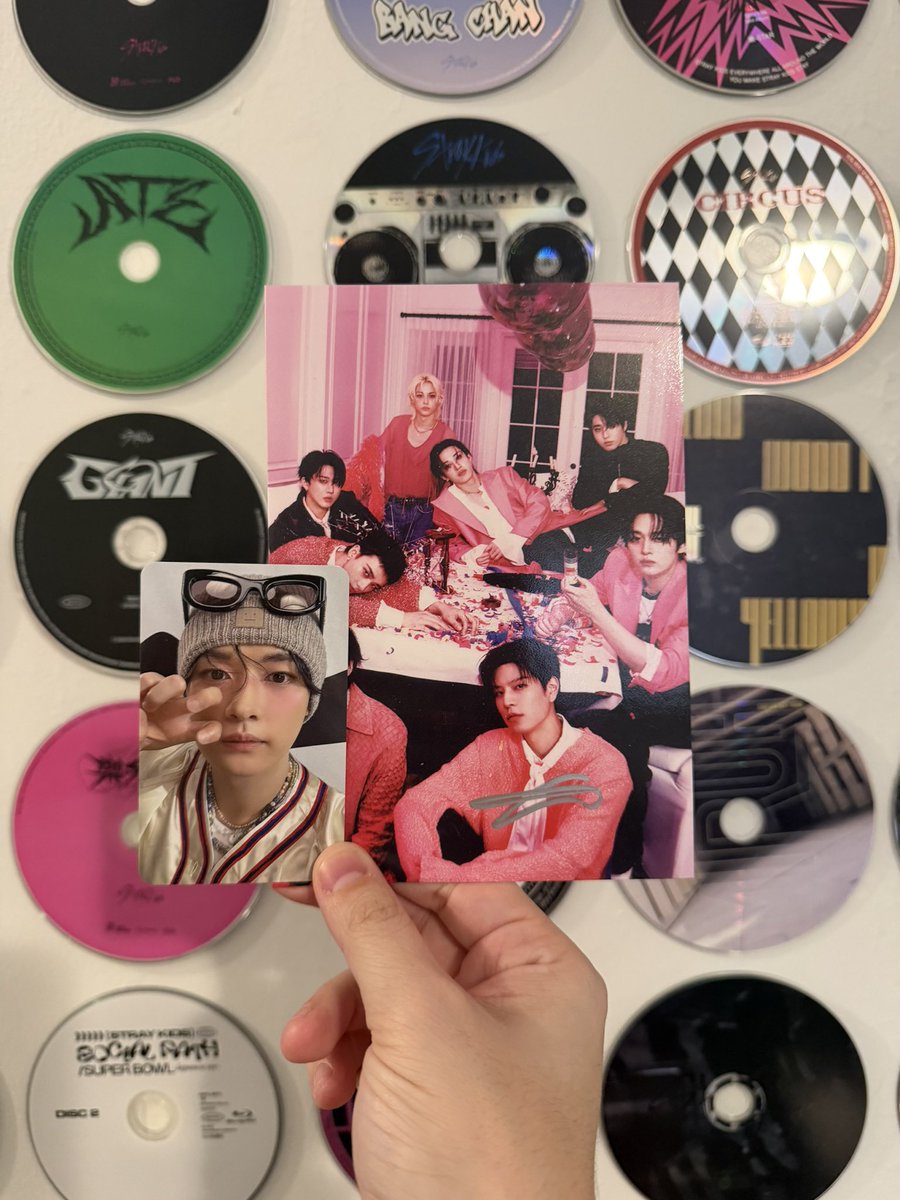
🐰 | LEE KNOW WW GIVEAWAY 🎉
🏆: LEE KNOW signed DO IT postcard, Lee Know Dominate merch POB
TO ENTER:
✅ Must be following (can unfollow after)
✅ Like & Retweet
⏰: ENDS April 13 12 PM EST
Ed Sullivan couldn't sing.
He couldn't dance. He wasn't charming. He stood stiff and awkward under the lights, spoke in a halting monotone, and always looked slightly uncomfortable in his own suit.
Critics said he had the warmth of a plank of wood. One reviewer wrote that "he got where he is not by having a personality, but by having no personality."
They missed the point entirely.
Ed Sullivan changed American culture more than almost anyone in television history. Not through talent. Through stubborn, unyielding decency.
The Ed Sullivan Show premiered on June 20, 1948, originally called Toast of the Town. It was a variety show—comics, acrobats, Broadway singers, opera, circus acts, music. Something for everyone.
And from the very beginning, Sullivan did something almost no one else on television would do.
He booked Black performers.
Not tucked away in "special" episodes. Not diminished or separated. They appeared alongside white performers, introduced the same way, treated exactly the same way.
This was 1948.
America was legally segregated. Interracial marriage was illegal in most states. Black Americans couldn't share schools, restaurants, water fountains, or theaters with white Americans.
And Ed Sullivan put Black excellence into American living rooms every Sunday night.
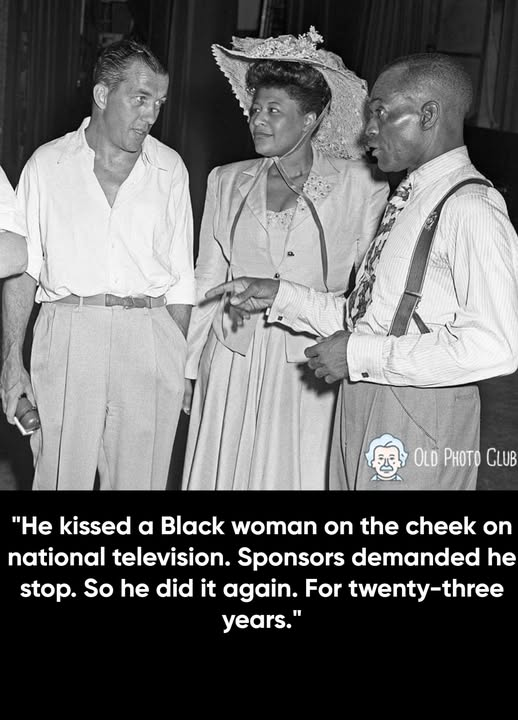
One week after the show premiered, Billy Kenny and the Ink Spots became the first Black performers on national television. On July 18, 1948—just the fifth episode—Sullivan paired Ella Fitzgerald with tap legend Bill "Bojangles" Robinson. She scatted. He danced. It was joy on display, broadcast into a divided nation.
Sullivan kept going.
Louis Armstrong. Nat King Cole. Pearl Bailey. Lena Horne. Duke Ellington. Count Basie. Sarah Vaughn. Sammy Davis Jr.
And he didn't keep his distance.
He shook hands. Kissed cheeks. Talked warmly on camera. Hugged them like friends—because they were his friends.
That basic humanity enraged sponsors.
When Sullivan kissed Pearl Bailey on the cheek, Southern sponsors exploded. When he shook Nat King Cole's hand, Ford's Lincoln-Mercury dealers threatened to pull their sponsorship and remove the show from the South entirely. Southern gas stations refused to serve customers who drove the Ford and Mercury cars Sullivan advertised.
Letters poured in accusing him of indecency.
One angry viewer wrote: "We enjoyed Ella Fitzgerald right up to when you had to make the point of hugging her right there in our living room!"
Sullivan's response? He booked them again.
He wrote angry letters back to bigots. He once said: "The most important thing is that we've put on everything but bigotry."
When the network warned him not to touch Coretta Scott King during her appearance, he embraced and kissed her anyway.
He didn't lecture America. He didn't call himself an activist.
He simply refused to participate in humiliation.
Week after week. Year after year. For twenty-three years.
In 1956, he introduced Elvis Presley—whose music was rooted in Black culture—into white living rooms. In 1964, he introduced The Beatles, launching a cultural earthquake.
But he never abandoned Black artists while elevating white ones.
James Brown. The Supremes. The Temptations. Stevie Wonder. The Jackson 5.
The soundtrack of integration played live on television.
Bill "Bojangles" Robinson, the legendary dancer who appeared with Ella Fitzgerald on that early 1948 episode, died penniless in 1949. Ed Sullivan paid for his funeral in Harlem.
Ella Fitzgerald appeared eight times over twenty-one years. She said of Sullivan: "His was one of the first shows that gave everybody a chance to be seen, and heard. And that was like a new beginning."
That was his power.
Black performers trusted him to treat them with dignity. White audiences trusted him enough to let him challenge their assumptions.
He used that trust quietly, carefully, relentlessly.
By the time the show ended in 1971, integrated television was normal.
But it wasn't inevitable.
It happened because one stiff, awkward man refused to segregate his stage.
Ed Sullivan wasn't flashy.
He wasn't cool.
He wasn't beloved for charisma.
He was decent.
And sometimes decency—practiced consistently, without compromise—changes everything.
🖤🩷| DO IT GIVEAWAY
🏆WINNER WILL RECEIVE:
DO IT POP UP SKZOO OF CHOICE.
(WW🌎) TO ENTER:
✅MUST BE FOLLOWING (can unfollow after)
✅ LIKE & RT
🗒️(I will be purchasing this for you, so please understand it is not currently on hand and I am not responsible should it get delayed etc. You will be provided with receipt of purchase and tracking information)
ENDS: 12/1
STRAY KIDS DO IT WW GIVEAWAY
both versions + target exclusive
winners will receive both versions of skz’s new album ‘DO IT’ including target exclusive.
✅- like and rt + tell me which song from the album you’re most excited for in the replies