Fan Bi (buy/ advise $5-50M brands in special sits)
@lifeofbi
Buying + advising distressed DTC/CPG brands ($5-50M). Capital stacks, lender negotiations, margin recovery. Host of In The Money. 1 deal/week in the newsletter.
If you're interested in:
🎧 Listening to some the most interesting $5m-$50m founders, operators, investors, acquirers, and lenders in the DTC and CPG space.
🔖 Reading about interesting M&A deals in the consumer products category.
👀 Seeing a proprietary deal a week from brands who want reach a broader audience of buyers.
Sign up for the link in bio.
Balenciaga just became the first fashion house to join Substack's native sponsorship program, alongside Uber, T-Mobile, Polymarket, and Whatnot, in a collective multi-million dollar push into the creator economy.
Programmatic newsletter advertising isn't new. But when someone pays $10/month to read a specific writer's analysis, that's deep trust in the writer's judgement.
That's what Balenciaga is paying for.
Instead of standard ad placements, the program funds high-quality content series, supports live events, and co-creates pieces spanning culture, design, and music.
This model already works in podcasting. Host-read podcast ads command a 3-5x premium over programmatic equivalents. Brands that understood this early built category leadership through that trust transfer.
Balenciaga is importing the podcast trust model into newsletters.
Millions of ad dollars flowing into a platform built on editorial independence will creator pressure on the thing that makes it valuable. If sponsorships compromise the independence, the premium multiple disappears.
Kim has SKIMS. $5B valuation.
Kylie has Kylie Cosmetics. Sold 51% to Coty for $600M.
Kourtney has Lemme. On track for $200M in 2026.
Kendall has 818 Tequila. Sold to Sazerac.
And then there's Khloé. She has demin brand, Good American, respected but never broke out.
Now she's flying with Khloud. $27M raised in the past year. K5 Global, Serena Ventures, WME, Shrug Capital, Springdale Ventures.
At Target: velocity running nearly double the standard popcorn category average.
At Walmart: 62% of Khloud buyers are entirely new to the premium popcorn category. Not stealing share. Creating demand.
At Starbucks: 13,600 locations. Paired with high-protein espresso drinks. Described internally as one of the most successful food partner launches.
29,000+ retail doors in under 14 months.
Now launching Protein Tortilla Chips on endcaps nationwide.
LesserEvil, the clean-label popcorn brand Hershey just paid $750M for on $165M in revenue, is already being outperformed by Khloud on Target velocity.
Is this going to be Khloé's big hit?!
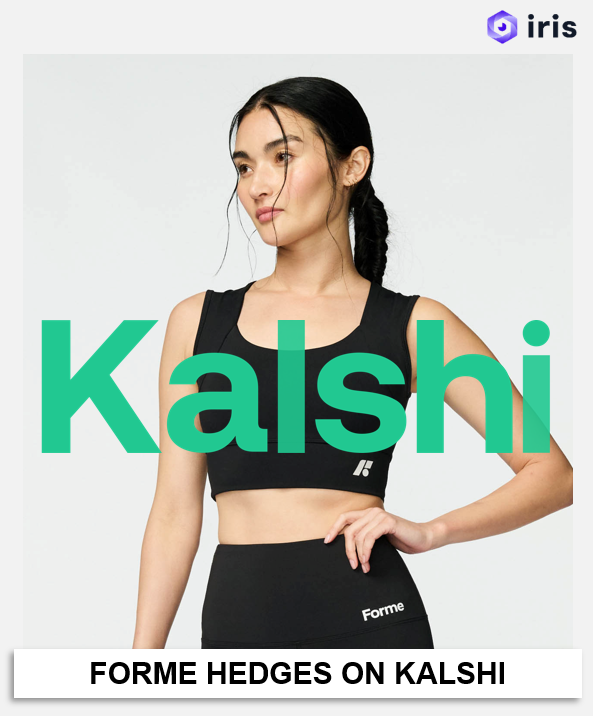
FORME SCIENCE BECOMES THE FIRST E-COM BRAND TO HEDGE RISK ON KALSHI
This one's clever from a financial engineering standpoint.
Forme, the posture/recovery wearables brand worn by olympians and celebrities, ran a promotion. If clients buy anything through June 30 with code TEAMUSA, and if Team USA reaches the World Cup Final, they get 100% cashback.
The promotion was hedged on Kalshi, and reframes promotional risk as a tradeable financial instrument. Instead of discounting (which erodes margin permanently and trains price sensitivity), Forme offered the chance of a full refund tied to a real-world outcome.
Morgan Zanotti walked into Whole Foods with a silver can. No final formula. No co-manufacturer.
Just a vision, a lot of charisma, and a prior $200M exit.
Whole Foods said yes. Nationwide.
She built the entire Waay brand in three months.
Before this, she built Primal Kitchen alongside Mark Sisson.
Mayonnaise. Salad dressings. Collagen bars. Avocado oil. Bootstrapped to $50M in revenue. Kraft Heinz acquired it in 2019.
She could have stopped there.
Instead she looked at the protein category, chalky, gritty, built for gym bros, and decided to build the drink she couldn't find on any shelf.
Clear. Fizzy. Sparkling protein water. For women.
🎧👇
When I lived in Sydney, I had one of these every day.
Rokeby Farms protein smoothie. 425ml. Grabbed from 7-Eleven on the way to the office.
286 calories. 30g protein. 27g carbs. 6.4g fat.
No added protein powder. No artificial sweeteners. No preservatives.
Danone just paid $1.5B for it.
Made Group, Melbourne-based, the group behind Rokeby: $325M+ revenue. $80M+ EBITDA. Consistent double-digit growth.
TPG bought it five years ago for ~$250M.
Sold for $1.5B. 6x return. EBITDA grew 5x in the same period.
This is Danone's second $1B+ protein acquisition in 90 days. In March, they bought Huel, the UK protein meal replacement brand for $1.2B.
A UK protein brand. An Australian protein brand. Both for $1B+. Who's next for Danone?
Reformation just filed its S-1. An entire category is watching, because the institutionally-funded fashion graveyard is getting full.
Reformation:
$507.1M revenue in 2025. Up 15.7%.
90% DTC. 1.1M active customers.
$422 revenue per customer. 80% full-price.
70 stores. 18% international.
20 consecutive quarters of double-digit growth.
Through COVID. Volatile CAC. Tariffs. They never missed a quarter.
But, profitability is going the wrong direction. Tariffs cited as the primary driver.
$32.6M net income in 2024 → $12.6M in 2025 → $12.1M net loss in Q1 2026.
Permira bought majority in 2019. Selling in the IPO.
Implied entry ~$250M. IPO target ~$1B. 4x over 7 years.
Solid. Not exceptional.
A whole category of brands is watching how this IPO gets priced.
12% of Americans are on GLP-1 medications. They eat 700 fewer calories per day, but need more protein to preserve muscle mass.
Nobody modelled what that would do to the whey protein market.
US whey protein isolate and concentrate: essentially unavailable for new buyers.
WP Concentrate: up 108% in two years.
WP Isolate: up 139%.
And it's just starting.
Patents on semaglutide, the active ingredient in Ozempic, are expiring in China, India, Brazil, and Turkey in 2026. Generic versions flooding those markets. Four countries representing 25% of the world's obese population.
If just 25% of obese people in those countries start GLP-1s and follow recommended protein protocols, the world needs an additional 3 million tons of whey protein.
But global annual production: 1.5-2 million tons.
The retail price shock is coming. Q1-Q2 2027.
The brands that survive will be the ones that locked in supply contracts, built relationships with alternative protein suppliers, and have the margin structure to absorb input costs without destroying consumer price points.
Ozempic changed how Americans eat, soon it's going to change how the world eats. And all of it is breaking the whey protein market.
In 2018, Melissa Snover dropped her bag of vitamins on the floor at Düsseldorf Airport. Seven bottles. Tablets rolling everywhere.
As a registered nutritionist, she knew she could build something better.
Three factories. 29 patents. £84M valuation.
Rem3dy Health just raised £14M from one of the most strategically curated investor bases I've seen.
- Suntory, Japanese wellness giant.
- Apollo Hospitals, India's largest hospital chain.
- UPSA, French pharmaceutical company.
- Estrella Galicia, Spanish brewing and retail conglomerate.
Each investor is simultaneously a financial backer and a distribution channel.
The product is a seven-layer 3D-printed gummy stack. Customer completes a questionnaire. Algorithm personalises from 10M+ configurations across 30+ ingredients. Printed on-demand in Birmingham. Shipped directly.
£10.2M in 2025 revenue. 61% growth.
Personalised supplements aren't a new idea.
Persona (Nestlé). Care/of (Bayer). Rem3dy personalises the actual product. Printed on-demand. Different for every customer.
Is that distinction enough to build a durable consumer brand at scale?
Steph Curry signed a $400M deal with Li-Ning.
Li-Ning merchandise is currently banned from sale in the United States.
The deal includes Curry Brand retail stores in America.
The brand manufacturing those products is legally prohibited from selling in America due to forced labor violations.
Either Curry Brand operates as a separate legal entity with a different supply chain. Or the deal includes a quiet bet that the regulatory environment shifts.
Either way, the US market isn't the real prize.
Li-Ning is gaining ground on Nike in China. The NBA is enormous there. Curry, two-time MVP, four-time champion, the man who changed how basketball is played, is one of the most recognised American athletes among 1.4B consumers.
The Way of Wade proved the model. Dwyane Wade built a cult sneaker phenomenon in China through Li-Ning. Jimmy Butler. Fred VanVleet. D'Angelo Russell. CJ McCollum. All Li-Ning athletes.
Curry is the institutional scale-up of that thesis.
At $400M, Li-Ning is betting it can build the Chinese equivalent of Jordan Brand.
When the market is 1.4B basketball-obsessed consumers, compliance headaches in Washington become a localised speed bump. Curry gets his lifetime deal. Li-Ning gets their flagship icon.
Three months ago I stood outside the Grand Palais in Paris and watched HYROX take over one of the most prestigious venues in the world.
18,000 athletes. Sled pushes under Europe's largest glass roof.
L Catterton is now in exclusive talks to acquire a major stake. Valuation: ~€1B.
€40M revenue in 2023. €140M in 2025. €200M+ projected in 2026.
The event revenue is only the beginning.
13,000 affiliated training clubs. PUMA partnership. Centr digital coaching. Amazfit 3-year wearable exclusive. Merchandise. Subscriptions.
Health is the new luxury. And the HYROX city badge is the ultimate status symbol.
To finish HYROX you need months of training. A premium gym and a nutrition protocol. Disposable income to travel to Berlin, London, Dubai, Paris for a race weekend. The physical capacity to run 8km and push a sled at race intensity without stopping.
Every major luxury brand is trying to buy access to this consumer.
Who understands that consumer better than LVMH's own investment arm.
Private members clubs are back. But not your grandfather's kind. No golf. No wood panelling. No old money.
Think ... Cold plunges. Saunas. Hyperbaric oxygen. Rooftop pools. Podcast studios. Art galleries. Coworking. All in one building. $500/month. Invite only.
The Portal just raised $5M for exactly this in Austin. Bathhouse has $41M from Imaginary Ventures and two 35,000 sq ft thermal wellness palaces in NYC. Remedy Place. The Well. NeueHouse. SIRO. A dozen more opening or fundraising right now.
The Portal sold out its Marin membership before the building was even finished.
The old third place was the coffee shop or the bar. The new third place is somewhere you can cold plunge, have a real conversation, work for three hours, eat well, and catch a live set, without leaving the building.
I think the private wellness club is the most interesting category in consumer experiential right now.
Fashion and apparel fundraises have been scarce for five years.
Allbirds. Everlane. Outdoor Voices. A generation of DTC apparel brands burning through $1B+ of capital with little to show for it.
So when a $50M apparel round lands, it's worth digging in.
CHAMP, the $500M athlete co-ownership fund launched by L Catterton and Patricof in April, just made its first investment.
$50M minority stake in Rhoback.
In 2016, three UVA business school friends started selling performance polos from a wooden camper van.
Ten years later: $150M in revenue. Profitable since day one. Completely bootstrapped.
Rhoback leaned into NIL from day one. Those college athletes are now professional superstars.
Joe Burrow, Dak Prescott, Tyrese Haliburton, Ja'Marr Chase are now co-owners through CHAMP.
CHAMP aggregates 250 professional athletes into a single distribution engine, a network of exactly the consumer Rhoback is built for.
How they harness it will be one of the more interesting brand stories of the next few years.
Two co-founders, one product.
Mid-seven figures, profitable, cash flow positive. Growing quickly.
Ohsun hydration is a great example of a DTC founding team.
One co-founder, Jack Atkinson, handles everything top of funnel; seeding, creators, photography, video.
One co-founder, Joe Welstead, handles everything below it; Meta, Shopify, Skio, Klaviyo.
75-90% of the founders efforts on growth. One part-time ops and finance person.
Maybe the most amazing part is Joe taught himself media buying at Oshun. He came onto the pod to talk all about it.
🎧👇
I walked into Le Labo on 203 Rue Saint-Honoré last week.
One of the most prestigious retail addresses in Paris.
Walked out empty handed.
$298 for 100ml of Santal 33. $398 for the Paris City Exclusive, Vanille 44. $895 for the 500ml decant.
Priced me out.
But I wanted to understand the business behind the brand.
Founded 2006 in New York by two French expats who left Giorgio Armani fragrances.
Their thesis: every bottle blended fresh, in store, at point of purchase, with your name and the date on the label.
Estée Lauder bought it in 2014 for ~$60M. A niche New York fragrance boutique. Seemed reasonable at the time.
Today Le Labo likely generates ~$600M in annual revenue.
Drives ELC's entire luxury fragrance business. #1 in Japan. Leading share gains in China and the US. First brand named in virtually every ELC earnings call.
Their City Exclusive model is a novel retail strategy in a growingly global luxury world.
Every major city has a fragrance available only there. Kyoto's Osmanthus 19. New York's Tubereuse 40. Paris's Vanille 44.
A reason to visit every store in every city you go to. Geographic scarcity that feels completely authentic.
Ok fine.
If this post reaches 10k views, the distribution it generates gets me over the hump on the $298 bottle.
Le Labo's economics of scarcity meets the economics of content attention.
Let's go!
Allbirds raised ~$350M. Peak valuation: $4.6B. Sold for $39M.
Almost single-handedly closed VC funding for footwear brands.
Brunt Workwear is about to reopen it.
Built for the 17 million tradespeople in construction, installation, maintenance, and repair across the US.
The consumer the challenger brand wave entirely ignored.
Brunt spoke to them.
$44M raised from Stripes, the firm behind On Running, Reformation, Erewhon. ~$250M in revenue. Profitable.
Now exploring a sale at $1B+ valuation.
There's also a broader cultural movement toward workwear.
Carhartt went from workwear to streetwear to luxury resale. Dickies appears in Supreme collaborations. Timberland boots are fashion.
VF Corporation needs a contemporary workwear challenger alongside Timberland and Dickies. Wolverine World Wide is watching its legacy workwear starve for digital community. Deckers, behind Hoka and UGG, knows exactly how to scale a hyper-focused category leader into a global lifestyle brand.
That cultural crossover is exactly what would drive the $1B+ institutional interest.
Authentic Brands Group is one of my favorite companies to write about.
The business model is genuinely one of the most intellectually interesting in consumer.
ABG acquires the IP of brands past their peak. Licenses that IP to operators who bear almost all the risk. Collects royalties. Never touches a physical product.
The result: 70%+ EBITDA margins. 800+ licensees globally. $38B in annual systemwide retail sales. 29,000+ stores. 450 employees.
The company owns Reebok, Guess, Champion, Brooks Brothers, Forever 21, Nautica, Nine West, Juicy Couture, Marilyn Monroe, Elvis Presley, Muhammad Ali, Sports Illustrated, and Kevin Hart's IP.
Second largest licensor globally after Disney.
$14.5B raised from BlackRock, General Atlantic, Leonard Green, Qatar Investment Authority, Temasek.
Revenue: $750M+.
Founder, Jamie Salter, confirmed ABG is going public within 12 months. It'll be the third attempt. Filed in 2021. Explored again in 2024.
When the S-1 drops, for the first time, ABG will need to disclose:
- Individual brand licensing revenue.
- Licensee contract terms and renewal rates.
- The rate of decay on legacy brands.
- How they model brand value accretion versus depreciation.
The model works as long as brands retain enough cultural residue to generate licensee demand. The moment a brand falls below the recognition threshold, licensing fees compress toward zero.