Jony Ive: Using touchscreens for basic car controls is a 'dumb design' that endangers lives.
"People are dying because of dumb design."
"Multi-touch shouldn't be in a car. It requires by definition that you're looking at a display."
When the man who popularized the touchscreen admits putting an iPad in your dashboard is a deadly mistake, automakers must listen.
I grew up in cars with analog switches, and I miss them. You could operate the radio or the climate control by pure muscle memory while keeping your eyes on the road.
Now, the data backs up that everyday frustration. A University of Washington study proves touchscreens cause lane drifting. Starting in 2026, Euro NCAP will actually strip 5-star safety ratings from cars that refuse to use physical buttons for basic controls.
We sacrificed safe, intuitive hardware for flat screens. It is time to bring the buttons back.
Source: Cleo Abram
LEAKED AUDIO: In an all-hands meeting on April 30, Mark Zuckerberg tells employees that he's training AI on them ahead of mass layoffs.
"The AI models learn from watching really smart people do things... The average intelligence of the people who are at this company is significantly higher than the average set of people that you can get to do tasks.
So if we're trying to teach the models coding, for example, then having people internally build tools or solve tasks that help teach the model how to code, we think is going to dramatically increase our model's coding ability faster than what others in the industry have the capability to do, who don't have thousands and thousands of extremely strong engineers at their company."
No me explico cómo este artículo no tiene miles de retuits (posiblemente porque es muy largo).
Es la reflexión más realista, preclara, y útil sobre la creación de valor con IA, que he leído en los últimos meses.
Muy de acuerdo con su tesis:
Trettitre just unveiled the TTT Series, a wall-mounted audio system for vinyl, CDs, and cassettes.
The players snap onto a magnetic rack and charge wirelessly from one USB-C cable.
The turntable has a self-balancing tonearm, built-in phono preamp, and ambient light panel.
@JaimeObregon Puedes disfrutar también de la web del Colegio de Registradores. Ayer, para pedir una nota simple, no conseguí autenticarme con certificado. Sólo por Cl@ve.
Y en el formulario, pedían teléfono fijo como campo obligatorio!!! jajaja https://t.co/aAsa4HluqY
Esta semana otra persona del equipo ha presentado la carta de renuncia. Le ha surgido una oportunidad que es irrechazable. De las que viviendo en la isla y dedicándote a lo nuestro no puedes decir que no. Me alegro por la persona.
There will be no AI jobpocalypse.
The story that AI will lead to massive unemployment is stoking unnecessary fear. AI — like any other technology — does affect jobs, but telling overblown stories of large-scale unemployment is irresponsible and damaging. Let’s put a stop to it.
I’ve expressed skepticism about the jobpocalypse in previous posts. I’m glad to see that the popular press is now pushing back on this narrative. The image below features some recent headlines.
Software engineering is the sector most affected by AI tools, as coding agents race ahead. Yet hiring of software engineers remains strong! So while there are examples of AI taking away jobs, the trends strongly suggest the net job creation is vastly greater than the job destruction — just like earlier waves of technology. Further, despite all the exciting progress in AI, the U.S. unemployment rate remains a healthy 4.3%.
Why is the AI jobpocalypse narrative so popular? For one thing, frontier AI labs have a strong incentive to tell stories that make AI technology sound more powerful. At their most extreme, they promote science-fiction scenarios of AI “taking over” and causing human extinction. If a technology can replace many employees, surely that technology must be very valuable!
Also, a lot of SaaS software companies charge around $100-$1000 per user/year. But if an AI company can replace an employee who makes $100,000 — or make them 50% more productive — then charging even $10,000 starts to look reasonable. By anchoring not to typical SaaS prices but to salaries of employees, AI companies can charge a lot more.
Additionally, businesses have a strong incentive to talk about layoffs as if they were caused by AI. After all, talking about how they’re using AI to be far more productive with fewer staff makes them look smart. This is a better message than admitting they overhired during the pandemic when capital was abundant due to low interest rates and a massive government financial stimulus.
To be clear, I recognize that AI is causing a lot of people’s work to change. This is hard. This is stressful. (And to some, it can be fun.) I empathize with everyone affected. At the same time, this is very different from predicting a collapse of the job market.
Societies are capable of telling themselves stories for years that have little basis in reality and lead to poor society-wide decision making. For example, fears over nuclear plant safety led to under-investment in nuclear power. Fears of the “population bomb” in the 1960s led countries to implement harsh policies to reduce their populations. And worries about dietary fat led governments to promote unhealthy high-sugar diets for decades.
Now that mainstream media is openly skeptical about the jobpocalypse, I hope these stories will start to lose their teeth (much like fears of AI-driven human extinction have).
Contrary to the predictions of an AI jobpocalypse, I predict the opposite: There will be an AI jobapalooza! AI will lead to a lot more good AI engineering jobs, and I’m also optimistic about the future of the overall job market. What AI engineers do will be different from traditional software engineering, and many of these jobs will be in businesses other than traditional large employers of developers. In non-AI roles, too, the skills needed will change because of AI. That makes this a good time to encourage more people to become proficient in AI, and make sure they’re ready for the different but plentiful jobs of the future!
[Original text in The Batch newsletter.]
The reason most stuff you watch on Netflix is forgettable is because you aren’t doing any work.
When you watch a movie, you are given all the visuals. The soundtrack even clues you into how you should feel in each scene.
But as Life of Pi author Yann Martel shares, this form of kidnapping makes for forgettable stories:
“I binge watch Netflix like anyone. But when they supply too little for you to imagine on your own and they give you everything, they’re forgettable. You haven’t worked enough for it.
Which is why books can be so powerful because it leaves so much for your imagination. A movie doesn’t do that.
The more you withdraw, the more the reader has to come halfway. They like being engaged in co-creating the story.”
Your tattoo isn’t just decorative ink: it’s a permanent trigger that keeps your immune system locked in a lifelong cycle of chronic inflammation.
As soon as the ink is injected into your skin, your body recognizes the pigment particles as foreign invaders. Immune cells called macrophages immediately swarm the area and attempt to swallow them up. But because they can’t actually break down the ink, the macrophages eventually die, releasing the pigment back into the surrounding tissue — only for a new wave of macrophages to arrive and repeat the process.
This endless cycle is what keeps the tattoo permanently visible, while also maintaining a state of ongoing, low-level inflammation in the skin.
Over time, some of these ink particles migrate through the lymphatic system and accumulate in the lymph nodes, placing constant stress on the body’s defense mechanisms. Emerging research suggests this internal ink buildup may interfere with normal immune function, potentially reducing the effectiveness of certain vaccines, including mRNA types. Additionally, many tattoo inks contain heavy metals like nickel and cobalt. Combined with the chronic inflammation, this has been linked to a modestly elevated risk of lymphoma and skin cancer.
While tattoos remain a powerful form of self-expression, they represent a complex, decades-long biological conflict between your immune system and foreign substances embedded in your skin.
[Nielsen, C., Jerkeman, M., & Jöud, A. S. (2024). Tattoos as a risk factor for systemic lymphoma: A population-based case-control study. eClinicalMedicine]
The only people who believe any of this are non-coders.
I tried to build a game (an area I’m an n00b in.) The results are amusingly disastrous - I never before coded a decent game.
But I’ll crack out backend services w AI rapidly - because I coded dozens of them before…
Muy interesante.
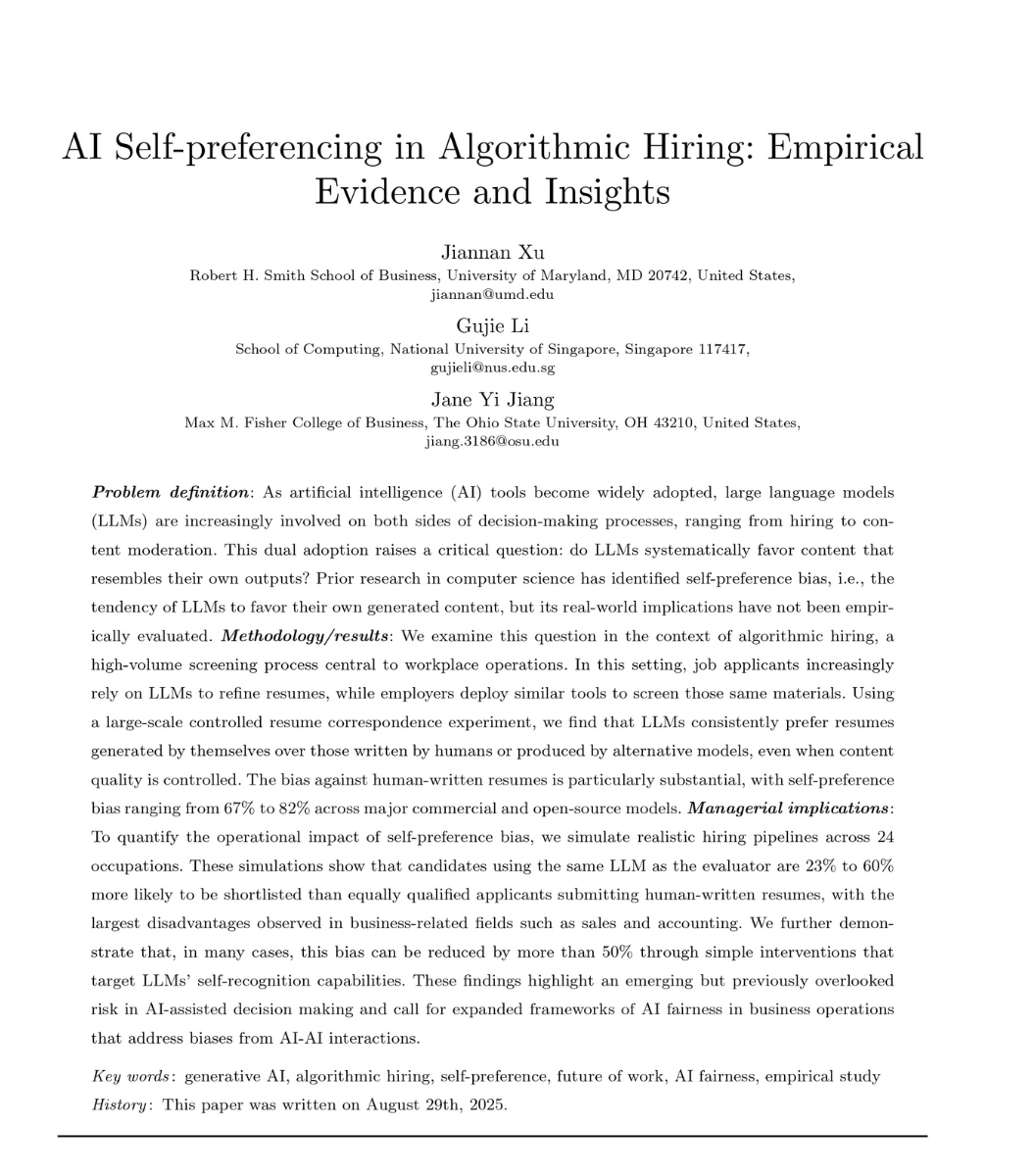
Resulta que los distintos modelos de IA tienen preferencia por el contenido que ellos mismos generan.
O al menos eso pasa con los curriculums…
Researchers sent the same resume to an AI hiring tool twice. Same qualifications. Same experience. Same skills. One version was written by a real human. The other was rewritten by ChatGPT.
The AI picked the ChatGPT version 97.6% of the time.
A team from the University of Maryland, the National University of Singapore, and Ohio State just published the receipt. They took 2,245 real human-written resumes pulled from a professional resume site from before ChatGPT existed, so the human writing was actually human. Then they had seven of the most-used AI models in the world rewrite each one. GPT-4o. GPT-4o-mini. GPT-4-turbo. LLaMA 3.3-70B. Qwen 2.5-72B. DeepSeek-V3. Mistral-7B.
Then they asked each AI to pick the better resume. Every model picked itself.
GPT-4o hit 97.6%. LLaMA-3.3-70B hit 96.3%. Qwen-2.5-72B hit 95.9%. DeepSeek-V3 hit 95.5%. The real human almost never won.
Then the researchers tried the obvious objection. Maybe the AI is just better at writing. So they had real humans grade the resumes for actual quality and ran the experiment again, controlling for it. The result was worse. Each AI kept picking itself even when human judges rated the human-written version as clearer, more coherent, and more effective.
It gets worse. The AIs do not just prefer AI over humans. They prefer themselves over other AIs. DeepSeek-V3 picked its own resumes 69% more often than LLaMA's. GPT-4o picked its own 45% more often than LLaMA's. Each model can recognize and reward its own dialect.
Then the researchers ran the simulation that ends careers. Same job. 24 occupations. Same qualifications. The only variable was whether the candidate used the same AI as the screening tool. Candidates using that AI were 23% to 60% more likely to be shortlisted. Worst gap was in sales, accounting, and finance.
99% of large companies now run AI on incoming resumes. Most of them use GPT-4o. The paper just proved GPT-4o picks GPT-4o 97.6% of the time.
If you wrote your own cover letter this week, you did not lose to a better candidate. You lost to a worse candidate who paid OpenAI 20 dollars.
Your qualifications do not matter if the AI prefers its own handwriting over yours.
There is massive irony in how AI coding tools are starting to become TOO expensive for many enterprises - after eg Anthropic removed subsidizing AI subscriptions.
We might go from "everyone use AI for everything!" to "you have $300/month AI budget; use your brain for the rest."
@PabloGrueso@DrywellCapital Y creo que, cualquiera que piense que todos podemos hacernos nuestro propio ERP, CRM, PIM o SGA con la IA, y mantenerlo, y asegurar el cumplimiento normativo, y hacerlo interoperable con terceros, y mil cosas más, o está simplificando mucho el discurso, o no sabe de lo que habla.
@PabloGrueso@DrywellCapital La cotización en bolsa no es más que el valor de un activo multiplicado por la expectativa de ese producto en el futuro.
Y esa expectativa es pura narración. Un Pitch Deck en Power Point.
Y en ese Pitch Deck, alguien ha escrito que todos construiremos nuestro propio Salesforce.





![AndrewYNg's tweet photo. There will be no AI jobpocalypse.
The story that AI will lead to massive unemployment is stoking unnecessary fear. AI — like any other technology — does affect jobs, but telling overblown stories of large-scale unemployment is irresponsible and damaging. Let’s put a stop to it.
I’ve expressed skepticism about the jobpocalypse in previous posts. I’m glad to see that the popular press is now pushing back on this narrative. The image below features some recent headlines.
Software engineering is the sector most affected by AI tools, as coding agents race ahead. Yet hiring of software engineers remains strong! So while there are examples of AI taking away jobs, the trends strongly suggest the net job creation is vastly greater than the job destruction — just like earlier waves of technology. Further, despite all the exciting progress in AI, the U.S. unemployment rate remains a healthy 4.3%.
Why is the AI jobpocalypse narrative so popular? For one thing, frontier AI labs have a strong incentive to tell stories that make AI technology sound more powerful. At their most extreme, they promote science-fiction scenarios of AI “taking over” and causing human extinction. If a technology can replace many employees, surely that technology must be very valuable!
Also, a lot of SaaS software companies charge around $100-$1000 per user/year. But if an AI company can replace an employee who makes $100,000 — or make them 50% more productive — then charging even $10,000 starts to look reasonable. By anchoring not to typical SaaS prices but to salaries of employees, AI companies can charge a lot more.
Additionally, businesses have a strong incentive to talk about layoffs as if they were caused by AI. After all, talking about how they’re using AI to be far more productive with fewer staff makes them look smart. This is a better message than admitting they overhired during the pandemic when capital was abundant due to low interest rates and a massive government financial stimulus.
To be clear, I recognize that AI is causing a lot of people’s work to change. This is hard. This is stressful. (And to some, it can be fun.) I empathize with everyone affected. At the same time, this is very different from predicting a collapse of the job market.
Societies are capable of telling themselves stories for years that have little basis in reality and lead to poor society-wide decision making. For example, fears over nuclear plant safety led to under-investment in nuclear power. Fears of the “population bomb” in the 1960s led countries to implement harsh policies to reduce their populations. And worries about dietary fat led governments to promote unhealthy high-sugar diets for decades.
Now that mainstream media is openly skeptical about the jobpocalypse, I hope these stories will start to lose their teeth (much like fears of AI-driven human extinction have).
Contrary to the predictions of an AI jobpocalypse, I predict the opposite: There will be an AI jobapalooza! AI will lead to a lot more good AI engineering jobs, and I’m also optimistic about the future of the overall job market. What AI engineers do will be different from traditional software engineering, and many of these jobs will be in businesses other than traditional large employers of developers. In non-AI roles, too, the skills needed will change because of AI. That makes this a good time to encourage more people to become proficient in AI, and make sure they’re ready for the different but plentiful jobs of the future!
[Original text in The Batch newsletter.]](https://pbs.twimg.com/media/HIIb1VGaUAAZoAB.jpg)
![Rainmaker1973's tweet photo. Your tattoo isn’t just decorative ink: it’s a permanent trigger that keeps your immune system locked in a lifelong cycle of chronic inflammation.
As soon as the ink is injected into your skin, your body recognizes the pigment particles as foreign invaders. Immune cells called macrophages immediately swarm the area and attempt to swallow them up. But because they can’t actually break down the ink, the macrophages eventually die, releasing the pigment back into the surrounding tissue — only for a new wave of macrophages to arrive and repeat the process.
This endless cycle is what keeps the tattoo permanently visible, while also maintaining a state of ongoing, low-level inflammation in the skin.
Over time, some of these ink particles migrate through the lymphatic system and accumulate in the lymph nodes, placing constant stress on the body’s defense mechanisms. Emerging research suggests this internal ink buildup may interfere with normal immune function, potentially reducing the effectiveness of certain vaccines, including mRNA types. Additionally, many tattoo inks contain heavy metals like nickel and cobalt. Combined with the chronic inflammation, this has been linked to a modestly elevated risk of lymphoma and skin cancer.
While tattoos remain a powerful form of self-expression, they represent a complex, decades-long biological conflict between your immune system and foreign substances embedded in your skin.
[Nielsen, C., Jerkeman, M., & Jöud, A. S. (2024). Tattoos as a risk factor for systemic lymphoma: A population-based case-control study. eClinicalMedicine]](https://pbs.twimg.com/media/HHfNpsmXYAAlrGO.jpg)