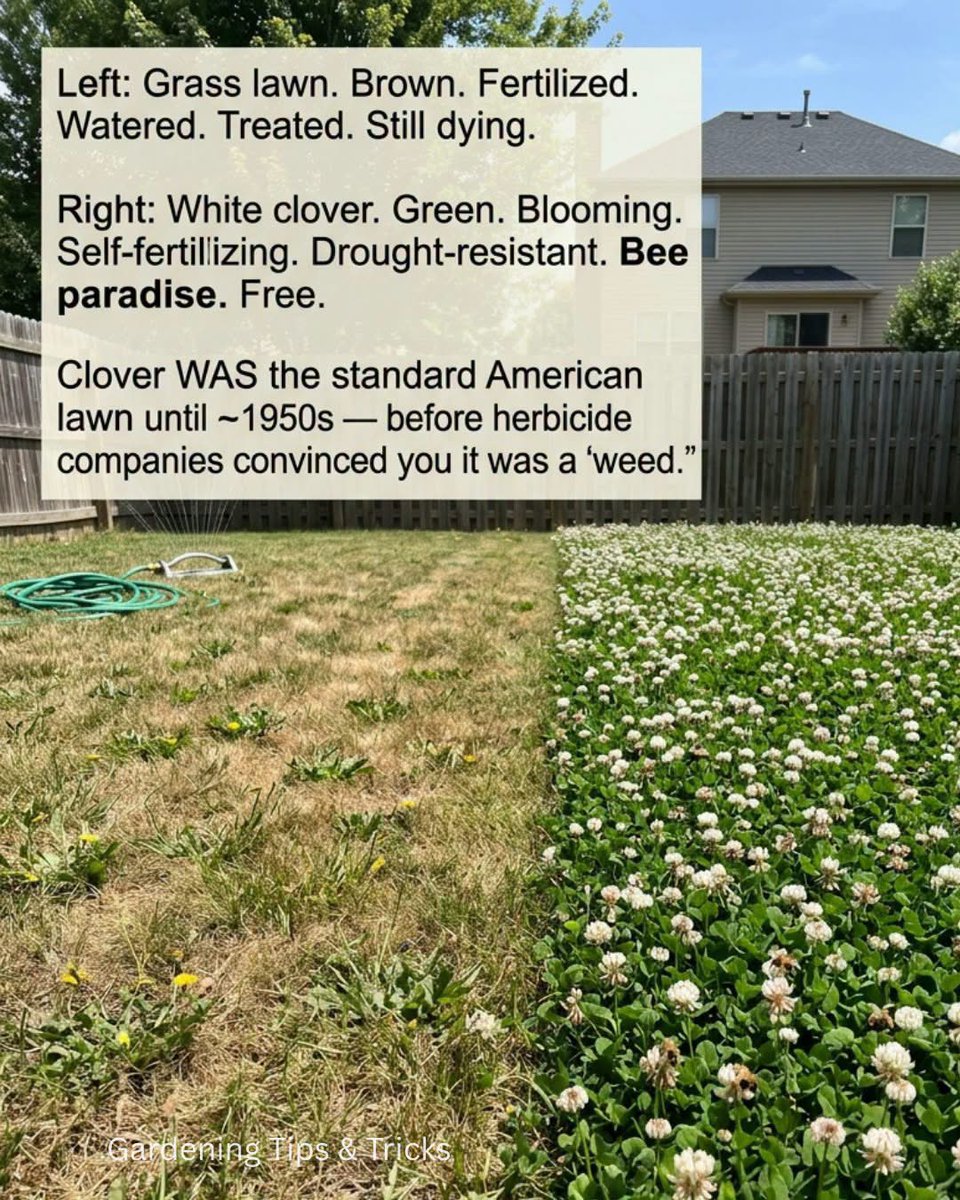
Before the 1950s, clover was a STANDARD component of American lawns.
Seed mixes included it on purpose.
Then broadleaf herbicides were invented.
They killed clover along with "weeds." So the chemical companies rebranded clover as a weed — to sell more herbicide.
That's it. That's the whole story.
Clover is not a weed. It's the future of your lawn.
White Dutch clover (Trifolium repens):
Self-fertilizing — fixes nitrogen from the air into the soil. No fertilizer needed. EVER.
…and it feeds the grass around it for free.
Drought-resistant — stays green when grass goes brown.
Bee paradise — constant blooms from May to frost.
Chokes out weeds — dense growth shades out weed seeds.
No mowing needed (stays 4-6 inches) — or mow monthly.
Soft underfoot — kids love it.
Costs $5-10 to overseed 1,000 sq ft.
How to add clover to your existing lawn:
Overseed in spring or fall.
Scatter seed (2 oz per 1,000 sq ft).
Water lightly for 2 weeks. Done.
Stop using broadleaf herbicides (they kill clover).
Stop fertilizing (clover makes its own).
Mow at 3-4 inches.
The lawn industry told you clover was a weed so they could sell you chemicals.
Take your lawn back.
In 1981, The Cannonball Run (45 today) hijacked the 20th Century Fox logo, turning it into a tiny car chase capped by Burt Reynolds’ legendary laugh. This gag is missing from many home releases/TV airings. I've also tacked on the intro… for THAT 1979 Lamborghini Countach.
@Chicago_Goofies 🤣 our mayor is trying to get an American flag in every yard for 250 July 4. The town center is lined 🇺🇲🇺🇲🇺🇲🇺🇲🇺🇲🇺🇲🇺🇲🇺🇲🇺🇲🇺🇲🇺🇲🇺🇲🇺🇲🇺🇲🇺🇲🇺🇲🇺🇲🇺🇲🇺🇲🇺🇲🇺🇲🇺🇲🇺🇲🇺🇲🇺🇲🇺🇲🇺🇲🇺🇲🇺🇲🇺🇲🇺🇲🇺🇲🇺🇲🇺🇲🇺🇲🇺🇲🇺🇲🇺🇲🇺🇲🇺🇲🇺🇲🇺🇲🇺🇲🇺🇲🇺🇲🇺🇲🇺🇲🇺🇲🇺🇲🇺🇲🇺🇲🇺🇲🇺🇲🇺🇲🇺🇲🇺🇲🇺🇲🇺🇲🇺🇲🇺🇲🇺🇲🇺🇲🇺🇲🇺🇲🇺🇲🇺🇲🇺🇲🇺🇲🇺🇲🇺🇲🇺🇲🇺🇲🇺🇲
Workers dredging the Savannah River expected to find mud, but instead uncovered 19 massive cannons that had been hidden beneath the water since the American Revolutionary War.
Recovered between 2021 and 2022, the weapons each weighed more than 1,000 pounds and had rested on the riverbed for nearly 250 years. Some were still loaded, suggesting they sank with a British ship deliberately scuttled in 1779 to block the advancing French fleet during the Siege of Savannah.
After years of conservation at Texas A&M, 17 restored cannons will go on public display for the first time on July 2, 2026, offering one of the most remarkable Revolutionary War discoveries ever made in Georgia and preserving a forgotten chapter of American history.
Credit: Savannah District, U.S. Army Corps of Engineers
Ladies - let me know if any of you are interested in the completely natural skin care routine I’ve put together after lots of intense study and research. These products are all from local small businesses that ship - and I’ve been using these products for 6 months now and I’m thrilled to recommend them.
I love supporting small businesses who care about their ingredients. This isn’t sponsored I just feel like if people are interested they should know.
Ice cream is actually one of the healthiest foods in existence, judging by a multitude of recent research articles.
There was a very highly publicized article that came out in 2018 out of Harvard.
It was for a student's dissertation, he found that ice cream was inversely associated with heart disease.
The nutrition department and the student himself tried repeatedly to "make the association go away" with different analysis, and checking his work.
But it didn't.
Not only was ice cream reported as beneficial,
it was actually one of the most beneficial dairy products analyzed.
With up to a 12% reduction in heart disease risk for having >2 servings of ice cream per week.
This wasn't the first study to find benefits of ice cream, and it also wasn't the last.
In a 2013 meta analysis of studies, they also found a protective effect of ice cream on diabetes.
You can see the bias against ice cream, as they don't even mention it in the main page.
That's despite ice cream showing one of the BEST results of any food studied for diabetes risk.
Another study from 2014 showed the same thing.
Again, this is a meta analysis, not just one study. They are pooling together all of the studies on ice cream and diabetes and still finding this.
The best result of any dairy food studied - here with a 32% reduction in diabetes risk.
The bias against ice cream is very strong in these studies.
A 2016 study once again showing the same benefit of ice cream for diabetes risk.
They say that the study above (Chen et al) showed "attenuated association" once diet collection information was stopped after hypertension or high cholesterol diagnosis.
They argue that this means that the association is invalid.
But not only did they not try to dismiss any other food studied like this, but this is just objectively not true (see above - there still was an association).
They also buried their results on ice cream in the supplementary tables so it didn't even make the paper.
That's probably because they didn't like the fact that once again, ice cream intake was inversely and strongly associated with diabetes risk.
So you really can't argue that there was some kind of agenda in favor of ice cream here.
More recent studies show the same thing.
A 2019 paper again showed a lower risk of diabetes with increased ice cream consumption.
And again, they put this information at the very end in the supplementary tables to try to hide it.
Finally, the most recent study in 2024 showed the STRONGEST association for ice cream's protective effect on diabetes.
There was a linear dose response.
That means more ice cream = less diabetes, straight up.
In fact, there was a 50% reduction in risk for having one serving per day.
Which, as you could guess by this point, was the greatest risk reduction of any dairy food studied.
Why would ice cream actually be good for you?
My main guess is the unique protective fats in dairy, that are abundant in ice cream.
◇ C15
◇ C17
◇ CLA
◇ TVA
◇ TPA
are fats almost exclusively in dairy fat, and all have unique effects.
◇ Mitochondrial enhancing
◇ Anti-inflammatory
◇ Anti-thrombotic
◇ Lipid lowering
◇ Fat burning
◇ Cancer preventing
I've covered these all at length in other content.
Of course, this is all observational.
This is simply seeing what people eat and then seeing what happens to them. It's not an experiment. That is definitely a limitation.
However, when you see the same association, consistently, across decades, regardless of analysis and confounding adjustment, you probably have something real.
This is not to say everyone should go and immediately pound gallons of ice cream for invincibility.
But... it does mean having reasonable amounts of ice cream is likely good for you.
10 WEBSITES THAT FEEL TOO USEFUL TO BE FREE
Bookmark every single one. No account, no trial, no card. Things people sell for a monthly fee, given away for $0.
1. https://t.co/9cyeoKnX8i
Type any math, physics, chemistry, or engineering problem and it solves it step by step, showing the full working. A private tutor for every hard subject, available at 3am, that never gets tired of your questions.
2. https://t.co/H9kXt5PCWy
The entire Photoshop, running in a browser tab. Opens PSD files, handles layers, masks, and smart objects, and processes everything on your own machine so nothing uploads. Adobe charges around $55 a month for this. Photopea charges nothing.
3. https://t.co/pMoKsL8s49
64 million books and 95 million research papers in one search box. Publishers won a $322 million judgment against it and seized its main domains this year. It moved to a new one and kept growing. The largest library in human history, and it refuses to die.
4. https://t.co/q9HgaQ5tL2
An AI search engine across 200 million academic papers. Ask a question and it pulls the relevant studies, the citations, and a plain summary of each. Researchers used to pay for tools that did a fraction of this.
5. https://t.co/r1VQAr12Zt
Open a blank canvas and sketch diagrams, flowcharts, and wireframes that look hand-drawn. Real-time collaboration, no login, nothing saved to a server unless you want it. Whiteboard apps charge teams monthly for less.
6. https://t.co/x17FIF83h0
A search engine for 200,000+ free courses from Harvard, Stanford, MIT, and Yale. It finds the free version of almost any course and tells you which ones are actually worth your time. The catalog universities never hand you.
7. https://t.co/fUutjW9qEm
Drop in any photo and it erases the background in two seconds. Designers used to charge per image for this and agencies built whole workflows around it. Now it's a single upload.
8. https://t.co/U3XuyKNhPg
Build and test any regular expression with a live explanation of every piece as you type. The thing that makes grown engineers cry, turned into a tool that teaches you while you use it. Free forever.
9. https://t.co/4kHtgwM9V4
Tick the apps you want on a new Windows machine, download one installer, and it silently installs all of them with no toolbars and no next-next-finish. IT departments pay for software that does exactly this.
10. https://t.co/Ud9gPh3xn1
The entire history of the internet, plus millions of free books, films, concerts, and old software you can run in your browser. The Wayback Machine alone has saved over 900 billion web pages. A civilization's memory, open to anyone.
Free was always the default. You just got trained to pay.
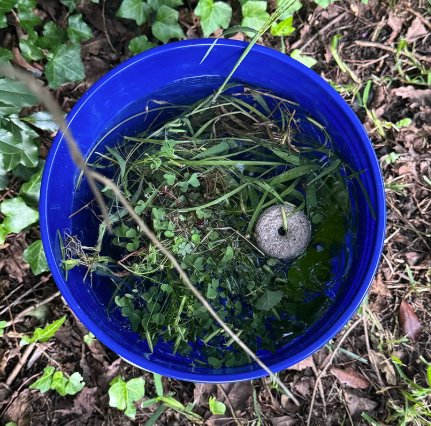
You can crash your yard's mosquito population without spraying a single chemical with a Mosquito Bucket of Doom.
Fill a 5-gallon bucket about two-thirds with water. Drop in a handful of grass clippings, leaves, or hay. Let it sit for a day, then drop in a Bti dunk (also called Bacillus thuringiensis israelensis, sold at any hardware store as "mosquito dunks," about $10 for six).
Mosquitoes are powerfully attracted to fermenting water and will lay their eggs in your bucket. Bti is a naturally occurring soil bacterium that produces a toxin that kills mosquito, blackfly, and fungus gnat larvae only.
This method doesn't harm bees, butterflies, fireflies, fish, frogs, birds, pets, or people. BTI dunks are EPA-approved for organic use and safe in animal water troughs and birdbaths.
One dunk lasts about 30 days. Top off the water as it evaporates. Cover with 1/2-in Mesh Hardware Cloth to prevent animals from getting trapped and put the bucket somewhere shady where pets and kids won't get into it.
The bucket becomes a mosquito magnet and a dead end. Compare that to fogging the entire yard with pyrethroids, which kills every insect in it, including the predators that eat mosquitoes.
Doug Tallamy's Homegrown National Park has been running the "Mosquito Bucket Challenge" since 2021. The more buckets in a neighborhood, the bigger the dent. One bucket per yard is a great start.