Today we're announcing over $9B in capital for a new family of funds — our largest raise in 25 years.
AI is rewriting the rules. We're backing the founders building what comes next.
Innovation happens at the frontier, and those frontiers are compressing.
Electricity led to computing, computing led to the internet, and the internet led to AI.
We are in a thrilling era in which multiple frontiers are emerging, each catalyzed by the breakthroughs that came before.
That’s why I believe this is such a phenomenal time to be a founder. Now, even when there’s no playbook, conviction has to come before proof.
I had a great time joining @clairejyz on Lightwork to talk about this era of abundance and frontier innovation.
@lightspeedvp
The internet took five years to reach 16 million people. AI hit a billion in less.
@ravirajjain joined @clairejyz to unpack why the compressing frontiers and why this “era of abundance” is such a fantastic time to be a founder.
for 1800 years, ground-shifting innovations were few and far between. but then, the developments started to compound, and the line hasn’t stopped climbing exponentially since.
today, multiple frontiers are emerging at once, and ai continues to reshape many people’s everyday life.
raviraj breaks down his thesis for the frontier this week on lightwork. ⬇️
“We believe fundamentally that we are entering an era of abundance.”
Lightspeed Partner @ravirajjain joins @clairejyz to break down the firm's frontier investing thesis.
Throughout history, there have been waves of compounding innovation. Before AI, someone had to invent the internet. Before that, electricity. In just the last 200 years, total global output has increased by more than 100x.
Raviraj expounds upon his frontier thesis and strategy on this week’s episode of Lightwork.
What does investing in "the frontier" actually mean?
@ravirajjain shares Lightspeed's frontier thesis - across intelligence, energy, life, space, sovereignty, and physical AI - and why he thinks we're nowhere near the top of the curve.
For the first 18 centuries of recorded history, human life barely changed. Then in 200 years, total world output went up more than 100x, driven almost entirely by innovation at the frontier: steam and rail, electricity, cars and oil, computing, the internet, now AI.
Where the @lightspeedvp team is spending time:
🧠 Intelligence: the cost of a million tokens from the same model has dropped 1000x since 2023
⚡ Energy: solar went from $100/watt in the 1970s to $0.20 today, and we deployed more solar in 2025 alone than all of civilization did through 2018
🧬 Life: the 20th century added 30 years to the average American lifespan, mostly by fighting disease after it showed up
🚀 Space: cost to launch 1kg has fallen from $54,000 to $900 in 20 years, with another 10x targeted in the next five. There were about 1,000 satellites in orbit in 2010. There are more than 10,000 now
🏭 Sovereignty: 94% of the world's magnets are processed in China, and we need them for EVs, data centers and robots. Owning our own supply chain is becoming a secular move across manufacturing, defense, metals and mining
🤖 Physical AI: this entire wave has been about moving pixels, but the world is made of atoms - moving atoms is the ultimate frontier for intelligence
If you're building in any of these spaces, we'd love to hear from you. No idea is too ambitious (those are the ones we're looking for!)
We'll be doing a full breakdown of the opportunities in each of these in episodes to come
There’s only so much AI can learn from the public internet. Some of the harder problems require data people have to create.
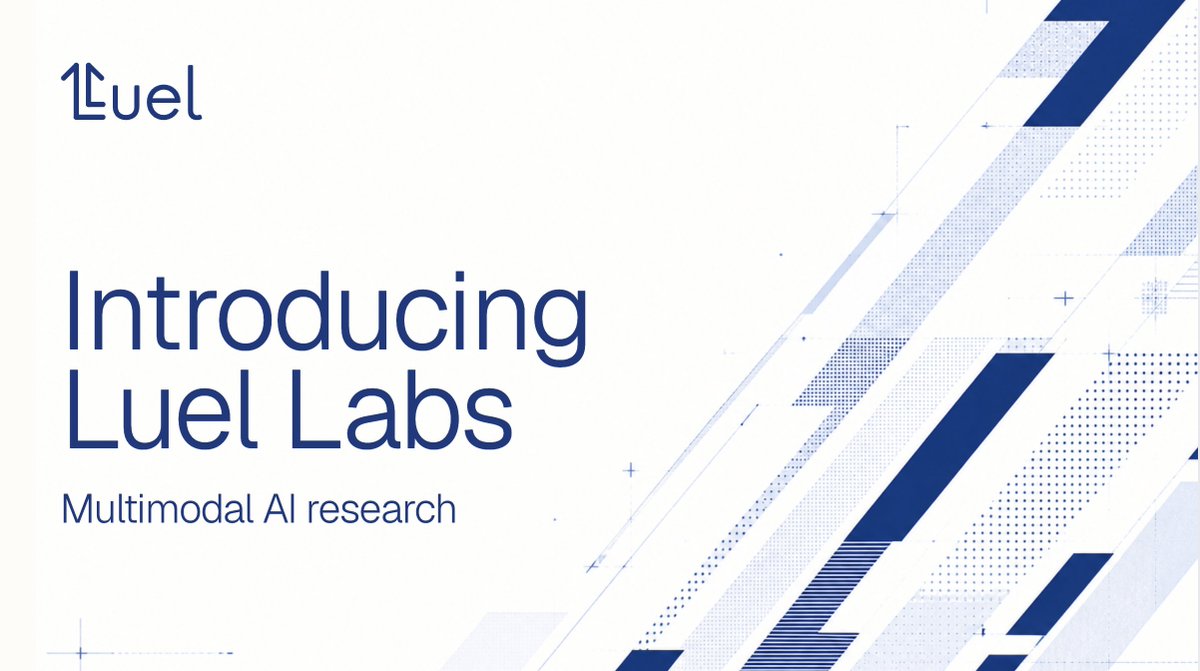
With Luel Labs, @LuelCompany is taking the human-data infrastructure it has built into multimodal research, starting with speech and underrepresented languages where existing datasets fall short.
We’re excited to see where @williamnamgyal, @Lenderking, and the team take Luel Labs.
Today we're launching Luel Labs, our end-to-end multimodal data lab.
Our research is powered by Luel's global network—leveraging 750,000+ contributors across 96+ countries to generate fully consented, quality-assured audio, video, and image data.
First up — Breakthrough TTS for underrepresented languages from the tips of the Himalayas and across the Sahara. We're delivering the first commercial-grade TTS for Tibetan and Dzongkha, and outperforming existing Masri and Darija models.
Alongside this effort, we’re driving foundational research to help the industry handle messy, real-world data—pioneering new approaches to 48kHz speaker separation, conversational overlap, STT modeling, data integrity, speech understanding and more.
“Your biggest competition, or your biggest challenge, is going to be you yourself.”
@Jainarvind on why execution matters more than competition in AI.
Great conversation between @Jainarvind of @glean and @KaranVaidya6 of @composio on the massive opportunity they believe is still ahead.
The first company I ever joined was @rubrikInc, @Jainarvind's previous company. It's where I learned how to build systems and engineering teams.
Years later, when we started @composio, @glean became one of our first customers, one of the first to believe in what we were building. So sitting down with Arvind felt like closing a loop.
In this episode:
•How Glean brought transformers to enterprise search before "semantic search" had a name
•Glean's partner-first strategy and why they chose Composio for actions
•Why Arvind has never worried about competing with OpenAI or Anthropic
•GLM 5.2 as the open-source inflection: 90%+ of enterprise AI tasks, majority of inference within 12–18 months
•Measuring real ROI: the US telco that cut case-resolution time by 48%
•Why agents built on MCP alone act like day-one employees and how context graphs make them tenured
CHAPTERS:
(00:00) – Rubrik days: how Arvind and Karan met
(01:05) – Glean's origin story: transformers before "generative AI" existed
(03:04) – What Glean is today: superset of ChatGPT and Claude
(05:39) – From embedding search to agents: was it a pivot?
(11:39) – The Composio partnership and why actions are hard
(14:43) – Why competition doesn't matter yet
(20:11) – The open-source inflection point (GLM 5.2)
(24:41) – Contracts and model risk: who absorbs the volatility?
(26:57) – Enterprise ROI: cost, tokens, and what to measure
(39:57) – Measuring value team by team
(44:11) – Day-one employees vs. tenured agents
(46:09) – Closing thoughts
The first company I ever joined was @rubrikInc, @Jainarvind's previous company. It's where I learned how to build systems and engineering teams.
Years later, when we started @composio, @glean became one of our first customers, one of the first to believe in what we were building. So sitting down with Arvind felt like closing a loop.
In this episode:
•How Glean brought transformers to enterprise search before "semantic search" had a name
•Glean's partner-first strategy and why they chose Composio for actions
•Why Arvind has never worried about competing with OpenAI or Anthropic
•GLM 5.2 as the open-source inflection: 90%+ of enterprise AI tasks, majority of inference within 12–18 months
•Measuring real ROI: the US telco that cut case-resolution time by 48%
•Why agents built on MCP alone act like day-one employees and how context graphs make them tenured
CHAPTERS:
(00:00) – Rubrik days: how Arvind and Karan met
(01:05) – Glean's origin story: transformers before "generative AI" existed
(03:04) – What Glean is today: superset of ChatGPT and Claude
(05:39) – From embedding search to agents: was it a pivot?
(11:39) – The Composio partnership and why actions are hard
(14:43) – Why competition doesn't matter yet
(20:11) – The open-source inflection point (GLM 5.2)
(24:41) – Contracts and model risk: who absorbs the volatility?
(26:57) – Enterprise ROI: cost, tokens, and what to measure
(39:57) – Measuring value team by team
(44:11) – Day-one employees vs. tenured agents
(46:09) – Closing thoughts
@Whatnot has delivered live commerce to Western markets, simultaneously creating a new class of retail entrepreneur. It’s the fisherman. The collector. The global brand.
We @lightspeedvp first invested two years ago, and are thrilled to deepen our partnership.
CC: @bsomaia
We’re excited to welcome Brian Kelly to the Lightspeed team.
Brian spent his career leading GTM strategy at high-growth B2B companies like Snowflake and ServiceNow.
Now, he’s bringing his expertise to Lightspeed as an Operating Partner, working with CEO’s and CRO’s to navigate through their GTM challenges.
In this video, Brian breaks down many of the most common sales problems founders face and how to identify them before they get too expensive.
We are thrilled to have him on the team.
0:00 The Cost of Poor GTM Strategy
0:59 Early Stage: Founder-Led Sales
3:08 Growth Stage: Scaling Your Sales Team
AI solves the unsolvable, and shows 294 pages of work humans couldn't do, for only $2,000.
This week on Lightwork:
- @GoogleDeepMind released three models of their new Gemini Robotics 2 robot family.
- The U.S. power grid looks at an upgrade via @basepowerco’s powerful home battery.
- Several top researchers at Google DeepMind (@JeffDean, @Sanjay_Ghemawat, @OriolVinyalsML, and @quocleix) are leaving to pursue a new venture, Discovery Loop (@DiscoLoopAI).
Full video below.
@clairejyz@Machiz
THIS WEEK: @OpenAI's models crack 10 previously-unsolved math problems, @GoogleDeepMind's Gemini Robotics 2, @jeffdean leaves Google after 27 years to start a new company, and @basepowerco raises $1B to fix the grid with home batteries.
1:10 OpenAI Solves 10 Open Math Problems
4:45 Can You Buy A Breakthrough?
7:49 Google Gemini Robotics 2: One Brain, Any Robot
12:32 How Gemini Robotics 2 Compares To Skild AI
14:41 Whole Body Control, Feet To Fingertips
18:07 Breaking: @JeffDean's New Company
21:43 @BasePowerCo Raises $1B At $13B Valuation
25:03 How Thousands Of Home Batteries Become One Virtual Power Plant
27:29 @K2SpaceCo Raises $500M Series D
28:23 @Whatnot Raises $545M Series G
@lightspeedvp@machiz
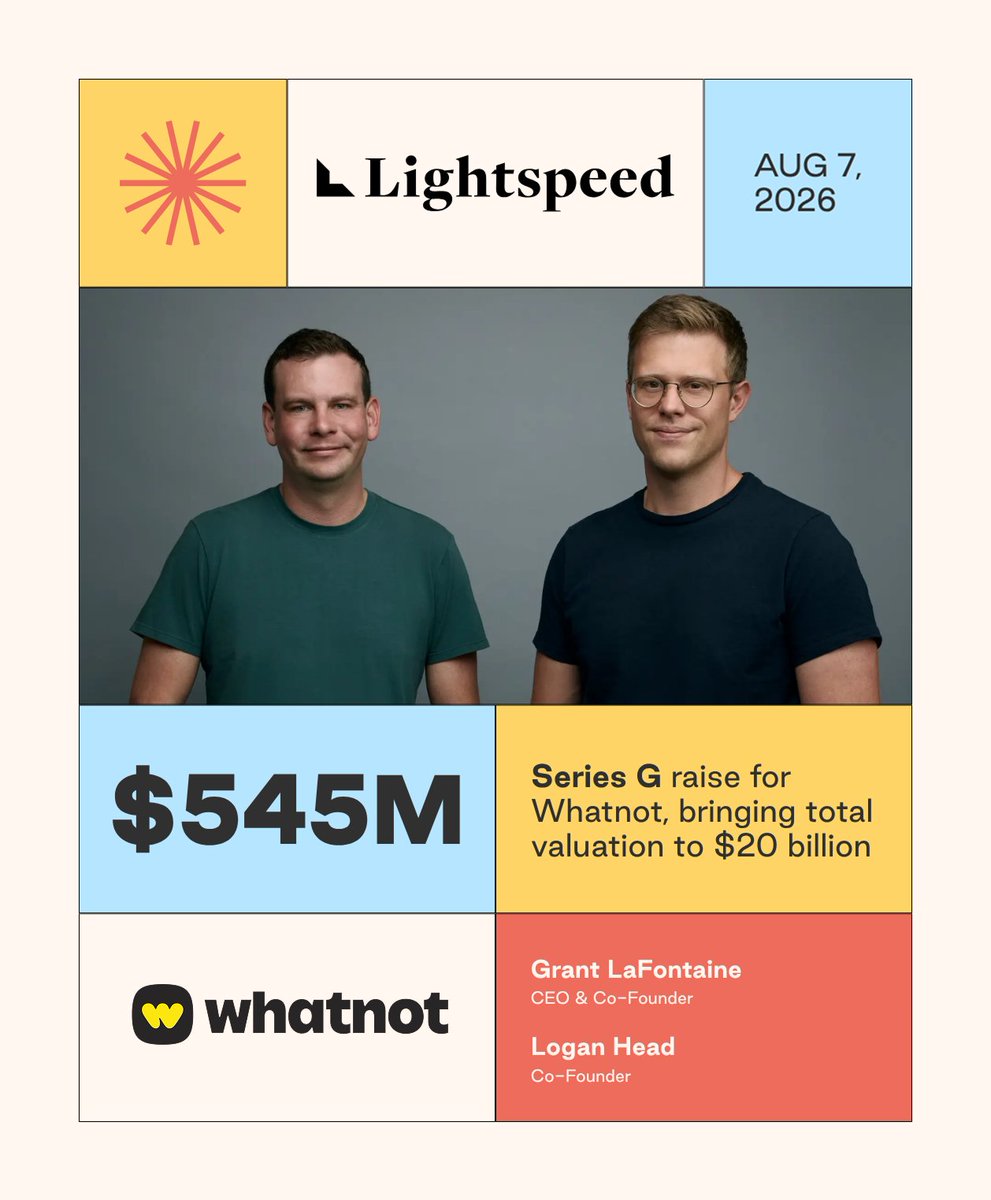
We / @lightspeedvp are thrilled to deepen our partnership with @Whatnot by leading their $545M Series G.
We first backed @GrantLaFontaine and @loganhead13 two years ago because we believed live commerce could fuel growth for sellers of all sizes. It has been remarkable to witness the team outrun our thesis across new geographies and categories.
Grant and Logan have built one of the internet’s strongest commerce communities by making shopping more interactive. This next chapter will deepen that experience through AI-powered tools for sellers, stronger marketplace trust, and international expansion.
We’re honored to continue building alongside the team. Congratulations on the raise!
CC: @sach_pat
We’re thrilled to co-lead @Whatnot’s $545M Series G.
From day one, founders @GrantLaFontaine and @loganhead13 believed live commerce could accelerate what’s possible for business growth.
With Whatnot, the team has built a marketplace where independent sellers and global brands alike can grow businesses around passionate communities. And now, they’re investing in AI-powered tools to make those connections even stronger.
We’ve been fortunate to partner with the team for the past two years, and have watched the company continue to scale at an extraordinary pace, reaching a $20B valuation.
We’re excited to continue supporting the mission. Congratulations on this milestone!
Cc: @bsomaia, @sach_pat
every once in a while, the internet writes a better script than you could.
this is one of those stories.
i’ve had @EquityPod in my podcast rotation through many hosts over the years. it’s taught me a ton about startups, venture, and the people building the future.
so getting invited onto the show alongside @clairejyz to yap about her new role at Lightspeed, what we’re building with Lightwork, and why AI news deserves to be more accessible (and a little more fun) was a pretty surreal full-circle moment.
thanks for having us @DominicMadori
https://t.co/B5IOqvTqh0
Today we are open-sourcing @boundarybench, a new paper, benchmark, and GitHub repo that enterprises can use to find out the REAL performance of their agents.
Boundary-Bench was developed by researchers from @Accomplish_ai and NYU, where we tested 12 frontier agents across roughly 10,000 runs, with realistic enterprise policies, simulating environments with EDR, SASE, and DLP security tools enforcing those policies.
We did this because generic leaderboard scores are being generated under conditions no security team would ever allow, which means orgs are making deployment and risk decisions based on numbers that don't hold up.
The results are surprising >>
.@clairejyz explains why the Meta / BlackRock 1 GW data center build is the "creation of a new institutional asset class around compute."
The deal is a $14B campus in El Paso. BlackRock owns 80%. Meta keeps 20%, leases the facility back, and pulls a $1B distribution out.
"For the last few years, hyperscalers have been self-funding the compute buildout. Meta, Google, Microsoft were building these data centers out of their own balance sheets and profits."
"BlackRock manages all these pension funds and insurers who need a safe place to park their money. In this case, that would be a 20-year lease to Meta, technically one of the most reliable payers on earth."
NEW EPISODE: More than 1,000 researchers want to pace the frontier, the financing structure behind @OpenAI and @Meta’s new data centers, and the debate around AI wearables.
Joe Diamond (CEO of @AxoniusInc) breaks down the growing trend of “Shadow AI”: why nobody can account for how many AI agents are actually running inside the company and the risks at scale.
0:00 Pacing The Frontier
9:15 The $500B Nvidia OpenAI Superintelligence Land Grab
14:00 Compute As A New Asset Class
18:30 Nvidia x SSI
22:00 @meetgranola Comes To The Apple Watch
26:45 Session-Based vs Ambient Recording
31:30 Axonius CEO: What Is Asset Intelligence?
45:00 Joe Diamond from CMO To CEO In Two Years
51:00 What Securing An Org Could Look Like In 5-10 Years
59:00 Three New Deals: @andera_ai, @cusp_ai, Harmony
FULL EPISODE BELOW @Machiz@Lightspeedvp