CMS’ proposed CJR-X model signals continued acceleration toward mandatory bundled payments and episode-based accountability nationwide.
For healthcare organizations, success will require stronger post-acute visibility, real-time analytics, scalable patient engagement, and alignment across care, operational, and financial teams.
Organizations that prepare early will be better positioned as bundled payment models continue to expand in value-based care.
Learn more about CJR-X: https://t.co/WjMJDWMD1Q
What does real value-based care actually look like, and why are so many organizations still struggling to get there?
In a recent episode of the Akros Advantage, Rachael Jones, MPA, CEO of Syntax Health (recently acquired by Lightbeam Health), sat down with Demi R. to unpack the realities of value-based care and the evolving role of hashtag#AI.
In the interview, Rachael and Demi discuss:
- The true definition of value-based care
- Where hashtag#VBC adoption stands today and why true downside risk is still limited
- VBC contracting failure points
- Where AI can meaningfully reduce administrative burden
- What it looks like for payers and providers to have more transparent conversations about goals and accountability
Watch the full episode: https://t.co/9IhJazi4uf
At HIMSS, our Chief Technology Officer, Michael Hoxter, shared an important point that cuts to the heart of how healthcare leaders should think about AI.
Mike appreciated the opportunity to speak with Brittany Quemby of Healthcare IT Today about why healthcare leaders must separate knowledge and intelligence to truly understand AI’s capabilities.
"AI is very, very smart, and it can answer questions that are general knowledge - it would kill it at trivia - but it doesn't know what you know," Mike said. "It doesn't know about your patient. It doesn't know a lot of the detailed, nuanced things that aren't out there available on the public internet."
https://t.co/J7EHjFj0Y1
Mike Hoxter at @LightbeamHealth says it's vital to separate the concepts of knowledge and intelligence with AI.
"AI is very smart, and it can answer questions that are general knowledge - it would kill it at trivia - but it doesn't know what you know."
#HIMSS26
Check it out👇
Healthcare’s digital transformation has made information the currency of care.
In one of Healthcare NOW Radio's top thought leader posts of the month, Russell Smith, Vice President of IT Security, discusses why cybersecurity is healthcare’s new trust framework.
"In an era defined by data exchange and AI-driven insight, cybersecurity functions as healthcare’s trust framework," Russell writes. "It gives organizations the confidence to share information, coordinate care, and adapt to new technologies without sacrificing reliability. That confidence is what turns digital progress into lasting, patient-centered improvement."
Read the article here:
https://t.co/rdVDDwJAQf
hashtag#HealthcareIT hashtag#Cybersecurity hashtag#HealthITSecurity hashtag#DigitalHealth hashtag#HealthcareInnovation
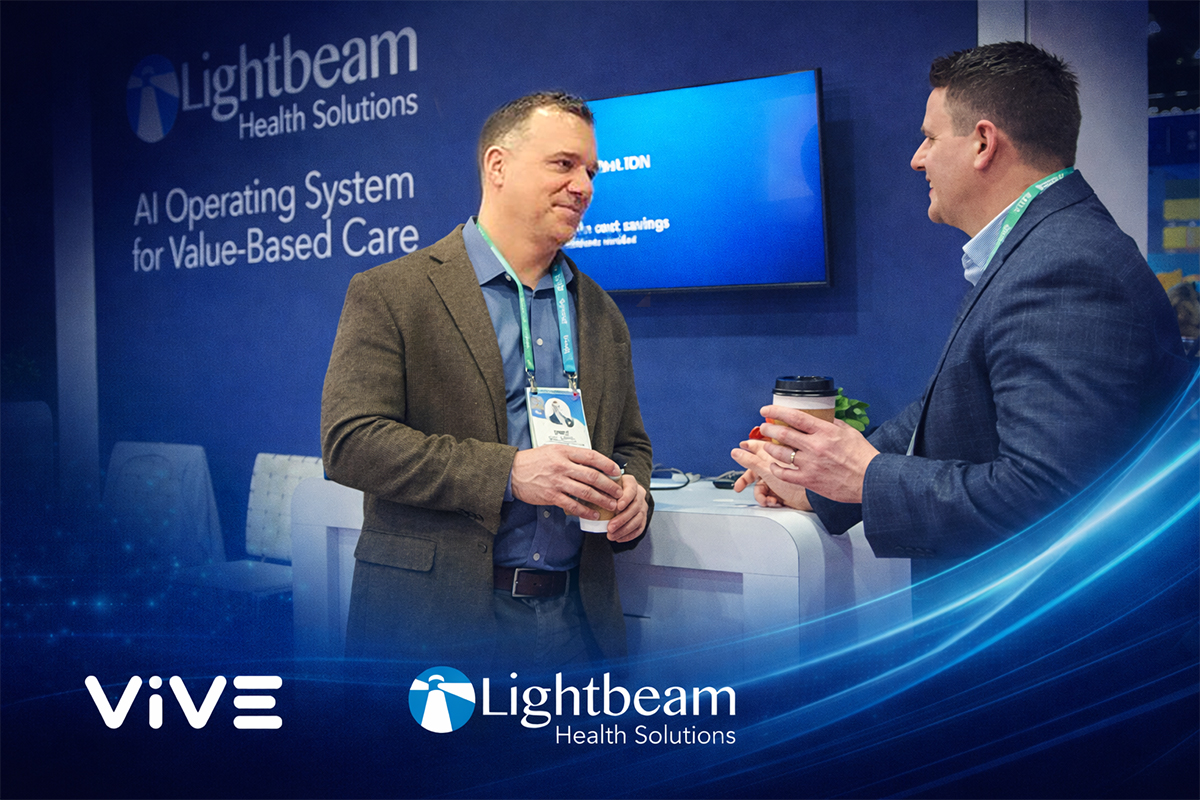
Still at #ViVE? The Lightbeam team is here at booth #802 and would love to connect.
If “one source of truth” for value-based care still feels out of reach, come see how Lightbeam clients are replacing spreadsheets with collaborative models, forecasting upside/downside in year, and turning modeled opportunity into real savings and revenue lift.
Stop by for a quick conversation, a demo, or just to say hello before the conference wraps.
#ValueBasedCare #HealthcareAI #PopulationHealth
Our VP of Advisory Services, Melissa Tyler joins fellow industry leaders to share her perspective on the role of data analytics and predictive modeling in value-based care.
Andy De, Chief Marketing Officer, Lightbeam Health Solutions
"The adverse impact of rising health insurance premiums and the loss of Medicare and Medicaid patients, which has already led to a number of rural and community hospitals shutting their doors, combined with reduced healthcare IT spend, will drive increased M&A across healthcare organizations as well as enterprise SaaS vendors in 2026. AI startups will continue to see disproportionate VC investment, but pragmatism will begin to outweigh FOMO, with growing demand for Agentic AI platforms and AI agents that address real-world problems, reduce fatigue and burnout for physicians, nurses, and care teams, and deliver robust value, ROI, and payback on these investments."
Lightbeam has achieved NCQA PHM Prevalidation, reinforcing our commitment to quality, population health excellence, and value-based care.
Read the full announcement: https://t.co/rUYnlfcaLY
#NCQA#PopulationHealth#ValueBasedCare#HealthIT
We’re excited to announce that Lightbeam has acquired Syntax Health, expanding our value-based contracting and incentive design capabilities. Together, we’re strengthening the future of #VBC with transparent modeling, smarter alignment, and a more unified operating system for our clients.
https://t.co/2ex4d235qh
Being named @Microsoft 2025 Partner of the Year for Healthcare & Life Sciences is a milestone that reflects the collective effort behind Lightbeam’s mission. We’re grateful for Microsoft’s partnership and the chance to co-innovate AI-driven solutions that strengthen outcomes and support the organizations delivering care every day.
Our CTO represented Lightbeam at Ignite as we celebrated this achievement and reaffirmed our commitment to advancing value-based care through responsible, impactful technology.
#MSIgnite #PartnerOfTheYear #HealthcareAI #LightbeamHealth
We’re proud to announce our latest milestone. Read the full press release to see how we’re advancing the future of value-based care. ⬇️ @WakelyCG
https://t.co/aUQHrsqQV2
🏥 Traditional risk models miss the full story.
In DOTmed News, Mike Hoxter of Lightbeam Health Solutions explains why incorporating Social Determinants of Health (SDOH) into population risk stratification is crucial for improving outcomes under value-based care.
Learn how AI and analytics are helping providers see the whole patient — and intervene sooner:
👉 https://t.co/5p3LmusnJF
#PopulationHealth #SDOH #AIinHealthcare #ValueBasedCare #LightbeamHealth
We are proud to announce that we have won the 2025 Microsoft Healthcare and Life Sciences Partner of the Year! Learn more here: https://t.co/qYxkmXqbwm
Read the press release: https://t.co/uMhYZARvXZ
#MSPartner#PartnersMakeMorePossible
🧠 95% of Gen AI projects fail — but they don’t have to.
In his latest byline for Healthcare IT Today, Lightbeam’s Chief Marketing Officer Andy Dé unpacks why so many Gen AI initiatives stall and how healthcare leaders can pivot toward Agentic AI and AI Agents to achieve real-world impact.
Read how automation is redefining clinical workflows, care management, and patient outcomes:
👉 https://t.co/VoXqUcQ3RB
#HealthcareAI #AgenticAI #DigitalTransformation #ValueBasedCare #LightbeamHealth
🔒 As healthcare becomes more connected and AI-enabled, trust is everything.
In this Health IT Answers feature, Russ Smith, VP of Infrastructure & Security at Lightbeam, explores how cybersecurity has evolved into healthcare’s new trust framework — protecting not just systems and data, but patient confidence itself.
Discover why resilience, structure, and shared accountability are now the foundation of digital care:
👉 https://t.co/4Y7lXTWypZ
#Cybersecurity #HealthcareIT #DataTrust #AIinHealthcare #LightbeamHealth
AI is already finding its footing in preventive care.
A new JAMA study from Johns Hopkins Medicine found that a fully AI-led diabetes prevention program matched the results of human-led programs: 31.7% of participants in the AI group met CDC-defined benchmarks for diabetes risk reduction, nearly identical to 31.9% in traditional programs. The AI model also had higher initiation and completion rates.
For millions at risk of type 2 diabetes, time and access are often the greatest barriers to preventive care. AI-led programs can help close that gap, extending interventions to populations who might otherwise never start.
At Lightbeam, these studies validate where population health is headed: technology and data working together to make personalized, preventive care possible for every patient, no matter their setting.
👉 Read more: https://t.co/0aLQ88nqke