A pair of earbuds is a few grams of plastic, metal and electronics, made across several factories before it reaches a pocket. Solar panels, circuit boards and wind turbines are built the same way.
For years, buyers had to juggle those factories themselves, while the one with exactly the right machine often never heard about the order. ZETWERK (@zetwerk) set out to close that gap.
We first partnered with Amrit Acharya (@acharyaamrit) and Srinath Ramakkrushnan (@srinathramki) in 2019. Since then, that idea has grown into a network of nearly 7,000 suppliers, serving customers in 29 countries across energy, precision products and capital goods. Along the way, Zetwerk has brought work to builders from workshops in India to factory floors in Germany. Amrit and Srinath were joined by Vishal Chaudhary, Ankit Fatehpuria and Rahul Sharma in their journey.
Today, Zetwerk’s name goes up on the NSE and BSE. Behind that name are thousands of people who built it, one part at a time.
Congratulations Amrit, Srinath and the entire Zetwerk team. This film is for all of you, and everyone who builds with you.
@bsomaia
Introducing https://t.co/U9Ti71EgWL. I've been getting pinged by more & more folks who are ready to return to India and were keen to talk to companies that could be their next career move. So I've put together a beautiful version of digital Bengaluru here with a selection of startups I use and/or admire. You could spend a whole afternoon poring over the little details I've been obsessed over. It also links to jobs pages of all Lightspeed backed startups, and a place to upload your CV for us to track future opportunities for you. Hope you enjoy & pls RT / share in your networks of Indians looking to move back for any reason.
h/t thanks to @NirantK for offering this domain way back in 2021!
We're hosting our first India event!
It is now abundantly clear that AI will drive future scientific discovery, including recursively improving the materials and chips that run it. We believe India should be at the forefront of this scientific discovery process.
We're hosting a research mixer with leaders from Google DeepMind, OpenAI and Applied Materials next Tuesday in Bangalore.
If you are a scientist, AI researcher or process engineer interested in AI driven scientific discovery, DM me or RSVP at the link in the 🧵
As AI gets dramatically better at maths, physics and the sciences, the next decade of semiconductor innovation will be shaped by AI-driven discovery of new materials and processes. As more of the discovery loop gets automated, the role of the materials scientist is changing too.
On Tuesday, 1 December, Lightspeed and @discoveredmat are hosting an evening in Bengaluru, "The Next Decade of Discovery: AI, Materials and the Future of Compute." We're bringing together people from across the intelligence stack, from materials and fabs to data centers and AI models, for a fireside chat and networking from 6 pm.
Speaking on the evening:
1. Anand Rangarajan (@mailanand), VP Engineering, Google DeepMind (@GoogleDeepMind)
2. Suraj Rengarajan (@SurajRengarajan), Principal Technologist, Applied Materials India (@Applied_India)
3. Kulapradip Bharali (@kpbharali), Applied AI Engineer, OpenAI (@OpenAI)
4. Advaith Sridhar (@advaith_sridhar), Co-founder, Discovered Materials (@discoveredmat)
5. Abhiram Tarimala (@AbhiramTarimala), Investor, Lightspeed India
The conversation will cover:
→ The biggest opportunities in semiconductor chip innovation over the next decade
→ Where AI can compress the lab-to-fab roadmap for next-generation compute
→ How the materials scientist's role is evolving
It's a small, invite-only evening. If you work in semiconductor materials, chemistry, fabs, compute or AI, request an invite here: https://t.co/XA4h1xac73
@MohapatraHemant | @_kkumar
"We aim to make 100 satellites in parallel next year..."
Deeptech demands serious capital long before a product generates revenue, so every funding round hinges on proving you’ve cleared the next major hurdle.
When we wrote our Seed memo on Pixxel (@PixxelSpace), capital was one of our biggest questions. Could a company like it raise the hundreds of millions of dollars it would need over time?
In Episode 2 of The Investment Memo, Lightspeed Partner Hemant Mohapatra (@MohapatraHemant) and Pixxel Co-Founder Awais Ahmed (@awaisahmedna) unpack how value builds in a space company, one milestone at a time. From its very first satellite onward, Awais breaks down exactly what Pixxel had to prove to unlock each round.
Full episode on YouTube: https://t.co/NTbjfVF4IR
Today we are introducing Sarvam Extract, our API for extracting structured data from documents, powered by our latest model, Sarvam Vision 2.1.
On ExtractBench, Extract sits on the accuracy-cost Pareto frontier, delivering the highest accuracy at its price points, outperforming LlamaExtract Cost Effective and Gemini 3.8 Flash.
The world is short of rockets, and we think that is India's opening.
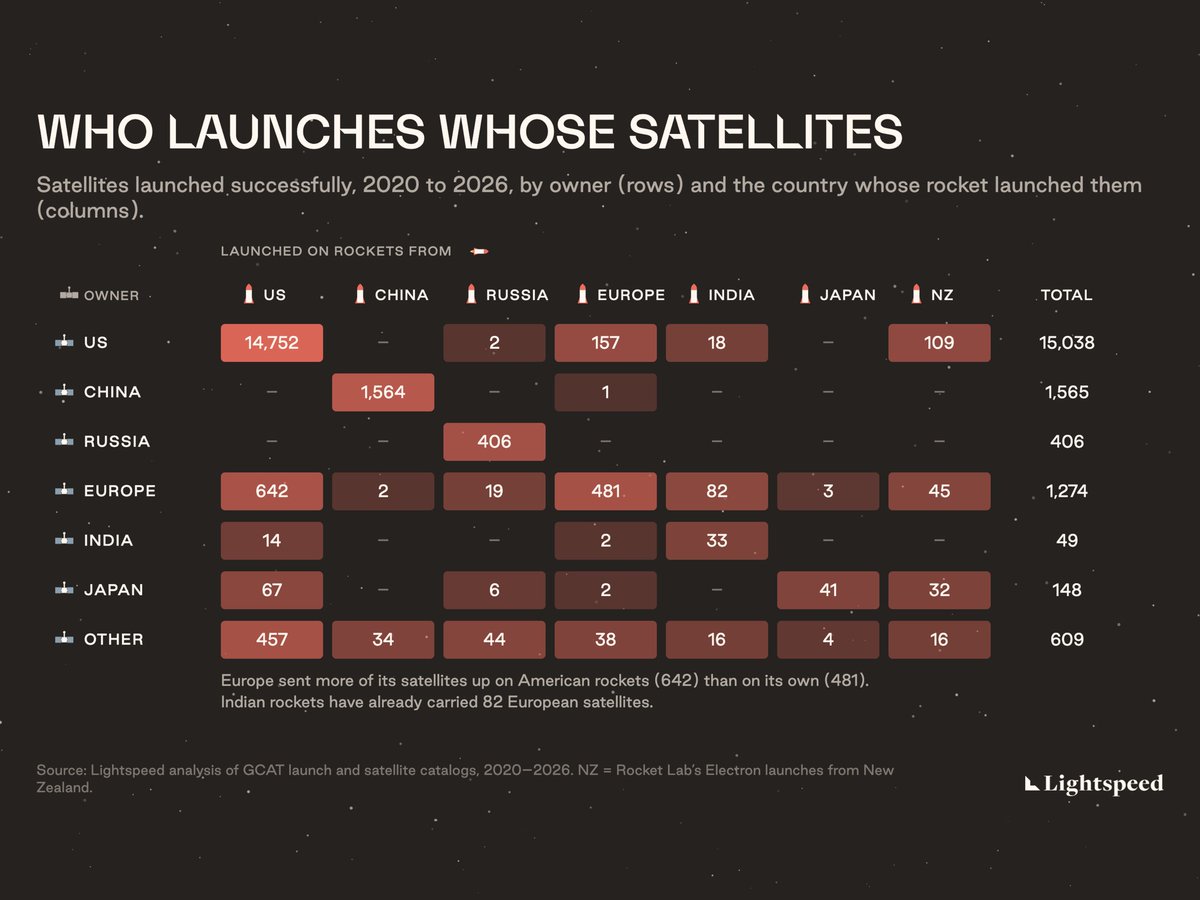
Demand to reach orbit is growing faster than the capacity to carry it. SpaceX flies mostly its own satellites, China and Russia launch almost only for themselves, and Europe has sent more of its satellites up on American rockets than on its own. As with compute in AI, a shortage like this makes room for new suppliers.
India is already one. Its rockets have carried 434 satellites for 34 countries, and its private companies are now building the next generation, bigger and designed to be reused.
We believe India's builders are well placed to fill the launch shortage and to build space companies that serve the world. Our latest Substack piece, by @JainAnuvrat, Tejas Jahagirdar and @MohapatraHemant, sets out why.
Read it here: https://t.co/q0IyyAfp5P
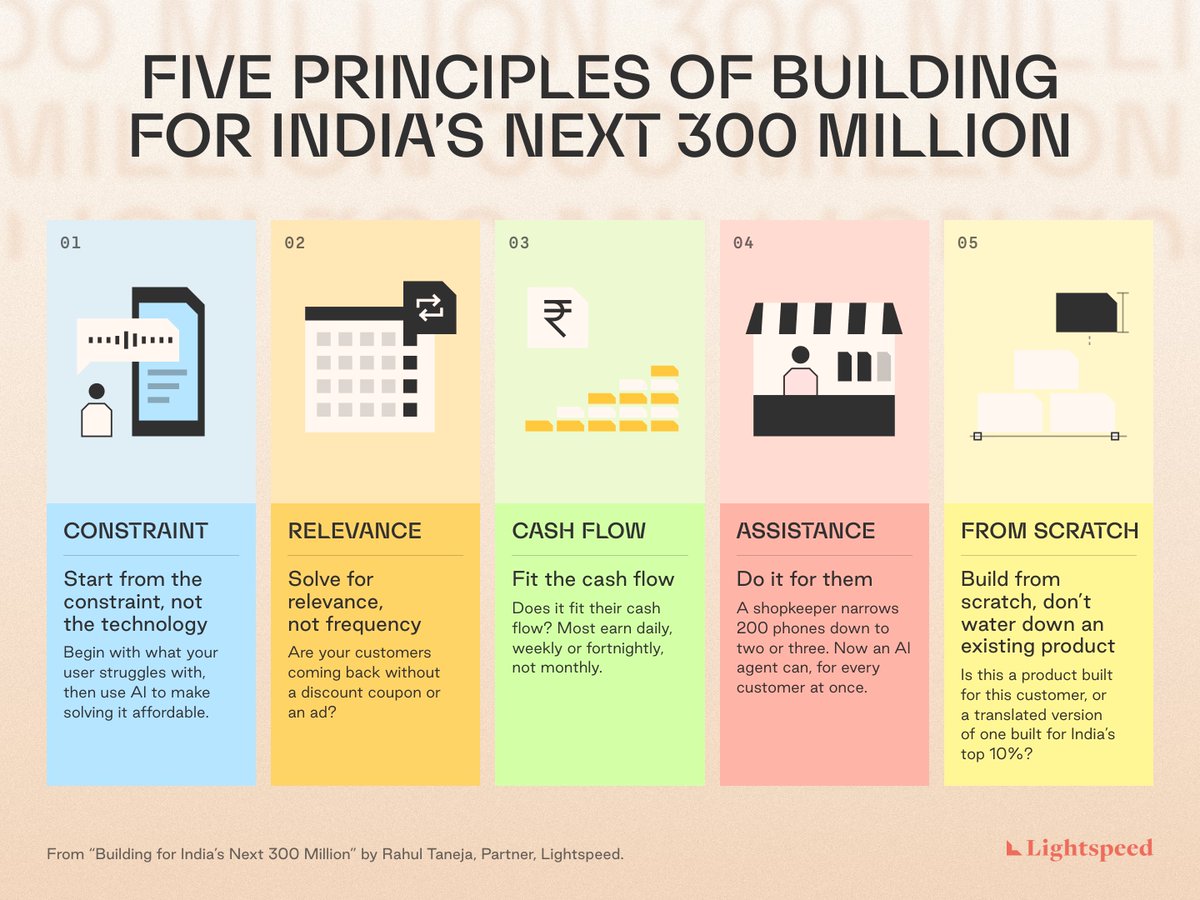
AI is bringing down the cost of reaching India's next 300 million users, but most platforms still assume their users read English, would rather type than speak, and will spend more per order.
Lightspeed Partner @rahultaneja's five principles come from what we see in the companies getting it right.
We believe the founders who win these users will build for them from scratch rather than translate a product made for someone else. His Substack piece sets out why.
Read it here: https://t.co/dr3KUFGxvf
Congratulations to @mukundjha and Madhav Jha, Co-Founders of our portfolio company @emergentlabs, on winning the Business award at CNN-News18 Indian of the Year 2026, in recognition of their work in India’s technology and AI startup ecosystem!
Twin brothers Mukund, CEO, and Madhav, CTO, started Emergent in 2024 so that, as Mukund said at the ceremony, “anybody on the planet with an idea” can build software. On Emergent, a person describes an app in plain language, and AI agents build and deploy it.
Builders in 190+ countries now use Emergent to make the software their businesses run on.
On stage in New Delhi, Mukund said India has the talent and the capital to build technology companies that compete globally. Emergent is showing what that looks like.
Proud to have been an early partner to Mukund and Madhav, since leading Emergent’s Series A in 2025.
Every layer of the space stack now has an Indian company building it.
Satellite platforms, propulsion, Earth observation, space tracking and analytics all have Indian builders, many of them founded by ISRO alumni and already selling to customers abroad. From our portfolio, @PixxelSpace has hyperspectral satellites in orbit and now builds satellite platforms, @celestialaero is building a launch vehicle, and @kalam_labs is building near-space platforms.
That matters because the world is short of ways to reach orbit, and India is one of the few countries that launches for others. Its rockets have carried 434 satellites for 34 countries.
We believe the launch shortage is one of the biggest openings in frontier technology, and that India's builders are well placed to fill it. Our latest Substack piece, by @JainAnuvrat, Tejas Jahagirdar and @MohapatraHemant, sets out why.
Read it here: https://t.co/q0IyyAfp5P
Today, @AnthropicAI goes public.
Lightspeed was founded 26 years ago to be early believers in what’s next. Across technology cycles, from the internet to mobile, cloud, and now AI, that has remained constant.
From the very beginning, @DarioAmodei, @DanielaAmodei, and the team saw a future where progress and safety had to go hand in hand. They understood both the extraordinary potential of AI and the immense responsibility that would come with advancing it.
It's rare to witness a company reshape an industry so deeply, so quickly. Rarer still to see it done by people who have stayed so close to the principles that brought them together.
Congratulations to co-founders @DarioAmodei, @DanielaAmodei, @NotTomBrown, @jackclarkSF, Jared Kaplan, @Sam_McCandlish, @ch402, and the entire Anthropic team! What a journey, and what an exciting future still ahead.
CC: @ravi_lsvp, @guruchahal, Sebastian Duesterhoeft
Congratulations to Lightspeed portfolio founders @awaisahmedna, @pratykumar and Shreya Mishra on being named to the inaugural TIME100 Next India, a list of 100 emerging leaders shaping India’s future.
From hyperspectral satellites to sovereign AI to rooftop solar, all three are building for India at scale.
Awais, Co-founder and CEO of @PixxelSpace, is named among the Leaders for building a constellation of hyperspectral satellites that capture light across hundreds of narrow wavelength bands, with six already in orbit.
Pratyush, Co-founder of @SarvamAI, is named among the Innovators for building AI models and enterprise products trained on Indian languages, local data and cultural context.
Shreya, Co-founder and CEO of SolarSquare, is named among the Phenoms for taking the company from commercial installations to households, and it now powers over 60,000 homes across India.
Proud to have been a partner in their journeys from their earliest days.
"95% of the power users of satellite data we spoke to said they'd pay us a premium for hyperspectral data..."
When Pixxel started, high spectral resolution was missing from what anyone in the world offered from space.
Our seed memo on Pixxel (@PixxelSpace) asked whether the market would come. In Episode 2 of The Investment Memo, Lightspeed Partner Hemant Mohapatra (@MohapatraHemant) and Awais Ahmed (@awaisahmedna), Co-Founder of Pixxel, discussed that question in Pixxel's mission control.
Awais walks through what the people who buy satellite data told Pixxel, and what happened once its satellites went up.
Full episode on YouTube, Spotify and Apple Podcasts:
YouTube: https://t.co/NTbjfVEwTj
Spotify: https://t.co/zjUwDeh9Ei
Apple Podcasts: https://t.co/dwSJwR3r2L
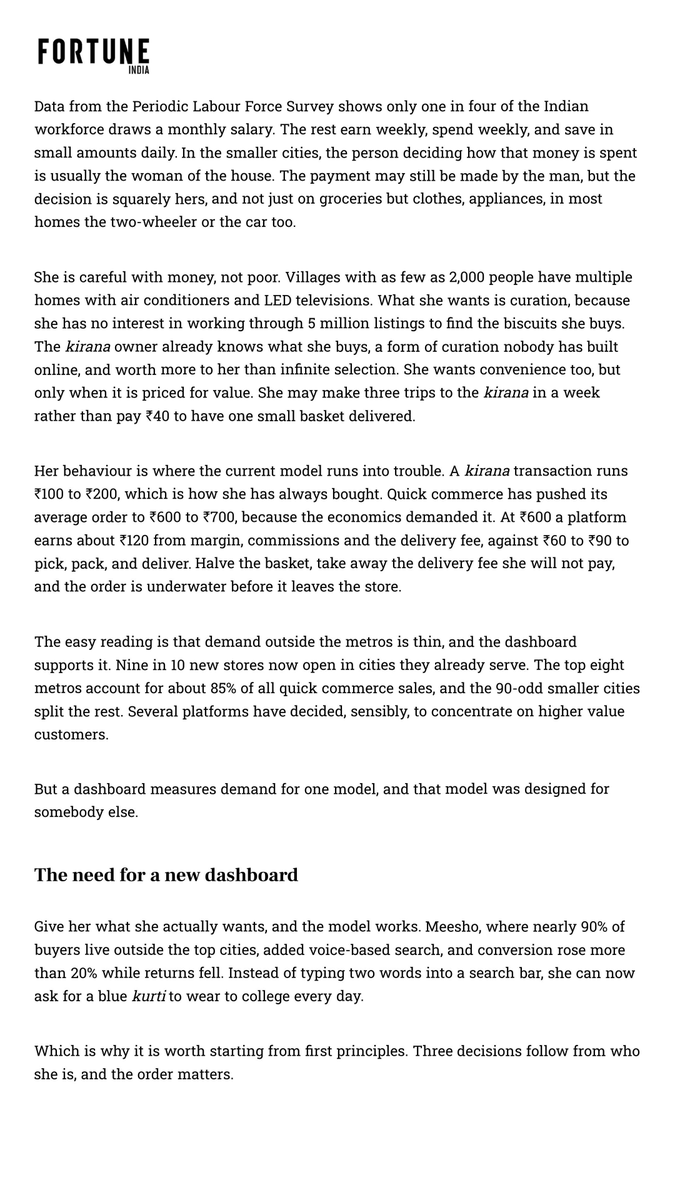
Indian quick commerce was built around one customer. He lives in a big city, earns a monthly salary and pays extra for convenience. The next customer looks very different.
Lightspeed Partner Rahul Taneja (@rahultaneja) writes in @FortuneIndia about who comes online next. This customer is more likely to be the woman of the house in a smaller city, whose household earns and spends weekly. She is careful with money, buys for value, and shops in ₹100 to ₹200 baskets that today’s model was not built to serve.
Rahul writes about the three choices that decide who wins her. Start with necessities, earn her frequency, and become the lowest-cost operator in the category. The next commerce companies won’t be cheaper versions of what came before. They'll be built differently from the start.
Read the full piece here: https://t.co/6noQ6inBpX
India’s launch moment is here. The world is short of rockets, and India is one of the few countries whose rockets serve global customers, with private companies now building the next ones.
There is more demand to reach orbit than there are rockets to carry it. SpaceX is booked until about 2028, and most of its flights carry its own Starlink satellites. Some customers are willing to pay up to six times the going rate just to launch on time.
Most of what Indian rockets carry already belongs to foreign customers, and in July Skyroot’s Vikram-1 became the first privately built Indian rocket to reach orbit.
We think the launch shortage is one of the biggest openings in frontier technology today, and that India’s builders are well placed to fill it. They start with lower costs, a coastline suited to launch, and sixty years of ISRO test stands and launch sites now open to startups.
Our latest Substack piece, by @JainAnuvrat, Tejas Jahagirdar and @MohapatraHemant, covers how launch went from a contest between superpowers to a business, what it takes for a launch company to win, and why India can launch for the world.
Read it here: https://t.co/q0IyyAfp5P
Congratulations to @SarvamAI on launching Token Factory for everyone, with Sarvam’s own models and leading open-weight models hosted on GPUs in India.
Data residency requirements and a lack of inference in India have kept many teams here away from the best open models. Token Factory serves them from India, with performance and reliability that match global providers.
For enterprises, it means more models to choose from and an AI stack they can own without lock-ins.
@pratykumar | @vivekrag | @MohapatraHemant | @BaggaRohil
Today, we are launching Sarvam Token Factory for everyone.
We host our own models, and the full range of best-in-class open-weight models, in India. We match leading inference providers on performance and reliability.
For enterprises, this means more models to choose from, and an AI stack they can own without lock-ins.
For most of India’s startup history, the IPO was the only exit a venture investor could plan on. Over the last three to four years, the private secondary market has become a second.
Anuj Bhargava, Managing Director at Lightspeed, wrote in The Economic Times (@EconomicTimes) about how that market fills a gap the IPO leaves open. The bar to list keeps rising, and IPOs above $100 million made up nearly 90% of venture exit value in 2025. Many good companies a few years from listing still have early investors who need to return money to their own backers.
Anuj writes about how secondaries bridge that gap, and about three shifts that have deepened the market. New kinds of buyers have emerged, founders are more open to early investors selling, and a strong IPO market gives buyers the confidence to invest. In his words, none of this replaces the public market. It prepares companies for it.
Read the full piece here: https://t.co/OJsqLx5F2K
Our Founders, @awaisahmedna and @kshitijgokul, sat down with @MohapatraHemant, Partner at @LightspeedIndia, for an episode of 'The Investment Memo', revisiting the original investment thesis behind Pixxel and reflecting on how far we’ve come, what we’ve built, and what lies ahead. 🚀