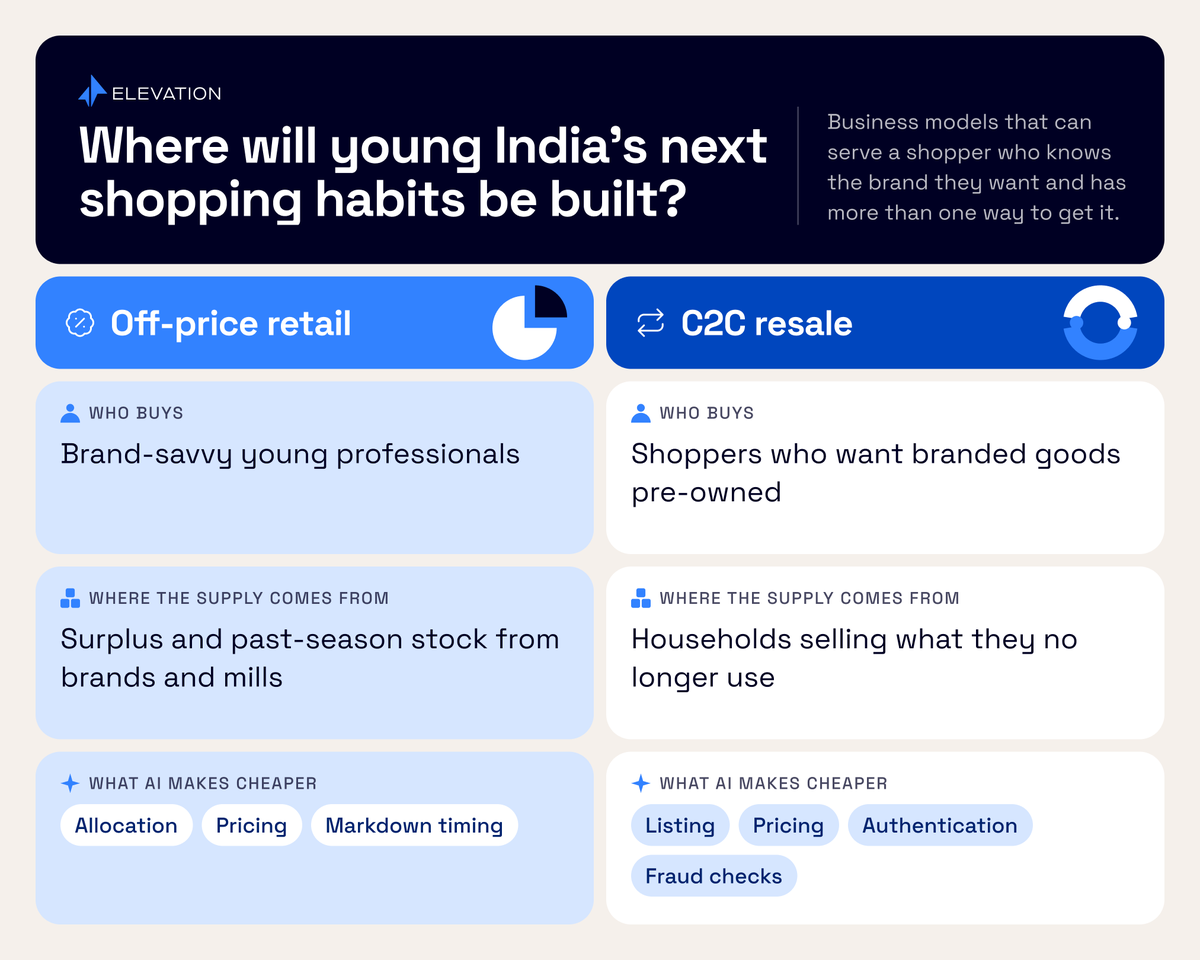
The young Indian shopper is deliberate about the life they want, and resourceful about how they get there. From surplus finds to pre-owned listings, this generation is finding new ways to reach the brands it aspires to have.
That resourcefulness has opened up real room for two business models:
→ Off-price retail brings surplus and past-season stock from brands and mills to brand-savvy young professionals. AI makes allocation, pricing and markdown timing cheaper.
→ C2C resale lets shoppers buy branded goods pre-owned from households selling what they no longer use. AI makes listing, pricing, authentication and fraud checks cheaper.
Both models operate in large trades that still run largely informally in India. We believe the opportunity lies in moving them onto organised platforms that shoppers can trust, and AI can make this work now. It takes the cost out of the patient, item-by-item work of describing, pricing and checking goods.
Vaibhav Chowdhury’s (@vaibhav9339) in-depth piece explores how aspiration and ingenuity are shaping the businesses that will serve the next generation of Indian shoppers: https://t.co/D5se0tDFHd
I've watched a few really good founders raise big seed rounds this year, then struggle to raise their A, even as the business kept making progress. The seed valuation had set a bar they weren't ready to clear yet. And with everyone excited about the term sheet, it was easy to put off what they'd need to show at the next round.
One of them had about as strong a resume as you'll see in AI, and a team to match. Sub-$1M ARR would have been a fine A story at a normal seed price. At theirs it wasn't.
(For what it's worth, I write both seed and A checks, so I sit on both sides of this.)
The top of the seed market is a bit wild right now. Carta's 95th percentile seed valuation was about $72M in Q2 last year. This Q2 it was $200M. Meanwhile the share of seed companies that get to a Series A within two years has roughly halved since 2018.
During a raise almost all the attention goes to how much and at what valuation. The question I wish more founders asked is whether the company is actually set up to hit the growth the next round will expect.
If you're planning on a 2-3x step-up at the A, here's what that means. A $25M post means pitching a $50-75M A, which a company with real traction can get to. A $100M post means $200-300M, and at that price the A partner is comparing you to the handful of companies growing faster than almost anyone.
The bar right now is brutal. In the A conversations I'm in, a $15M seed (usually a $75-100M post today) means $2M+ ARR, growing 5-6x over the last year, with a believable path to another 5x.
None of this means raise less. Before you sign, work backward: what will we need to show at the A, and does this money and ~24 months get us there? If it does and the terms are good, take it.
If the honest answer is "only if everything goes right", that's worth knowing now rather than in month 20.
A big seed buys you runway and a higher bar. Most founders only count the runway.
While we interact with a new and promising AI agent every other day, the possibilities for AI to operate in the real world are equally exciting.
We're thrilled to partner with @spc_india to bring you Physical AI Demo Night, a curated evening to explore the most interesting use cases for AI in the physical world, from robotics and hardware to drones, spacetech, and more.
A few selected teams will present their live demos, followed by an open house to get a closer look at every product.
Apply to demo or participate as audience: https://t.co/temfhMZTxH
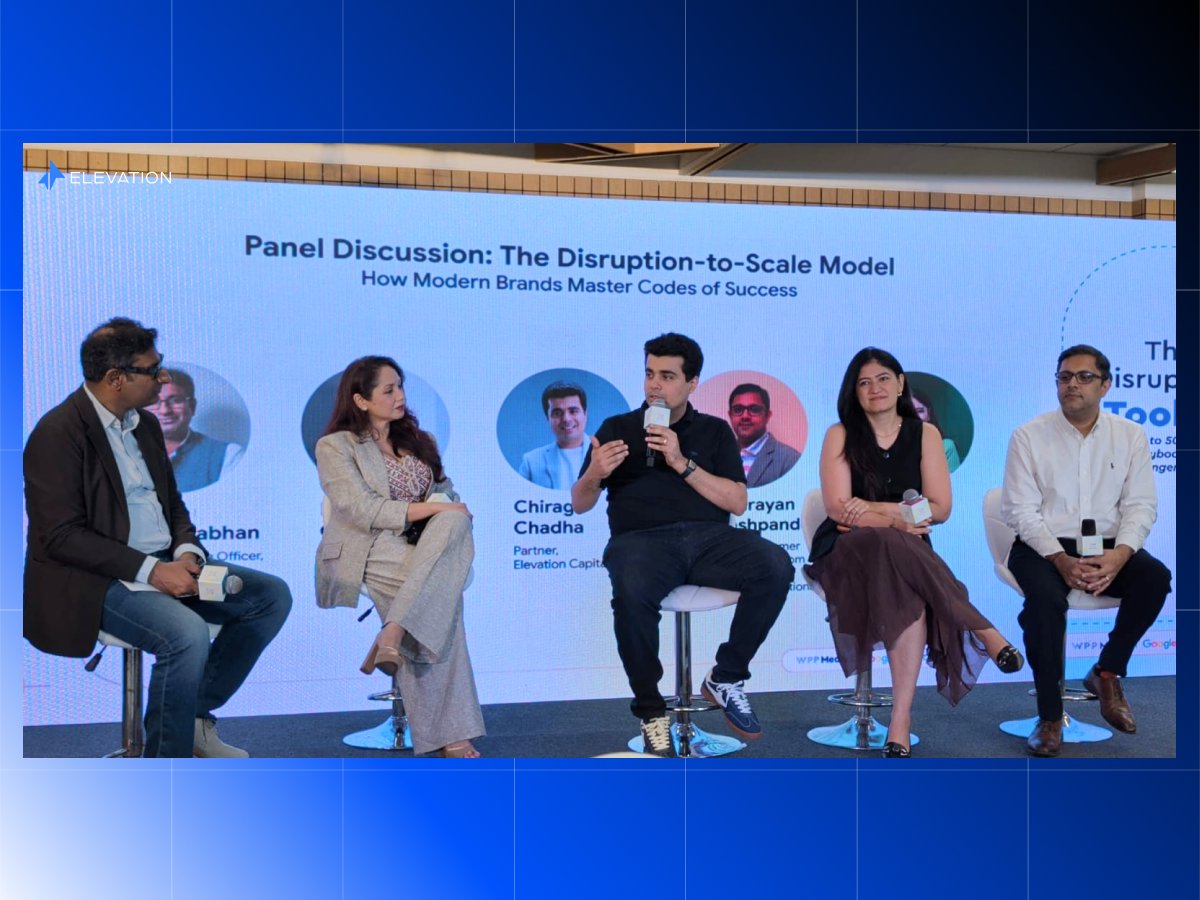
We’re excited to launch The Disruptor’s Toolkit: The 0 to 500 Crore Playbook for Challenger Brands, a comprehensive report created in collaboration with @Google and @wppmedia for new-age consumer brands to win over India’s new experimental shopper.
At the launch of the playbook, @chiragchadha9 spoke about what it takes to scale a challenger brand from ₹0 to ₹500 crore. This journey no longer looks like one long sprint. Instead, it’s a relay race, and each leg asks a harder question. Can you own a single niche? Does every new channel make the others stronger? Are you building revenue, or building lasting value?
As Chirag put it, “the brands pulling ahead are those that own a sharp consumer need before earning the right to go wider.”
With this playbook, we give founders a blueprint on how brands break out with the margins, the team and the brand to win every leg of the race.
Thank you to our partners at Google and WPP Media, and to the audacious founders whose journeys shaped this playbook.
Read the full report: https://t.co/uH68HlAJoB
@vaibhav9339 spoke to @ET_Marketing about how personal AI agents are reshaping India’s consumer internet. He believes the last decade was a race to win attention, and the next one will be a race to deliver on user intent.
In a world where people increasingly let AI assistants handle tasks, the advantage will shift to businesses that are genuinely better on price, selection, and reliability.
He also sees India’s D2C sector as a particularly interesting space for this agentic AI era to play out. The value of an AI assistant will essentially hinge on real-world actions they can fulfill, whether the order arrives on time, the service professional shows up, the return gets picked up, and so on.
Read Vaibhav’s take on personal AI agents for India: https://t.co/bQtwsbjilz
We’re excited to announce our partnership with Spill Games and lead their $10.5 million Series A fundraise!
Spill Games is building an AI-native gaming studio that compresses mobile game development from months to weeks. With AI embedded across the development lifecycle, from discovering new gameplay formats and testing concepts to producing, launching, and optimising games, the platform helps move promising game ideas from concept to market with greater speed and precision.
In a category where sustained player retention is difficult to achieve, the speed and learning velocity fueled by Spill Games’ AI-native development model are a powerful advantage.
We’re excited to back Om Misra, Harsh Garg, and Tapan Ranjan as they continue scaling this audacious idea.
Read our investment memo to learn what excites us about Spill Games: https://t.co/yftd8rHlYI
@manishadvani12 | Shreedhar Malpani
AI is leaving the screen.
For the physical world. We're here for it.
Physical AI Demo Night at SPC India, in partnership with @ElevCap, and powered by @AWSCloudIndia.
Curated, live demos of real products across robotics, autonomy, computer vision, advanced manufacturing and more! If you have a working build, apply to share your demo, and story.
If you just want to be part of this room, apply to attend.
We have limited slots. Link below.
@ankitcc@garg_tushar_@bansalvartika@OnaRoy88@amruthajalihal
We’re proud to back @mesaschool_'s next chapter as it raises ₹110 crore in Series A funding!
India’s entrepreneurial spirit runs deep. Ankit Agarwal and Varun Limaye built Mesa as a new-age business school to help more young people tap into that spirit and turn their ideas into enduring businesses.
Over the last four years, they’ve created a founder-led learning environment. Mesa's emphasis has been on enabling students to sharpen their entrepreneurial instincts and understand what it takes to bring an idea to market.
We’re excited to continue backing Ankit, Varun, and the Mesa team as they help more young Indians become the sharpest builders of tomorrow.
@mukularora | @manishadvani12
For more than two decades, billions of dollars in venture capital have gone into recruiting tools covering every stage of the hiring funnel.
Yet recruiters still spend over 65% of their time manually sourcing and screening candidates. And candidates fare no better with roughly 180 applications for a single hire.
Today, AI is positioned to close this gap, and we believe the opportunity looks different for every buyer in this space. Three segments are ripe for innovation through AI:
→ Startups hiring white-collar workers are best served by an AI-native agency
→ Startups hiring blue-collar workers are best served by a voice or WhatsApp-first infrastructure
→ Enterprises and GCCs hiring white-collar workers are best served by an orchestration layer tailored to their needs
Explore our full read on how AI could create recruitment's first new winner since LinkedIn in 2003: https://t.co/hFBXHVlays
The AI landscape is changing faster than ever, where even a few months can completely reset the playing field and rewrite the advantage.
In our latest SummitUp episode, @kpowerinfinity and @PoorviVijay unpack how the space has evolved and share their read on where enterprise AI's real value is headed next.
They talk about:
➡️ How open-weight models like Qwen and Kimi 2.5 are emerging as strong frontier alternatives
➡️ The growing emphasis on building a goal-oriented harness layer and the future of domain-specific harnesses
➡️ Inference becoming the new battleground in the agent economy where agents operate autonomously
➡️ Creating lasting context to run agents on memory built up over time regardless of the model
Watch the full episode here: https://t.co/1R1bn9DnnI
Can startups and private companies actually break into India's massive defence opportunity?
In the latest episode of our Defending India series, @AshrayIyengar sat down with Smit Shah, President of the Drone Federation of India (DFI), to talk about the role startups can play in building out the country's military manufacturing base.
Smit expressed his conviction that startups will take over. But this future won't be built by one kind of company alone. He broke it down into two tiers:
➔ A handful of large-scale manufacturers with the capital and factories to build at volume
➔ A layer of 10-20 specialist firms around them, doing design, development, and production together
This structure looks nothing like the conglomerate-led defence models India has historically relied on. And it has room for founders to plug into that second tier.
Watch the full conversation to hear more on where startups fit into India’s defense matrix: https://t.co/YYkjhwdQkb
When Sajid came back to the Bay Area in 2024, he asked his old hotel friends what had changed since the pandemic. Pretty much nothing. Labor was still expensive, overnight shifts were impossible to staff, and revenue was still going to voicemail.
So he built an AI agent for a couple of properties as a favor. Reviews went up at both within 90 days. That became Dextr AI, and today we're announcing their $6.7M seed, led by @ElevCap with our friends at @FoundationCap.
At a lot of hotels nobody's at the front desk after hours, and most of the time nobody's there at all. The call rings out, the guest books on an OTA, and the hotel pays a 40% tax on its own traffic. Dextr answers that call. One hotel now books $100-300K a month through Daisy, their voice agent.
What stuck with me was owners telling us Dextr changed their life. It's an AI workforce running alongside their team, from reservations to housekeeping, and the owner runs it all over text. Hundreds of properties, zero churn, before raising a dollar.
The agents do the work, so they compete for a hotel's labor budget, not its software budget. Hospitality is one of the clearest cases of that I've seen.
Welcome to the family, Sajid and Scott. Now please fix my late check-ins.
@ElevCap@FoundationCap@mukularora@poorvivijay Dhruv Sanskar Prerna
#VerticalAI #AIagents #HotelTech
Congratulations to Dextr AI on raising $6.7M in the seed round!
Hospitality is, at its core, a business of human connection. But behind every warm welcome is a mountain of repetitive work, from managing bookings and answering routine queries to coordinating between vendors and keeping operations running smoothly.
Dextr AI is building a specialised AI workforce to take on this busywork. Its forward-deployed team of AI strategists and engineers works directly with hospitality operators to identify high-impact opportunities and build bespoke agents for use cases spanning guest bookings, concierge services, workflow automation, and more.
By taking care of the repetitive tasks, Dextr gives hospitality teams more time to focus on the moments that make a guest’s experience memorable.
We’re delighted to back Sajid Shariff and Scott Arnold as they aim to automate the work around hospitality while keeping the human touch intact.
Read our investment memo to learn what excites us about Dextr AI: https://t.co/XV9bQR0bWK
@kpowerinfinity | Dhruv Jain
In a stirring speech at Basecamp Dialogues, @PawanKChandana walked us through his almost decade-long journey of building @SkyrootA.
Pawan built a category-defining space tech company at a time when India lacked the policy, capital, and talent needed to build one.
He emphasized the beauty of building within constraints and candidly shared how, even with all the odds stacked against them, his team continued to build on their audacious idea and went on to launch the country’s first-ever privately developed orbital rocket.
His story is proof of what founders can achieve when pushing against the currents.
@basecampblr
We spoke to more than 30 CTOs across India’s startup ecosystem to understand how AI is playing out within the engineering function.
Our report, 𝗦𝘁𝗮𝘁𝗲 𝗼𝗳 𝗔𝗜 𝗶𝗻 𝗘𝗻𝗴𝗶𝗻𝗲𝗲𝗿𝗶𝗻𝗴: 𝗜𝗻𝘀𝗶𝗱𝗲 𝗜𝗻𝗱𝗶𝗮𝗻 𝗦𝘁𝗮𝗿𝘁𝘂𝗽 𝗧𝗲𝗰𝗵 𝗧𝗲𝗮𝗺𝘀, maps how tech leaders are doubling down on AI to create business leverage, what it costs, and how it impacts the team structure.
Some key takeaways from our research:
→ The engineer’s role is moving closer to business outcomes. It’s expanding beyond producing code to framing ambiguous business problems, directing AI towards useful solutions, and taking ownership of the value delivered.
→ The hiring bar is changing with this redefined role. Product thinking, system design, and judgment are becoming increasingly important signals for CTOs evaluating engineering talent. The question is no longer just whether someone can build, but whether they have the aptitude to gauge what’s worth building and how to assess the result.
→ Access to AI tools is only the starting point. The teams getting the most out of AI are building the systems around it: clear codebase boundaries, contextual documentation, room for experimentation, and review practices that protect quality.
Our report also explores where engineering leaders are directing AI spend, how they are measuring ROI, and what it takes to run agents reliably in production.
Read the full report here: https://t.co/aqWmDfOHHg
@bansalvartika | Harsh Agarawal
We wrapped the tenth edition of Elevation Connect, our signature investor-founder connect platform, with 500+ curated meetings across two editions in 2026.
Elevation Connect 2026 began with a virtual edition in March and culminated in an in-person edition in Bengaluru this September. Across both editions, we facilitated 500+ meaningful interactions between 35 of our portfolio companies and a diverse lineup of 100+ domestic and global investors across the US, SEA, UK and Middle East.
A Sundowner in Bengaluru brought together our portfolio founders, investors, and the Elevation team for an evening of warm conversations and new connections, a fitting close to our tenth edition.
The energy and engagement we witnessed, both virtually and in person, reaffirm our belief in the quality of founders we back and the relationships we continue to build around them.
We're excited about the connections made and the possibilities ahead. Here's to the founders building the next generation of category-defining companies.