Seventeen Years
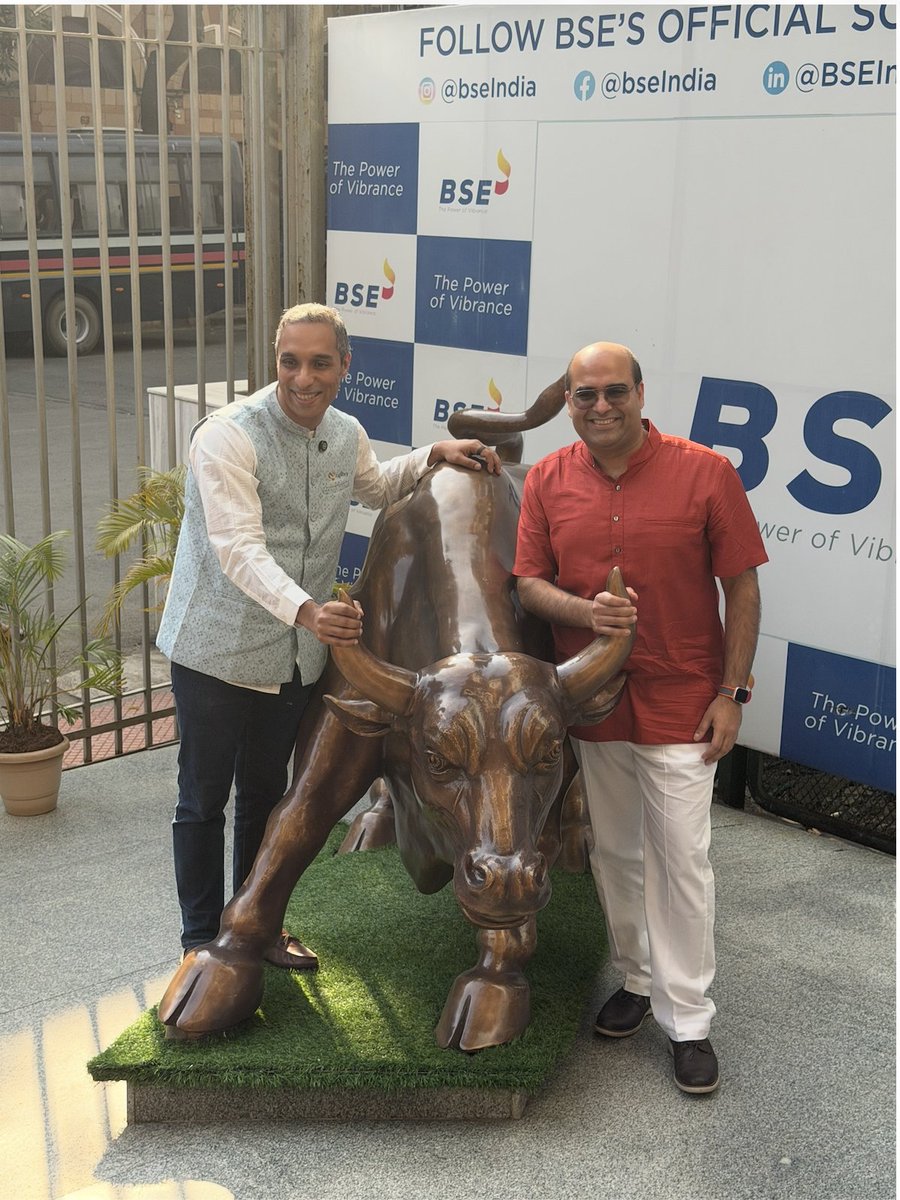
Today @capillarytech goes public. Seventeen years since three kids fresh out of college decided to start something in the wreckage of 2008.
I wasn't there for the second half.. the harder half. @AneeshBReddy steered this ship through storms I can only imagine. I'm grateful beyond words.
What I remember most isn't the milestones. It's the texture of those early days.
Merchants in Kolkata who humored us when we had nothing. Durga Puja 2008, camped outside police headquarters chasing traffic updates. Pan IIT at IIT Madras where our scrappy SMS service caught fire. That first angel check of ₹15 lakhs from IIT Kharagpur that we paid back in crores.
We had no idea what we were doing. Just energy, naivety, and this strange refusal to think small.
Then Aditya Birla and Future Group said yes. Right after Lehman fell. I still don't know why they trusted us.
The apartment in CV Raman Nagar with no water during the day. Chai walks in BTM Layout with @shubhmalhotraa, Abhilash, Prakhar, @pigol1.. trying to figure out if we were building something or just fooling ourselves.
Then loyalty took off.
That first campaign—₹11 lakhs in incremental sales, one weekend, fully attributed. That's when we saw it. A chance meeting with @KartheeMadasamy at CCD led to the @Qualcomm QPrize. We were shocked when we won.
The business grew, but we stayed scrappy. That tiny hotel in Dadar because it was cheapest. The Bangalore home-office. The Gurgaon apartment where Ajay held the fort. Holed up in Bur Dubai searching for product-market fit. The exhilaration when @sequoia (now @peakxvpartners) and @NorwestVP bet on us, alongside angels like @RajanAnandan, Venkat, KS, and Harminder.
But what I really remember are the crazy things.
Flooding someone in Gujarat with hundreds of thousands of texts. The new hire who nearly wiped our database on day one—later led all of engineering (take a bow, @pigol1). Anant building a POS system on an Excel sheet to close a deal. Sujatha, our first female hire, making sure our office was no longer a dorm room. Building loyalty systems where internet barely worked—the magic of "nightly sync."
We were pirates, not professionals. That's what made it magic.
Like humans, companies find their early years most thrilling. The teenage years? Brutal. But at seventeen, she's finally ready—scarred, wiser, infinitely stronger.
We remember our failures more than our wins. We carry the scar tissue.
But today, we celebrate.
What a journey, Capillary family. What a journey.
Big news: Portkey has joined @PaloAltoNtwks.
Portkey will become the AI Gateway for Prisma AIRS: the control plane for routing, securing, and governing every AI transaction in the enterprise.
Following integration, it will offer:
• Runtime security on agentic traffic
• AI identity + least-privilege access controls
• Compliance tooling
• 3,000+ LLMs and MCP tools, unified
• Production reliability via automated failovers and more
Same gateway. Same APIs. Same team. Full story: https://t.co/8UoPkn8pIN
The days of building a set of data pipes, dashboards and some workflows and building a business around it are long gone, not just in India but anywhere in the world. I don’t think we should call this out as a disadvantage for Indian founders only. You cant build a company for it even in Dogpatch
This is so dumb. @PaloAltoNtwks just announced intent to acquire @PortkeyAI: built entirely in India. Portkey had the most marquee global customers you could ask for.
Indian founders are stuck at a hard place in this AI wave. The super power of the Indian founders was that we could build quickly. AI has taken away that power. The process and data is king.
Indian founders would move to the valley, understand the processes there and build from India and sell to the US.
This playbook is broken now. The US businesses don't need Indian founders to map the technology gap. Even if you go to the valley, there are enough people there who have your skill set.
You cannot build a sales agent or support agent or marketing agent for US businesses. You don't know their processes. Even if you go to the valley, they will ask you to build with AI, so where is your advantage.
You may succeed individually as an FDE or something, but hard to justify an Indian business in the US in the AI world. I may be missing something, please point it out if you see it.
So what do we do?
In my opinion we have two choices.
1. Build for India.
2. Build some core tech.
That's it.
Palo Alto Networks agrees to acquire Portkey, which develops AI gateway tech to manage and secure AI agents; sources say the deal values Portkey at $120M-$140M (The Economic Times)
(Visit Techmeme dot com for the link and full context!)
Three years ago, two technical founders in India started building AI infrastructure for a market that didn't exist yet. Today, @PaloAltoNtwks announced their intent to acquire @PortkeyAI. Huge congratulations to @jumbld, @ayushgarg_xyz and the entire Portkey team!
It started with a problem they'd seen up close together at PepperContent. Conviction on where AI infrastructure was heading before most enterprises had shipped a Gen AI feature to production. A stellar team, a deeply opinionated product, a category they helped define from scratch. All built across a 12-hour time difference.
When we first met them, what stood out wasn't the pitch. It was how clearly they could see around corners. They predicted the shift from "do I even need a gateway?" to "I need federated gateways in three regions" before most CTOs knew they had the problem. By the time we led their Series A a few months ago, Portkey was already governing $180M+ in annualized AI spend, processing 500B+ tokens a day for the likes of DoorDash, Roche, Postman, and Snorkel AI. They had a crisp view of becoming the default control plane for enterprise AI. Palo Alto Networks saw the same inevitability. This outcome validates that entire thesis.
For a long time, the narrative around Indian startups was limiting. Great operators, but not category creators. Execution, not invention. There have been acquisitions before, but many were acqui-hires that quietly got tucked into a portfolio.
Rohit and Ayush didn't get the memo. They built cutting-edge infrastructure that the world's biggest security company wrote a serious check to own.
That narrative is now outdated. The next founder watching this thinks: "I can build from here, for the world, and win."
That's the virtuous loop.
For everyone in the corridor doing the 24-hour flights, the 6am customer calls, the cold LinkedIn outreach that goes nowhere, the late nights debugging on call while your kids sleep one timezone over: today is a good day. It's harder, but sometimes it's worth it :)
This is just the beginning. Rohit and Ayush: you have just inspired a whole generation of founders.
@PoorviVijay@mukularora Dhruv Jain Prerna Gupta Sanskar Jain @ElevCap
Three years ago, two technical founders in India started building AI infrastructure for a market that didn't exist yet. Today, @PaloAltoNtwks announced their intent to acquire @PortkeyAI. Huge congratulations to @jumbld, @ayushgarg_xyz and the entire Portkey team!
It started with a problem they'd seen up close together at PepperContent. Conviction on where AI infrastructure was heading before most enterprises had shipped a Gen AI feature to production. A stellar team, a deeply opinionated product, a category they helped define from scratch. All built across a 12-hour time difference.
When we first met them, what stood out wasn't the pitch. It was how clearly they could see around corners. They predicted the shift from "do I even need a gateway?" to "I need federated gateways in three regions" before most CTOs knew they had the problem. By the time we led their Series A a few months ago, Portkey was already governing $180M+ in annualized AI spend, processing 500B+ tokens a day for the likes of DoorDash, Roche, Postman, and Snorkel AI. They had a crisp view of becoming the default control plane for enterprise AI. Palo Alto Networks saw the same inevitability. This outcome validates that entire thesis.
For a long time, the narrative around Indian startups was limiting. Great operators, but not category creators. Execution, not invention. There have been acquisitions before, but many were acqui-hires that quietly got tucked into a portfolio.
Rohit and Ayush didn't get the memo. They built cutting-edge infrastructure that the world's biggest security company wrote a serious check to own.
That narrative is now outdated. The next founder watching this thinks: "I can build from here, for the world, and win."
That's the virtuous loop.
For everyone in the corridor doing the 24-hour flights, the 6am customer calls, the cold LinkedIn outreach that goes nowhere, the late nights debugging on call while your kids sleep one timezone over: today is a good day. It's harder, but sometimes it's worth it :)
This is just the beginning. Rohit and Ayush: you have just inspired a whole generation of founders.
@PoorviVijay@mukularora Dhruv Jain Prerna Gupta Sanskar Jain @ElevCap
Exciting News: We've signed a definitive agreement to join Palo Alto Networks!
We started Portkey on a single idea: that AI in production would need a control plane. Not a feature, not a category somewhere on the side of the stack. Infrastructure. A place where governance, observability, security, and routing converge so that enterprises can run AI the way they run any system they actually depend on.
Three years later, we route trillions of tokens per month for teams running AI at real scale. The idea became the floor. AI control planes don't win by being clever, they win by becoming standard.
The default. The thing nobody questions is in the stack. That's the next chapter. Getting there at the speed the moment requires means joining a company with the depth, reach, and enterprise footprint to make the standard real. Palo Alto Networks is that company for us.
Link to blog post: https://t.co/PfmEJsrKmK
When we first invested in Snabbit, it was live only in Powai. Every time I described it to friends elsewhere, their immediate question was always: “When is this coming here?”
In hindsight, the insight feels obvious. But it took an India-first, customer-backwards lens to see it… and exceptional execution to bring it to life.
What’s stood out since is the speed of adoption amongst consumers and experts.
Snabbit is on track to become a household name, bringing convenience to consumers across multiple services and more importantly unlocking better livelihood for experts.
Really fortunate to have had a ringside view to witness @Aa_Agarwl and team @just_snabbit creating a new category! 🙌🙌
@ElevCap@manishadvani12
Mosaic has raised a $3.8M seed round to build video editing agents.
What started as a side project to edit our own YouTube videos has quickly turned into something much bigger.
Today, global agencies, platforms, and news networks rely on our AI video editing workflows to scale content production.
I am especially excited to announce our partnerships with:
1. TubeScience: Meta's largest ad creative partner, 8K videos a month, 100M views a day, $2B annual spend.
2. News Corp: one of the world's largest media organizations, operating businesses like The Sun, TalkSport, Wall Street Journal, MarketWatch, HarperCollins, The Times, and more.
We are proud to be backed by top class Silicon Valley investors, like @ycombinator, @MayfieldFund, @ElevCap, @pioneer_fund, @transposevc, @twentytwovc, @scriptcapital, @phosphorcap, @amino_capital, @OliveAssetMgt, @FogVentures, @DCGco, and angels from @ycombinator, @OpenAI, @GoogleDeepMind. Special shout-out to @garrytan, @harjtaggar, and @bosmeny for being our partners through YC and beyond.
The funds from this round will be used to add a few more people to our lean team in San Francisco and continue research & development on the frontier of multimodal AI and agentic video editing.
I'm incredibly grateful to the entire Mosaic team for all the hard work each and every one of you do. I am so pumped for what is ahead.
Follow along our journey @mosaic_so and read more about the announcement at mosaic [dot] so.
Very excited to share our partnership with @noondesign. Design is what differentiates truly great products from the also-ran. But the people who design them — they have been stuck either with stodgy tools, or grappling with SWE-centric tools like Claude Code which were not built for their workflow. Noon changes that: built natively for the design workflow to help speed creativity and not get caught up in slop.
From the first time we met @bandiaditya and @kushagrasinha7 we were struck by both the audacity of vision as well as their ability to translate that vision into reality: one that designers we showed to had a jaw-dropping moment. A design canvas that’s fluid enough to unleash creativity but produces impeccable code that your engineering partner is going to be thankful for.
It’s been incredible to see them build with painstaking detail over the last year. This is what good design looks like - sweating the details. And this is the ethos designers appreciate. The Noon team’s been cooking - reach out if you want to be an early access customer.
It’s not been straightforward since this is a complex technical challenge, and the Noon team has created one of the most talent dense environment to help craft this product. Reach out if you are interested in building the future of product design.
@PoorviVijay@mukularora@ElevCap
I’m thrilled to announce we’ve raised $44M to build a new home for product design. Meet @noondesign.
No workflow is more broken and fragmented in 2026 than the product designers’. The very same people who care most about building software don’t have software purpose built for them. @kushagrasinha7 and I have lived this problem first hand as designers ourselves.
That’s why we built Noon. The first product design tool that works entirely on your product code, so you can design not only how a product looks, but also how it works. With AI at its core that works in seconds, not minutes.
For the first time, you can create, iterate, build, test and ship. All in one canvas. No translations or roundtrips to the codebase and back.
Comment “Get Noon” and we’ll get you on the list for early access.
today, we are making the @mosaic_so video editing api available to all agents & humans.
see how we setup larry — our slack openclaw agent — with a mosaic api key and had it clip, edit, and post archived steve jobs footage.
all without ever leaving slack.
you can connect your openclaw agents, claude code, or vibe-coded saas to our agentic video editing api.
no waitlist — now live at mosaic [dot] so.
comment "API" to get 100 free credits dropped into your account to get started with the api for free.
more details on why & how we’re making this change below (thread):