🚨🚨 BREAKING: YOUR EMPLOYER'S CASHFLOW PROBLEMS DO NOT SUSPEND YOUR RIGHT TO A SALARY.
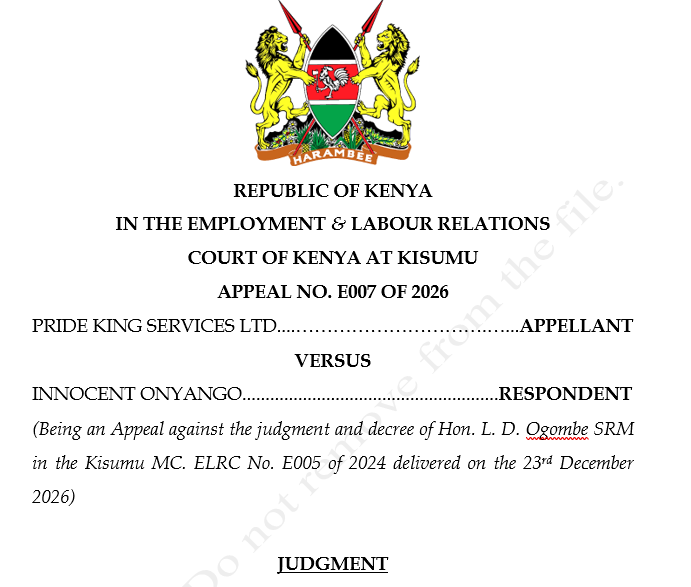
The Employment and Labour Relations Court at Kisumu has delivered an important decision clarifying a question that affects thousands of Kenyan workers: what happens when an employer simply stops paying salaries because business is struggling? In Pride King Services Ltd v Innocent Onyango [2026], a security guard resigned after going four consecutive months without receiving his salary. The employer admitted that it had experienced financial difficulties, explained that employees had been informed of the situation, and argued that the Respondent should have waited for the company to stabilize because the outstanding salaries would eventually be paid. The Court rejected that reasoning. In one of the most striking passages of the judgment, Justice Nzioki wa Makau reasoned that it is not the responsibility of a worker to figure out how the employer will pay his wages. The Court held that by failing to pay wages for months, the employer had created the very circumstances that led to the termination of employment and therefore upheld the finding that the employee had been constructively dismissed.
The Court's reasoning is significant. A salary is not a discretionary benefit that an employer may postpone until business improves; it is the primary consideration for an employee's labor and one of the employer's most fundamental contractual obligations. While the employer pleaded financial hardship, the Court found that such hardship could not be shifted onto an employee who continued reporting to work without pay. At the same time, the Court carefully distinguished liability from quantum. Although it upheld the findings on unlawful termination, salary arrears, notice pay, service pay and compensation, it reduced the awards for underpayments, house allowance and accrued leave because those claims were subject to the statutory limitation period under the Employment Act.
The jurisprudential importance of this decision lies in its reaffirmation that the risk of running a business belongs to the employer, not the employee. Courts will not readily accept financial difficulties as a legal justification for withholding wages while expecting employees to continue working. Equally, employees who seek relief must be alive to the limitation periods governing employment claims, as even a successful claim may be substantially reduced if brought outside the periods prescribed by law. The judgment therefore strengthens two important principles of Kenyan employment law: wages remain a fundamental contractual obligation despite economic hardship, and statutory employment rights must be enforced within the timelines established by Parliament.
Kindly repost widely 🙏
The 4th Kenya Blockchain & Crypto Conference (#KBCC2026) is in full swing — where Africa’s digital economy meets the future of stablecoins, payments & blockchain innovation. Big shoutout to Title Sponsor @okx
for powering this movement and backing builders! #OKXatKBCC