Another week on the road meeting with a couple dozen IT and AI leaders from large enterprises across banking, media, retail, healthcare, consulting, tech, and sports, to discuss agents in the enterprise.
Some quick takeaways:
* Clear that we’re moving from chat era of AI to agents that use tools, process data, and start to execute real work in the enterprise. Complementing this, enterprises are often evolving from “let a thousand flowers bloom” approach to adoption to targeted automation efforts applied to specific areas of work and workflow.
* Change management still will remain one of the biggest topics for enterprises. Most workflows aren’t setup to just drop agents directly in, and enterprises will need a ton of help to drive these efforts (both internally and from partners). One company has a head of AI in every business unit that roles up to a central team, just to keep all the functions coordinated.
* Tokenmaxxing! Most companies operate with very strict OpEx budgets get locked in for the year ahead, so they’re going through very real trade-off discussions right now on how to budget for tokens. One company recently had an idea for a “shark tank” style way of pitching for compute budget. Others are trying to figure out how to ration compute to the best use-cases internally through some hierarchy of needs (my words not theirs).
* Fixing fragmented and legacy systems remain a huge priority right now. Most enterprises are dealing with decades of either on-prem systems or systems they moved to the cloud but that still haven’t been modernized in any meaningful way. This means agents can’t easily tap into these data sources in a unified way yet, so companies are focused on how they modernize these.
* Most companies are *not* talking about replacing jobs due to agents. The major use-cases for agents are things that the company wasn’t able to do before or couldn’t prioritize. Software upgrades, automating back office processes that were constraining other workflows, processing large amounts of documents to get new business or client insights, and so on. More emphasis on ways to make money vs. cut costs.
* Headless software dominated my conversations. Enterprises need to be able to ensure all of their software works across any set of agents they choose. They will kick out vendors that don’t make this technically or economically easy.
* Clear sense that it can be hard to standardize on anything right now given how fast things are moving. Blessing and a curse of the innovation curve right now - no one wants to get stuck in a paradigm that locks them into the wrong architecture. One other result of this is that companies realize they’re in a multi-agent world, which means that interoperability becomes paramount across systems.
* Unanimous sense that everyone is working more than ever before. AI is not causing anyone to do less work right now, and similar to Silicon Valley people feel their teams are the busiest they’ve ever been.
One final meta observation not called out explicitly. It seems that despite Silicon Valley��s sense that AI has made hard things easy, the most powerful ways to use agents is more “technical” than prior eras of software. Skills, MCP, CLIs, etc. may be simple concepts for tech, but in the real world these are all esoteric concepts that will require technical people to help bring to life in the enterprise.
This both means diffusion will take real work and time, but also everyone’s estimation of engineering jobs is totally off. Engineers may not be “writing” software, but they will certainly be the ones to setup and operate the systems that actually automate most work in the enterprise.
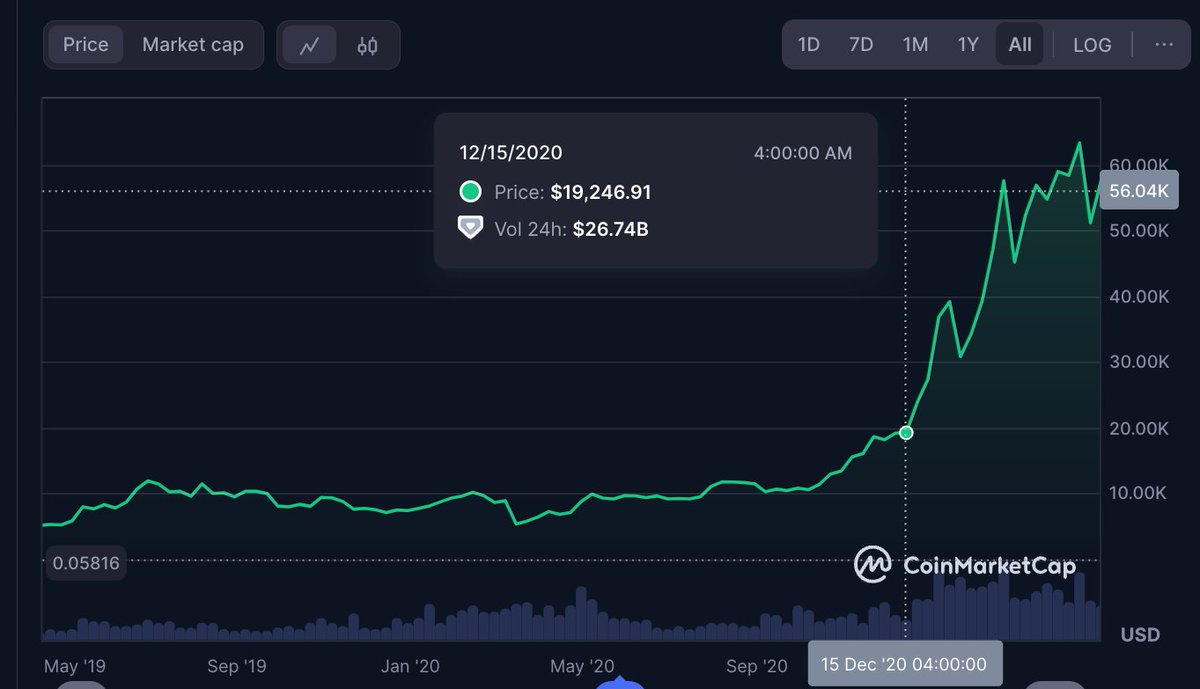
In this bloodbath today, I see a lot of people referring to this tweet 👇😂
For context, the bitcoin price was $19,000 when this tweet was written 5 years ago.
Also, I had no visibility of the graph to the right of the cursor at the time. That was in the future.
Zoom out. 🙏
2025 is a mathematical wonder.
▪️It is a perfect square. ( 45² = 2025 )
▪️It is the product of two squares ( 9² *5² = 2025 )
▪️It is the sum of three squares. ( 40² + 20² + 5² = 2025 )
▪️ It is the first square year after 1936. ( 44² = 1936 )
▪️It is sum of cubes from 1 to 9. ( 1³+2³+3³+4³+5³+6³+7³+8³+9³ = 2025 )
▪️Next perfect square is 92 years away and is 2116.
▪️The digits of 2025 add upto 9 and as per Indian numerology the digit 9 represents completion, attainment and fulfillment. ( 2+0+2+5 = 9 )
Let's make 2025 the most memorable and successful year. Make 2025 be the Best Year of Your Life
Via @T_Investor_
Chipotle steak burrito a decade ago: $6.65
Now: $11
“It’s inflation - what can you do?”
Chipotle profit a decade ago: $327 million
Now: $1.23 billion
“It’s savvy business!”
Chipotle CEO decade ago: made 778x the median worker
Now: CEO makes 1,354x the median worker
“He earned it! They didn’t.”
@hntrbrkmedia@GaryGensler@SECGov Specifically, yesterday they bought $HIMS July 22 puts, July 21.5 puts and July 21 puts ($1.26 million in total). Today they closed almost all of them by mid morning. This manipulation needs to be investigated for market integrity @GaryGensler
@hntrbrkmedia I don't think this is getting enough attention... @GaryGensler there was abnormally large put buyers recently; Yesterday was particularly unusual due to their exceptionally large size, and given they acquired them the day before the report was released. ...
@SpecialSitsNews@Preypark HIMS growth and future guidance doesn't include GLP-1s if you listen to the conference call.
LLY and NVO production rises in 1-2 years. Even to their own commentary it's a 2026 and 2028 story.
What happens to HIMS after is they continue on their growth path, w/ more customer's.
With OpenAI, Figure 01 can now have full conversations with people
-OpenAI models provide high-level visual and language intelligence
-Figure neural networks deliver fast, low-level, dexterous robot actions
Everything in this video is a neural network: