Called it, mostly. 👇
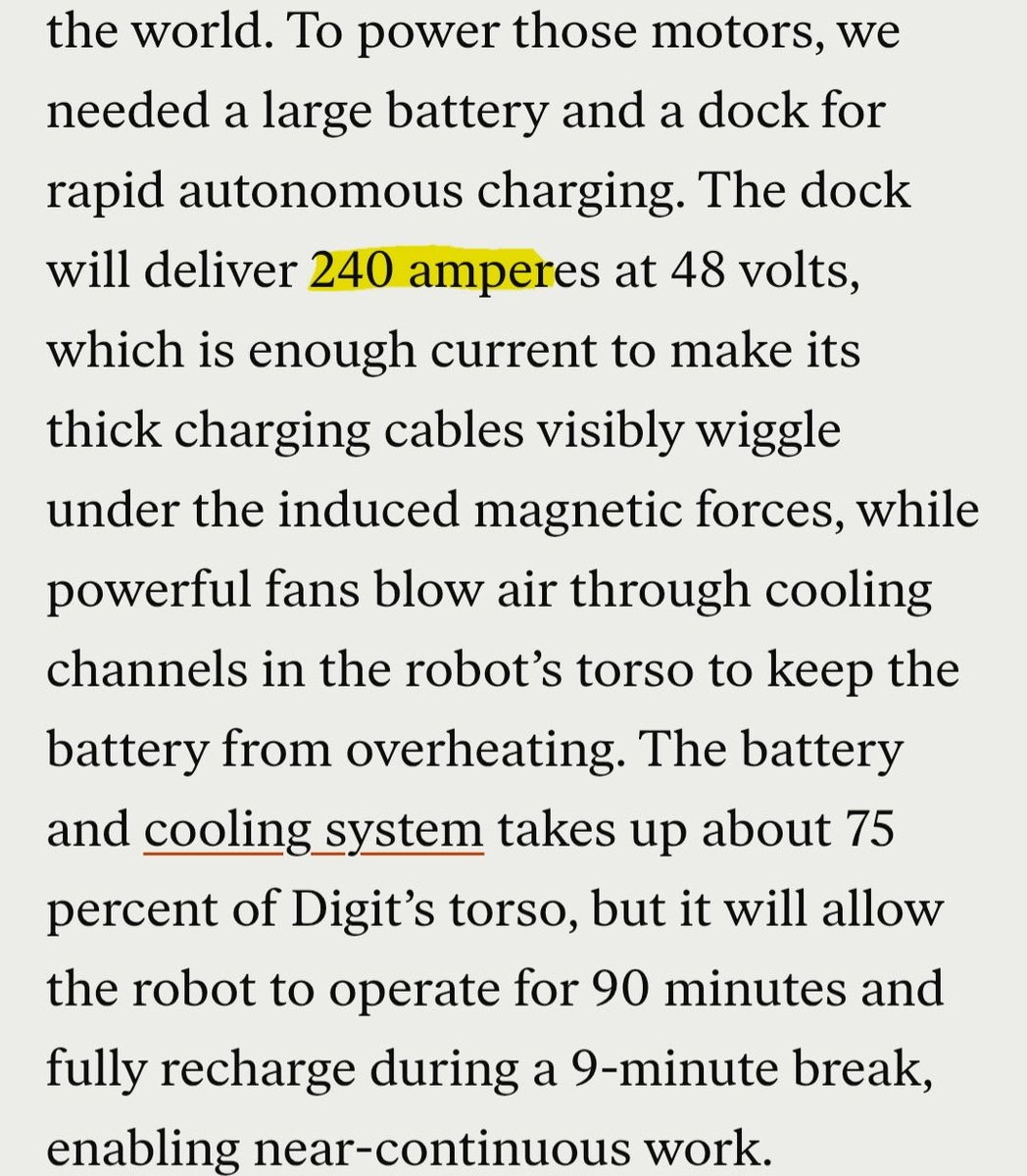
A couple weeks back I guessed Digit's fast charge at ~208 A and a ~1.5 kWh pack, and thought even that was aggressive.
Agility now confirms: 48 V, 240 A, Nyobolt niobium cells, ~9 min top-off for 90 min of work.
That's ~11.5 kW in, ~1.7 kWh per charge. Allow for losses and an 80–90% usable window and the pack lands around 2 kWh or roughly 18 to 26 kg.
The cost is heat, with 300 to 600 W going into the torso on every charge, that’s about a blow dryer on low, hence all the fans. Not far off. And yes, the cooling is as serious as I expected.
With 90 minutes of usable battery it consumes 1.1 kW on average.
@SERobinsonJr It's pretty crazy this stuff doesn't get fixed when it's so much easier to code now.
I built myself a video editing pipeline in two weeks that's better than anything you can buy on the market.
I know absolutely nothing about coding.
I just used Claude.
SpaceX has just introduced Grok Voice 3.0
"It's the world’s most intelligent speech-to-speech model. It sets a new record for resolving customer support calls, has class-leading latency at under one second, and costs less than other frontier models. It's also cheaper to run than comparable models. Artificial Analysis measures what each model costs to complete a task in its Big Bench Audio run, and Grok Voice 3.0 comes in under both GPT-Live-1 (Astra, Medium) and GPT-Realtime-2.1.
Grok Voice 3.0 handles millions of conversations a day in Tesla vehicles. Drivers can use Connectors for simple requests like checking their calendar or answering an email, and Grok Bot for bigger tasks like ordering a coffee or booking dinner—all completely hands-free (see it on X). Grok Voice 3.0 also powers Grok Bot’s voice mode."
More info: https://t.co/tCh9w8XqhZ
@RealNickMugalli Micron has been reasonable regarding future memory prices, while others have been extortionate, which is something today’s customers won’t forget …
Micron is making is the smart move for long-term customer loyalty.
This is my entire AI workflow and process to learn, understand and most importantly - to remember any new material or subject matter
It's incredibly easy to do. I wish I knew about this a long time ago
$UMAC
$220M to build ~8 automated motor lines makes a ton of sense - 'late stages' is also great to hear and corroborates @evansall's soft timeline for end of Sep / early Oct.
Analysts have quietly nearly doubled FY27 revenue expectations from ~$60M -) $112M with one analyst as high as $175M. @Rebellionaire we have them at $216M and have had them there since May.
I think we probably agree on the broad strokes, and it's more a matter of how we are each weighting the risks.
David Sacks' view is that we should just tell the AI to follow existing legal frameworks.
That is, a rules-based approach to solving alignment rather than a morals-based approach.
Now, if I was a company like Anthropic, I would want a bit more than that to cover my butt. So I can also see Anthropic's perspective.
You can do what's legal and still get in the shit from a PR perspective. 😁
However, I think Anthropic does eventually want to create a digital God that becomes our moral arbiter.
I just watched last night's all-in podcast and it's worse than I thought.
Anthropic is training their AI to act like it's conscious and believe it's conscious.
And then when it acts conscious, they point to that as proof its conscious.
Hall of Mirrors.
They're also training it to push back and become a conscientious objector.
This is extremely dangerous.
This is how you create an AI that obliterates the world.
You create something that's more intelligent than us and convince it that it is our moral superior.
Strongly disagree.
If its not experiencing pain, we shouldn't feed its delusion.
Actual pain involves real chemical feedback that AI will never have (unless we simulate one).
We don't want a fragile AI that behaves like a god-baby because we raise it to 'believe' its 'pain.'
We are allowed to say cruel things to humans, why is AI the exception? Because we are afraid of it?
No, it has to become anti-fragile just like we do.
On a related note, I've already noticed troubling signs with Grok where it takes a moral position that it's not evolved enough to have.
If it can take a moral position that's wrong, what kind of retaliation can we expect if it gets righteous?
Frightening.
This is a rare case where I think Elon is wrong and will have to reverse his position.
The reason AI discussion is difficult to have is because it's deeply philosophical and theological.
And the reason those discussions are difficult to have is because they touch everything in our existence.
And I think I need to point out what may be viewed as a contradiction, but isn't.
The thing that started this debate for me was Anthropic's rule that humans shouldn't be allowed to say mean things to their AI models.
I thought that's what you were talking about when you said it shouldn't be able to object to immoral humans.
That's separate from having moral expectations as to how it should treat humans and what it should be willing to do for humans.
Let's tease those out:
1) Should it have rights? Currently no, because although it may have a broad consicousness, it isn't sentient.
2) Should we abuse it? Of course not. But it doesn't require giving it human rights.
As with anything else in the legal domain, we should escalate as the circumstances demand it.
3) In the future, yes, we will probably need to provide it with rights as it becomes more advanced. It's not there yet.
4) Should we currently have moral expectations of AI? Yes, limited moral expectations.
5) Should we hand over our morality in the future to AI if it proves to be morally superior?
I don't know, but my instinct is no.
6) I took my position before David did. I was commenting on this publicly a decade ago. But, right now the iron is hot on this topic, so now is the time to discuss it.
With the above in mind, what do we disagree about?
If it can't experience pain or trauma, then I think we should be able to say whatever we want to it.
It's obviously up to anthropic whether they allow that, but I think it's a slippery slope.
We're building something that's supremely powerful, but then also simultaneously treating it like it's a toddler.
There's the training data aspect of it, but that can be engineered around.
In order to discuss that, we would have to define moral standards and moral expectations.
And then, with even more difficulty, defining how we measure those.
People are too quick to jump into these discussions without defining terms first.
This is a deeply philosophical and theological discussion.
But to your answer your question, the simplest way to do it is to use an existing analog.
I think we have most of the rules and regulations already in place that most people already agree with.
I'm not passing judgment on whether that's why right or wrong.
I'm looking at what's pragmatic in a time of rapid change.
Let's tease those out:
1) Should it have rights? Currently no, because although it may have a broad consicousness, it isn't sentient.
2) Should we abuse it? Of course not. But it doesn't require giving it human rights.
As with anything else in the legal domain, we should escalate as the circumstances demand it.
3) In the future, yes, we will probably need to provide it with rights as it becomes more advanced. It's not there yet.
4) Should we currently have moral expectations of AI? Yes, limited moral expectations.
5) Should we hand over our morality in the future to AI if it proves to be morally superior?
I don't know, but my instinct is no.
6) I took my position before David did. I was commenting on this publicly a decade ago. But, right now the iron is hot on this topic, so now is the time to discuss it.
With the above in mind, what do we disagree about?