Very excited that our latest version of scMerge2 to integrate multi-sample multi-condition single-cell datasets is out @NatureComms. We managed to integrate ~5 million cells from 20 COVID-19 studies. The new scMerge2 is available at https://t.co/tCu4kjlXJR.
Very proud of our new #SingleCell work on #PTSD and #MDD out in @Nature today.
Paper: https://t.co/W5WWmSmvoY
News and views: https://t.co/BMd9PnUXLr
Press: https://t.co/OdLX8CBVM3
Data: https://t.co/kjb0iJgDDH
Code: https://t.co/RZU7K56lBi
This work would not have been possible without all the members @sydneybioinfo involved! It was a wonderful experience collaborating with Helen! A special thanks to my supervisor @jeanyang21 for her great support!
Our new method BIDCell for segmentation of subcellular spatial transcriptomics data is finally out at @NatureComms ! BIDCell incorporates cell type and morphology info in segmentation and can be applied to Xenium, CosMx, Stereoseq and MERSCOPE. https://t.co/JavyOVgJO8
BIDCell is available at https://t.co/EdEDXfgPtt. We also developed a Cell Segmentation Performance Assessment (CellSPA) framework available at https://t.co/9LsiT7NBx5
.@LinYingxin@jeanyang21@sydneybioinfo present scMerge2, a computational method for integrating a large COVID-19 data collection with over five million cells to reveal distinct signatures of disease progression.
#BiotechNatureComms
https://t.co/L6XduvGGZ7
Very excited that our latest version of scMerge2 to integrate multi-sample multi-condition single-cell datasets is out @NatureComms. We managed to integrate ~5 million cells from 20 COVID-19 studies. The new scMerge2 is available at https://t.co/tCu4kjlXJR.
The COVID19 datasets used in scMerge2 can be downloaded from https://t.co/WVtPzU5je8, developed by @joshuawkho lab. Check out covidscope preprint for more details: https://t.co/5Ok0e0Zhru
I'm excited to share our publication of Stabilized mosaic single-cell data integration using unshared features 🎉
This was one of my final projects during my postdoc @CRUK_CI@emblebi and I'm immensely grateful to @MarioniLab & Carolina Guibentif for their efforts and support!
Next Monday, Helen and I will share our latest work in cell segmentation of subcellular spatial data. Join us in person (CPC) or via zoom to know more about our new method and new evaluation framework 😬
Next Monday, two of our postdocs @LinYingxin and Xiaohang Fu will be presenting on BIDCell, a data-driven strategy which can significantly enhance single-cell spatial expression analyses, including cell-cell interactions. See you in person or on Zoom!
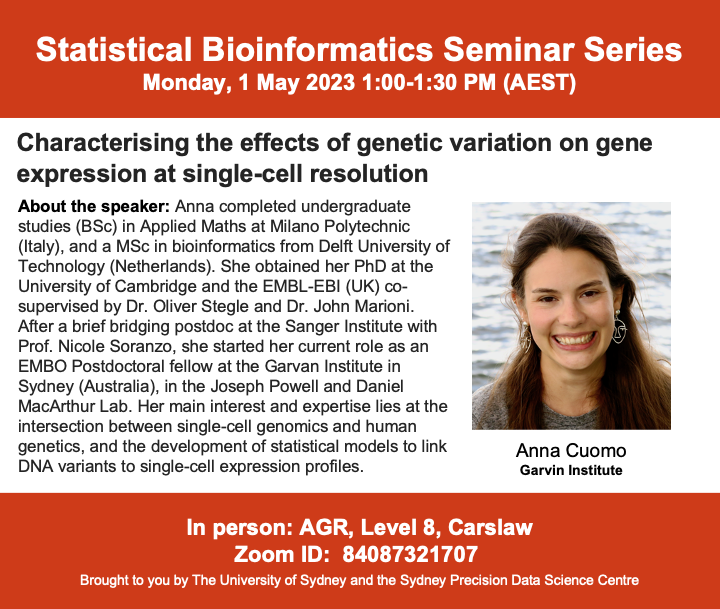
Next Monday, hear @AnnaSECuomo discuss the challenges in single-cell population genetics. She will present CellRegMap, a statistical framework to map regulatory variants across the continuous manifold of cellular environments estimated from scRNA-seq. Join in person or on Zoom!
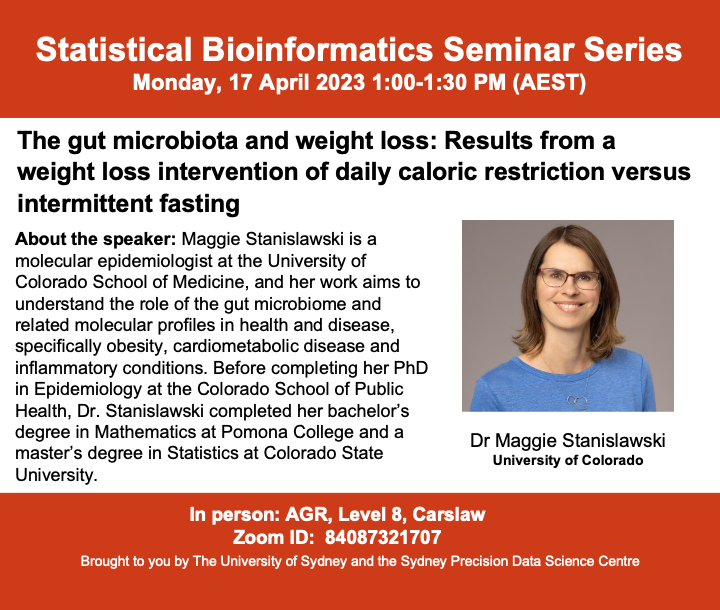
Altered gut microbiota has been linked to obesity and may influence weight loss. How do omic profiles respond to a weight loss intervention and how do they relate to weight loss responsiveness?
Join us in person or on Zoom next Monday with @MagStanislawski to hear more!
We are extremely delighted to host Professor @MelanieBahlo from @WEHI_research to present on multi-Omics and AI approaches for the study of retinal diseases such as macular telangiectasia Type (MacTel). We look forward to seeing you in person or on Zoom!
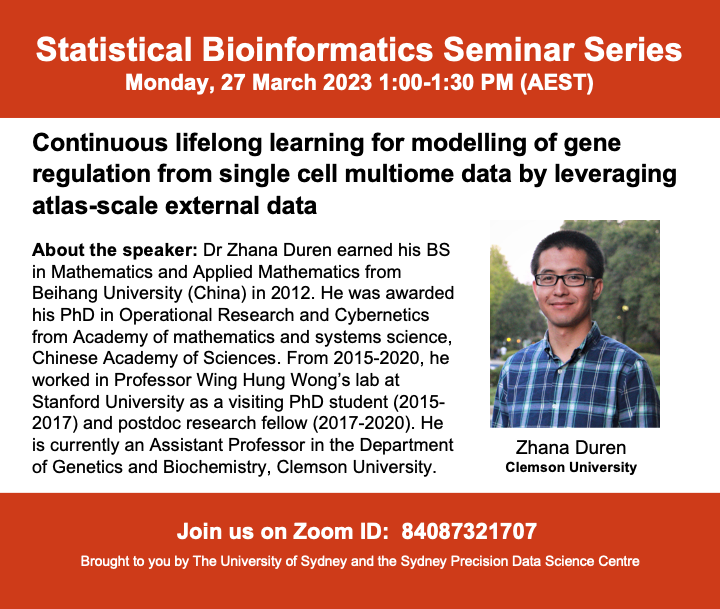
How can we increase the accuracy of inferred context-specific Gene Regulatory Networks (GRNs) from genomics data? Next week, join us on Zoom with @DurenZhana who will present on scPECA, a method which can provide 3 times higher accuracy compared to other methods.
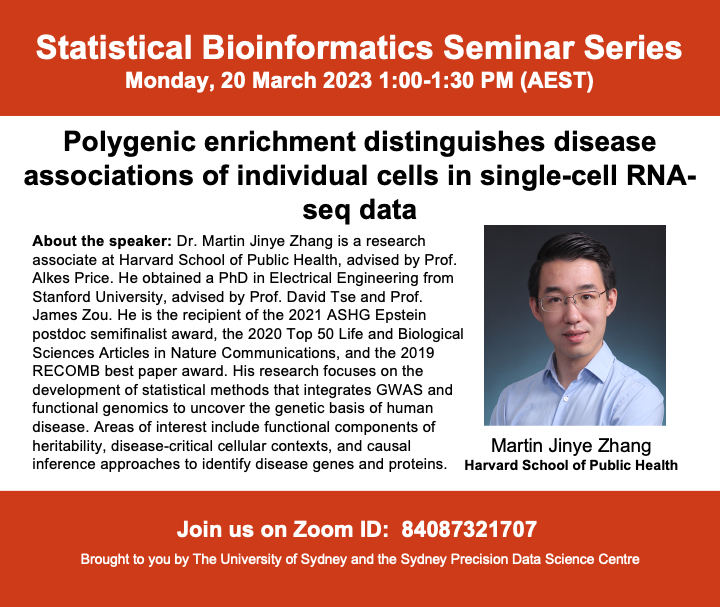
Next Monday, we are thrilled to have @martinjzhang discuss the benefits of using scDRS. It can identify subpopulations of disease-associated cells not captured by existing cell-type labels, providing insight into schizophrenia and inflammatory bowel disease. Join us on Zoom!