Shift into GEAR (Gemini Enterprise Agent Ready).
This course covers ADK’s open-source framework—moving from simple prompt engineering to a code-first, structured software development approach for enterprise multi-agent systems → https://t.co/UkTbg6CyUt
Solving Mathematical Problems: A Personal Perspective, by Terence Tao
╰┈➤https://t.co/jsZApXcdbO
Amazon summary: "Authored by a leading name in mathematics, this engaging and clearly presented text leads the reader through the various tactics involved in solving mathematical problems at the Mathematical Olympiad level. Covering number theory, algebra, analysis, Euclidean geometry, and analytic geometry, Solving Mathematical Problems includes numerous exercises and model solutions throughout. Assuming only a basic level of mathematics, the text is ideal for students of 14 years and above in pure mathematics."
5 open-source AI repos that blew up on github this week →
1. MinerU (opendatalab) - ~69k★
turns any PDF or office doc into clean, LLM-ready markdown - the fix for garbage RAG inputs
https://t.co/aUClIWBNTQ
2. voicebox (jamiepine) - ~35k★
open-source AI voice studio - clone a voice, dictate, create. the local ElevenLabs
https://t.co/TEOE9CNmdN
3. ai-website-cloner-template (JCodesMore) - ~22k★
clone any website with one command using your AI coding agent - great for learning and prototyping
https://t.co/bMOft1G7ND
4. Anthropic-Cybersecurity-Skills (mukul975) - ~21k★
800+ ready security skills for AI agents, mapped to MITRE ATT&CK and NIST - works with claude code, cursor, codex
https://t.co/mr1LYeunvK
5. agent-native (builderio) - ~3k★
a framework for building apps designed for AI agents from day one, not bolted on after
https://t.co/SG6MR1X2lS
one of these saves you a paid tool. bookmark before you forge
Fine-tuning massive LLMs used to be painfully slow, but not anymore!
4 open source libraries that accelerate fine-tuning of Large Language Models
1. Unsloth AI
• Fine-tune models like Qwen3, Llama 4, and Gemma 3 up to 2× faster with 70% less VRAM
• Uses optimized Triton kernels and manual backprop for exact accuracy
• Supports low-resource setups and runs on consumer GPUs or even Colab/Kaggle with ~3 GB VRAM
GitHub repo → https://t.co/n2aa7vWE1v
2. LLaMA Factory
• Fine-tune over 100 models (LLaMA, Mistral, Gemma, etc.) using a simple CLI or WebUI
• Supports LoRA, QLoRA, full or frozen fine-tuning across 2–8‑bit precision
• Includes built-in dataset templates, training monitors, and model export options
GitHub repo → https://t.co/Zrbg95fXpy
3. DeepSpeed
• Built for large-scale distributed fine-tuning with ZeRO and FSDP
• Optimized for multi-GPU and multi-node training with advanced memory management
• Trusted in production environments for scalable LLM training
GitHub repo → https://t.co/OekS5EZU2Z
4. Axolotl
• Yaml-based setup for fine-tuning, LoRA/QLoRA, DPO, GRPO, and multimodal workflows
• Includes kernel optimizations for memory-efficient training
• Actively maintained with support for Hugging Face, model export, and inference
GitHub repo → https://t.co/tUQ2W1Kpcl
Don’t learn ML by jumping between random tutorials.
DS-ML Bootcamp is a public Data Science & Machine Learning Bootcamp repository for beginners who want a structured path from zero to hands-on projects.
It helps you move from setup and concepts into practical ML work by organizing lessons, assignments, code examples, datasets, and submissions around the core machine learning workflow.
Key features:
• End-to-end workflow – covers collecting data, preprocessing, train/test splitting, model choice, training, evaluation, and deployment
• Lesson-based path – starts with tools/setup, data science, machine learning, data foundations, and regression
• Practice material included – assignments give learners structured tasks instead of only reading notes
• Code + datasets – Python examples and raw CSV datasets are included for hands-on exercises
• Follow-along setup – README says you can clone the repo and use Jupyter or VS Code while watching each lesson
Free public GitHub repo.
Link in the reply 👇
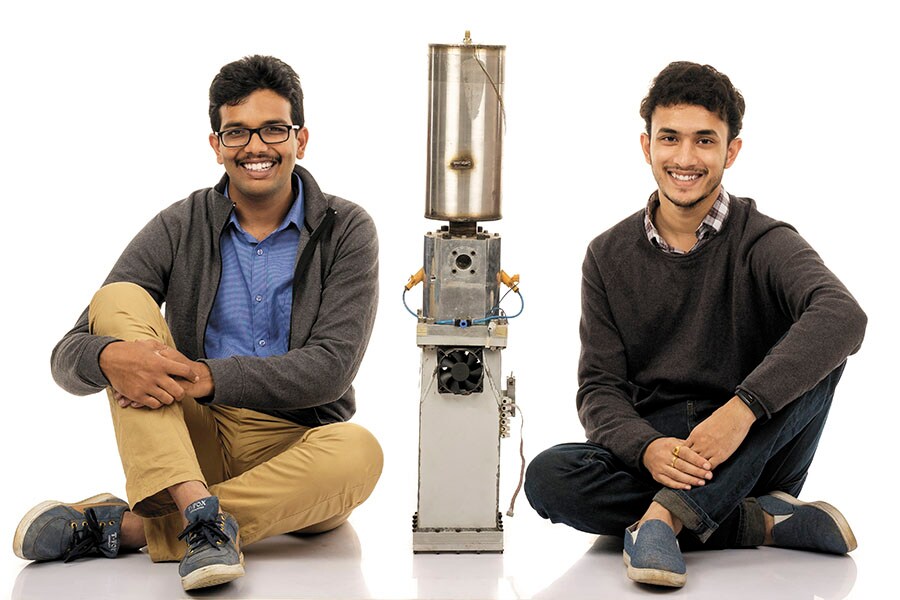
In 2012, a 19-year-old aeronautical engineering student from Coimbatore presented propulsion research at a NASA event. Dr. APJ Abdul Kalam noticed, sought him out for a meeting, and handed him a recommendation letter with one challenge: prove your concept.
That student was Rohan M. Ganapathy. Three years later, he and family friend Yashas Karanam co-founded Bellatrix Aerospace from IISc's incubation lab in Bengaluru. The problem they chose to solve touches every satellite in orbit.
Nearly all satellites run on hydrazine, a propellant that has been standard since the 1960s. It is deeply toxic, carcinogenic, and so hazardous that it requires specialized crews and loading facilities near the launch site. India imports all of it. Nobody was building an alternative.
Bellatrix built two. Rudra is India's first high-performance green propulsion system, delivering hydrazine-equivalent thrust while cutting handling costs by over 60%.
Jal is a microwave plasma thruster that uses water as propellant, which Bellatrix claims is the world's first such system built by a private company. Both have been tested in orbit: Rudra fired on ISRO's POEM-3 in January 2024, and again on POEM-4 in January 2025.
Their third product, Pushpak, is an orbital transfer vehicle the company says can bring satellite deployment costs from $45,000 to $25,000 per kilogram. In October 2024, Bellatrix signed an MoU with ISRO's commercial arm, NewSpace India Limited, to integrate Pushpak into its launch missions. The company has raised $31 million to date, backed by BASF Venture Capital, Inflexor Ventures, and Cactus Partners.
For India, a domestic green propulsion stack means less dependence on imported hydrazine, lower costs for Indian satellite startups, and export-ready technology in a global market actively moving away from toxic fuels.
Kalam asked Rohan to prove his concept. More than a decade later, the proof has been fired in orbit.
@rohanooty@BellatrixAero@YashasKaranam
On this day in 1974, Mario Molina (left) and Sherwood Rowland (right), published an article demonstrating that CFC gases have a damaging effect on ozone in the atmosphere.
Thanks to their work the gases were banned and the depletion of the ozone layer has slowed.
“Plasma Physics An Introduction to Laboratory, Space, and Fusion Plasmas” by Alexander Piel
This is a really solid introduction textbook to plasma physics, it covers everything from lab plasmas and fusion experiments to the solar wind and plasmas in space!
(I managed to source all 409 pages of it for free online for you too.😊)
Source ☢️: https://t.co/vE2U0akcsD
Bilgisayar bilimi için açık kaynak “lisans müfredatı” varsa, Elektronik Mühendisliği için neden olmasın?
GitHub’da devre analizinden dijital elektroniğe, sinyaller ve sistemlerden mikroişlemcilere, kontrolden haberleşmeye kadar Elektrik-Elektronik Mühendisliği müfredatını adım adım sıralayan açık kaynak öğrenme rotaları bulunuyor.
Üstelik kaynakların önemli bir bölümü MIT, Stanford ve benzeri üniversitelerin ücretsiz derslerinden oluşuyor.
Tek fark şu:
Bilgisayar bilimi bilgisayar başında öğrenilebilir.
Elektronik mühendisliği ise devre kurmadan öğrenilemez.
Bu yüzden açık derslerin yanına breadboard, multimetre, mikrodenetleyici ve gerçek projeler eklemek gerekiyor.
Diploma vermiyorlar.
Ama bir mühendislik bölümünde hangi konuyu, hangi sırayla öğrenmeniz gerektiğini ücretsiz gösteriyorlar.
Üniversite müfredatları artık yalnızca üniversite duvarlarının içinde değil.
https://t.co/rluObSD0Va
A brief history of Quantum computers 👇
1905: Albert Einstein explains the photoelectric effect and suggests that light consists of quantum particles or photons
1924: Max Born uses the term quantum mechanics for the first time
1925: Werner Heisenberg, Max Born, and Pascual Jordan formulate matrix mechanics, the first formulation of quantum mechanics
1925-1927: Niels Bohr and Werner Heisenberg develop the Copenhagen interpretation, one of the earliest and most common interpretations of quantum mechanics
1930: Paul Dirac publishes The Principles of Quantum Mechanics, a standard textbook on quantum theory
1935: Albert Einstein, Boris Podolsky, and Nathan Rosen publish a paper highlighting the counterintuitive nature of quantum superposition and arguing that quantum mechanics is incomplete
1935: Erwin Schrödinger develops a thought experiment involving a cat that is simultaneously dead and alive, and coins the term “quantum entanglement”
1944: John von Neumann publishes Mathematical Foundations of Quantum Mechanics, a rigorous mathematical framework for quantum theory
1957: Hugh Everett proposes the many-worlds interpretation of quantum mechanics, which suggests that every possible outcome of a quantum measurement actually occurs in a parallel universe
1961: Rolf Landauer shows that erasing a bit of information dissipates a minimum amount of energy, known as Landauer’s principle
1965: John Bell proves that quantum entanglement cannot be explained by any local hidden variable theory, known as Bell’s theorem
1973: Alexander Holevo proves that n qubits cannot carry more than n classical bits of information, known as Holevo’s theorem or Holevo’s bound
1980: Paul Benioff proposes a model of a quantum Turing machine, a theoretical device that can perform any computation using quantum mechanical principles
1981: Richard Feynman suggests that simulating quantum systems would require a new type of computer based on quantum mechanics
1982: David Deutsch generalizes Benioff’s model and proposes the concept of a universal quantum computer
1984: Charles Bennett and Gilles Brassard develop a protocol for quantum key distribution, which allows two parties to securely exchange cryptographic keys using quantum states
1985: David Deutsch and Richard Jozsa devise an algorithm that can solve a specific problem faster than any classical algorithm, known as the Deutsch-Jozsa algorithm
1991: Artur Ekert proposes another protocol for quantum key distribution based on quantum entanglement, known as the E91 protocol
1992: David Deutsch and Richard Jozsa extend their algorithm to handle multiple inputs, known as the Deutsch-Jozsa algorithm
1994: Peter Shor discovers an algorithm that can factor large numbers in polynomial time using a quantum computer, known as Shor’s algorithm
1996: Lov Grover invents an algorithm that can search an unsorted database in square root time using a quantum computer, known as Grover’s algorithm
1997: Isaac Chuang, Neil Gershenfeld, and Mark Kubinec demonstrate the first implementation of Shor’s algorithm using nuclear magnetic resonance (NMR) techniques
2000: David DiVincenzo proposes five criteria for building a practical quantum computer, known as the DiVincenzo criteria
2001: IBM researchers implement Grover’s algorithm using NMR techniques and achieve a modest speedup over classical algorithms
2007: D-Wave Systems claims to have built the first commercial quantum computer, but its validity is disputed by many experts
2019: Google announces that it has achieved quantum supremacy by performing a calculation on a 53-qubit quantum processor that would take a classical supercomputer thousands of years to complete
2020: IBM demonstrates that its 65-qubit quantum processor can perform calculations beyond the reach of any classical computer
📷 An IBM QC photographed by James Estrin
Looking forward to reading this book!
"The Shortest History of Innovation: From the Wheel to Gene Editing, AI, and Beyond―How New Ideas Shape Our World" by Andrew Leigh.
"In The Shortest History of Innovation, bestselling author Andrew Leigh tells the story of human innovation by identifying three of its most essential driving forces: tinkering, teams, and trade. Unveiling the surprising linchpins behind the everyday innovations that we take for granted, Leigh takes a closer look at the myriad ways ideas are developed, the forces that suppress them, and how they travel and evolve across borders and disciplines. From technologies and tools to art and feats of engineering, innovation is everywhere. Drawing on his background as an economist and his experience as a decision-maker in Australia’s House of Representatives, Leigh revisits history with fresh eyes and deftly connects it to the rapid innovation taking place today. The result is a lively, compact look at the engines powering progress."
https://t.co/cgkGpPjBjp
Linux Finally Killed strncpy. It Took Six Years, 362 Patches, and 70 Contributors.
The story of a 40-year-old C function that looked safe but wasn't, and the codebase-wide work that removed it from the kernel entirely.
Article Link: https://t.co/EKq81ZS24z
BOOM!
Meet the open source Cambrian Explosion of repulsion of Anthropic!
Meet Qwythos 9B, a Qwen3.5 based GGUF that's both uncensored and quantized for efficiency.
I am running it now and it is brilliant!
A model that can reason through 1 million tokens of context, understand images and text, and even call functions.
Come and take it!
https://t.co/UFU3fas9OD
Purchase, consume, spend, buy, acquire. Throw a coin in the well and make no wish. Throw bills from the roof of a ghost town. Invest and never take profit. Watch the snake bite its tail, watch him form the ouroboros. Wait. Wait until it’s dead. Add oil to the machine, until the mechanisms break. Press the pedal — accelerate until the engine explodes. Fast. Fast. Faster! Then wait. Wait again. Watch everything burn. Bathe in the ashes. Dance. You have never felt better. We can start again. And this time, this time we’ll make it work.
I’ve had enough
With Fable 5 being gatekept from us, and now GPT 5.6 being gatekept, I’m going full open source
Just went to Microcenter and built this RTX 5090 computer. Will be adding a RTX Pro 6000 to it shortly
This brings my home AI lab to:
• 3 Mac Studio 512gb
• DGX Spark
• RTX 5090
• 2 Mac Minis
I’m building a home AI lab that will allow me to run and support as many local models as possible
I already have Qwen 3.6, Orinth1.0 and GLM 5.2 running. Will be adding more.
They’re all running on my new custom built AI lab platform that’s making sure these models do work 24 hours a day for me
With frontier models being gatekept, and hardware prices becoming outrageous (this build cost $9,000), it was time to pull the trigger
In 1 year I believe prices for hardware will be triple from here. Mac Studios starting at $10,000. Mac Minis starting at $2,000. MacBook Pros starting at $5,000.
2 years from now I don’t believe any hardware will be available to consumers
The time to strike was now and I struck
In an age where intelligence both in the cloud and in your home are being limited, I’m becoming sovereign.
It might be time for you to do the same.
Kian Katanforoosh, Stanford AI lecturer (Forbes 30 Under 30):
"Wall Street will pay you $500K a year to build these models. I'd rather teach them to you for free."
this free stanford lecture holds the entire "AI predicts the market, 80% win rate" pitch the 2026 quant threads are selling you. and the man teaching it didn't take the fund money either, he co-built stanford's deep learning class, gave it to millions online for free, and started an AI company instead of a hedge fund.
at the board he builds it from scratch: a neural net doesn't predict the future, it learns the expected outcome across thousands of inputs at once, patterns no single indicator could hold. stack enough weak guessers, let them vote, the noise cancels and the signal survives. that's the whole "100 AI agents auditing the market" idea, minus the marketing.
backpropagation has been public since 1986. hinton won a nobel for it in 2024. random forests came out of leo breiman's free 2001 paper. none of it is secret. it's the same stack i mapped in the article above, old and free and sitting in a textbook the whole time.
and here's the honest part the win rate hides. a model that scored 80% on past data is describing the past, not promising the future. ensembles cut variance, they don't turn a weak edge into a real one, and the market shifts under the model in ways the training set never saw. the lecture is free. knowing whether your 80% survives on live capital is exactly the part the course skips.
Qualcomm just paid $3.9 billion for a 150-person company. The prize: a programming language that lets AI run on ANY chip without NVIDIA's CUDA.
Meta and Microsoft are already placing orders.
The NVIDIA software monopoly just got its first real challenger. $3.9B says this is real.
“If I were not a physicist, I would probably be a musician. I often think in music. I live my daydreams in music. I see my life in terms of music.”
― Albert Einstein