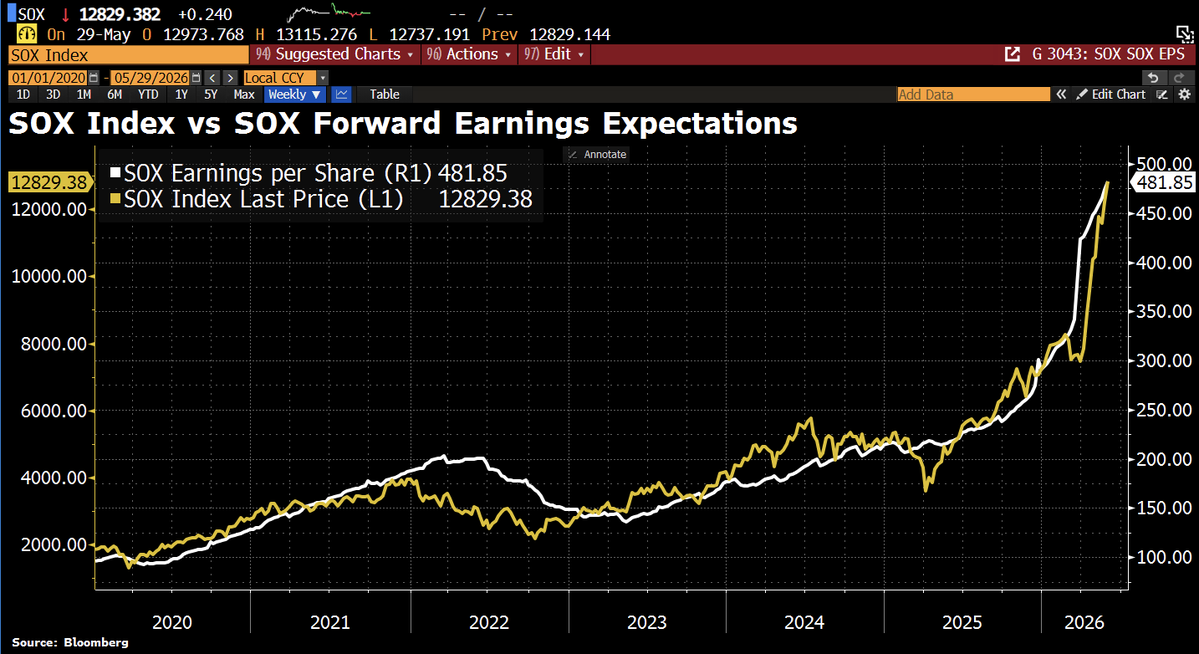
One of the most striking charts out there: the SOX index has risen sixfold since 2020, while SOX earnings per share have climbed fivefold. In other words, most of the rally has been backed by real earnings growth, not just higher valuations. The key question now is whether these profits will actually come through and whether they can keep rising. (HT Goldman Sachs)
A new and possibly controversial perspective:
In this video, I explain the sense in which generative AI trained by supervised learning is incapable of making novel discoveries.
https://t.co/zin5QbbT9N
The text of the speech:
AI Creativity and Discovery
Good day ladies and gentlemen. I regret that I am unable to be with you all today to engage in a back-and-forth discussion, but I am nevertheless pleased to be able to share with you, via this recording, some high-level thoughts about the current and future state of artificial intelligence, and in particular about AI’s relationship to science and mathematics, which is, as I understand it, the central focus of this meeting and of the SAIR Foundation.
I would like to start with an old joke; I am sure you have heard it before. It is the one about the researcher whose work is being evaluated, and the review comes back, and says “This work is both novel and good. Unfortunately, the parts that are good are not novel, and the parts that are novel are not good.”
My first point about AI is that this assessment applies exactly to large parts of AI as we know it today. Not all of today’s AI, but a large part of it. Pretty much all of what we mean by “Generative AI”---which includes large language models, and the images and video models, and even the new methods for learning world models. All of these AIs take large numbers of examples and produce a “model” which behaves similar to the examples, that is, which generates text like people, or images like artists or nature, and videos like we find on the internet. Don’t get me wrong, Generative AI can be extremely useful. No doubt about that. But the assessment of the joke still applies. These systems can produce output that is both novel and good, but not at the same time.
In many ways this is just absolutely not a problem. When we ask an AI for an answer from the internet, or to summarize a document, we don’t want it to be novel. We are happy if the quality of the answer, the goodness, comes from the source material—from the people who wrote the document or the articles on the internet. If the AI’s answer is novel it means it is going beyond the source material, adding something beyond it. This is what we call “hallucinations”. In most cases, we don’t like it when the AI makes something up, when it adds something novel.
One exception, of course, is when we are looking not for facts or reality, but for fiction and entertainment. We might ask for a bedtime story for a child, or an image based on existing images on the internet but which is nevertheless different and distinct from them. In these cases, it is never easy for us to know how creative the AI is actually being, as we do not know how close the AI’s story, poem, or image is to the source material. In a real practical sense we can not know this because the internet is too big, the possible sources that the AI may draw upon are too numerous.
When we ask for a fiction or novelty, the AI can give it to us because its processing is in part stochastic. Every decision can go multiple ways and will go different ways and produce a different trajectory every time. The trajectory can be random—and thus novel—or it can be based on the training data—and thus “good” because the training data is good, sourced from people or reality. Thus, the trajectory is either novel or good—based on randomness or based on data—but never both at the same time.
Really, I think it is okay if the output of Generative AI is never good and novel at the same time. For the researcher in the joke this is a devastating criticism, but for most things it is not, and for Generative AI it is not. Generative AI is meant to be a mimic. This is what supervised learning is for. Generative AI can be extremely useful, even when it just mimics, if it is faster, or cheaper, or smaller, or more customizable, or more copy-able, than the thing being mimicked. It is okay if Generative AI cannot be both novel and good at the same time. It is still a transformative technology.
But it is a limitation. And remember we are here to use AI for science and mathematics, and for these areas the assessment of the reviewer in the joke is devastating. For these areas we need true creativity and discovery. Generative AI—or Mimicking AI—will never get where us there. For these we need something more, and indeed we have something more in other parts of AI. We have many AI systems which can give us more. We have AlphaGo with its world-changing move 37, or AlphaZero with its brilliant original chess-playing style. We have GT-Sophy that drives simulated racecars better than any human. We have AlphaFold and AlphaProof and Claude-Code, which have brought true advances in science, mathematics, and programming. We have RL-Lyft which optimizes the assignment of cars to passengers in the ride-hailing business. All these systems have found things that are both novel and good. And, truth be told, some language models have been augmented in ways that make them more than Generative AI based on supervised learning.
All these systems have some additional features that make them capable of true creativity and true discovery. It is important for us to recognize what this is—and that it is not present in ordinary, garden-variety Generative AI. It is something that can not come from just supervised learning, from learning from examples. What is it? Well, it is a simple thing, a commonsense thing. It is not new. We have many names for it, but unfortunately none of them are very good names. I will call it Discovery. Basically, Discovery is just the idea of trying many things and seeing which of them work, then keeping those that worked the best. Evolution by natural selection works this way. The scientific method works this way. And just ordinary life and learning works this way. We try things and remember what works. What could be more obvious? In this behavioral case, psychology has two names for it— “instrumental learning” and “operant conditioning”—and in machine learning it is what we mean by “reinforcement learning”. We also see the idea of Discovery in planning and combinatorial search—anything that involves the idea of “generate and test”.
The essence of Discovery is to combine three steps:
1. Variation,
2. Evaluation, and
3. Selective retention.
Of course, I am not the first to say this. I am not the first to point out that this combination of steps is key to science, to evolution by natural selection, and to animal behavior. I think particularly of papers by Donald Campbell, by Daniel Dennett, and by Gary Cziko. What is new in my remarks is to directly relate the idea of Discovery to modern AI to help us see that it is not present in supervised learning or Generative AI—in particular, that Discovery is not present in backpropagation or gradient descent.
Let me say explicitly what is missing from Generative AI. As we have remarked, these systems do have a stochastic aspect, so they do generate a variety of trajectories and behavior. What is missing is the Evaluation step. The generator was pre-trained by supervised learning, leaving no way at runtime to Evaluate what it generates. And of course without Evaluation there can be no Selective retention, and thus no Discovery. The variation can bring novelty, but without evaluation there is no Discovery, and arguably, no creativity. That is, I would say that creativity requires that the new things generated be Evaluated. Without evaluation, and retention of the best, there is nothing created. The novelty flickers into existence but, if its value is unrecognized, it flickers away and is lost.
In many cases, Evaluation is done by people to make a discovery. As when we have Generative AI make many pictures for us, and then we pick the one that we like the best. The human+AI system completes the discovery.
In many other cases, the Evaluation comes from a clear objective. Some moves lead to checkmate, some steps lead to a proof, some actions result in high reward, some genotypes make more copies, some theories explain the data better.
Some prefer the Variation step to be called Blind variation, where “blind” here means that it is uninformed, a shot in the dark. It does not need to be completely uninformed; a good scientist does not select theories to test at random. But neither can it be completely informed and determined. There must be some uncertainty about where the answer lies in order for there to be a discovery. In practice, the variation is partly informed and partly blind, but it is the blind part that corresponds to the discovery.
Now let us briefly go all the way to modern deep learning, to the backpropagation algorithm. At first it might seem that backpropagation is incapable of discovery because it is deterministic and thus incapable of variation. But this is not correct. The weight updates of backprop are deterministic, but the weights are initialized to small random values. The random initialization is often downplayed, but in fact it is a necessary form of variation; it must be done properly to get good performance. In backprop this Variation is done once, at network initialization, so its effect is temporary, and later the network may lose its ability to learn. This is the weakness of deep learning that is alleviated with a new algorithm that my group presented in Nature a couple of years ago. Our “continual backpropagation” made one small change: every so often a less-used neuron would be re-initialized to small random weights. This allows the variation to continue and plasticity to be retained.
Although there is much more to be said about Creativity and Discovery, this is the key point: they are more than supervised learning, more than pattern recognition, more than prediction, and more than world modeling. Those things are important, but they alone will not bring us to discovery. Discovery requires Evaluation from a person or from an explicit goal, and only in the latter case will we attain full autonomy.
So that is my call to arms. If we want the full power of AI scientists, then we should share the goals with them so they can create, evaluate, discover, and in these ways fully participate in achieving the goals. Let’s be bold! Let’s fully automate Creativity and Discovery!
强化学习之父 Richard Sutton 发布最新演讲《AI Creativity and Discovery》,指出仅靠监督预训练的生成式 AI 本质上是「模仿式 AI」(Mimicking AI),无法在科学和数学领域实现真正的创造与发现。
Sutton 此前曾发推以 26 字重申「苦涩的教训」(The Bitter Lesson)立场,呼吁专注于搜索与学习等能随算力扩展的通用方法,而非人类知识。
Sutton 阐明,真正的发现与创造必须包含变异(Variation)、评估(Evaluation)和选择性保留(Selective Retention)。生成式 AI 虽有采样随机性带来的变异,但运行时(runtime)缺乏评估机制,无法选择性保留有价值的生成。这导致生成式 AI 的输出要么因随机而新颖,要么因数据而优秀,但无法同时做到新颖且优秀,试图超越源材料便会产生幻觉。
Sutton 强调,发现的本质是基于明确目标函数的「尝试与保留」,这存在于强化学习、规划和组合搜索中,但纯预测和监督学习并不具备。即使是反向传播算法(Backpropagation),在运行时也是确定性的,变异仅发生在权重初始化阶段,导致神经网络在训练中逐渐丧失可塑性(Plasticity)。为此,他介绍了此前发表于《自然》(Nature)的持续反向传播算法(Continual Backpropagation),通过定期随机重置低使用率神经元的权重,使网络得以维持持续变异与学习能力。
Sutton 最后呼吁,若要实现全自动自主 AI 科学家,人类必须将科学探索的衡量标准写成算法可度量的「目标函数」共享给模型。只有让 AI 在运行时自主进行「生成尝试、利用目标打分、选择性保留」的完整闭环,不再依赖人类在屏幕前充当裁判,才能真正自动化科学发现与创造。
A British biologist looked at 200,000 years of human history and found that the entire reason humans broke out of poverty was not intelligence, not language, not even agriculture, but one mechanism so simple a 6-year-old could explain it.
His name is Matt Ridley.
He is a zoologist by training, an evolutionary biologist by career, and in 2010 he wrote a book called The Rational Optimist that quietly argued the most important fact about human progress had been hiding in plain sight for the entire history of economics.
Naval Ravikant has been telling people to read everything Ridley has ever written for the last 15 years. The reason is the argument inside this one book.
For 200,000 years, anatomically modern humans walked around with the same brain you have right now. Same skull size. Same neural architecture. Same raw capacity for language, planning, and abstract thought.
For roughly 190,000 of those years, almost nothing happened. Generation after generation lived and died inside the same Stone Age toolkit their great-great-grandparents had used. Then somewhere around 50,000 years ago, the line on the chart of human progress started to tick upward. Then it bent. Then it exploded.
The question Ridley spent years on was the only question that mattered. What changed.
It was not the brain. The brain had been the same for 190,000 years. It was not language, which had existed long before the takeoff. It was not even agriculture, which arrived only 10,000 years ago and was actually preceded by the upward bend, not the cause of it.
What changed was that humans started trading with strangers.
This sounds too small to be the answer. Ridley argues that it is the answer to almost everything. The moment one human exchanged a useful object with another human from a different group, something happened that no other species on earth had ever done.
Two ideas that had developed in isolation came into contact. The flint knapper learned what the spear maker had figured out. The fisherman from the coast learned what the hunter from the forest had figured out. The two pieces of knowledge fused into something neither side could have produced alone.
Ridley calls this ideas having sex. The phrase sounds frivolous and it is meant to. The point is that ideas, like genes, get better when they combine with other ideas from different lineages.
An idea sitting inside one head, no matter how brilliant the head, eventually hits a ceiling. The same idea exposed to ten thousand other ideas does something genes do under sexual reproduction. It mixes. It recombines. It produces offspring nobody planned.
The cleanest proof of this argument is the most uncomfortable case study in the book. Tasmania.
Around 10,000 years ago, rising sea levels cut Tasmania off from mainland Australia. A population of roughly 4,000 humans was now isolated on an island, with no possibility of contact with the rest of humanity. They had the same brains. The same language. The same starting toolkit as their cousins 150 kilometers north. The natural experiment was now running.
What happened next is something no economist or geneticist had ever predicted.
The mainland Australians kept inventing. Boomerangs. Spear-throwers. Fishing nets. Bone needles for sewing fitted clothes. Watercraft with paddles. Their technology compounded slowly across the centuries.
The Tasmanians went the other way. They did not just fail to invent the new tools their cousins were developing. They started losing the tools they already had. Fishing was abandoned within a few thousand years. Bone tools disappeared. Fitted clothing disappeared. They forgot how to make fire from scratch and started carrying lit firebrands from camp to camp instead, relighting their fires from a neighbor's whenever their own went out.
By the time European explorers arrived in the 17th century, the Tasmanians had the simplest toolkit of any human society ever recorded. Their material culture had gone backward for 8,000 years.
The archaeologist Rhys Jones called it a slow strangulation of the mind.
Joseph Henrich at Harvard later proved with formal mathematical models that there was nothing wrong with Tasmanian brains. There was something wrong with their network. A toolkit requires a critical mass of people exchanging skills to maintain itself.
The act of teaching a skill is imperfect. Every generation loses a small percentage of what the last generation knew. If your population is large enough and trading widely enough, those losses get caught and corrected by someone else who still remembers.
If your population shrinks below a certain threshold and stops mixing with outsiders, the small losses compound until entire technologies disappear.
This is the part that should haunt anyone reading this in 2026.
Intelligence is not a property of the individual brain. Intelligence is a property of the network the brain is connected to. A genius in isolation will produce less than a mediocre thinker inside a dense exchange of other mediocre thinkers.
The thing your ancestors needed in order to break out of 190,000 years of stagnation was not better brains. It was better connections between brains they already had.
The implication for any individual is direct and uncomfortable. If you are smart and isolated, you will be outproduced by people half as smart who are connected.
The most successful people in any field are almost never the smartest people in it. They are the ones positioned at the intersection of the most idea flows. They are reading more authors than their competitors. They are talking to more people from more disciplines. They are in the rooms where ideas from different lineages bump into each other.
Ridley ends the book on the line that sounds optimistic but is actually a warning its this "The future will be invented by people who connect ideas, not by people who guard them."
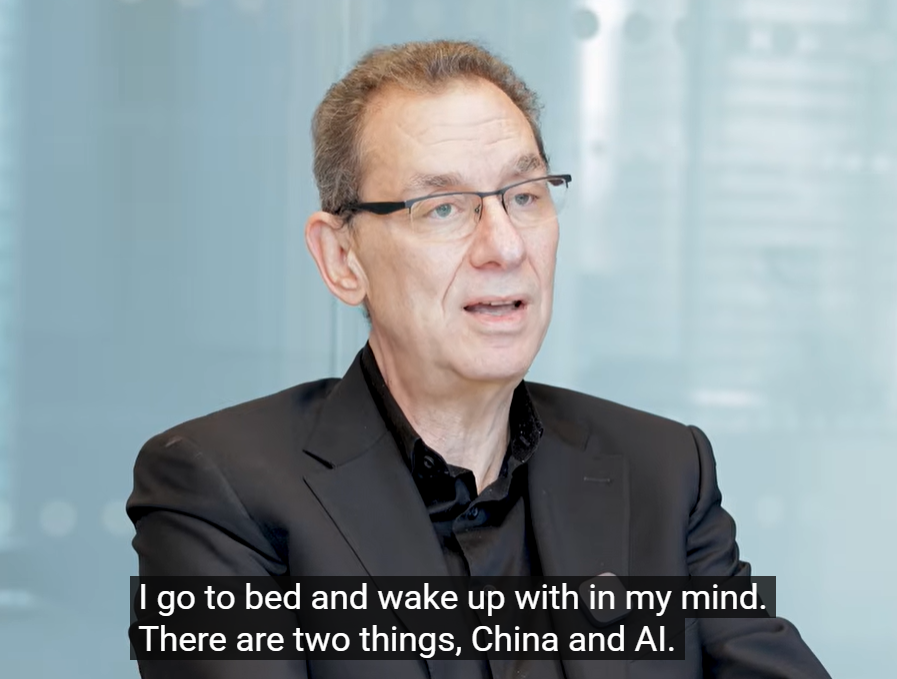
Pfizer CEO on the Norges interview, he goes to bed and wakes up with two things in his mind: "China and AI." common theme too with other pharma CEO interviews.
He said a few interesting things, below, and before you start screaming how much you dislike this guy (imagine thinking Greeks ever cared about being liked) just discount his message according to your bias.
For me, a lot of what he is saying is probably pumped on purpose to send a message to his regulators (wake up or China will eat our lunch). But still worth incorporating into your thinking.
1-In his view, Chinese pharma strength right now is in early stage (discovery, chemistry, testing, preclinical) "for every one area we have a company working on something novel the Chinese have ten companies working on it too" and on R&D productivity "they do things 3 times faster and at half the cost"
2-Another strength is the technical capability of the regulator, paraphrasing "they spent years copying the FDA, iterating, their process mirrors it, but is now faster, and with an ability to quickly distinguish garbage from diamonds" (the Novartis guy also mentioned something like this)
3-And final strength, most surprising for many: he says it is a great place to invest because of how they have developed a very strong IP protection system (imagine that) "the judiciary system can resolve IP issues very quickly, if someone challenges your patent you are not having uncertainty for 10 years"
4-He says Chinese pharma weakness is they still don't have global clinical development teams neither global commercialization teams. That is what makes all these licensing deals with global pharmas possible:
---usd200bn deals announced over the past couple of years, latest actually on Friday by Pfizer usd650m + usd10bn licensing deal with Innovent for 12 early stage oncology candidates
5-However, he thinks licensing is not a sustainable strategy for global pharmas, because at some point Chinese pharmas will stop selling their drugs to global players, and instead go to market themselves to keep the profit
6-So the only way long term is to be better than them, and that requires an exponential change to productivity, since the benchmark is the above "3 times faster, half the cost" (hint to the regulator there)
7-Finally after 30min of talking he decides to directly point at the regulator saying "stop spending 80% of your time and effort in slowing down China, because it is not going to work, and instead spend 80% of your time an effort in helping us accelerate"
Now, from an investing perspective:
8-There is a big mismatch between China biotech "insider vibes" from CEOs, industry participants, and commercial newsflow, vs share price performance
9-Innovent stock was up 11% on Friday on the back of the Pfizer deal, but has been rangebound for almost 1 year, and recently starting to break lower. Similar story with Beone or Akeso. Other China pharma bluechips like Hengrui are already down 30% (from big multiples true).
---On the fundamental front, Innovent and Beigene had 2025 as their first year of profitability, with top line growing at 40%. They trade at 10x 6x P/S respectively
10-Similar story around services, where only Wuxi Apptec is working, while XDC and Biologics are rangebound (despite XDC saying they are fully booked till 2030, almost as if they were making datacenter gas turbines), and tier two names like tigermed, pharmaron, joinn starting to break lower.
11-Medical equipment is even worse, from big guys like Mindray to smaller like Tofflon.
12-Even AI pharma pump names like Insilico are breaking (this company btw gives me forbes 40 under 40 vibes, though I confess I haven't bothered to look in detail, it may be a fantastic business, you tell me)
So, a lot of good stuff happening for people, new good cheaper drugs, not a lot of good stuff happening for investors. May be a global sector issue, may be a flow issue, which generalist in its right mind is selling Nvidia to buy Chinese pharmas.
Cash flow no longer covers the AI capex bill, so hyperscalers are funding it with record debt:
Hyperscaler bond issuance has soared to $150 billion YTD, more than the prior two years combined.
Dan Loeb started Third Point with $3 million. it's now $24 billion.
when asked which books shaped how he invests, he named four, each one representing a different phase of his evolution as an investor:
phase 1. event-driven deep value:
"You Can Be a Stock Market Genius" by Joel Greenblatt. "most of the people i know in that world use that as their framework." spin-offs, privatizations, post-reorganization equities. buying things cheap that nobody else was doing the work on.
....
One thing that feels different between the US and East Asia:
In a lot of East Asian systems, your trajectory gets determined very early.
People who perform well academically early tend to stay ahead in very linear ways.
In the US, the variance feels much wider.
You see people peak later, reinvent themselves, switch paths entirely, start companies, become creators, unexpectedly win.
Maybe that’s part of the American Dream mindset:
the belief that your future doesn’t have to be fully decided at 15.
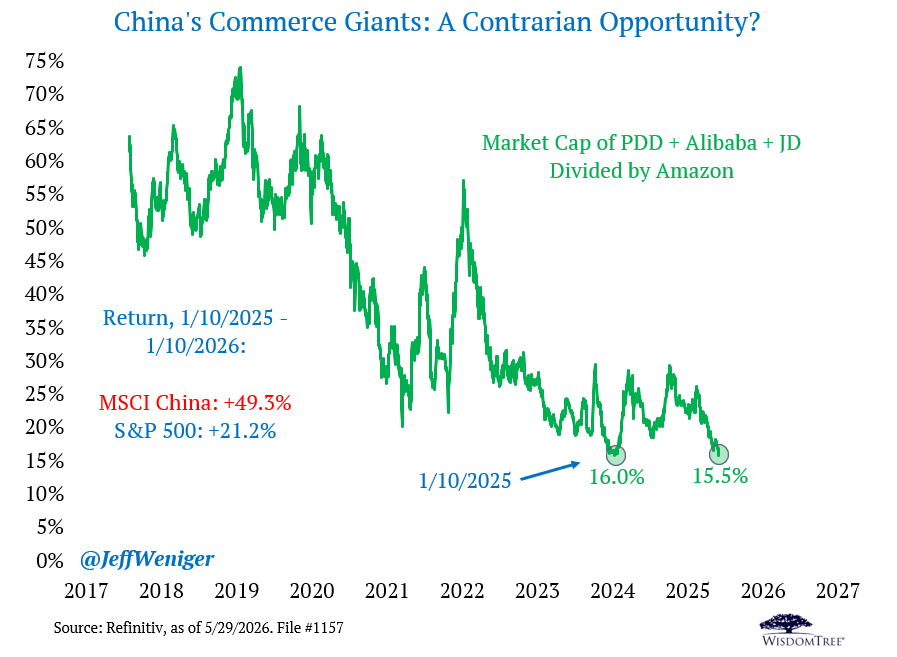
This market has left PDD, Alibaba and JD for dead, with a total market capitalization across all three down to 15.5% of Amazon's market cap. They also got this low on January 10, 2025, at which point Chinese stocks proceeded to destroy the S&P 500.
In the last 30 days alone:
– Microsoft cancelled most of its Claude Code licenses, citing cost
– Uber burned through its entire 2026 AI budget in 4 months
– Uber's COO publicly said AI costs are "harder to justify"
– A Fortune 20 CEO ordered token spending to be "dramatically slashed"
– One company spent $500M in a single month on Claude with no usage limits
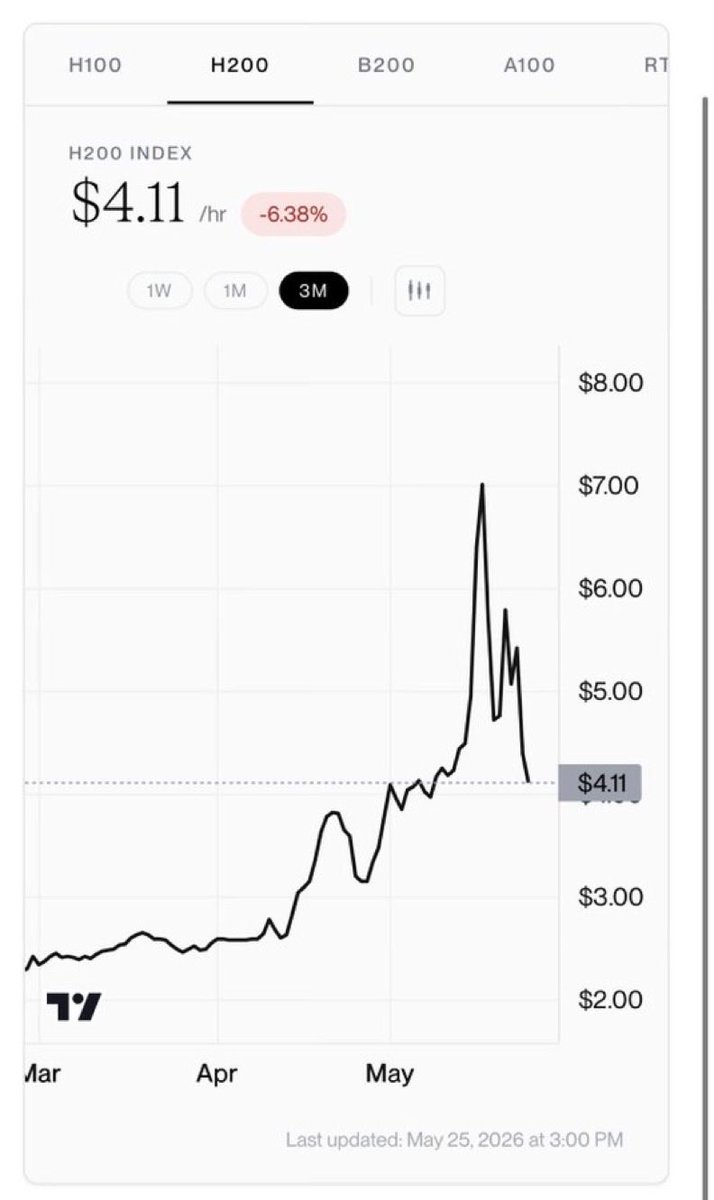
– H200 rental prices crashed from $7/hr to $4/hr in three weeks
The stocks: still at all-time highs.
How long can the market keep ignoring the receipts?
NEW: Amazon has reportedly scrapped its internal AI leaderboard as costs soared, with a senior executive telling staff: “don’t use AI just for the sake of using AI.”
OpenAI and Anthropic are effectively telling the market they can't solve every problem with a generic AI coworker.
You don't pour billions into massive forward-deployed joint ventures if you think the next model release is going to take care of it.
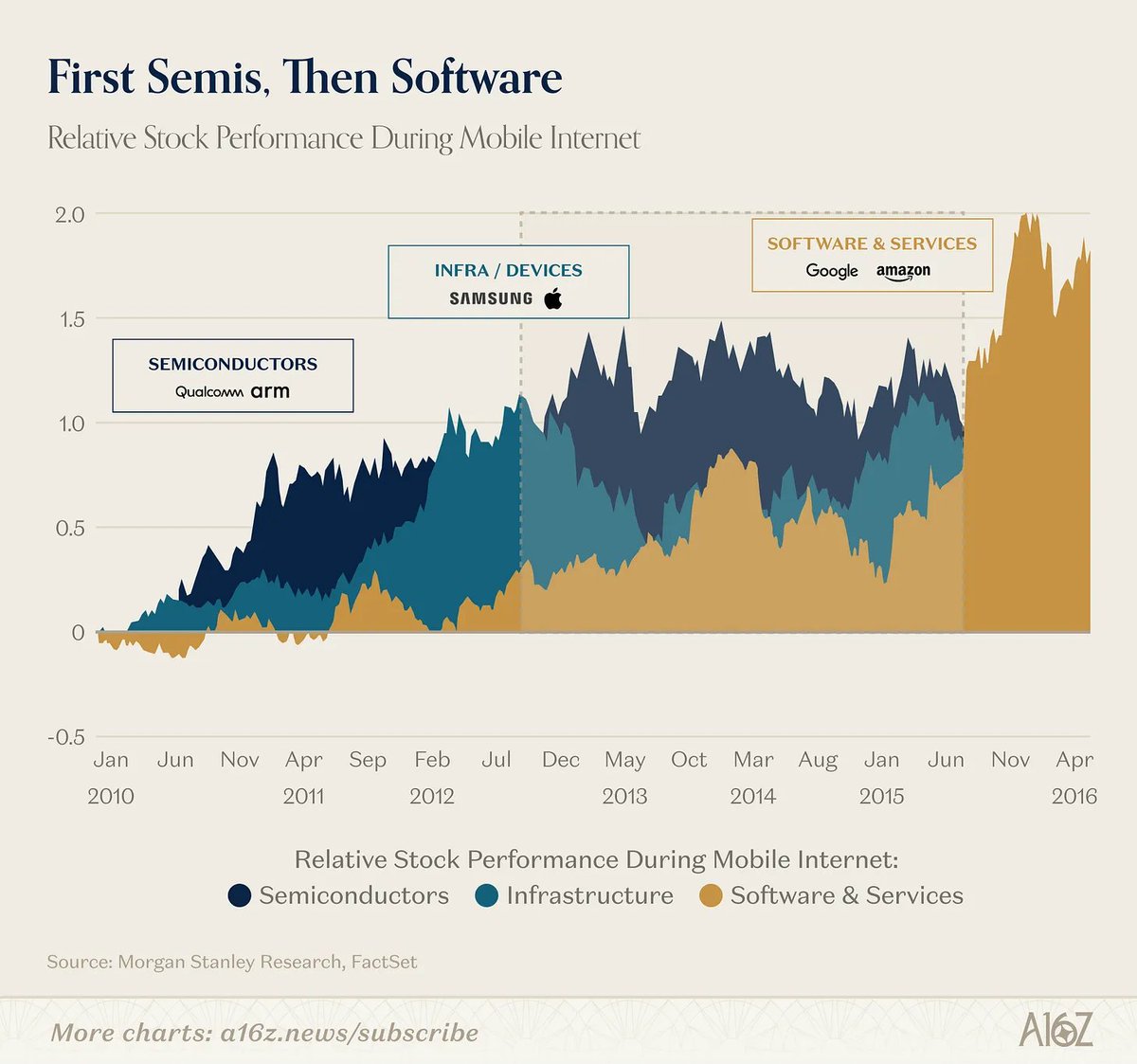
In the cloud supercycle, semis led and software followed (and you didn't need Qualcomm or ARM to tell you the value was migrating up the stack).
In AI, the infra layer itself is telling us the application layer is a separate, massive opportunity they can't fully capture.
a16z's @joeschmidtiv on why the app layer isn't dead: https://t.co/84QN5Mj9T3
The price to rent an Nvidia H200 just collapsed from $7/hr to $4/hr in three weeks.
A -40% drop in the cost of the single most strategic asset in tech.
When the underlying commodity that powers your entire thesis loses 40% of its value in a month, that usually means one of two things: supply finally caught up, or demand was never as deep as the headlines said.
Either way, somebody is selling.
So why is the AI trade still pricing in scarcity?
- Semis are 22% of $SPX
- Big AI is 40%
- The 41 AI-stocks in the $SPX are 61%
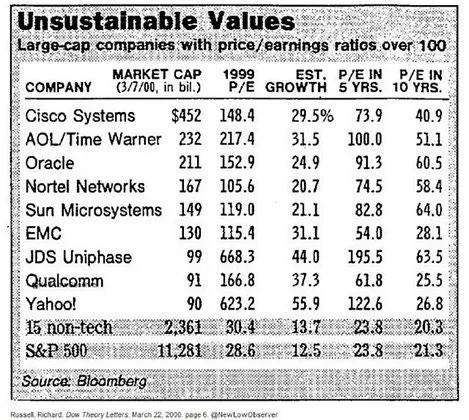
So, yes, the biggest bubble concentration ever - railroads - is challenged today.