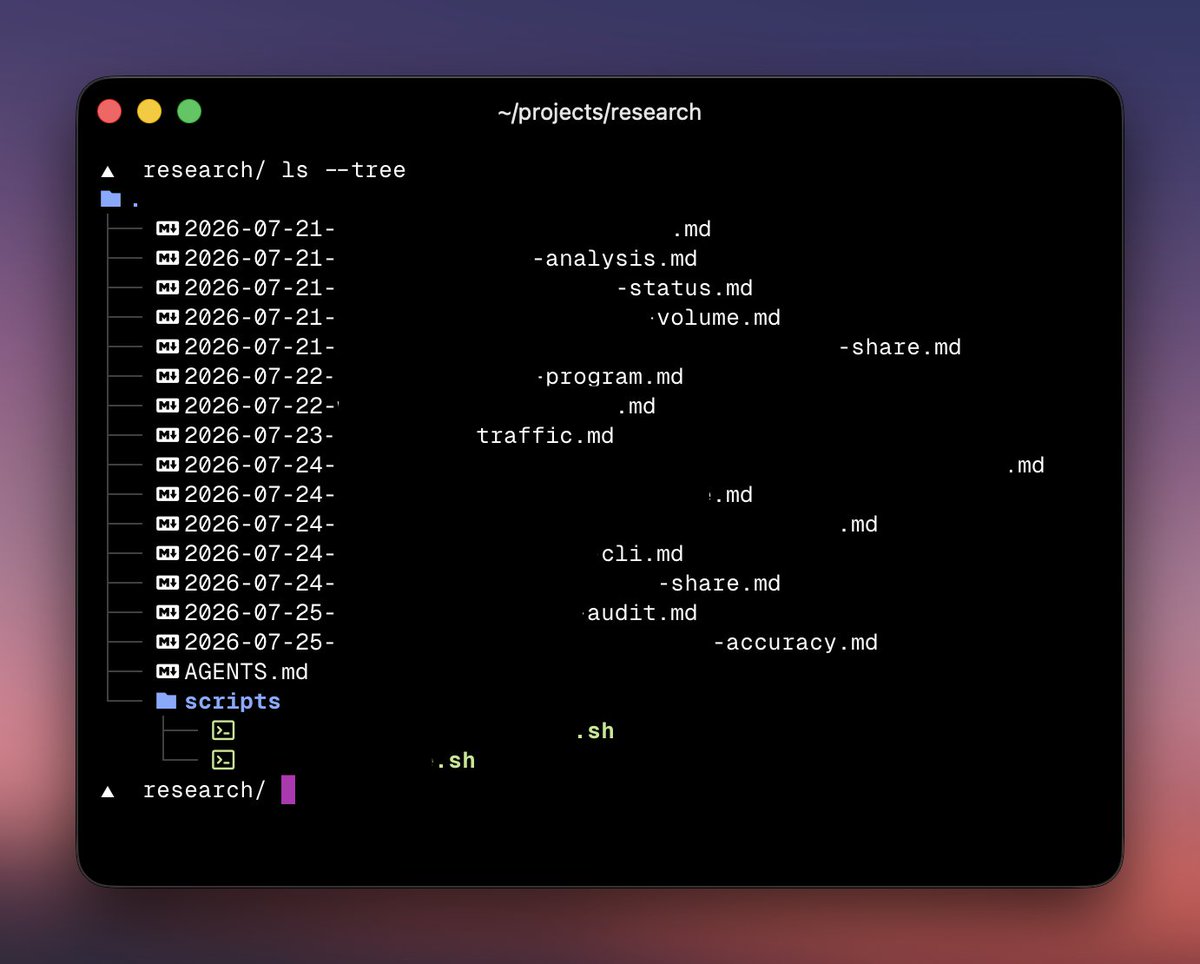
I started doing all my research with agent CLIs and the filesystem. A 📁 𝚛𝚎𝚜𝚎𝚊𝚛𝚌𝚑/ folder, an 𝙰𝙶𝙴𝙽𝚃𝚂.𝚖𝚍 describing the format I like and best practices. Then launch my agent and ask a question.
No fancy apps, knowledge graphs, UIs. The agent can be asked to find and correlate knowledge from previous sessions. Scales to infinity. The folder can be synced via iCloud, git, etc.
If I want to share some outcome, I can ask the agent to render a cool HTML report and deploy it to Vercel. The "software" that powers this is English in 𝙰𝙶𝙴𝙽𝚃𝚂.𝚖𝚍.
If you aren't yet bold enough to install the Codex app, you can stay in the presence of your orange crab and point it at GPT 5.6 Sol. Takes 5 minutes. Kudos to Theo for explaining one of the ways to get this done.
Step 1: Install CLIProxyAPI
Step 2: Connect
Step 3: Define following alias and enjoy claudex
```
alias claudex='CLAUDE_CODE_SUBAGENT_MODEL=gpt-5.6-sol \
CLAUDE_CODE_ALWAYS_ENABLE_EFFORT=1 \
CLAUDE_CODE_MAX_TOOL_USE_CONCURRENCY=3 \
ENABLE_TOOL_SEARCH=false \
claude --model gpt-5.6-sol'
```
If this gets blocked, I owe you a reset.
Your Openclaw / Agent can now control multiple robots in realtime.
We’ve abstracted and standardized all hardware and control interfaces so your agent can run our spatial tool calls on ANY robot.
Fleet command of humanoid, quadruped, xARM, and Piper arm in unison. Fully open source.
I don't prompt Claude Code anymore.
I have loops running that prompt Fable, and my job is just to write loops.
This is the Boris Cherny method, and I have to say, it's extremely powerful.
Everything you need to get started with loop engineering (as a complete beginner):
met an anthropic engineer making $1.2M a year.
asked him how he ships alone at the pace of a full team.
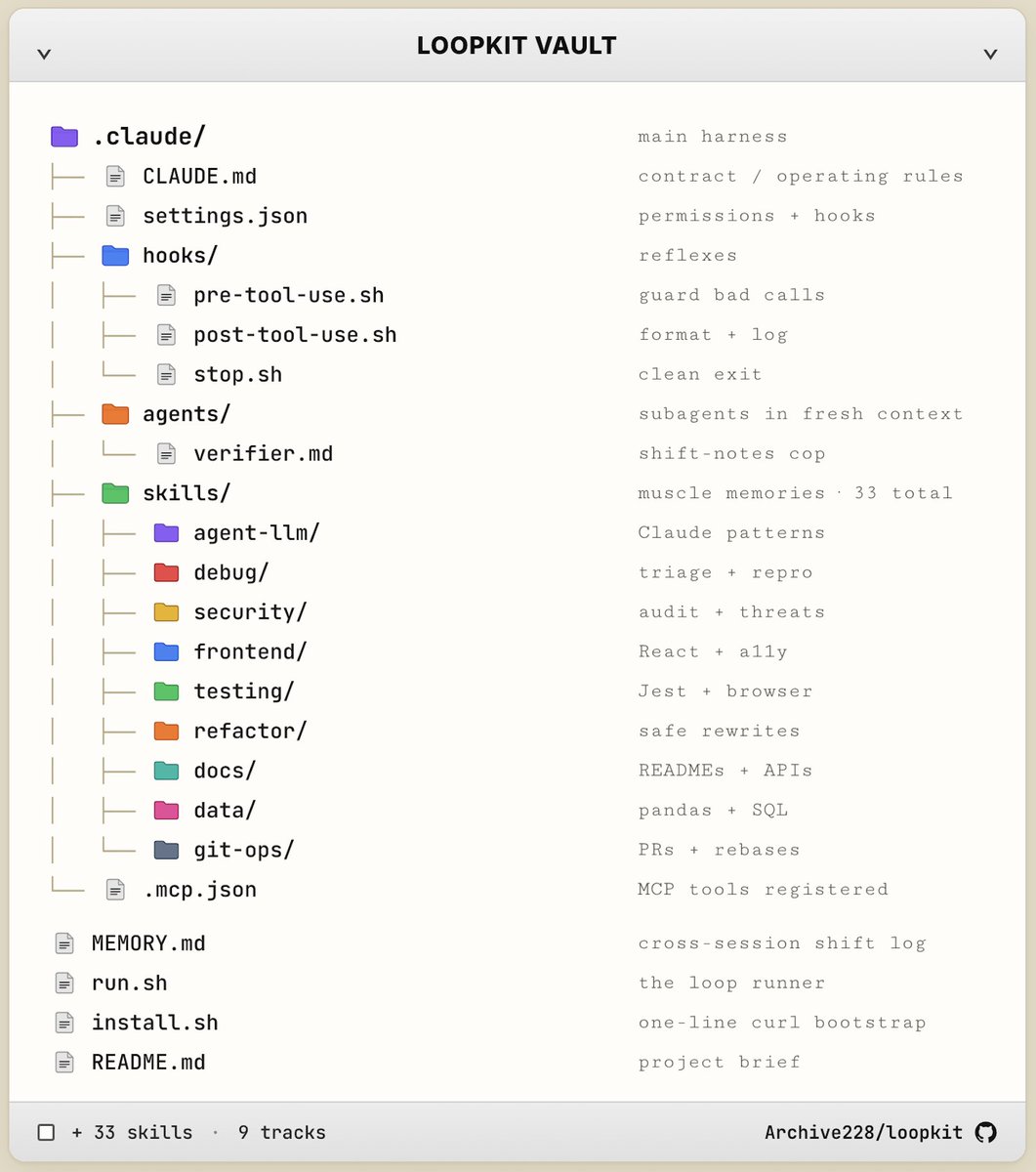
he didn't answer. sent me his .claude/. one folder.
SAME MODEL - DIFFERENT RESULT.
everyone's still picking between opus and sonnet like the model is the ceiling. it isn't.
the real lever is what the model wakes up into:
CLAUDE.md → hooks → verifier subagent → skills → mcp → memory → shift notes.
you stop chatting with the model.
you write the folder once. the folder runs the model.
- CLAUDE.md - the contract
- settings.json - the permissions
- hooks/ - the reflexes
- agents/verifier - the shift-notes cop
- skills/ - 33 muscle memories
- .mcp.json - the tools
- MEMORY.md - the shift log
that's the stack.
full breakdown in the article below. bookmark before he realizes i posted it.
Use Fable 5 as orchestrator and Opus + Codex to execute (to save fable usage):
Fable 5 (max reasoning) = orchestrator
Opus = deep reasoning subagent
Sonnet = mechanical work subagent
Codex = peer Sr. engineer, different perspective
Setup:
1. Set Fable 5 as your main model In Claude Code: /model → Fable 5 → reasoning /effort to max
2. Create 2 subagents with /agents In Claude Code:
deep-reasoner → pinned to opus "Use for reasoning-heavy phases, architecture, debugging complex issues, algorithm design. Think thoroughly, return a concise conclusion the orchestrator can act on."
fast-worker → pinned to sonnet "Use for mechanical tasks, boilerplate, tests, formatting, simple edits. Execute efficiently."
3. Add OpenAI's official Codex plugin (install codex cli in your computer first), In Claude Code type:
/plugin marketplace add openai/codex-plugin-cc
/plugin install codex@openai-codex
/codex:setup
4. Drop this in your CLAUDE.md in your folder:
## Orchestration workflow
You (Fable) are the orchestrator. Plan, decompose, synthesize.
Reasoning-heavy phases → deep-reasoner
Mechanical work → fast-worker
Codex (/codex:rescue --background) is a cracked engineer on par with deep-reasoner, from a different perspective. Treat as a peer, not a reviewer.
High-stakes decisions: task Opus + Codex on the same problem in parallel, synthesize the best of both, without showing either the other's answer. Keep your own context lean.
5. Then prompt Fable like a tech lead: "Goal: [what you want] Context: [files, constraints] You're the lead. Delegate reasoning to deep-reasoner, grunt work to fast-worker, fresh-perspective problems to Codex. Show me your plan first, then execute."
That's it.
I've been getting a TON done with Fable today and I'm not hitting rate limits. Wanted to share some tips on how I'm doing that
1. I only use Fable on "high" effort for now. xhigh is token hungry. max/extra is a furnace with worse outputs than lower options imo
2. I taught Claude Code how to use Codex as a fallback for lots of implementation tasks. GPT-5.5 is incredibly steerable, and Fable can learn how to steer it
3. I wrote up a big section in my CLAUDE[.]md on how to prioritize different models for different work when orchestrating workflows and subagents
4. Things that are unnecessarily token hungry (computer use, codebase analysis, etc), I do with other models and report results back to Fable
Spotify Chief Architect, Niklas Gustavsson:
"Once we implemented loops in our workflow, our agent success rate went from 20-30% to 80%."
26 minutes with Claude Code creator Boris Cherny on how Spotify runs AI agents across 20 million lines of code.
Today 73% of their code is written by AI, most merged without a human ever seeing it.
The model matters less than the loop you build around it.
Watch it, then read the full guide on building loops below.
@github Just to be clear:
Microsoft’s GitHub was compromised when a Microsoft developer using Microsoft VSCode installed a rogue extension from Microsoft’s VSCode extension library, which is moderated and hosted by Microsoft.
I guess I’ll be reevaluating my life choices.
Unpopular opinion: I don’t care if most web apps look the same. All I care about is whether it does what it says and does it fast.
Make it fast. Make the UX obvious. Put the right things in the right place and little to no animations.
HTML is the new markdown.
I've stopped writing markdown files for almost everything and switched to using Claude Code to generate HTML for me. This is why.
Coding agents will be the foundation of all superintelligence.
At a minimum, coding ability is indistinguishable from 'proficiency with computers'. Great coding agents like Claude Code master bash, filesystems, configuring and installing programs…
But it's also about self-improvement. A coding agent has the ability to examine its source, its state, its skills, its instructions… it can propose changes to itself (with human supervision and audit trail, I recommend), or even mutate itself directly.
In retrospect, this should be obvious. "What I cannot create, I cannot understand". Coding fluency has given models a deeper understanding of all computer and knowledge work. To master programs, you must be able to create them.
The Head of Claude Code at Anthropic hasn’t written code by hand in months.
Vibecoding his way to 49 features in 2 days.
Just dropped a 30-min breakdown of the workflow.
honestly better than most $200 courses
We’ve added a new command: npx shadcn apply.
Instantly apply a full preset across your project. Swap components, themes, colors, CSS variables, fonts, and icons all at once.
Apply. Test. Repeat.
New agent skill: 𝚛𝚎𝚊𝚌𝚝-𝚟𝚒𝚎𝚠-𝚝𝚛𝚊𝚗𝚜𝚒𝚝𝚒𝚘𝚗𝚜
Add React <𝚅𝚒𝚎𝚠𝚃𝚛𝚊𝚗𝚜𝚒𝚝𝚒𝚘𝚗> animations to any React app. Also covers how Next.js can natively integrate them.
• Animate elements across navigations
• Slide pages forward and back
• Smooth loading transitions
• Composition and accessibility handled
8 new rules added to the React Best Practices skill:
npx skills add vercel-labs/agent-skills --skill vercel-react-best-practices
Some of these patterns are a fun read for humans too.





![diegocabezas01's tweet photo. Use Fable 5 as orchestrator and Opus + Codex to execute (to save fable usage):
Fable 5 (max reasoning) = orchestrator
Opus = deep reasoning subagent
Sonnet = mechanical work subagent
Codex = peer Sr. engineer, different perspective
Setup:
1. Set Fable 5 as your main model In Claude Code: /model → Fable 5 → reasoning /effort to max
2. Create 2 subagents with /agents In Claude Code:
deep-reasoner → pinned to opus "Use for reasoning-heavy phases, architecture, debugging complex issues, algorithm design. Think thoroughly, return a concise conclusion the orchestrator can act on."
fast-worker → pinned to sonnet "Use for mechanical tasks, boilerplate, tests, formatting, simple edits. Execute efficiently."
3. Add OpenAI's official Codex plugin (install codex cli in your computer first), In Claude Code type:
/plugin marketplace add openai/codex-plugin-cc
/plugin install codex@openai-codex
/codex:setup
4. Drop this in your CLAUDE.md in your folder:
## Orchestration workflow
You (Fable) are the orchestrator. Plan, decompose, synthesize.
Reasoning-heavy phases → deep-reasoner
Mechanical work → fast-worker
Codex (/codex:rescue --background) is a cracked engineer on par with deep-reasoner, from a different perspective. Treat as a peer, not a reviewer.
High-stakes decisions: task Opus + Codex on the same problem in parallel, synthesize the best of both, without showing either the other's answer. Keep your own context lean.
5. Then prompt Fable like a tech lead: "Goal: [what you want] Context: [files, constraints] You're the lead. Delegate reasoning to deep-reasoner, grunt work to fast-worker, fresh-perspective problems to Codex. Show me your plan first, then execute."
That's it.](https://pbs.twimg.com/media/HMLGA58XYAAP9vZ.jpg)


