Compute & Cocktails 🍸
How do you finance AI infra? @stanleylee21 (@liquidcompute ) + Mark-Daniel Shelton (@general_compute ) on underwriting compute, getting past prepay and the right debt/equity mix.
📍 Dawn Club, SF · Wed, Oct 28
Request to join → https://t.co/HLFGLKptZL
@stanleylee21 came to us from high yield and distressed credit. These are his thoughts on CoreWeave at 16% and what it means for everyone in compute, lenders, operators, and buyers.
Worth the read and let us know if our team can be helpful!
@ArpitGuptaji19@peternoszek@ronitrjain@stanleylee21 We are. We just arranged our first bridge for a neocloud to cover the GPU payment ahead of the term loan, and we have a lot more in the pipeline. If you're seeing deals stall on this, check out https://t.co/Y0lJx0PXg3 or reach out to [email protected]
Good post from @prashantrad . The question that matters for AI debt is who actually bears the adoption risk. Take-or-pay from a strong counterparty and the lender barely cares about adoption speed. Leave utilization or pricing exposed and it's a different credit. That's exactly what our @liquidcompute Offtaker Credit Map scores. All publications can be found here https://t.co/ZZDRvD3QUC
Part II of the GPU Offtaker Credit series today. You can find it along with our other research on our website: https://t.co/rHjaviv1VQ Stay tuned as the series continues!
Liquid Compute and K8 announce a $250M prepayment facility to help compute buyers fund prepayment capacity commitments.
This facility makes compute financeable the way every other commodity already is, and we are already finalizing our first deployments with a few large inference clouds.
We're proud to build this with K8 as we bring the discipline of commodity finance to compute.
We released the latest part of the GPU Offtaker Credit series today. You can find it along with our other research on our website: https://t.co/ORsl43XETa
Stay tuned as the series continues!
The response to our GPU Offtaker Credit Map was more than we expected. Lenders asked how to use it, operators asked who to sign, and companies asked how to move up.
So we're turning it into a multi-part series, one tier at a time: who's in each tier, the deals in market, how lenders should structure them, and how companies get financed.
Part 1 starts at the top, because Tier 1 is the benchmark every other deal is built against. Each tier gets more interesting from here, so stay tuned...
Lender or company looking for compute financing? Reach out to the team @liquidcompute
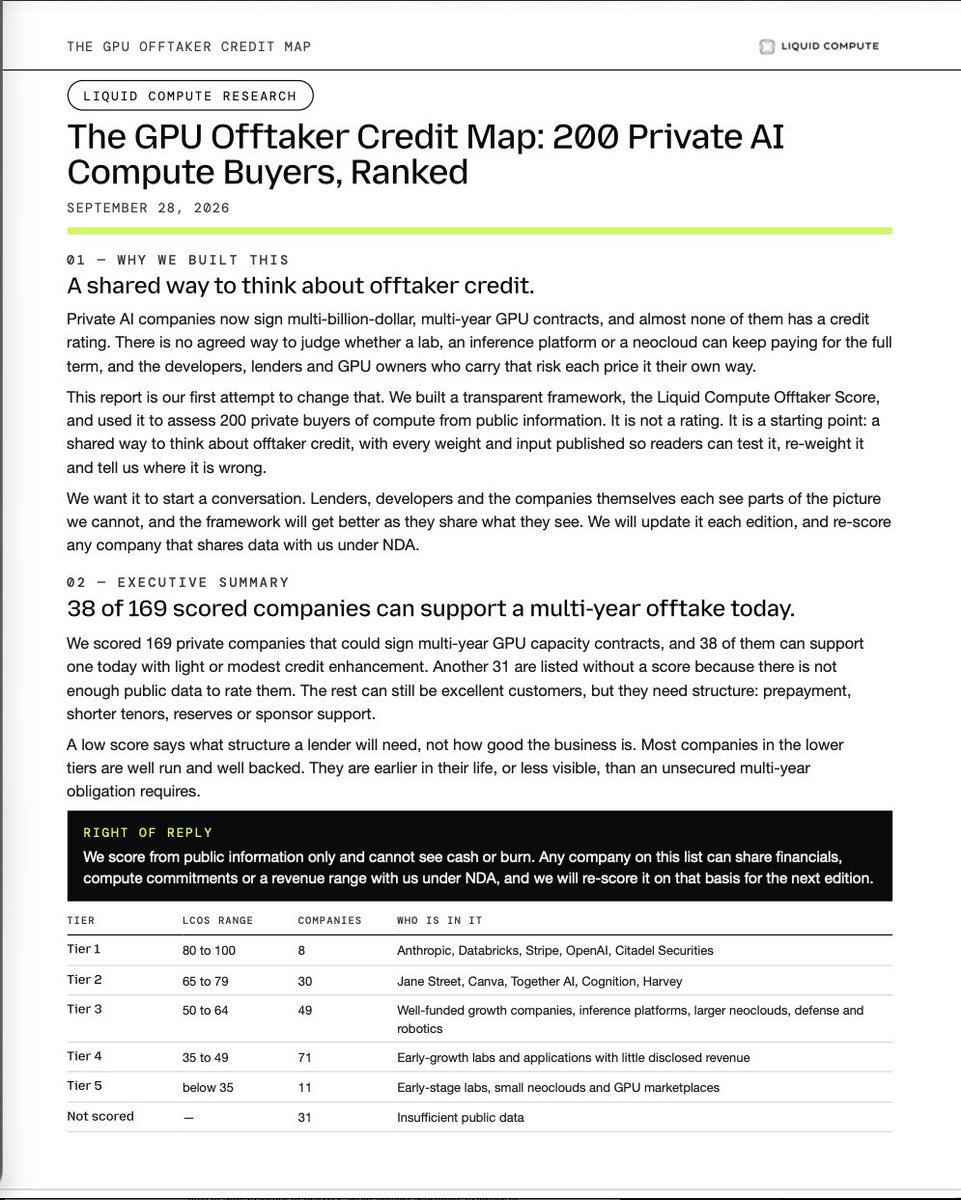
Announcing the Liquid Compute GPU Offtaker Credit Map
We assessed 200 private buyers of compute and ranked 169 on a single, transparent credit framework. Our findings cut against consensus: the strongest private offtakers are trading firms and profitable private corporates, not necessarily best-known AI labs.
We released this because the real bottleneck to access compute is capital markets. Capacity gets built when someone will finance it, and financing turns on a question nobody had a shared answer to: can this buyer keep paying for the full term?
The framework is published in full, and we intend it to become the stepping stone for providing greater transparency about counterparty credit. If you buy, build or finance compute, we want to hear from you. If you are on the list and think we have you wrong, please reach out. We welcome all comments and direct feedback on the methodology.
@Oracle has sent a force majeure notice on Project Jupiter, the 2.45GW Stargate campus in New Mexico, per Bloomberg. Oracle says it's on schedule. Its credit is trading like it isn't.
Read-through for compute:
1. The binding constraint is increasingly power, permits and politics, not chips.
2. Capacity already built and energized gets scarcer. GPUs in the ground are worth more.
3. A take-or-pay is only as firm as its delay and termination clauses. Every one gets re-underwritten.
What's missing: a standard contract, an independent price for compute, and a way to hedge it.
That's exactly what we're building at Liquid Compute.
https://t.co/SOeXqDClJB