I’m excited to share that today @liquidcompute emerges from stealth with a $15 million seed round. We are announcing pending applications before the CFTC for Designated Contract Market (DCM) and Derivatives Clearing Organization (DCO) status to build the first regulated orderbook to trade both cash and physically settled contracts on compute.
The reality of compute is that it is heterogeneous and cannot be stored, functioning much like electricity rather than oil. Our approach focuses on developing a highly efficient short-term market to underpin a cash-settled derivatives layer, operating similarly to PJM or ERCOT sitting below liquid derivatives markets.
Over recent months, I’m also happy to announce that Liquid Compute has collaborated with leading financial firms like Susquehanna International Group, @BGCGroupInc and @wintermute_t to facilitate liquid OTC trading for AI startups, neocloud providers, and lenders.
This round was co-led by @chemistry and @FirstMarkCap , with participation from K8 Cap, Night Capital, @ufo_holdings, @TrueBridgeCP, Brainchild Holdings (@kalvepuri), @ycombinator, and angels such as Dmitry Balyasny, @taro_f , @JdotJdotF, Ethan Lin and others from companies like CoreWeave, Jane Street, OpenAI
Our latest piece at @liquidcompute discusses the term structures that impact how GPU capacity trades today. Please feel free to reach out or leave a comment if you would like to discuss! https://t.co/LGCMgLilx5
We spent the last few months talking to credit investors about financing GPU fleets. Four questions came up in nearly every conversation:
1. What does the market actually price?
2. Is there a secondary market for the hardware?
3. How do you tell good offtake from bad?
4. What does the depreciation curve look like?
No document answered them, so we wrote one.
Investing in the Middle Market for Compute covers the segment below the hyperscale tier, where the borrower is a real operating business and the offtaker is not investment grade. The core finding is that capital is not the scarce input here; bankable offtake is. Operators routinely hold term sheets they cannot draw because the layer beneath the debt is unfilled.
It also covers the down payment gap that kills deals, how the market views obsolescence, and why recovery in this asset is a distribution problem. Plus observable pricing from our own book and the security package items operators will actually give you.
If you'd like a copy, shoot us a message and we'll send it over.
Great working with @wintermute_t to advance the commodification of compute. If you’re an AI lab, neocloud, or speculator looking to trade OTC, shoot me a dm.
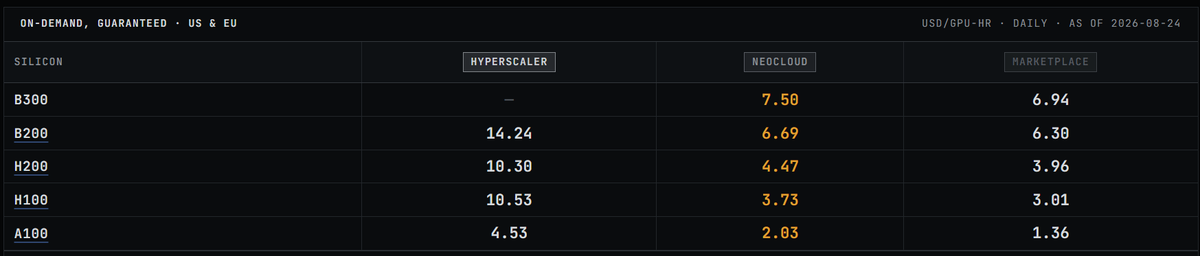
The same H100 trades at different prices across three markets.
Guaranteed on-demand, August 24, 2026:
- Hyperscaler $10.53 / GPU-hr
- Neocloud $3.73 / GPU-hr
- Marketplace $3.01 / GPU-hr
That is not a wide bid-ask. It is three products sharing a chip name.
Price, tenor, prepayment, fabric, tier and delivery still move together. Two offers at the same headline rate can differ by twenty percent in economic terms. The hyperscaler to marketplace gap on this print is more than 3x before those fields are even negotiated.
Until the description is standard, buyers cannot rank quotes, sellers cannot lay off the book, and lenders have nothing to mark.
Source: CCIR
Startups buying long-term compute get asked for 20–30% down. On a 16-node B300 cluster, ~$13.5M over 3 years, that's a $4.5M down payment.
We're partnering with lenders to finance that prepayment.
Buying compute or looking to originate? https://t.co/UqnjMyxrr8
This week, Nvidia CEO Jensen Huang decided to change tack: He went public this week with the effort, saying a group of firms including Goldman and Blackstone are aiming to collectively finance AI computing deals totaling $500 billion. https://t.co/bBcuYXfjyB
May: $3.1B GPU-backed loan, 6x book, priced tighter.
July: same issuer, same structure, flexed 150bps wider with covenants attached.
Not a repricing of risk. A change in who sets terms, inside one quarter.
https://t.co/m34rXnk9wH
The race for compute is driving the biggest data center buildout in history, and it's all still done by hand. For the past few months as a part of the YC S26 cohort, @apai253 and I have been tackling this problem.
Today, we are excited to launch @ProprioRobotics. At Proprio, we are building the physical automation layer for data centers.
Our robots assemble, maintain, and tear down server infrastructure, harvesting reusable components along the way to tackle material shortage.
Welcome to the future!