How will Warsh tighten credit & reduce inflation? Will he raise rates or use the Fed balance sheet to do it?
QT/QE Dual Axes Framework:
Axis 1: Reserves QT ➡️ Liquidity
Axis 2: Duration QT ➡️ Term Premium
Tool 3: Policy Interest Rate ➡️ Front-End
Warsh will use Axis 2.
Warsh led with headline PCE 3.7 and 6 month pace at 4.1. He never named the 3.3 core print. Then he went to gauge he uses: 54% of PCE basket running above 3%. He measured underlying with the distribution of the basket, not with food & energy exclusion. Emerging reaction function.
Warsh's speech IMO clears up a lot of confusion from July FOMC w/substantive review of economy, inflation incl. granular look inside PCE w/o crossing into forward guidance; one can infer a hawkish bias. Market reaction is opposite of July FOMC: 30y down, 2y up. Mkts see tighter near term policy, less long-term risk.
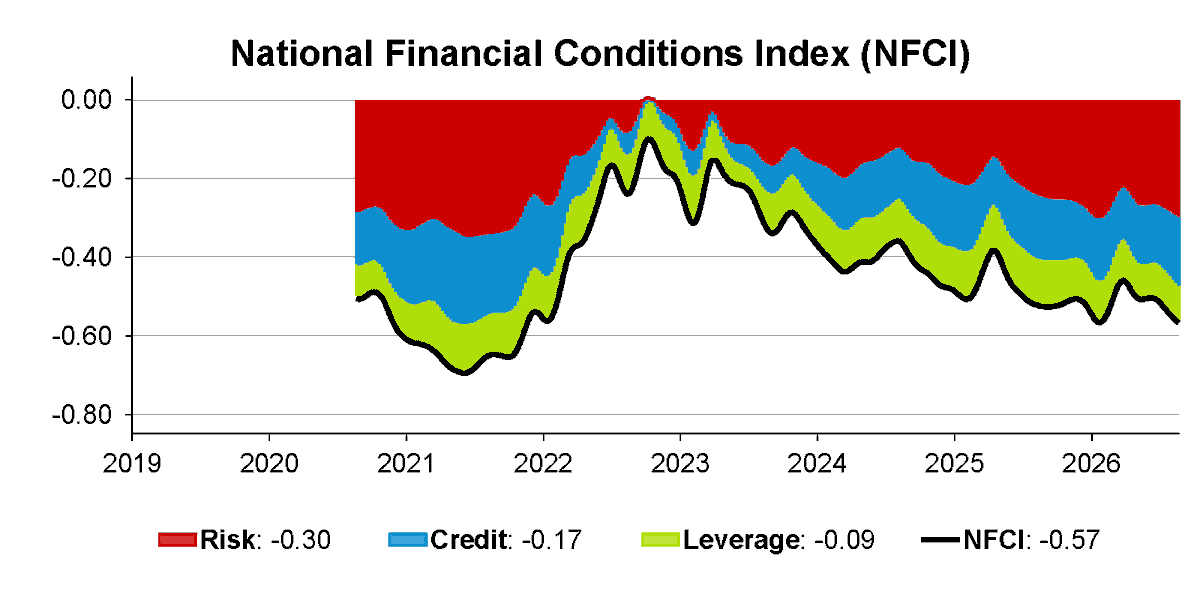
Warsh is correct that financial conditions are not restrictive. They have gotten looser since he took over. NFCI is 7 bps looser. May 22: -0.50 vs August 21: -0.57 ⬇️#Fed.
Federal Reserve Chairman Kevin Warsh signaled the central bank may not be done fighting inflation, saying financing conditions didn't look restrictive to him and that better price readings recently hadn't convinced him the trend was improving.
"I would be hard pressed to describe broad financial conditions as restrictive."
"We must be confident that underlying inflation is moving to our objective, clearly and at sufficient speed. Otherwise, we have work to do."
"And while this summer's PCE and CPI readings were better than expected, they do not tell me that underlying trends have meaningfully improved."
10y from 3.97 to 4.67 hasn’t delivered the tightening needed for 2% inflation. NFCI is still 7 bps looser than on Feb. 27. To tighten financial conditions the Fed needs to stop long end balance sheet accommodation.
Common thinking - if bond yields don’t come down, something is going to break
Proper thinking - if something doesn’t break, bond yields are not coming down.
$4B buybacks can��t compete with Fed dry powder. $1.616T in >10y treasuries & $1.93T in MBS. Warsh wants a steeper curve to hit 2% and he holds the duration cards. ⬇️#Fed
10y from 3.97 to 4.67 hasn’t delivered the tightening needed for 2% inflation. NFCI is still 7 bps looser than on Feb. 27. To tighten financial conditions the Fed needs to stop long end balance sheet accommodation.
Treasury Twist vs. Fed Untwist
Fed’s $3.5 trillion long duration stock = potential operation untwist. Without Fed accommodation & cooperation the buybacks fight the balance sheet. Warsh prefers the steeper curve path to 2%. ⬇️
This is a symptom of the Fed’s restrictive mortgage stance. Mortgage rates stay elevated while shelter inflation is 3.2%. Getting shelter sustainably closer to 2% requires continued high mortgage rates and further price adjustments. ⬇️ #Fed
The National Financial Conditions Index (NFCI) decreased to –0.57 in the week ending August 21, suggesting looser financial conditions. #NFCI#economy https://t.co/Qqsy9Jn4Op
One way to gauge monetary policy:
SOFR-SOMA. 3.66%-60-80bps (estimated duration suppression) = 2.86-3.06%. Core PCE: 3.3%. Monetary policy stance is below inflation and accommodative. #Fed
The stakes for Kevin Warsh's debut keynote at the Fed's annual economic jamboree in Jackson Hole are higher than just a few weeks ago.
His July press conference raised questions about how he plans to follow through on his pledge to deliver disinflation. An unexpected and off-cycle change in Treasury debt-management designed to prevent an AI-related borrowing binge from pushing up term premiums raised more questions about the emerging fiscal-monetary regime.
Warsh's speech will have two important audiences: The markets, and his own colleagues, who are looking for a sense of what regime change means for the overarching question facing the Fed: Is inflation high because of one-off shocks such as tariffs and a war, or because the economy is simply running too hot?
A growing minority of Warsh's colleagues say policy is no longer tight enough for the Fed to credibly claim that it has a plan to squeeze out the last percentage point on inflation.
Don’t be distracted by the AI sideshow. Druckenmiller’s message is aligned with the Warsh framework: stop the yield suppression, let the bond market speak, and force fiscal discipline. ⬇️
Billionaire Stanley Druckenmiller has said that "of course" he used AI to write op-ed on Bessent and bond market, per Jeff Stein of NOTUS.
"There's a reason I moved from an English major to being an economics major," he said, "I'm not embarrassed by it"
The “whatever it takes” question is the right one. Warsh has signaled a framework that cuts Treasury and Congress off from the Fed balance sheet. Interventions and deficit spending require Fed accommodation. Without it the path changes. The balance sheet decides. ⬇️ #Fed
Economists will tell you that the Fed buying bonds by issuing reserves is economically identical to the Treasury buying bonds by issuing bills. And yet because the Fed is (a) independent and (b) does not have to find willing buyers of reserves, it can simply force them upon the banks and (c) is not constrained by the debt ceiling, it can "do whatever it takes" Draghi-style, but Bessent cannot.
Stanley Druckenmiller renders an unfavorable opinion of Treasury Secretary Scott Bessent's use of buybacks to defend against higher yields in a market that is functioning normally.
"I have spent five decades trading on a simple premise: Markets aggregate information no committee possesses, and prices are how that information reaches decision makers. The long-term Treasury yield is the most important price in the world. It is also the only fiscal disciplinarian the U.S. has left."
"Every basis point of artificial yield suppression is a subsidy to procrastination."
"Return buybacks to their stated purpose: small, scheduled, off-the-run liquidity operations announced at quarterly refundings, never off-cycle responses to yield levels. Term out the debt honestly and pay the price the market sets."
"If the 30-year must trade at 5.5% to clear, that isn’t a crisis. It is an invoice. Then do the only thing that durably lowers long-term yields: address the primary deficit."
https://t.co/Xe8Vi38WiI
This is a symptom of the Fed’s restrictive mortgage stance. Mortgage rates stay elevated while shelter inflation is 3.2%. Getting shelter sustainably closer to 2% requires continued high mortgage rates and further price adjustments. ⬇️ #Fed
Treasury Twist vs. Fed Untwist
Fed’s $3.5 trillion long duration stock = potential operation untwist. Without Fed accommodation & cooperation the buybacks fight the balance sheet. Warsh prefers the steeper curve path to 2%. ⬇️
The Treasury could use its near $1 trillion General Account to help fund its recently announced plans to increase purchases of government bonds, according to two senior Treasury officials.
Using the TGA would provide the Treasury with considerable firepower to influence long-term bond yields. https://t.co/mFQKixPQKH