Análisis Renta Fija y 9 de área | Profesional en Finanzas | PM | Rofex | Apolítico | Los análisis y conclusiones son personales no son recomendaciones |
Argentina se destaca entre emergentes y latinoamericanos como el único país con superávit fiscal del grupo seleccionado y comuna cuenta corriente cerca del equilibrio.
📰🧵🇦🇷 ALL OF THIS HAPPENED IN @JMilei's ARGENTINA THIS WEEK!
1️⃣ ARGENTINA'S ECONOMY GREW FASTER THAN EXPECTED IN DECEMBER — A RECORD WHEAT HARVEST OFFSET POST-ELECTION JITTERS
Argentina's economy expanded 1.8% month-on-month in December, snapping back from a 0.3% contraction in November. Year-on-year growth came in at 3.5% — crushing the 0% estimate from economists surveyed by Bloomberg.
The driver: agriculture. The sector surged 32% YoY on the back of a historic wheat harvest. Finance also contributed. But manufacturing and retail both fell.
📊 The context: Markets had tanked ahead of October's midterms on fears of another @JMilei setback. Instead, La Libertad Avanza won big — but the damage was done. Most sectors had pulled production forward into Q3, bracing for a post-election devaluation that never came. That front-loading drained October and November.
@MeryCastiglioni, C&T Asesores Económicos: "After two months where the economy underperformed, December was very strong. Agricultural activity clearly helped a lot."
@smenescaldi, EcoGo: "Manufacturing is still suffering. The upside is that the agricultural cycle doesn't care about elections."
⚠️ The bigger picture: Full-year growth was sluggish. According to Goldman Sachs, activity expanded just 0.02% in the first 11 months of 2025. The labor market lagged too — formal job losses were mostly offset by informal employment gains.
@Jimezu, Bloomberg Economics: The data should give some relief to Milei's administration. But several factors expected to support robust growth this year — credit momentum, real exchange rate depreciation — now look like they'll provide more modest stimulus.
📈 What's next: The @BancoCentral_AR's latest survey of economists projects 3.2% GDP growth and 22% inflation for 2026.
2️⃣ LABOR REFORM CLEARS FINAL SENATE HURDLE 42-28 — BUT INDUSTRY SAYS THE LAW ALONE WON'T CREATE JOBS
@JMilei's labor reform passed its final vote Friday night, 42-28, after months of protests and a national strike. Two senators abstained.
The bill had already cleared both chambers, but needed a final Senate sign-off after Milei stripped out a controversial sick pay cap that threatened to sink the whole thing. Also dropped: a provision letting workers receive salaries in digital wallets — killed after local banks pushed back.
📊 What it does: Dismantles labor rules dating to the 1970s that are so rigid nearly half of Argentines work informally. The reform shifts wage negotiations from national sectoral deals to company-level bargaining, narrows the definition of severance, speeds up labor lawsuits, and creates mandatory employer-funded severance accounts.
The goal: make both firing and hiring cheaper — and bring informal workers into the formal economy.
⚠️ The reality check: Gustavo Weiss, president of Argentina's Construction Chamber, told Infobae he "fully supports the Milei government's macro direction" — but was blunt on the reform's limits.
"There's unanimous consensus that the labor reform alone won't create jobs. Jobs are created when companies have more activity. A modern labor framework means that when that happens, companies currently hiring informally will shift to formal hires."
On his sector: "We lost 120,000 jobs between mid-2023 and 2024. Since then, we've plateaued. The complete elimination of national public works hit us hard — along with the absence of mortgage credit."
📈 Why Wall Street cares: Approval signals political strength and raises expectations for economic stability. @JMilei heads to New York in March to pitch banks and funds on Argentina. The reform could pave the way for lower rates and a return to international bond markets after the 2020 default.
⚠️ The backdrop: Unemployment has overtaken inflation as voters' top concern since September, per an AtlasIntel poll for Bloomberg. Milei's disapproval sits at 55%, approval at 41.5%. More manufacturers expect layoffs in coming months than during the Covid peak.
3️⃣ THE PESO KEEPS STRENGTHENING — ECONOMISTS WARN OF "DUTCH DISEASE" RISK AS NPLs CLIMB AND MANUFACTURING SENDS MIXED SIGNALS
The peso is defying its history. The dollar fell below ARS$1,400 as the @BancoCentral_AR bought over US$2.5 billion since January and INDEC reported a US$1.99 billion trade surplus — exports up 19.3%.
The government says it's permanent. Vice Economy Minister José Luis Daza: "The strong peso is here to stay."
⚠️ The risk: @econviews warned that avoiding excessive appreciation is "vital to protect tradable sectors." Their take: "The problem isn't the direction — it's the speed of change and the absence of shock absorbers." Last five months: 71,000 registered jobs lost, real wages down, activity stagnant.
@Santiagobulat, @Invecq, is skeptical: "It doesn't make sense to talk about Dutch disease when the BCRA still has negative reserves."
🏭 Manufacturing: Orlando Ferreres data shows January output fell 4.4% YoY — but rose 1.2% MoM, snapping three months of declines. Auto production crashed 30.1% YoY. FIEL had food & beverages up 4.7%.
📉 NPLs rising: System-wide delinquency closed 2025 at 5.5%. Household NPLs: 9.3%. Francisco Mattig, one618: "Credit won't rebound until real lending rates come down — but NPLs are high because incomes are depressed, which keeps rates high."
4️⃣ ARGENTINA BECOMES SECOND COUNTRY TO RATIFY EU-MERCOSUR DEAL — AFTER A SPRINT TO BEAT URUGUAY
The Senate approved the EU-Mercosur trade agreement 69-3 on Thursday, making Argentina the second country to ratify the deal after 25+ years of negotiations. Uruguay crossed the finish line minutes earlier.
The deal, signed January 17 in Asunción, creates a market of 700 million people.
📊 What Argentina gets: Tariff elimination on 92% of Mercosur exports to the EU. The government projects a 122% increase in Argentine exports over 10 years, with energy, mining, agribusiness, and industry as the biggest winners.
Foreign Minister @pabloquirno celebrated on social media: "With this ratification, the European Commission will have the conditions to move forward with provisional application. Our exports will begin to benefit from the negotiated tariff preferences."
⚡ The race: The Milei government tried to be first. The ruling coalition moved up the Senate vote from Friday to Thursday, placed it second on the agenda, and skipped floor speeches — inserting written remarks into the record instead, per @lanacion.
It wasn't enough. Uruguay's parliament approved the deal just before 1 PM local time.
📈 The signal: Hans-Dieter Holtzmann, Friedrich Naumann Foundation: "The speed with which Argentina and Uruguay approved the deal, with Brazil and Paraguay to follow, sends a key political message to the EU. Now all eyes are on Brussels to push for provisional implementation."
5️⃣ TREASURY RAISES US$250M IN NEW DOLLAR BOND DEBUT, RELEASES PESOS — BUT LEW EXITS CAPUTO'S TEAM AFTER JUST 3 MONTHS
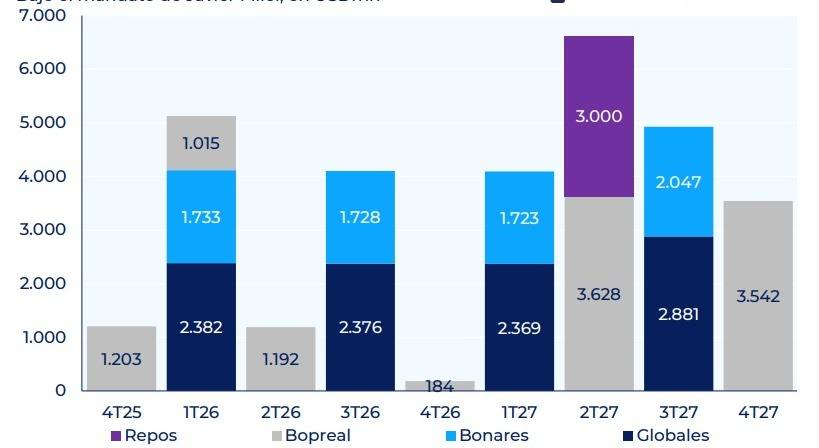
The Treasury captured US$150 million in the first round of its new AO27 dollar bond at a 5.89% yield — cutting just above par after receiving US$868 million in bids. A second round Thursday added US$100 million more. The government aims to raise up to US$2 billion to cover July's US$4.2 billion in maturities.
📊 On the peso side: Treasury placed ARS$6.74 trillion against ARS$7.2 trillion in maturities — a 93% rollover. That releases ~ARS$460 billion into the market Friday, reversing weeks of liquidity drainage that had spiked short-term peso rates.
The move follows apparent @BancoCentral_AR intervention late last week. Consultancy 1816: "Broad money supply rose ARS$1.5 trillion between Thursday and Friday — very few precedents for that. Only ARS$0.3 trillion can be explained by BCRA dollar purchases. The data confirms the Central Bank injected pesos to cap rates."
97% of peso placements went to CER (inflation-linked) instruments. Dollar-linked demand: near zero.
⚡ The shakeup: Hours after the bond debut, Economy Minister @LuisCaputoAR announced Finance Secretary Alejandro Lew is out — replaced by @FedericoFuriase , a BCRA director and longtime Caputo collaborator.
Caputo on X: "I deeply thank Alejandro Lew for his commitment and dedication. We've been working on an orderly transition following his decision to resign for personal reasons."
Lew joined in November — just three months ago — replacing now-Foreign Minister @pabloquirno. He oversaw Argentina's first dollar placement in nearly eight years.
📈 The context: Furiase co-founded Anker Latinoamérica with Caputo and BCRA chief @Kicker0024 before the Milei administration. Before Anker, he worked at EcoGo under @mdalpog.
⚠️ The timing: @JMilei heads to New York in March to pitch Wall Street. The Finance Secretary swap comes just weeks out.
6️⃣ CORPORATE UPSETS: $YPF POSTS SECOND STRAIGHT LOSS, $MELI DROPS 9% DESPITE REVENUE BEAT
YPF: The state-controlled oil giant reported a Q4 net loss of US$649 million — its second straight quarter in the red after -US$198 million in Q3. Revenue (US$4.56B) beat expectations; EBITDA and net income missed.
The culprit: a ~US$1 billion tax hit from joining ARCA's payment plan to settle legacy tax liabilities over 120 monthly installments. "YPF resolved a relevant fiscal contingency," the company said. Minimal cash flow impact — the accounting hit was one-time.
📈 The bright side: Full-year EBITDA hit US$5 billion — highest in a decade. Shale production averaged 165,000 bpd (+35% YoY), hitting 204,000 bpd in December. Shale now accounts for 70% of YPF's oil output and 88% of reserves. Lifting costs fell 44% YoY as the company exits mature fields.
Matías Cattaruzzi, AdCap: "Solid operationally, mixed financially. Downstream was the clear winner — record refinery volumes offset weak crude prices."
MercadoLibre: The stock dropped ~9.4% Wednesday after Q4 results. Revenue (US$8.76B) beat consensus by 3%, but net income (US$559 million) missed by 5.8%. Profit fell 13% YoY even as sales rose 45%.
Delphos Investment: "Operating fundamentals remain firm. We maintain a constructive view."
Wall Street agrees — 16 of 17 broker reports tracked by Bloomberg rate $MELI buy or overweight. But price targets are coming down: Barclays cut to US$2,600 from US$2,900; Cantor to US$2,400 from US$2,750. Morgan Stanley held at US$2,950.
7️⃣ US GOVERNMENT BACKS ARGENTINA IN $18B YPF CASE — URGES JUDGE NOT TO HOLD COUNTRY IN CONTEMPT
The US Department of Justice urged a federal judge Thursday not to declare Argentina in contempt for allegedly failing to hand over texts and emails from government officials to former $YPF shareholders seeking to collect on an US$18 billion judgment.
📊 The backstory: Burford Capital-backed plaintiffs won a 2023 ruling that Argentina violated their rights in the 2012 nationalization of YPF. But collecting has proved difficult. The plaintiffs want officials' communications to argue that state-owned Aerolíneas Argentinas and Banco Nación are "alter egos" of the government — and thus subject to seizure.
⚖️ The DOJ's position: The discovery request is "improper" — many assets held by those entities are immune. Washington also warned that allowing "burdensome and intrusive" discovery on foreign officials "could give rise to reciprocal adverse treatment of the United States and its officials in foreign courts."
This isn't the first time. The US has previously backed Argentina in the case, urging courts not to let plaintiffs seize the country's majority stake in YPF.
8️⃣ AEROLÍNEAS ARGENTINAS POSTS FIRST YEAR WITHOUT STATE TRANSFERS SINCE 2008 — OPERATING SURPLUS NEARLY DOUBLES
The state airline reported a US$112.7 million operating surplus for 2025 — nearly double the US$56.6 million from 2024 — with zero government transfers. It's the first time the airline has gone without state support since its 2008 renationalization.
📊 The contrast: Between 2008 and 2023, Aerolíneas averaged US$400 million in annual operating losses and received over US$8 billion in direct state transfers.
Revenue topped US$2.22 billion. Occupancy: 83% across ~300 daily flights. Passengers: 12.8 million for the year. On-time performance: 99.4%.
💰 Debt down: Bank and financial debt fell 41% — from US$341.9 million in December 2023 to US$207.4 million.
✈️ Fleet expansion: 18 new aircraft incoming — four Airbus A330neo, eight Boeing 737 MAX 10, four 737 MAX 9, and two 737 MAX 8.
CEO Fabián Lombardo said the result "consolidates a strategy focused on cost reduction and profitability maximization." The 2025 balance is being audited by KPMG; board approval expected mid-year.
9️⃣ ARGENTINE HRTECH HUMAND RAISES US$66M SERIES A — GALPERIN, KASZEK, Y COMBINATOR ALL IN
Humand, founded by Nicolás Benenzon and Gerónimo Maspero (both under 30), closed a US$66 million Series A led by Kaszek Ventures and US-based Goodwater Capital.
The cap table reads like a startup hall of fame: @marcos_galperin ($MELI co-founder), Arash Ferdowsi (Dropbox founder), Sebastián Mejía (Rappi founder), Rajat Suri (Lyft founder), Y Combinator, and Newtopia VC.
📊 The product: A private social network styled like Instagram — but for "deskless workers" (logistics, manufacturing, healthcare, hospitality). These are employees without corporate email or computers. Emergence Capital estimates 80% of the global workforce fits this profile.
Humand offers 20 modules: internal comms, vacation management, OKRs, attendance, onboarding. The pitch: consolidate everything into one app so workers don't have to juggle multiple platforms on personal phones with limited storage.
🌎 The footprint: 1.6 million users across 51 countries. Clients include Día, Oxxo, MRV, Magazine Luiza, Ogilvy. Brazil (150,000 users) is now priority — the company projects 174% revenue growth there this year and plans to triple headcount from 20 to 50 by December.
⚡ What's next: US and Asia expansion, plus AI agents to automate employee onboarding.
🔟 MORGAN STANLEY: ARGENTINA COULD BECOME A "KEY EQUITY MARKET" BY 2027-2028 AS MINING BOOM TAKES SHAPE
Morgan Stanley published a bullish report on Argentina's mining potential, projecting over US$50 billion in projects and export revenues rising from ~US$5 billion (2025) to ~US$40 billion by 2035.
The title: "Malbec and Minerals: Is Argentina the Next Mining Frontier?"
📈 The thesis: "Argentina is transitioning from a mining jurisdiction perceived as high-risk and constrained by restrictive policies toward a competitive destination for large-scale mining capital deployment."
The bank says this supports its view that "Argentina could become a key equity market in 2027-2028, as pro-investment policies drive a bullish scenario" — timed around presidential elections that could signal policy sustainability and potential MSCI index inclusion.
On sovereign credit: "The shift supports our positive outlook on Argentine sovereign credit, as improved mining and energy balances lead to a structural repricing of credit risk."
Projects to watch: • Vicuña JV (Lundin Mining/BHP): potential top-5 global copper mine, final investment decision expected by late 2026. NPV of US$3.8B at 10% discount rate — or US$35B at spot prices. • Taca Taca (First Quantum): 17% IRR under base case, 27% at spot — contingent on deleveraging. • Glencore's Argentine developments: optionality for ~510,000 tons/year of copper production. • Ganfeng and Zijin: lithium output could triple from ~30,000 tons (2025) to ~91,000 tons (2028). • Rio Tinto: targeting ~200,000 tons/year of lithium carbonate equivalent by 2028 — ~64% from Argentina.
For daily coverage: @BloombergLineaA
📰🧵🇦🇷 ALL OF THIS HAPPENED IN @JMilei's ARGENTINA THIS WEEK!
1️⃣ CONGRESS PASSES LABOR REFORM AMID GENERAL STRIKE — MILEI SET TO CLAIM VICTORY BEFORE MARCH 1 ADDRESS
Argentina's lower house approved @jmilei_english's labor reform bill early Friday morning with 135 votes in favor and 115 against, hours after the CGT labor union staged a general strike in opposition. La Libertad Avanza assembled a coalition with PRO, the UCR, and legislators aligned with allied governors to push it through. The Senate already scheduled debate for this Friday — if it passes, Milei will have the law signed before his March 1 congressional address.
The bill's most controversial (and last minute) provision — Article 44, which would have allowed employers to slash wages by up to 50% during medical leave — was stripped during the lower house vote. But three major pillars survived intact.
1.RIMI (Regime for Labor Modernization and Inclusion): employer payroll taxes for new hires would drop from roughly 27% to 15% for 48 months, provided positions represent a real headcount increase.
2. Vacation splitting: workers can now divide annual leave into blocks of at least 7 days by mutual agreement.
3. The FAL (Labor Assistance Fund), which requires employers to make monthly contributions — 1% for large firms, 2.5% for SMEs — to pre-fund future severance obligations, though final rates depend on regulatory implementation.
The Oficina del Presidente celebrated the result, calling it "the end of the lawsuit industry in Argentina" and promising the reform will drive formal job creation. The urgency is clear: Argentina has not generated net formal private-sector employment since Cristina Fernández de Kirchner imposed currency controls in 2011. Over 14 years of rigid labor regulations and crushing payroll taxes have pushed job creation almost entirely into informality and self-employment. The government's bet is that a more flexible framework with a lower tax burden can finally start reversing that trajectory.
⚡ The tension: Can lower hiring costs, greater predictability on severance obligations, and a more flexible regulatory framework undo 14 years of structural informalization? The labor market will be the test.
2️⃣ MILEI EXTENDS RIGI DEADLINE BY ONE YEAR AND ADDS OIL & GAS — BUT SMEs ASK: WHERE'S OUR DEAL?
Economy Minister @LuisCaputoAR announced via Decree 105/2026 that the deadline to join RIGI (Regime for Incentive to Large Investments) has been extended to July 8, 2027, while expanding its scope to include onshore oil and gas exploration and production with a minimum investment threshold of US$600 million. "When the rules are clear, investment arrives," Caputo said, noting 10 projects already approved worth US$25.5 billion with more under review.
RIGI offers a powerful package: 30-year regulatory stability, a flat 25% income tax rate, zero export duties, no obligation to repatriate foreign currency earnings, and exemptions on the bank debit/credit tax. For capital-intensive sectors like energy and mining, it's been a magnet. Worth noting: the regime isn't just a tax break — it comes with teeth. Projects must deploy at least 40% of the minimum investment threshold within the first two years of approval to retain benefits, a condition designed to filter out speculative applications and ensure capital actually hits the ground. The executive can lower that floor to 20% for strategic long-term export projects (minimum US$2 billion), but 40% is the standard.
But here's the growing frustration: the gap between what RIGI offers large foreign investors and what RIMI (the SME-oriented regime included in the labor reform) offers domestic businesses is enormous. @Santiagodelsola, former chief of staff at the Agriculture Ministry, laid it out bluntly: RIGI companies pay 25% income tax vs. 35% + 7% on distributed dividends under the general regime. RIGI projects face zero export duties; agriculture still pays retenciones. RIGI firms can hold export earnings abroad; everyone else must liquidate through the central bank. Even the accelerated depreciation benefit touted for smaller firms is largely useless for agriculture — most farms don't generate enough taxable income to take advantage of it. "Let's talk about export duties — that's the point. The rest doesn't help," Del Solar said.
🖼️ The big picture: The extension and expansion of RIGI signals the government doubling down on attracting mega-projects in energy and mining. But it also sharpens a two-track economy debate: one set of rules for billion-dollar foreign ventures, another for the domestic productive base that employs most of the workforce. How long the government can sustain that asymmetry without political blowback — particularly from the agricultural sector that generates most of Argentina's export dollars — is an open question.
3️⃣ FATE ANNOUNCES CLOSURE AFTER 84 YEARS — AND THE MADANES GROUP'S OTHER COMPANY IS ALSO UNDER PRESSURE
FATE (Fábrica Argentina de Telas Engomadas), one of Argentina's most iconic industrial firms, announced the permanent closure of its tire plant this week, threatening 920 jobs. Employees arrived Wednesday to find the factory gates locked and a notice posted by management. The plant has a production capacity of over 5 million tires per year.
The company, co-founded in 1940 by the Madanes family and Emilio Horn, cited shifting market conditions driven by falling demand and increased trade openness. The writing had been on the wall for years: FATE went through a preventive crisis procedure back in 2019, and filed for another one with the Labor Ministry in June 2024. Negotiations with SUTNA (the tire workers' union) collapsed without agreement. Following worker protests, the Secretaría de Trabajo imposed a 15-day mandatory conciliation, freezing dismissals while the government mediates.
But FATE is only half the story. The Madanes Quintanilla group also controls aluminum producer Aluar ($ALUA) — and that company took a hit this month too. On February 12, the Economy Ministry via Resolution 134/2026 eliminated the 80.14% antidumping tariff on Chinese aluminum sheet imports that had been in place since 2020. The removal was requested by Laminación Paulista Argentina and Industrializadora de Metales, both downstream manufacturers that use Aluar's aluminum as an input. Aluar said the volumes involved are "minimal" — but the signal is clear: the government is prioritizing lower input costs for manufacturers over protection for domestic producers.
And there's a US dimension: Washington's 50% tariff on aluminum imports directly hits Aluar, which exports roughly 40% of its production to the American market. In a separate move, Aluar disclosed it purchased nearly 32% of FATE's San Fernando land last week for US$27 million — a parcel already in use by Aluar that doesn't include the tire production areas.
The UIA expressed "grave concern," noting the industrial sector has shed nearly 65,000 jobs (-5.4%) over the past two years.
🏭 The backdrop: The Madanes group's twin pressures — FATE squeezed by imports and weak demand, Aluar caught between Chinese competition at home and American tariffs abroad — encapsulate the dilemma facing Argentine industry under Milei's trade liberalization push. The government argues this is creative destruction. For FATE's 920 workers, the next 15 days will determine whether there's anything left to save.
4️⃣ MILEI MEETS TRUMP TWICE IN THREE WEEKS — THEN CLOSES WITH ARGENTINA WEEK IN NEW YORK
Milei has three US dates locked in before mid-March. On Thursday he attended Trump's inaugural Board of Peace session in Washington, where Trump publicly singled him out: "I backed him. He was a little behind in the polls and ended up winning by a landslide." Next: a Latin American leaders summit in Miami on March 7, focused on countering Chinese influence — Brazil, Colombia, and Mexico were not invited. Then Argentina Week in New York (March 9-11), organized by JPMorgan, Bank of America, the Argentine Embassy, and Kaszek. Ambassador @AlecOxenford confirmed registrations blew past capacity — the sign-up form, accreditation, and waitlist have all been shut down.
🖼️ Why it matters: Investor enthusiasm is running ahead of the hard data — net FDI inflows hit US$4.25 billion in Q3 2025, still below the US$6.05 billion in the same period of 2023. But the pipeline is building: 10 RIGI projects approved for US$25+ billion, and Foreign Minister @PabloQuirno announced a US$14 billion Glencore mega-investment in two mining projects in San Juan and Catamarca this week.
5️⃣ WALL STREET IS LOADING UP ON ARGENTINA — FROM HEDGE FUND TITANS TO INSTITUTIONAL ALLOCATORS
Two of the loudest Milei bulls on Wall Street reversed course in Q4 2025 after dumping Argentine stocks during the midterm election uncertainty of Q3. SEC 13F filings show Robert Citrone's Discovery Capital went broad — buying back into $GGAL (640,629 shares), $YPF (270,100), $BBAR (448,100), $BMA (49,000), and nearly doubling his $AGRO position (+93.5%). Stanley Druckenmiller was more selective: he added 492,295 shares of $YPF but trimmed $MELI and fully exited the $ARGT ETF. Both had reduced or eliminated Argentine exposure in Q3, when La Libertad Avanza lost the Buenos Aires province midterms. The October national victory pulled them back in — but with different conviction levels.
The bullishness isn't limited to hedge fund titans. Bank of America's latest LatAm Fund Manager Survey — polling 30 managers overseeing ~US$94 billion — shows nearly 60% of respondents expect further improvement in Argentine asset prices. The region's risk appetite is near historic highs, cash allocations have dropped to 5.2%, and financials remain the most overweight sector. Brazil is still the top pick over Mexico, but Argentina is steadily gaining ground on institutional radars.
📈 The read: Citrone is betting across Argentine financials and agribusiness; Druckenmiller is concentrating on energy. Institutional money is following the same direction, just more gradually. The main risk flagged by survey respondents: a stronger dollar that could pressure EM currencies and assets across the board.
6️⃣ CENTRAL BANK RESERVES HIT HIGHEST LEVEL SINCE AUGUST 2021 — AFTER SANTA FE FINALLY BRINGS ITS DOLLARS HOME
@BancoCentral_AR reserves jumped US$1.35 billion on Friday to US$46.26 billion — their highest since August 2021 — driven primarily by Santa Fe province finally depositing the US$800 million it raised through a 9-year bond at 8.10% back in December. The funds were transferred from a provincial account in New York to the province's account at Banco de Santa Fe, boosting gross reserves via higher bank reserve requirements (encajes). The BCRA also bought US$167 million in the FX market, and valuation changes added roughly US$200 million.
The transfer ends a weeks-long standoff between Governor Maximiliano Pullaro and the Milei administration. After the bond placement, @LuisCaputoAR had pressed Pullaro to bring the dollars in immediately — at the time, the Treasury was still scrambling to assemble the US$4.2 billion needed for the January 9 bondholder payment. Pullaro refused, saying the funds were earmarked for infrastructure, not current spending, and that he'd bring them in as project payments required.
But the peso's appreciation in early 2026 turned the delay into a costly bet. Juan Pablo Carreira, who runs the government's official X response account, posted on February 6 that Pullaro was "down 50 million bucks in his stupid war against Toto Caputo." Caputo himself corrected the figure upward: "It's 120 billion pesos in two months. A shame — a pointless speculation that could have saved the people of Santa Fe a fortune."
⚡ The tension: The episode is a case study in federal-national fiscal dynamics under Milei. Provinces that tapped international markets now face pressure to repatriate dollars into a system where the peso keeps strengthening — meaning every day they held out, they lost value in local currency terms.
7️⃣ YPF CEO MARÍN: CAPEX HOLDS EVEN IF OIL HITS $55 — TARGETS 200K BARRELS AND FIRST DIVIDEND IN A DECADE
$YPF CEO @HoracioMarin_ok told @business the company has stress-tested its portfolio to keep upstream capex at ~US$3.5 billion regardless of whether oil trades at $70 or $55. "We prepared," Marín said from his Buenos Aires office. "Our capex doesn't change."
The targets are aggressive: YPF wants to surpass 200,000 barrels per day of shale oil this year, up from 170,000 in Q3 2025, after two years of cost-cutting and asset divestitures that freed up US$1 billion in cash (plus a pending exit from gas distributor Metrogas). If the earnings ramp works, YPF is eyeing its first dividend payment in a decade. The stock is up 127% since Milei took office at ~$38; Marín's target is $60 by end of 2027.
This week's RIGI expansion to include shale oil drilling (story 2️⃣) is a direct catalyst. Previously, the regime's oil component only covered upstream infrastructure like pipelines, separation plants, and offshore exploration. Now shale wells qualify — with a US$600 million minimum per project — which could lure US independents running out of top-tier Permian acreage. Marín confirmed informal conversations with Continental Resources (Harold Hamm's company, the first US independent to enter Vaca Muerta) and Devon Energy, which just agreed to acquire Coterra Energy to become one of the world's largest shale players. "Their geologists like Vaca Muerta," Marín said. "That's what they told us informally, at least."
On the Argentina LNG mega-project with Eni and XRG (which formalized its commitment last week), the search for at least US$14 billion in financing — the largest project financing in Argentine history — is intensifying. "Several banks are offering very high initial tickets," Marín said, adding that export credit agencies could provide part of the funding. He compared assembling the deal to solving a puzzle.
🛢️ The bottom line: "This is the key year," Marín said. "It's the final transition year, and then you get liftoff." Full strategy details drop on the February 27 earnings call.
8️⃣ FITCH: ARGENTINA'S GAS OUTPUT COULD HIT A NEW RECORD IN 2026 — BUT SOVEREIGN CEILING CAPS THE UPSIDE FOR CORPORATE RATINGS
Fitch Ratings says Argentine natural gas production could reach an all-time high this year, after growing ~15% between 2021 and 2025 on the back of Vaca Muerta development. The key unlocking that growth: infrastructure bottlenecks are finally easing. $TGS (Transportadora de Gas del Sur) was awarded the expansion of the Gasoducto Perito Moreno — a ~US$700 million project to install three compressor stations that will lift pipeline capacity from 21 to 35 million cubic meters per day, adding 14 million m³/day of evacuation capacity from Vaca Muerta to Buenos Aires and the Litoral region.
Fitch sees the expansion reducing Argentina's reliance on imported LNG and alternative fuels during winter peak demand — a period when the country has historically scrambled for supply. Combined with the Argentina LNG project led by $YPF and Eni (story 7️⃣), the agency says Argentina could transition from seasonal gas importer to emerging global LNG supplier, provided regulatory stability holds and export protocols remain clear.
The report names Tecpetrol, Pampa Energía, and Pluspetrol alongside YPF as companies positioned to benefit from higher gas production and revenues. But there's a ceiling: most Argentine corporate ratings remain capped by the sovereign rating at B-, reflecting transfer and convertibility risks. The immediate credit impact is limited — even as the operational outlook improves.
🖼️ The big picture: Fitch notes that sustained hydrocarbon exports could strengthen the trade balance and boost reserve accumulation — factors that, if consolidated, would be positive for the sovereign rating and, by extension, the country ceiling that currently holds back every Argentine corporate credit. The virtuous circle is visible, but it hasn't closed yet. Fitch expects upstream capex to moderate between late 2026 and 2028 as current mega-projects reach completion.
For daily coverage: @BloombergLineaA
Video generated with AI via @HeyGen
🕓 11:48
ARGENTINA RECHAZA LOS PEDIDOS PARA LIBERAR EL PESO Y PLANEA MANTENER LAS BANDAS CAMBIARIAS
🕓 11:48
ARGENTINA CONFIRMA A LOS BANQUEROS SU PLAN PARA RECOMPRAR LOS BONOS 2029 Y 2030
🕓 11:48
ARGENTINA PLANEA COMENZAR A COMPRAR RESERVAS CON EL PESO DENTRO DE LA BANDA CAMBIARIA
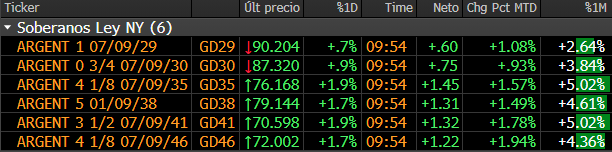
Bonos Argentinos en el exterior suben hasta 24.6% en el exterior, en la previa de la rueda, tras la victoria del oficialismo en las elecciones legislativas
There's two big "fear of floating" countries in EM: Argentina (lhs) and Turkey (rhs). Both have fallen back into pegging their currencies to the Dollar, i.e. preventing needed depreciation. The result is that both currencies are overvalued, the Peso much more so than the Lira...