🚨 $TSM has been moving a ton over the last couple of days.
It shot up from around $417 to almost $449, showing some serious short-term momentum. That tells you people still believe in semiconductors and AI chips.
Then it dropped back to $427, but bounced almost right back to $447. 📈
So what's that mean?
Buyers are still jumping in when it dips, and the uptrend isn't totally broken yet.
Technically, the first support to watch is:
$432 to $439
That's a key short-term zone. If $TSM drops there and holds, it could be a spot to watch for small positions. 🎯
If it holds, this could just be a normal pullback after a big run, and it might test $449 again.
But if that support breaks, things could get weaker.
Next real support would be around:
$419 to $422
If it falls past the first zone and heads there, expect stronger selling and a deeper drop. With $TSM's size, more downside could mean more value lost. ⚠️
And it's not just $TSM.
The whole market is pulling back. $SPX, $NDX, $QQQ are all under pressure, and tech stocks are cooling off together.
$SMH is a key ETF to keep an eye on.
If it keeps weakening, money is leaving semi stocks, which puts more pressure on $TSM.
If $QQQ and $SMH calm down, $TSM has a better shot at attracting buyers back. 📊
Long-term, nothing's really changed for $TSM.
They're still the top dog in advanced chip manufacturing, with big clients like $NVDA, $AAPL, $AMD, $AVGO, and $QCOM.
AI chips, data centers, high-performance computing, phone chips, and process upgrades are still the big drivers. 🚀
My take is simple:
Don't chase after a big move.
Just watch that $432–$439 zone.
If it holds, it's a potential watch spot for small positions.
If it breaks, next stop is $419–$422.
Also watch if $SPX, $NDX, $QQQ, and $SMH can stabilize.
$TSM's long-term story is solid, but short-term price action has to deal with market pressure, sector cooling, and profit-taking.
⚠️ This is just market analysis, not financial advice. Do your own homework.
$PLTR’s move over the last couple of days isn’t just a regular dip anymore.
It shot up from around $132 to nearly $163, showing crazy short-term momentum.
But after that jump, it quickly fell back to about $140, which tells me people are taking profits at those higher levels. 📉
Right now, the most important level isn’t $163 or $140.
The real spot to watch is the $136–$139 support zone. 🎯
This area will decide if this rally was just hype or if the bullish trend can keep going.
If $136–$139 holds, it means buyers are still stepping in and believing in $PLTR’s AI software story. A rebound could happen.
But if it breaks, the short-term picture weakens a lot. Traders who bought high might keep selling, and the stock could look for lower support. Market cap pressure might grow too.
This pullback isn’t just about $PLTR.
The whole U.S. market is under pressure:
$SPX is weakening.
$NDX / $QQQ are dropping.
AI growth stocks are cooling off.
Expensive software names are getting repriced.
Short-term money is moving away from high-beta stocks.
So this $PLTR drop is really about two things:
First, the stock ran too fast and needs to settle.
Second, the broader market and tech sentiment are turning cold.
But long term, I still don’t see $PLTR as just another software company.
Its real value is in:
AI data analysis.
Government and defense systems.
Enterprise AI platforms.
Big institutional decisions.
Sticky customer relationships.
In the AI age, whoever controls data controls decisions.
That’s the long-term upside story for $PLTR. 🚀
My take is simple:
Don’t chase it blindly in the short term.
Watch $136–$139 closely.
If support holds, there’s still a rebound chance.
If it breaks, short-term risk keeps rising.
$PLTR’s long-term story is solid, but short-term price needs to respect technical levels and market pressure.
⚠️ This is just market analysis, not advice. Do your own research.
🚨 $MSFT is hitting a major technical zone right now.
In the last couple of days, Microsoft jumped hard from about $412 to almost $466.
That was a huge rally.
But after such a quick climb, it's already pulled back and is trading around $427. 📉
What this means:
The stock still looks good long-term, but short-term folks are clearly cashing out.
I'm keeping an eye on the $419–$423 support area. 🎯
That's where buyers need to step in.
If $MSFT holds that zone, the bullish pattern stays solid and we could see another bounce.
But if it breaks, the market might start expecting more downside, especially with the overall market looking shaky.
This isn't just about Microsoft right now.
The whole U.S. market is cooling off.
$SPX is under pressure.
$NDX is dropping.
$QQQ is losing steam.
Mega-cap tech isn't moving straight up anymore.
The reason is straightforward:
After a strong run in AI and big tech, the market needs time to adjust valuations, earnings expectations, and risk.
For $MSFT, the long-term story is still solid.
Azure cloud growth.
Enterprise AI.
Copilot.
Office ecosystem.
Windows.
LinkedIn.
Enterprise software.
These aren't hype—they're real business foundations driving long-term growth. 🚀
But even great stocks pull back.
That's why I'm not blindly buying $MSFT here.
My plan is simple:
Watch $419–$423.
Watch $SPX, $NDX, and $QQQ.
Watch if buyers defend support.
Watch if volume comes back.
If support holds, this could be a strong pullback buy.
If support breaks, short-term risk goes up.
Long term, I'm still bullish on $MSFT.
Short term, patience beats emotions.
⚠️ Just market analysis, not financial advice. Do your own homework.
🚨 $NVDA has gotten a lot more volatile in the last couple of days.
It shot up from around $211 to nearly $232, showing some serious short-term strength. But then it dropped just as fast and is now sitting near $214. 📉
Technically, the key support zone is around $209–$211.
That's where the rally started and where bulls need to hold the line. 🎯
If $NVDA can hold that area and buyers come back, the bullish setup stays intact and we could see another bounce.
But if that support breaks, short-term sentiment could get weaker and the stock might look for lower levels. Given Nvidia's huge market cap, a sharp pullback like this can also wipe out a ton of value. ⚠️
This isn't just about $NVDA.
The whole U.S. market is feeling the heat. Right now, $SPX, $NDX, and $QQQ are all pulling back, with tech and semiconductor stocks dropping together.
$SMH is worth watching too. If it keeps weakening, it means money is still flowing out of semiconductors, which could weigh on $NVDA short-term.
If $QQQ and $SMH stabilize, $NVDA has a better shot at attracting buyers again. 📊
This drop might be tied to:
• Weakness in $SPX
• Pressure on $NDX / $QQQ
• Cooling in $SMH
• Profit-taking after a big run
• Valuation adjustments for AI leaders
• Less risk appetite overall
But looking long-term, Nvidia's core story hasn't changed. AI demand, data centers, GPU supply constraints, enterprise AI adoption, and semiconductor upgrades are still in play. 🚀
My take is simple:
Don't chase this move short-term.
Keep an eye on $209–$211 support.
Watch if $SPX, $NDX, $QQQ, and $SMH can find their footing.
If support holds, a rebound is possible.
If it breaks, short-term risk goes up.
Long-term is still bullish, but short-term price action has to respect the broader market pullback and sector pressure.
⚠️ This is just market analysis, not financial advice. Do your own research.
$MU is still being traded like one of the strongest names in AI memory. 🚨📊
On the 15-minute chart, Micron moved up from around 1,038 and climbed all the way to 1,089.
Now the price is hanging near 1,079, which tells me buyers are still in the game, but the stock is already in a high-level consolidation zone.
This isn't a weak chart.
It's a strong one that just needs support confirmation.
The level I'm watching first is 1,069–1,070.
If $MU pulls back and holds that area, the short-term bullish setup stays solid.
Key support is at 1,057–1,058.
As long as $MU stays above that, the trend is still healthy.
If $MU can take back 1,089–1,090, the market might start eyeing the next psychological level around 1,100.
But this is bigger than just Micron.
When $MU moves, the whole AI memory and data center supply chain gets attention:
$NVDA — AI GPUs depend on HBM
$AMD — AI accelerators
$AVGO — custom AI chips and networking
$MRVL — AI networking and data movement
$TSM — advanced chip manufacturing
$WDC — NAND and storage
$STX — data storage demand
$DELL — AI servers
$SMCI — AI server infrastructure
$AMAT $LRCX $KLAC — semiconductor equipment
$SMH $SOXX — semiconductor ETFs
Here's my take:
AI isn't just about GPUs anymore.
AI needs memory.
AI needs HBM.
AI needs storage.
AI needs servers.
AI needs full data center infrastructure.
That's why $MU matters.
Strong chart.
Strong AI memory story.
Strong semiconductor read-through.
But after a big move, entry price still counts.
I want support confirmation, not emotional chasing. 📊🔥
Not financial advice.
$AMD is looking like it's back in momentum recovery mode. 🚨📊
On the 15-minute chart, it bounced hard from the 524 area and ran up to 546.
That shows buyers are still hanging around.
Right now it's trading around 542, pretty close to the recent high, so I'm not chasing here.
First level I'm watching is 538.
If it pulls back and holds 538, the short-term bullish setup still looks good.
Key support is 532–533.
As long as it stays above that zone, bulls are in charge.
If it can push above 546–547, momentum might keep going.
But it's not only about AMD.
When AMD moves, the whole AI chip and data center space gets attention:
$NVDA — AI GPU leader
$TSM — advanced chip manufacturing
$MU — AI memory and HBM
$AVGO — custom AI chips + networking
$MRVL — AI networking + custom silicon
$ARM — chip architecture
$DELL — AI servers
$SMCI — AI server infrastructure
$ASML $AMAT $LRCX $KLAC — semiconductor equipment
$SMH $SOXX — semiconductor ETFs
Here's my take:
AI demand isn't going to be a one-company game.
$NVDA is still top dog, but hyperscalers need more supply, more competition, and better data center options.
That's where $AMD comes in.
EPYC CPUs.
Instinct AI GPUs.
Data center acceleration.
AI infrastructure demand.
The chart looks strong.
Buyers are active.
The AI chip story isn't dead.
But after a quick move, entry price still matters.
I'd rather wait for support confirmation than buy near the high. 📊🔥
Not financial advice.
$ASML is currently testing a high-level pullback, not a broken chart. 🚨📊
The 15-minute chart shows a strong jump from the 1,588 area all the way up to 1,742.7.
That was a big move in the semiconductor equipment space.
But after hitting that high, $ASML pulled back to around 1,726, so buyers are getting tested right now.
The first level I'm watching is 1,722–1,723.
If $ASML holds that zone, the short-term setup still looks good.
The real key support is 1,710–1,711.
As long as it stays above that range, the broader bullish structure is still intact.
If price can get back to 1,732–1,735, momentum starts to pick up again.
But it's not just about ASML.
When $ASML moves, people start watching the whole semiconductor gear and AI chip supply chain:
$AMAT — semiconductor equipment
$LRCX — etch and deposition tools
$KLAC — inspection and process control
$TSM — advanced chip manufacturing
$INTC — foundry expansion
$NVDA — AI GPU demand
$AMD — AI accelerators
$AVGO — custom AI chips and networking
$MRVL — AI networking and custom silicon
$MU — AI memory and HBM
$SMH $SOXX — semiconductor ETFs
My take is simple:
AI isn't just about GPUs.
AI demand eventually reaches advanced nodes, EUV tools, fabs, wafers, inspection, memory, networking, and the whole semiconductor capex cycle.
That's why $ASML is important.
It's one of the biggest bottlenecks in advanced chip manufacturing.
The chart is still constructive.
The pullback is testing support.
The semiconductor equipment story is still alive.
But after a big move, entry price matters.
I want confirmation, not emotional chasing. 📊🔥
Not financial advice.
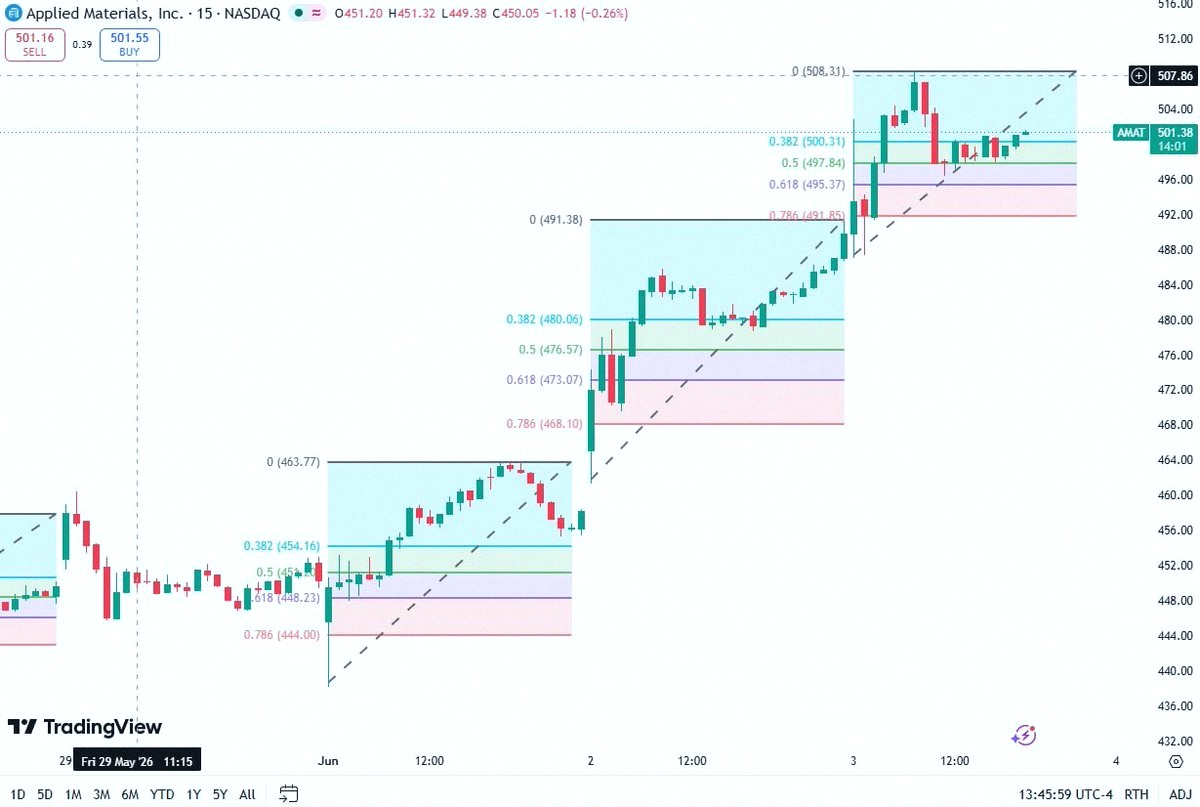
$AMAT is still one of the strongest players in the semiconductor equipment space. 🚨📊
The 15-minute chart tells a pretty clear story.
Applied Materials went from around 462, broke through 480, reclaimed 491, pushed past 500, and hit a short-term high near 508.31.
That was the momentum phase.
Now it's pulled back and sitting around 499–500, so we're seeing if buyers can hold that breakout line.
This isn't a bearish breakdown yet.
It's more of a high-level retest after a solid move up.
The first level I'm watching is 500.
If $AMAT can get back above and hold 500, the short-term setup stays healthy.
Key support is 495.
As long as it stays above 495, the bullish structure remains intact.
But if it loses 495, I'd get more cautious since the pullback could go down to 491–492.
The bigger picture isn't just $AMAT.
When Applied Materials moves, the market usually starts looking at the whole semiconductor equipment and AI chip supply chain:
$ASML — EUV lithography
$LRCX — etch and deposition tools
$KLAC — inspection and process control
$TSM — advanced chip manufacturing
$INTC — foundry expansion
$NVDA — AI GPU demand
$AMD — AI accelerators
$AVGO — custom AI chips and networking
$MRVL — AI networking and custom silicon
$MU — AI memory and HBM
$SMH $SOXX — semiconductor ETFs
My take is simple:
AI demand isn't just about GPUs.
It spreads into fabs, wafers, tools, advanced processes, memory, networking, and the whole semiconductor infrastructure layer.
That's why $AMAT matters.
Solid chart.
Strong sector signal.
Clear AI supply-chain read-through.
But after a fast run, entry price still matters.
I want support confirmation, not emotional chasing. 📊🔥
Not financial advice.
@DavidKWilliams Pretty impressive run from 462 up to 508. I'd be curious to see if it can hold above 500 though, feels like that level might get tested again.
$WDC is way more than just a storage play now. 🚨📊
On the 15-min chart, Western Digital shot up from the 520 zone all the way to 602.
That was one strong momentum swing.
It's since pulled back and sits around 590—not in that vertical breakout phase anymore.
We're in a retest and recovery zone now.
First level I'm watching is 588–592.
If $WDC holds this area and pushes back above 592, the short-term recovery looks solid.
Key support sits at 584–585.
If that breaks, I'd get more cautious since the pullback might stretch to 579–580.
But this goes beyond just one chart.
When $WDC moves, the market tends to pay attention to the whole AI storage and data center chain:
$MU — AI memory and HBM
$STX — data storage demand
$NVDA — AI GPUs drive massive data needs
$AMD — AI accelerators and data center chips
$DELL — AI servers
$SMCI — AI server infrastructure
$AVGO — custom AI chips and networking
$MRVL — AI networking and data movement
$AMAT $LRCX $KLAC — semiconductor equipment
$SMH $SOXX — semiconductor ETFs
My take is simple:
AI isn't just about GPUs.
It's also memory, NAND, storage, servers, networking, and huge data infrastructure.
That's where $WDC becomes key.
The chart had a strong move.
Now I need confirmation.
Hold 588–592 → recovery stays alive.
Lose 584–585 → risk goes up.
I'd rather wait for support to confirm than chase after that vertical run. 🚀📊
Not financial advice.
$KLAC is flashing a big semiconductor equipment signal today. 🚨📊
This isn't just about one stock moving up.
On the 15-minute chart, KLA broke out of the 1,900–1,948 range, regained momentum, and then shot up into the 2,087–2,103 high zone.
That tells me buyers are flowing back into semiconductor equipment names.
Right now, $KLAC is still hanging near the upper range, but after a move like this, I'm not chasing emotionally at the top.
The levels I'm watching:
First support: 2,071–2,072
If $KLAC dips and holds here, the short-term bullish setup stays solid.
Key support: 2,051–2,052
As long as $KLAC stays above this, the broader short-term trend is still intact.
If $KLAC keeps holding near the highs, the market might start eyeing the whole semiconductor equipment and AI chip supply chain.
Names to keep an eye on:
$ASML — advanced lithography
$AMAT — semiconductor process equipment
$LRCX — etch and deposition tools
$TSM — advanced chip manufacturing
$INTC — foundry expansion
$NVDA — AI GPU demand
$AMD — AI accelerators
$AVGO — custom AI chips and networking
$MRVL — AI networking and custom silicon
$MU — AI memory and HBM
$SMH $SOXX — semiconductor ETFs
My take is simple:
AI demand doesn't stop at GPUs.
It ripples into fabs, wafers, inspection, process control, equipment, memory, networking, and the whole semiconductor infrastructure layer.
That's why $KLAC matters.
KLA isn't just an equipment stock.
It's a key player behind advanced chip yield, inspection, and manufacturing quality.
Strong chart.
Strong sector signal.
Strong AI supply-chain read-through.
But after a sharp move, entry price still matters.
I'd rather wait for support confirmation than chase near the high. 🚀📊
Not financial advice.