I like to write and comment. I follow people who also comment/post. I’m a conservative who checks sources and weighs the validity of “theories”. No “Q”. 🙄
Yep you are right, autocorrect got me.
Here it is corrected.
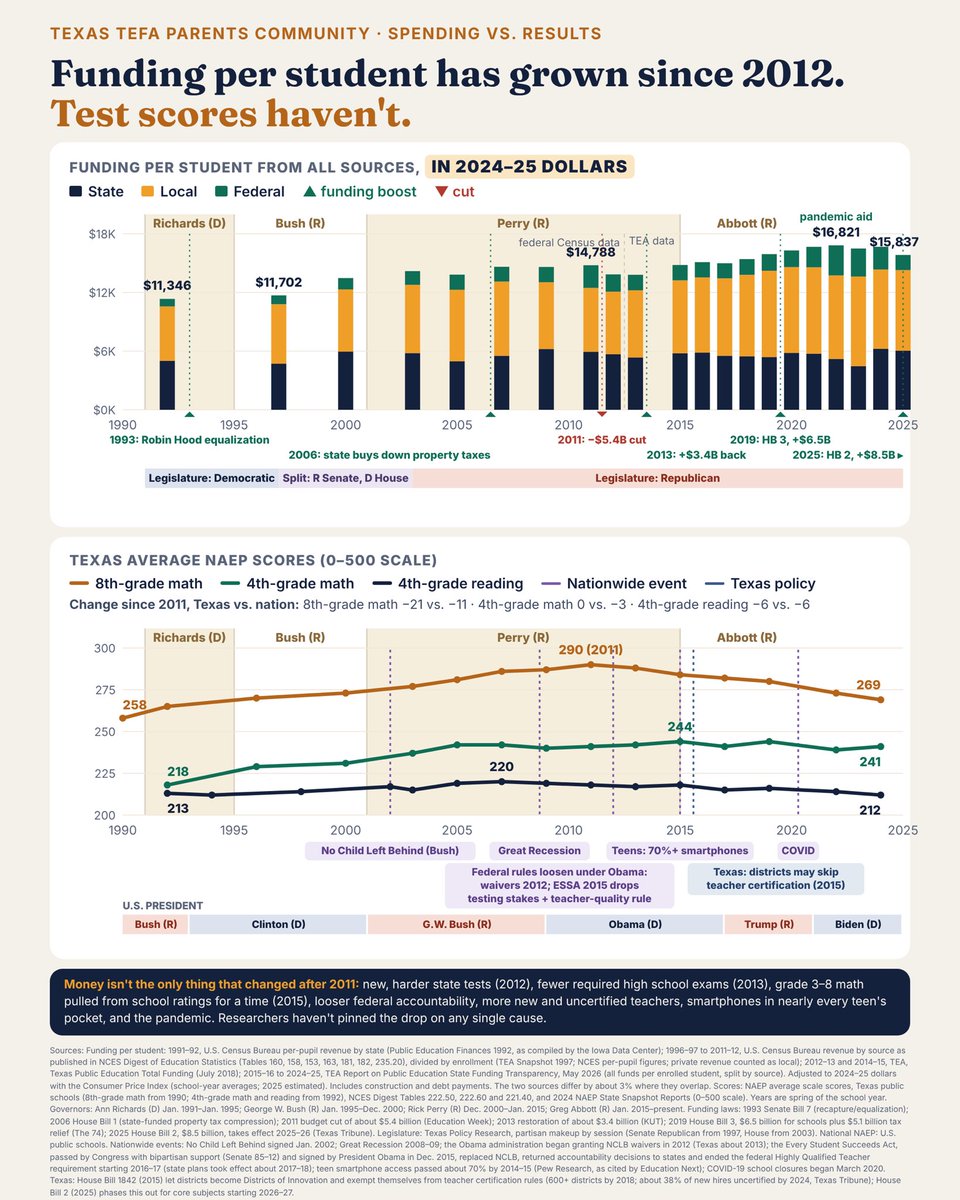
The chart cites the Texas Comptroller. The $6.5M paid to TSA, the 2,621 transactions, and the 111,327 funded students all come from the state's TEFA dashboard: https://t.co/gn2Xfi8Si8…
The full source list is at the bottom of the graphic.
Can you contest any of the actual info on the chart?
This group of schools had to jump through hoops, just like any of the other schools. Including TEA approved accreditation through Cognia. Every student has an individual individualized economic path to go through online. It’s like homeschooling which any high school parent will tell you doesn’t take all day. That said most of the programs they’re using are the same ones that are being used in public school classrooms.
NEW: The top voucher school in Texas?
It's a network of AI-driven sports academies that require just two hours in the classroom:
https://t.co/6p3pNyFNnH
No. The chart cites the Texas Comptroller. The $6.5M paid to TSA, the 2,621 transactions, and the 111,327 funded students all come from the state's TEFA dashboard: https://t.co/QlUCkjhCzz
The full source list is at the bottom of the graphic.
Give you a contest, any of the actual info on the chart?
The only thing I'd question about your reply is why you're attributing this to "Texas." I'm a big girl. I can handle it, including the limitations of compiling multiple studies and the critique that I'm cherry-picking.
So let me ask you this: if you're not going to evaluate learning based on engagement, how do you know whether someone is, in fact, learning? I see how you folded creativity and depth of thought into the process of learning, which I also agree with. How do you feel about assessment measures?
Secondly, in a public school classroom, are you more of a proponent of differentiation, or even Universal Design for Learning? Do you think that, with quality teaching, teachers can ensure all students in their classroom are learning?
Or do you lean more toward different educational settings? It sounds like you're a proponent of a Waldorf-style, exploratory kind of learning: slower, encouraging creativity, and so on.
Basically, how much "slow learning" do you think is actually happening in public school classrooms? Are there elements of the teaching structure that need to be included? And do you think teachers are capable of ensuring their students learn, and learn more deeply, under the current public education model?
That’s because there was an active effort to prevent current public school students from participating in TEFA. That wasn’t from TEFA proponents. These people would’ve qualified as well as any of the other others. But they didn’t because they heard lies about the program or we’re simply not informed. So who filled the gaps low income families that were scraping by that had already left the system. In that respect, you are correct.
NCES (hours per subject):
https://t.co/unksEn6zFw
UCLA (lost time, high vs. low poverty):
https://t.co/fvr2vr1VkH
Brown, Kraft & Novicoff (time in school):
https://t.co/02YngPyZ15
Carnegie Mellon (29% off task):
https://t.co/5CxJniVXtP
Beginning Teacher Evaluation Study (Rosenshine):
https://t.co/VLUoBllMn9
Texas Education Code §25.081:
https://t.co/5Q7W63yzSs
The outcome cross-references time in class on course subjects plus distractions and time off task.
Do you propose desegregating public schools based on income and geography? Because this is exactly right it is. What about a free flow of students between districts? Would that help? I sure would help the 113,000 kids that are academically stranded.
You yourself said that segregating private schools was based on a students income.
Isn’t this effort exactly that? To break down those segregation barriers?
I will happily take the counter on this:
1. That total represents a network of 10+ schools, whereas the "second place" is one school. Megan wrote the story before the article.
2. Educational outcomes will beat the ISD.
3. "Poor kids get the same academics as one of Texas' most expensive private schools" sounds pretty progressive for "equalizers". Also, there aren't academic admissions filters.
They're using a "jocks are dumb" dogwhistle to say "sports are bad"... but neither is true.
Sigh. During that two hours they’re getting just as much engaged educational time as would be found in a public school over the course of a school day. 50% of the software they’re using is broadly used in public schools. 50% are their own educational programs. Not “off the shelf computer games”. The beauty of TEFA is that it doesn’t have a uniformity requirement. After all adults aren’t required to all go to a workplace that’s exactly the same and work in the same setting.
Why don’t you tell me right now what you do. Besides this, I mean. I’m genuinely interested because my work focuses on things like curriculum and teaching and programs. How do you make your students lives better? Understand that the echo chamber of X makes it seem like you’re being paid by your district to use your moderate sized platform, try to derail 111,000 low and medium income and disabled kids from their schools. 1115, which happened to be in your district. It’s quite possible that this is not the case but it rings true for people on this end of your ex account. Feel free to clarify what your actual job is, though that would be enlightening and maybe help people to see you differently.
Because the people paying for private school normally aren’t the population that this program is built for. Oddly enough, the public school kids who would have easily qualified for this program were actively deterred from using it. What it did was open up a vacuum filled with “working poor” families, just scraping by to keep their kids in private school.
Sigh. No billionaire is using TEFA at Strake. The only reason why they have the program at all is because it’s being consistent with the Catholic school policy. If you’re saying that means tested should be that we should look at external assets. If you look at the “wealthy” families that have third tier priority and have still about 50% on the waitlist, those people are primarily working class. We’re talking nurses, firefighters, teachers, etc.. So I suppose one of these people could be stashing funds in some anonymous Cayman Islands account and spending their $20,000 (4% of overall income) to take trach a summer vacation to Milan. But to do it, they would have to “slum it” with the poor middle class and lower class folk. 😂😂😂😂
The reason why it helped so few is because there was an organized and concerted effort to keep them from applying. And it wasn’t pro TEFA people that did so whenever you get the only 17% stat know that many eligible public school families who would have gone into the program were deterred.