Can't wait for our symposium @ICCB2021 tomorrow on Insights for Catalysing Conservation. We are presenting lots of new quantitative and qualitative research, so please join us! December 13, 2021 at 12-1pm CET
#ICCB2021
For those attending #ICCB2021, my pre-recorded presentation "Measuring the intensity of conflicts in conservation" is now available!
The Q&A session will take place on 15th December in the session "Solutions to Human-Wildlife Conflict 1".
See you there!
This December join over 1,200 ecologists from around the world at Ecology Across Borders 2021, a joint Annual Meeting with @sfecologie.
Throughout this week, we will be announcing the internationally renowned plenary speakers at the core of #EAB2021!
https://t.co/Fiud6ca095
Very excited that the coding club is running this again!
Come along if you’d like to hear me rambling at length about autocorrelation, polygons, point data and just why is generally a good idea to fit a spatial model if you can (bonus content: cute foxes and pretty maps)
🦊🦊🦊
Hierarchical modelling of spatial data using INLA! Join us Wed 3-5pm UK time for our latest LIVE #rstats session to delve into the world of hierarchical spatial modelling and INLA, our last modelling tutorial this semester! Don't miss out, sign up below ⬇️
https://t.co/I6qX7naH3k
Hierarchical modelling of spatial data using INLA! Join us Wed 3-5pm UK time for our latest LIVE #rstats session to delve into the world of hierarchical spatial modelling and INLA, our last modelling tutorial this semester! Don't miss out, sign up below ⬇️
https://t.co/I6qX7naH3k
New paper about sex specific gene expression and DNA methylation in a species with paternal genome elimination. 🧬 #epigenetics#insects#genomicimprinting
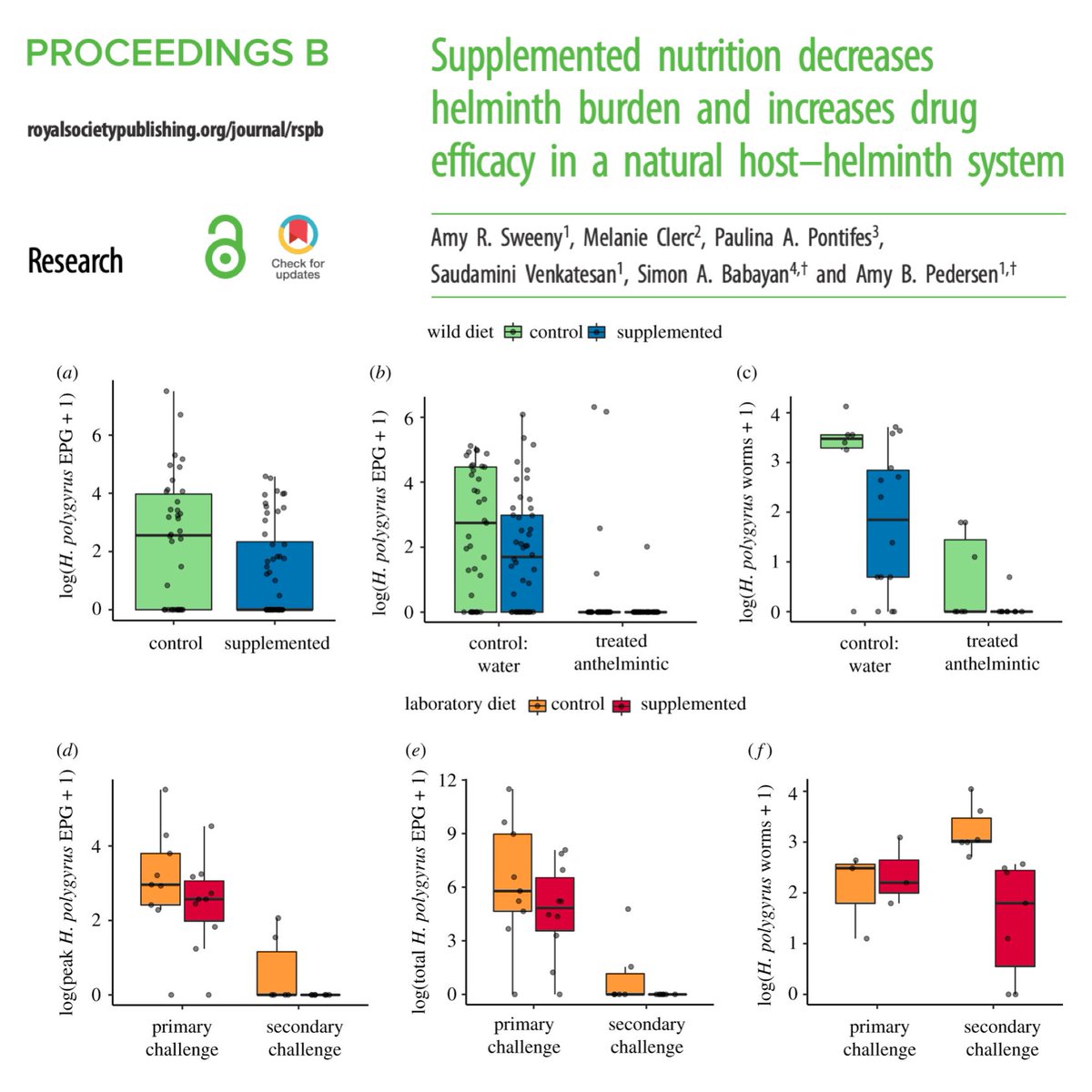
📢 New paper! Using complementary wild and laboratory populations of the same host-helminth system we show that nutrition supplementation increases resistance to helminths and efficacy of deworming. 🐭🍎🍔 Delighted this is out today in @RSocPublishing
https://t.co/GwDpjBdfQ1
Overall, we show how taking into account fine scale variation in the urban landscape can help our understanding of disease ecology of urban species.
5/5
During the Christmas break our paper on the effect of urbanisation on fox parasite communities went live on @Ecol_Evol.
Check it out if you're struggling to get through the first day back at work and looking for some parasite-related distraction. 1/5
https://t.co/mBmofL3heg
The amount of Greenspace, as well as the ecological characteristics of the area itself are the strongest predictors of parasite prevalence and burden. foxes living in "wilder" areas surrounded by a lot of greenspace have the higher parasite diversity, prevalence and burden. 4/5
I'm going to give an extended version of my meta-analysis talk for the disease mapping group tonight (8pm GMT). Grab a pint and join if you'd like to hear in excruciating details how I tackled this monster of analysis!
Bonus: cute foxes and pretty maps
Our Disease Mapping Working Group is excited to host @Lisa_Gecchele on Mon 10/26 at 4PM EST for a talk titled, "Determining the impact of urbanization on parasite infection of European red foxes: a large-scale, spatio-temporal meta-analysis"
More info: https://t.co/tnTmBVwdUq