Really excited to finally share that I'll be starting my @e3dtp PhD in September with @amybpedersen up in Edinburgh, where I'll be working on the ecology of infection and immunity in wild mice and get more opportunities to work on all things parasite-y!
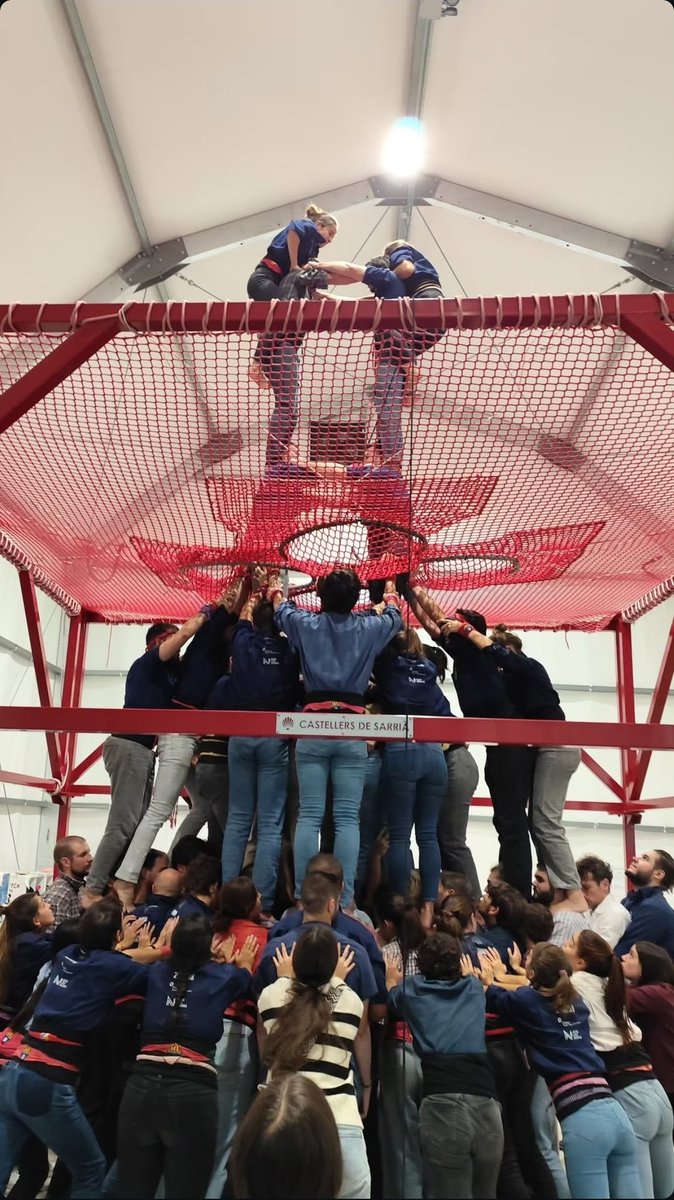
⚡️NO TENIM LÍMIT⚡️
Diumenge, a la FM de Sarrià, vam fer història!
🔸️4pd4, 5d7, 2d7, id4d8, 4d8, 2pd5 i pd4bal
Som la primera colla del món casteller que descarrega 2d7 i 4d8 per primer cop a una diada💪
Celebrem-nos, colla, això només acaba de començar!
#enVolemMés#castells
ARA SI! UN ANY DESPRÉS ACONSEGUIM DESCARREGAR EL 2D7!!!!!! 🥵🎖
Primer de la nostra història! Felicitats collaaaaaaaaa! 🥁💥🧨
#enVolemMés#castells#castellers
Ja no cal dir res més, després de l'assaig d'ahir el sostre ens el posem nosaltres 🤯
Feinada espectacular, ens veiem diumenge a plaça per petar-ho 💥
#enVolemMés
Bon dia!
Avui ens hem llevat aviat per participar a les matinades de la Diada de la Mercè.
Comença un dia emocionant! Som-hiiiii!!!
#enVolemMés#castells
@instrumenthull@seanluomdphd@anonymoostafa Isn't one of the points here we can't rely on law of large numbers? In some phase II oncology trials we might be looking at tens to low hundreds of patients. In these scenarios this matters
A model trained with a frequentist objective using i.i.d. observational train and validation data is almost surely converging to the non-causal model of the underlying data generating process.
That is because using short cuts/spurious correlations leads to a lower loss than not, i.e. you are actually specifically incentivizing your model not to be causal.
"Emergence" believers' core fallacy is the assumption the causal model would have the lowest error, and therefore better optimization would eventually converge to the causal model.
The opposite is true - the best scoring model (per frequentist objective) is actually the one that is best at exploiting spurious correlations.
Despite clear guidelines, germline genetic testing remains underutilized in patients with metastatic breast cancer.
In our new study published in JCO Precision Oncology, we evaluated >15,000 patients with metastatic breast cancer and found that fewer than half received germline BRCA1/2 testing.
This represents a missed opportunity—not just for personalized treatment, but also for cancer prevention in families.
How can we close this gap?
🔗 https://t.co/oDZxkkkant
@TJCoats@AlexJDeighton I keep hearing that but it still really doesn't feel great to be paying an additional 9% tax of my post-tax earnings (I'm overseas) and not making a dent in the interest for the next 25 years compared to those who went to university a few years before I did.
I am excited to share our new article published in BJS. In this study, we proposed a modified IPCW estimator for Kendall's rank correlation coefficient for survival and ordinal outcomes. https://t.co/599HYTQRah
@sib313@premnsikka Paying 9% of my post-tax income (because I moved abroad for a job) is seriously damaging. Everyone seems fine calling it a graduate tax when they don't have to pay it, but I'm stuck paying a shed load of money for the next 28 years and it's getting a bit annoying
Avui hem descarregat el nostre 30è 4d7 i el nostre 25è pd5!!! 🥇
Moltes gràcies a les colles per l'ajuda i als nostres incansables músics! 🥁
La setmana que ve més i millor 😊✨
#laCollaEtsTu#castells
For the new kids in back: If you hate statistics, you'll love my free lectures. Putting science before statistics, from basics of inference & causal modeling to multilevel models & dynamic state space models. It's all free, made with love and sympathy. https://t.co/GnOYGex9Yg