saw this post and realized I never took the time to share the work I did many months ago that are genuinely quite cool. it resolve a big issue people broached (bit exactness) in the replies and also significantly alleviates a secondary issue (speed).
it uses zero floating point ops in the inference, so you can run the thing on a GPU, CPU, or even a toaster and get bit exact (de)compressed text by design, and it's around 3600x faster than @nathanrs's Qwen experiment on CPU. on GPU it gets 50MB/s decompression, which is 28,000x faster than Fabrice Bellard's GPU implementation.
https://t.co/KEzyXHYiDi
🎉I’m excited to announce our $18M Series A, with participation from @VenrexVC, @thegp , @VirtueVC , @caffeinatedcap , @arrayvc, @GreatPointVC , @LiveRamp, @haystackvc, @CapitalAlso, @LifeXvc , Circle & Co, and WS Investments.
The first generation of AI was built on public, human-curated data. The next will be built on real-world data. The datasets carrying real human behavior are what now separate one AI system from another. AI companies want them. The companies that hold them want to put them to work. The barrier has always been risk.
We solved that risk in healthcare, one of the most regulated data environments there is. Today we bring it to the rest of the economy.
Announcing our manifesto, Lex et Libertas.
The history of commerce is a history of The People writing their own rules.
When a merchant in thirteenth-century Venice wanted to trade across the Mediterranean, he signed a commenda — a private contract that split the risk between an investor and the merchant who sailed, and held up wherever the ship made port. It was not issued by a king. No parliament approved it.
Merchants wrote it because it was machinery for their economic freedom. This was the precursor to the modern corporation.
This set of norms, jus gentium, grew out of how foreign traders actually dealt with one another, not out of a sovereign's decree. The merchant law was customary, portable, and enforced in the merchants' own courts.
It still works that way, when we let it. In 2013 a startup accelerator, not a legislature, wrote the SAFE, and it now governs a huge share of how companies get funded. That is the spirit of merchant law. Yet despite all of this fantastic success, we’ve lost that spirit.
The civilization that invented the corporation is now strangling it.
The US Code of Federal Regulations ran 9,745 pages in 1950 and runs more than 190,000 today. The average large multinational holds 549 subsidiaries across 56 countries. The rules merchants once wrote for themselves now arrive from thousands of jurisdictions at once. It is impossible for it to be owned by anyone, and the price is paid after midnight by people no one is paying attention to.
Lex et Libertas is our argument for the future we are building. It is the manifesto for my life’s work.
The merchants built their own freedom technology. In dedication to these giants, we are building the only managed entity platform, enabling businesses to seamlessly operate across 100+ countries. 500+ firms including TRX, Remote, Exa AI, Seismic, and Composio have already joined us.
As we enter into the agentic era, software will form the backbone of global industry. A new legal order will emerge to facilitate the future of commerce across our planet, and beyond.
And Commenda is where it will be built. Jus agentium.
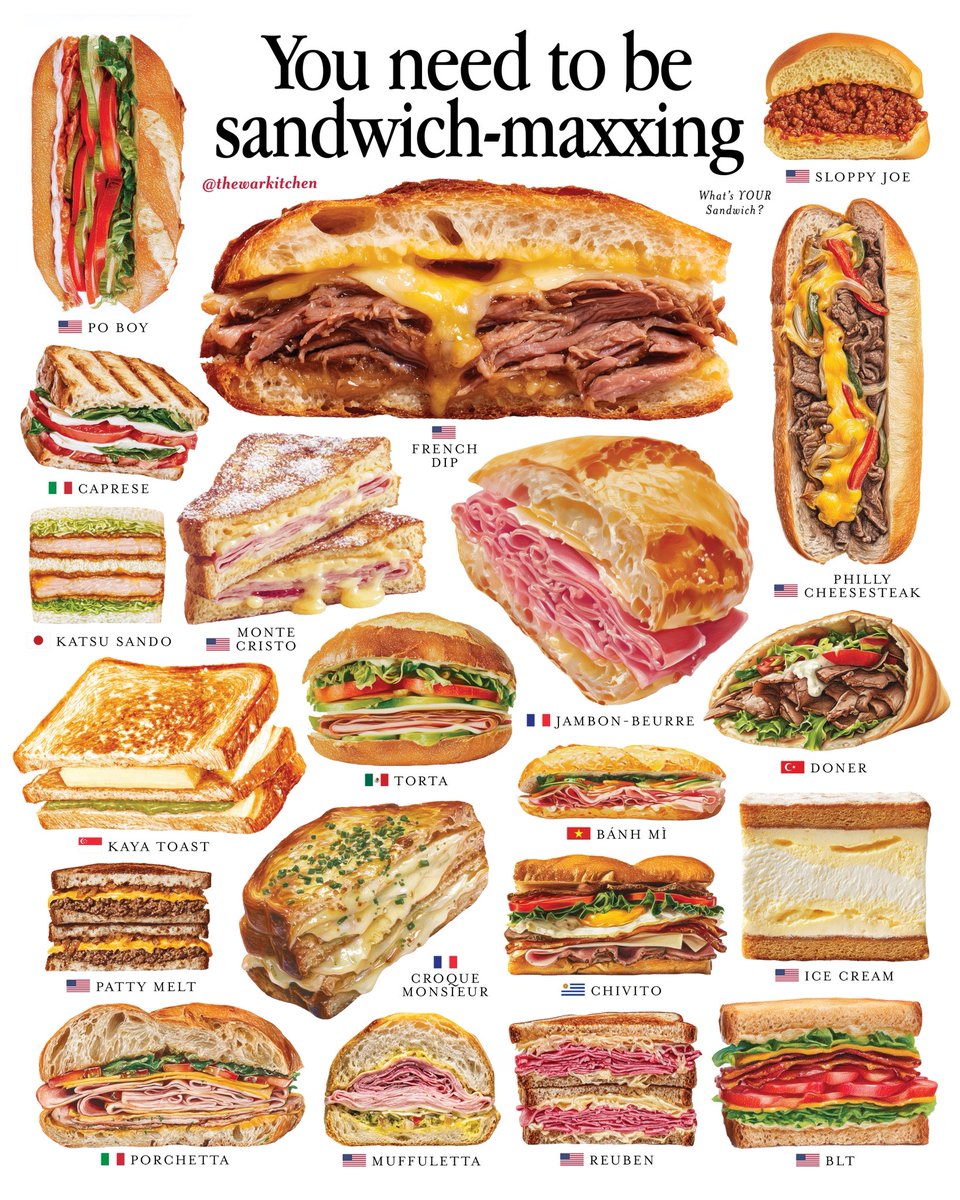
We need to rethink how we view sandwiches. They shouldn’t be a guilty pleasure. When you make a sandwich with the right ingredients, it can absolutely become a health food you can have everyday. Use good quality sourdough. Fresh burrata. Build your sandwich with real meat. Nothing processed. Sauces made from scratch. No seed oils. Fresh greens. The right ratios. You can enjoy a sandwich everyday, guilt-free. The sandwich is a health food.
Seeing subquadratic LLM research trending alongside news of big companies cutting frontier AI budgets or switching to open source.
I suspect migrating AI workflows to open source models will be a short term trend until frontier labs figure out how to do inference cheaper
1/4
Most people spend their lives living in buildings they had little influence over.
We believe AI can help change that.
Over the last month, 120,000 people generated 325,000+ home designs with https://t.co/M3bUUqREhP
Today, we're excited to share that we've raised a $16M Seed led by Buckley Ventures to continue building multimodal generative models for residential architecture and spatial design.
Here's a glimpse of what we're building:
The world is getting warmer while our infrastructure gets older: a recipe for disasters.
We’re excited to announce Fund II: $85M for early stage investments in disaster resilience.
> you watch an ad
> Meta already knows how your brain will respond…
> …but do you buy? Decision data is captured
> Meta trains model to predict buyer intent based on brain response/ad pairs
> Meta can generate something you can’t resist buying
Today we're introducing TRIBE v2 (Trimodal Brain Encoder), a foundation model trained to predict how the human brain responds to almost any sight or sound.
Building on our Algonauts 2025 award-winning architecture, TRIBE v2 draws on 500+ hours of fMRI recordings from 700+ people to create a digital twin of neural activity and enable zero-shot predictions for new subjects, languages, and tasks.
Try the demo and learn more here: https://t.co/VkMd1YpQWI
MiroFish is trending for its potential in trading, but at some point will probably become *dangerous* as a political tool
This is chemical reactions kinetics but for population modeling