Finance teams have been told painful ERP migrations are just part of the deal.
Flow begs to differ.
Under 2 minutes. That's how long it takes Flow to migrate years of transaction history with all dimensions included.
No consultants, phased rollouts, or horror stories.
Minutes to migrate. Days to go live.
Flow just set a new bar for ERP implementation. 👇
Nobody likes writing categorization rules by hand.
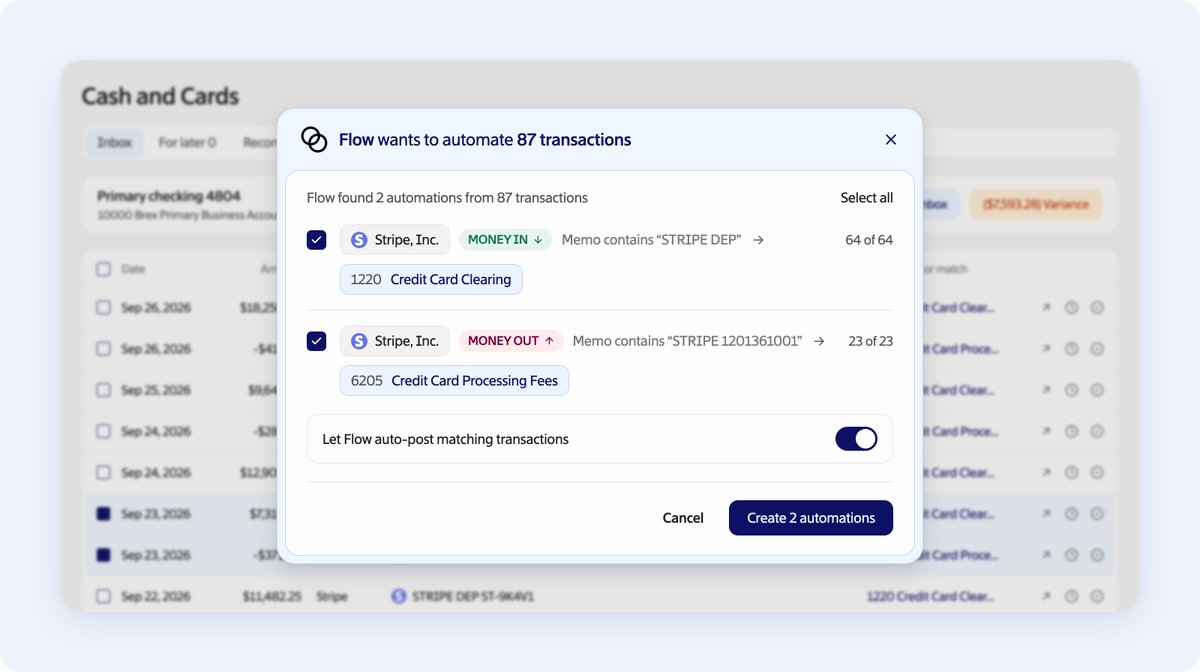
Take Stripe: payouts and fees look almost the same, and the only difference is the money's direction and a code buried in the memo that you need to differentiate.
Flow AI now writes those rules for you.
It spots the patterns, drafts an Automation for each one, and tags Departments, Locations, and more.
Nothing posts until you approve it.
You can always see what Flow AI did and why, with a clear audit trail.
Your Automations now write themselves.
A euro bill and a dollar bank account never agree on the exact number. So you end up refereeing the fight with a quick spreadsheet 🙄
Flow does the currency math for you.
Match across currencies: the realized gain or loss books itself, with an audit trail intact.
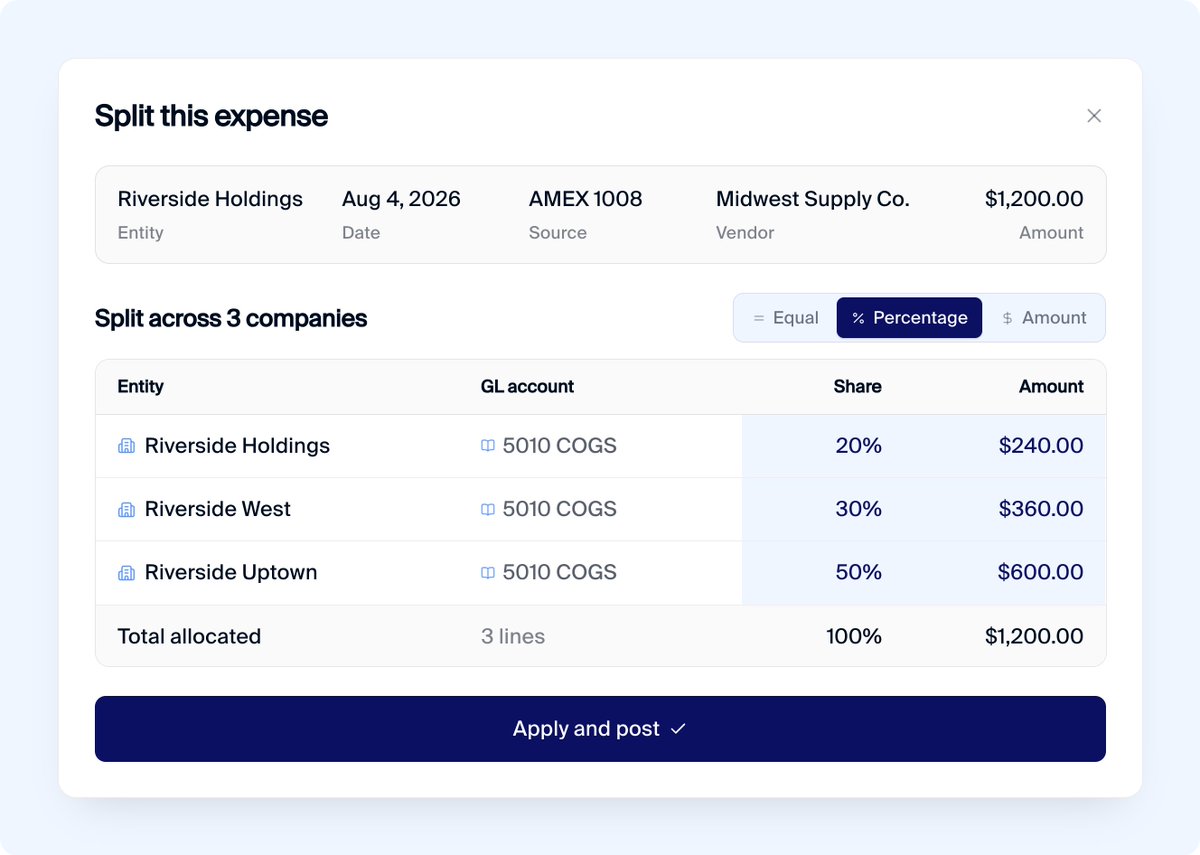
The multi-entity chore nobody enjoys: split a shared cost across accounts, then re-key the intercompany side on the other company's books by hand.
In Flow, you enter it once, and both sides post off your mapped intercompany accounts. Ties out at consolidation🤌
For most finance teams, the real reporting still lives in Excel, and every month someone loses hours to copy-pasting.
Flow connects your reports to Excel live. Build the model once, and it stays up to date.
And yes, your formatting holds.
Bank reconciliation is mostly hunting for the handful of lines that don't agree.
Flow does the hunting for you.
Upload a PDF statement; it auto-matches to your books, side by side.
Then it surfaces the outliers and helps you clear them, so the exceptions get resolved.
With Flow, reconciliation finishes in no time.
You're sending money to yourself.
Somehow this requires two entries, a clearing account, and an "in transit" purgatory whenever the legs land on different days or currencies.
Truly the height of finance innovation.
Flow matches the two sides once, books both journal entries, bridges the timing, and handles multi-currency on its own.
Consolidation nets clean the first time. This is Intercompany Transfers in Flow.
Your vendor list has trust issues.
"Amazon." "https://t.co/5ImNPiRsdQ." "AMZN."
One supplier, three records, so every spend-by-vendor report is a little off.
Flow's AI Vendor Merge finds duplicates, combines them into a single profile, and rolls spend up correctly across entities.
Full audit trail intact 🤌
Most ERPs bolted on an AI chatbot you have to go ask for help. Flow's agent doesn't wait to be asked.
Upload a receipt and watch the bill fill itself out: vendor, amount, GL account, all drafted for your review. No typing, no template, no half-working OCR that fumbles every third field.
The work happens where the work actually is.
See it below.
Month-end close used to take us 10 days. Now it takes 3.
So we moved LiveFlow's own books from QuickBooks to Flow.
Our Controller, Matthew Roy, now has:
- One system instead of 10+ spreadsheets
- Real-time data he can actually make decisions on
- Up to 10 hours back every week
Check it out:
https://t.co/tiBTFSZLot
Our Finance in the AI Era report found that finance teams are already using AI. Just not in the tools where the work actually happens.
Many legacy ERPs added an AI chatbot and a fancier report generator. Neither touches close, reconciliations, or the workflows that eat up 60% of your week.
Modern ERPs built with AI at the center work differently. The AI isn't something you go to — it's categorizing, flagging, and drafting.
See what it's like to work on a platform built for less data entry and more decision-making: https://t.co/tFWPbKawTV
The plan was simple: find the gap, fill it with a tool, and the work gets easier.
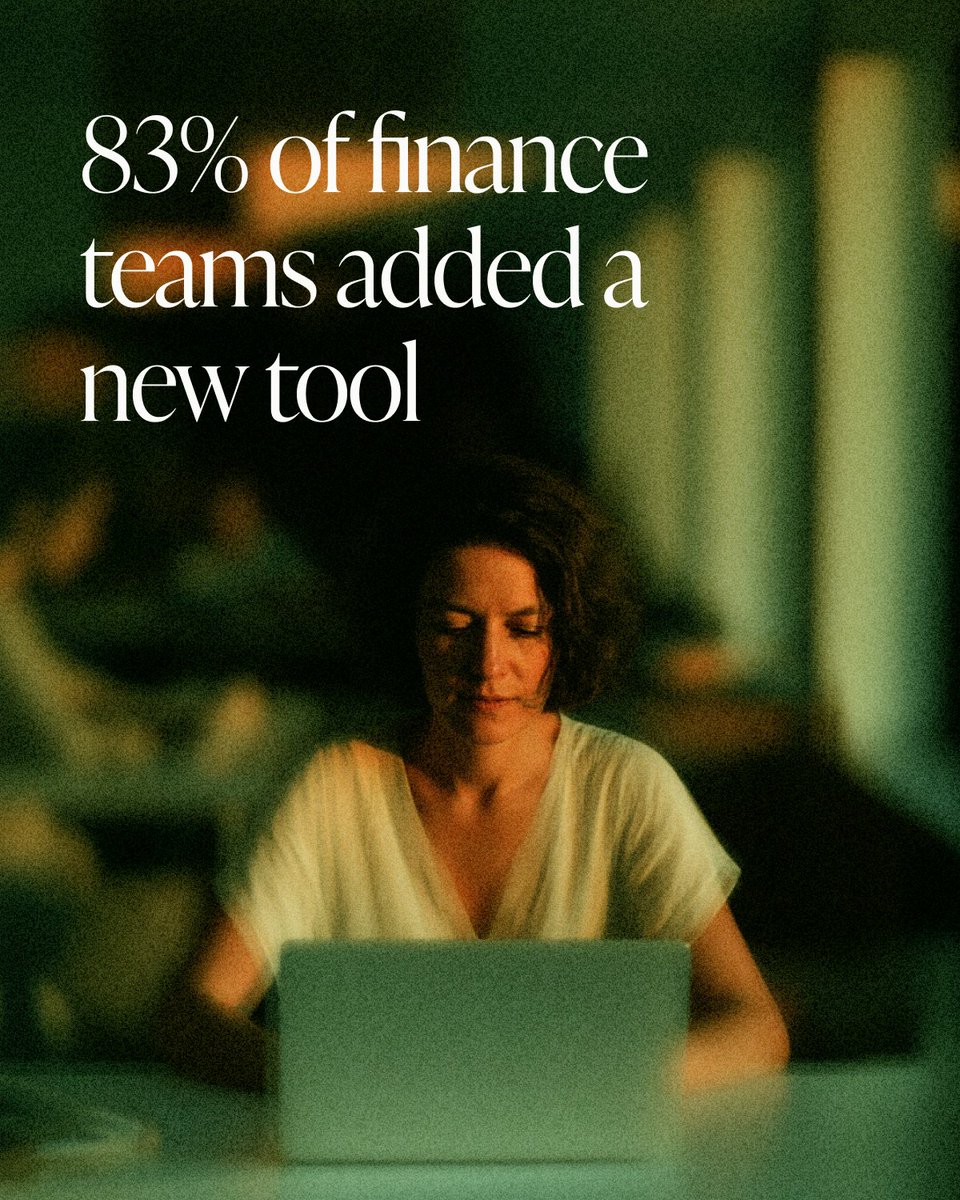
The reality? 83% of finance teams added new software last year, and 48% say their stack got more complex as a result.
More tools don't always mean a better process. Sometimes they just mean more to manage.
We surveyed senior finance operators to understand what software is actually helping and where it's just adding noise. Download Finance in the AI Era: https://t.co/rR9sqWKTae
LiveFlow has been named #1 for FP&A and Financial Close in the @G2dotcom Summer 2026 report.
We build for finance teams who deserve better than clunky tools and manual workarounds. This tells us we're on the right track.
Thank you to every customer who took the time to share their feedback.
Your journal entries have patterns. Flow ERP found them.
🖥️ The MacBook you bought in January? Depreciated every month for the next three years.
📄 The insurance policy you prepaid? Amortized every month for the next 12.
🔁 That intercompany management fee? Same accounts, every single close.
Flow's Journal Entry Agent studies your past entries, learns what recurs, and drafts those entries on schedule. The agent maps the entries to the correct accounts with amounts pre-filled.
No setup or rules. Flow proposes, and you simply approve.
Two weeks of recurring close work, completed in minutes.
Flow ERP 🤝 @billcom
Flow's new native BILL integration provides a real-time, two-way sync between AP/AR and your general ledger.
Transactions, bills, invoices, and payment activity 👉 tracked, mapped, and reconciled with zero manual data entry.
A number changed in your report. You check your audit log and find... nothing helpful.
Audit trails shouldn't be a mystery.
With Flow ERP's Audit Log, every transaction carries its full history: what changed, when it happened, and who made the change.
Need the full story fast? Simply ask Flow's AI Agent to summarize it.
Watch it in action. 👇
Payroll is one of your biggest expenses. Shouldn't you see it in your books in real time?
Flow ERP now connects to your payroll provider, with daily sync and automatic mapping to the correct entity.
Sync pay statements, journal entries, and headcount data from @ADP, @Deel, @GustoHQ, @Paychex, @Paylocity, and many more.
Check out the integrations: https://t.co/WOdqJcaPRT
The AI adoption story in finance has a gap.
Teams are using AI, but the most time-consuming, operationally demanding part of the job is still a manual process: month-end close.
We spoke with @CFOdive about the data infrastructure problem plaguing modern finance teams: https://t.co/JCigJKY2gT
How can Flow ERP help accountants regain time and alleviate much of the frustration they've experienced over the years?
With AI agents that work continuously in the background: categorizing transactions, flagging exceptions, and surfacing answers the moment you need them.
You simply review and are free to spend the rest of your time on work that requires your judgment.
See three ways Flow ERP saves you time 👇