I've realized there's a huge misconception on asset "useful life" by the public.
This is likely what drives the disconnect in how $CRWV cash flow is currently perceived vs. the impending risk of adjustments that'd result in a re-rate and investment loss for $NVDA.
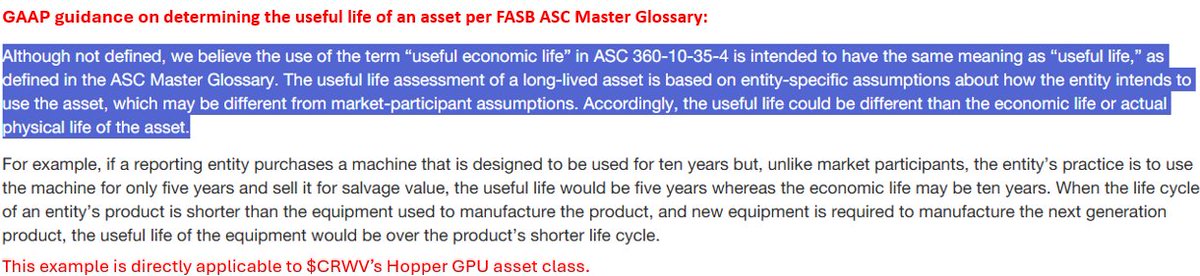
"Useful life" is a strictly defined term under GAAP - it refers specifically to the period of which an asset can generate economic benefits to the business. Even if the asset "still works", it doesn't contribute to useful life if it generates 0 revenue.
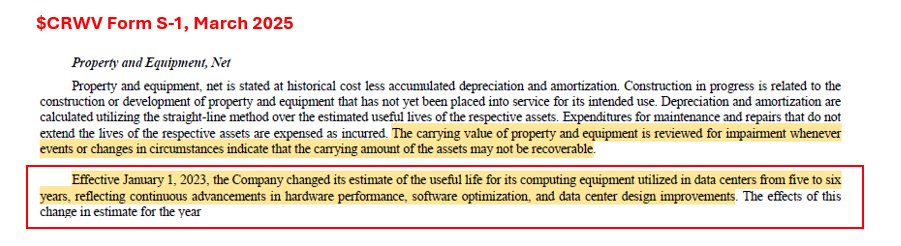
$CRWV actually extended GPU useful life from 5yrs to 6yrs in Jan'23, citing tech advancements:
But this doesn't necessarily mean an extended period of economic benefit generation, which is clear in the significant drop in Hopper pricing.
Putting the GAAP definition for "useful life" to work will adversely effect $CRWV accounting and cash flow assumptions in several ways:
1. PPE recoverable amount assessment
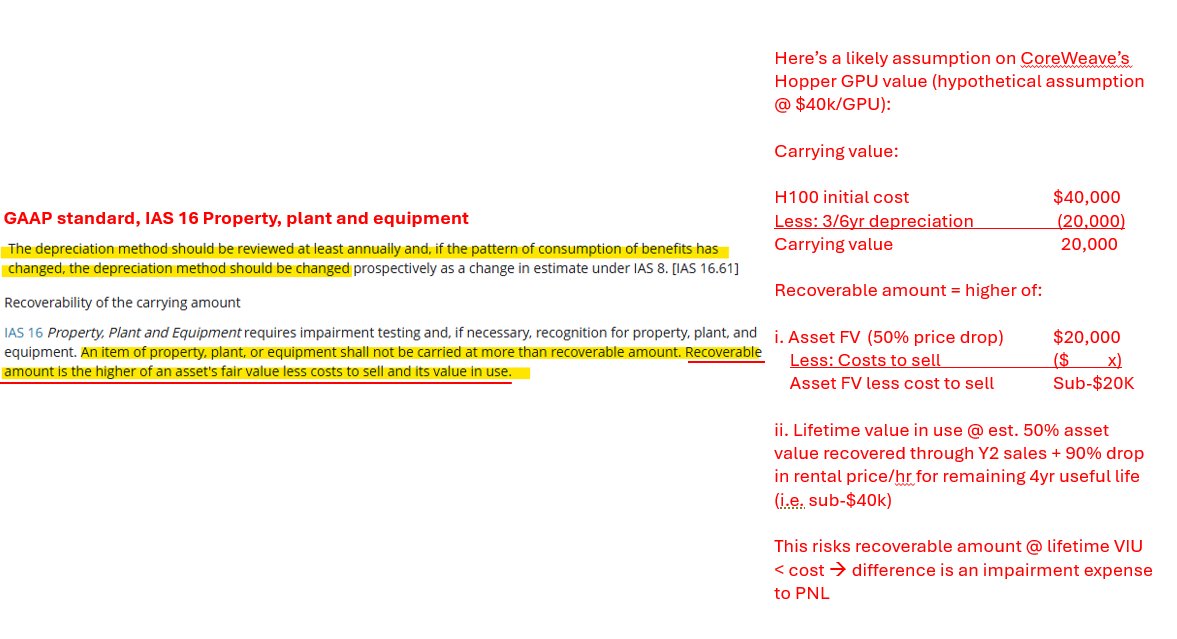
Hopper prices and rental rates/hr have come down 50-90% since Blackwell launch. This is sufficient to trigger a reassessment of PPE recoverable value, which GAAP requires on an annual basis anyway.
PPE impairment occurs when recoverable amount < carrying value (i.e., cost less depreciation). Recoverable amount is defined as the higher of a) asset FV less costs to sell (i.e., current ~50% reduction in H100 pricing) vs. b) its value in use (i.e., 90% drop in H100 rent/hr x remaining useful life).
Say $CRWV spent $40k on H100 in '22 and assumes 6yr useful life. It's likely RA < CV today, meaning impairment losses are on the table.
Here's another way to put it:
Say $CRWV bought a H100 at $40k, and it's only recouped $20k of it through Y2 before prices plummeted from $8/hr to $1/hr. $CRWV would need greater demand than Y1 + Y2 through Y6 to make up for the price drop w/ volume and dodge impairment. But how is it possible to generate greater demand for H100 today than when it was first released, especially when we have newer and better Blackwells?
This is why PPE impairment is an underappreciated risk for $CRWV.
2. Extended/altered cash flow realization schedule
There are also misconceptions that take-or-pays secure LT cash flows for $CRWV and will mitigate its exposure to asset impairment.
That's not entirely true.
As I've said before, $MSFT won't sign an onerous contract and commit an outsized $ to a specific GPU it knows will become obsolete quick. Even if LT contracts are take-or-pay, they're likely transferrable to newer GPUs. This leaves the older GPUs' recoverable amount short of its original cost, resulting in an imminent impairment loss.
Alternatively, some $CRWV customers have committed consumption-based sums to Hopper GPUs. Considering the 90% drop in H100 rental prices, the timeline to realizing this commitment becomes significantly extended - perhaps even beyond the chip's life expectancy. This pushes out cash flow realization and adversely impacts $CRWV valuation.
The scenario drives the impairment narrative home once again because the lifetime recoverable amount < cost.
3. GPU derecognition
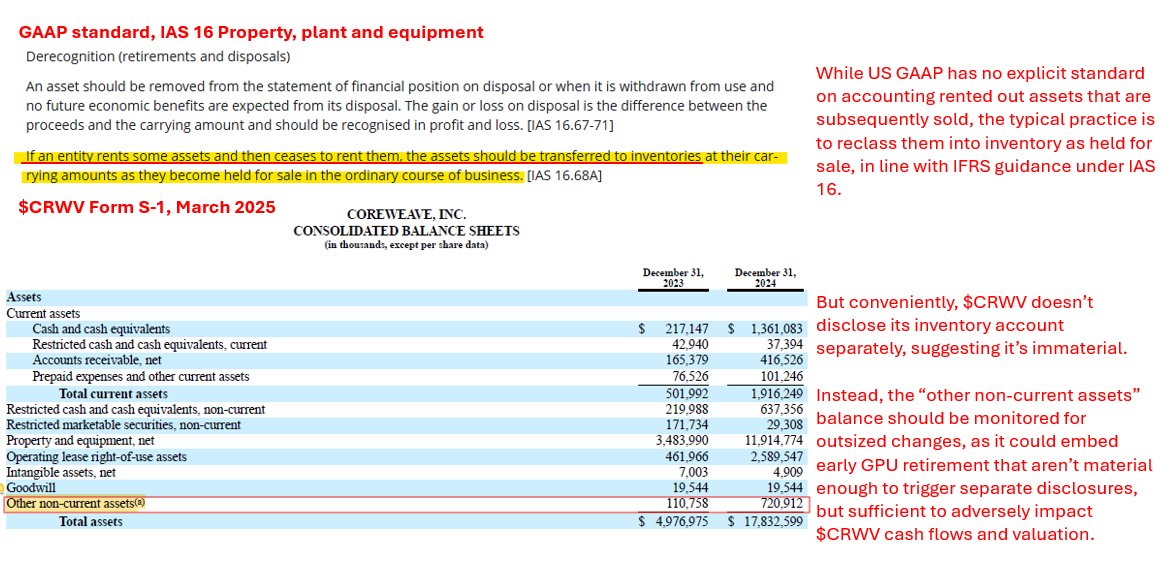
When a GPU is deemed no longer in use and derecognized, GAAP requires it to be transferred to inventory as a "held for sale" asset. This means any increase to inventory balance would be indicative of changes to $CRWV PPE composition (e.g., H100 retirement), even if it wasn't separately disclosed.
But wait - $CRWV does not separately disclose its inventory balance either.
It currently reports all immaterial LT asset balances in a lumpsum via "other non-current assets".
This is something to keep a close eye on for sizable changes. There's risk $CRWV will start to embed older GPU retirements in other LT assets w/o separate disclosure due to "immateriality". But that doesn't mean the balance won't grow and significantly impact its cash flow assumptions.
In my past life as an auditor (to those who ask in my DMs - here's your answer), I'd witnessed a material accounting-related valuation reset on a transaction that'd blindsided my client. And this ongoing $CRWV $NVDA debacle is becoming eerily reminiscent of it.
It was one of the biggest accounting backfires I've seen. My client had acquired a telco with what seemed like straightforward revenue streams - rent collected from cell towers. But a deeper dive into existing MSAs post-close uncovered a technical accounting issue that'd ultimately converge those revenues into costs. The less accommodative accounting caused the cash flow assumptions used to justify the acquisition to fall apart. The result was a forced write-off, massive goodwill impairment, and a valuation reset that blindsided my client.
$CRWV and $NVDA faces a similar fate.
$NVDA now owns 7% of $CRWV, whose valuation is based on LT GPU rental contracts. But here’s the caveat: $CRWV assumes a 6yr GPU lifespan, despite $NVDA accelerating its upgrades to a 1yr cadence. Prices for older H100 and even H200 chips are collapsing, down 90% and 50%, respectively.
This means $CRWV will eventually be forced to shorten its depreciation schedule. This would alter the cash flow assumptions on which its valuation is based on, resulting in a massive re-rate and write-off to the $NVDA investment.
Still don't believe me? The weak link's hidden in plain sight in $CRWV S-1 disclosures:
$CRWV said it only deploys capex when there's confidence they can be fully recouped through LT contracts. There are 2 primary types - take or pay and consumption-based contracts. But $CRWV doesn't disclose the mix.
Considering the rapid pace of tech advancements, it's unlikely customers like $MSFT are dumb enough to commit to take-or-pays on a rapidly deteriorating GPU. The contracts are likely consumption-heavy, and commitments can be transferred to newer generations of GPUs. This leaves limited evidence that $CRWV 's existing GPUs can generate sales for 6yrs.
Even worse, consumption-based contracts tied to older GPUs risk becoming economically obsolete, reducing the PV of LT cash flows. Say I commit $6B to renting H100s and H100s only. With rental prices declining 90% after Y1, it's going to take significantly longer for the $6B commitment to be realized into revenue, which pushes the billing and cash receipt cycle further out.
These risks are clearly not priced in for $CRWV and will ripple back to the $NVDA investment too.
The AI halo effect may hold for now. But if these accounting cracks widen (it’s just a matter of time), both companies could face a sharp revaluation.
Don't be blindsided like my client.
$NVDA is essentially derisking the RPT/circular financing narrative off its books by convincing WS to backstop a $500B GPU bill.
Nvidia only needs to put up a 25% insurance - which under US GAAP doesn't even need to be fully reflected on its balance sheet due to FV reporting.
NVIDIA compute is a productive, investable asset.
We’re partnering with six of the world’s leading long-term capital providers to establish independent financing platforms aimed at mobilizing over $500B of third-party capital — helping customers access AI compute at scale.
Jensen shares more:
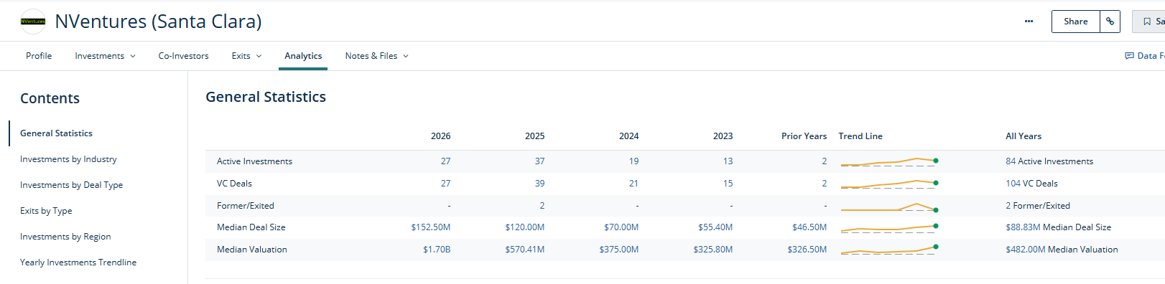
The pattern isn't new. $NVDA has been concentrating its investments in unprofitable neoclouds and AI labs for a while now. Only 8 of 67 investments made YTD (ex-NVentures) were in profitable companies - and the majority served an upstream supplier function to Nvidia's AI ecosystem rather than a GPU-buying function.
Changes in $NVDA’s segment reporting beginning FY26 is increasingly obscuring the composition of its profitability just as circular transactions expand.
Although Nvidia now offers increased visibility into the split in data center demand between Hyperscale and AICE, income disclosures remain aggregated under much broader umbrellas between the Compute & Networking and Graphics segments.
This disparity reflects a high-risk area flagged by the SEC in AI-era financial reporting – particularly the transparency of segment disclosures around significant expenses.
Nvidia states that segment expenses aren’t regularly provided to its chief operating decision maker (ie Jensen Huang) and are instead reviewed on a consolidated basis. In Q1 FY27, it bundled $21.2B of compute & networking costs under “other segment items”, while the income split between Hyperscale and ACIE remained undisclosed.
The aggregated expense disclosure doesn’t necessarily violate ASC 280 Segment Reporting. But limited visibility into the economics behind rising data center demand – precisely as Nvidia deepens its financial involvement with customers via circular arrangements – could draw greater regulatory scrutiny and force incremental disclosures.
For now, aggregated Compute & Networking income disclosures could be masking weaker margins and standalone economics carried by Nvidia-backed demand from unprofitable AI labs and neoclouds – even as headline data center growth remains strong.
But not all AI demand is the same – investors could be misled into pricing marginal data center AI demand as economically equivalent to traditional hyperscaler demand without knowing whether Nvidia is taking on greater capital exposure to sustain it.
Growing regulatory pressure for more transparent segment disclosures across the AI industry represents an underappreciated downside catalyst for Nvidia – especially if it reveals that the company’s fastest growth drivers are also the most dependent on Nvidia funding.
I think a reverse in current FCF trends between semis and hyperscalers could be coming.
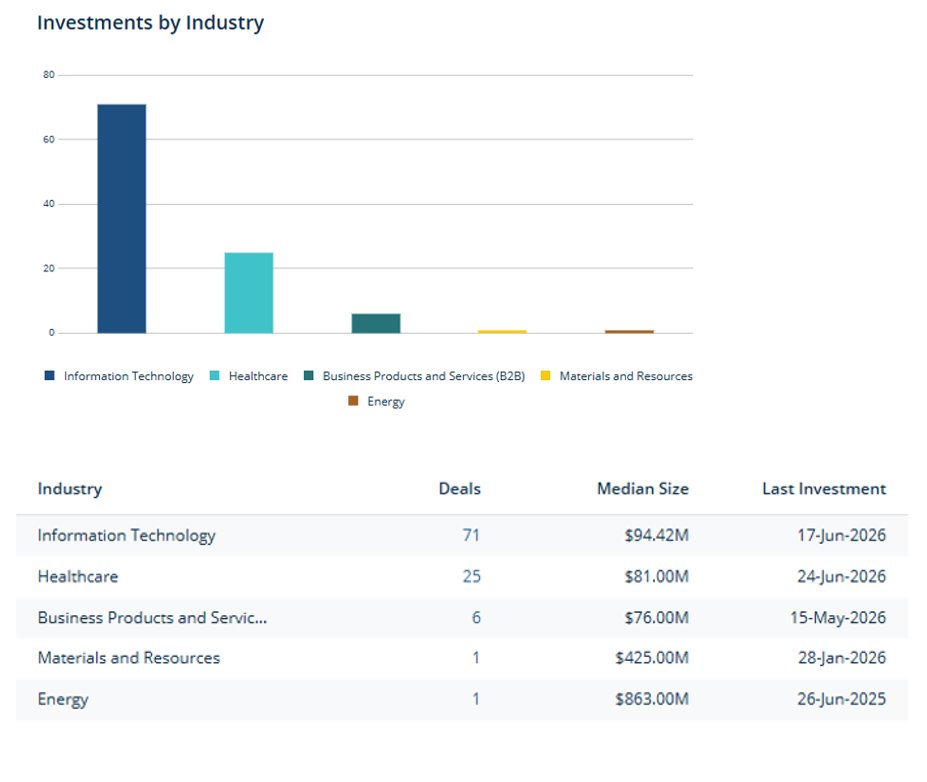
$NVDA isn't just backstopping billions $ of compute, DC and power infra deals. NVentures is also ramping deal velocity concentrated in IT, healthcare and services - it's funding the workloads that ultimately consume growing compute capacity.
$GOOG's recent talent exodus may be less damaging to its LT AI strategy than market’s pricing in.
Recent data suggests Google has built a strong track record of retaining economic exposure to innovation generated by ex-Googlers through Google Ventures – and strategically backing Jeff Dean’s new startup, Discovery Loop, is likely no exception.
GV’s track record is extending Google’s R&D beyond its own walls – portfolio companies absorb the speculative research spend, risks and commercialization costs, while Google preserves equity upside in successful outcomes. Corporate VC investments have also emerged as a strategic earnings management tool, limiting EPS headwind by partially “outsourcing” experimental AI R&D to venture investments booked as assets, with upside captured through investment gains if successful (downside capped at committed capital, resulting in asymmetric exposure to high-risk research).
The early data's also encouraging. Out of the 116 unique GV deals from 2025-2026, ~44% founded by ex-Googlers have already reached unicorn status vs. ~20% for the rest of the cohort. The disparity suggests a meaningful sourcing advantage for Google when backing its own alumni. Moving promising AI research outside of Google’s complex org structure also reduces managerial constraints that've slowed commercialization, driving faster time-to-value.
This makes Google's recent talent drain selloff potentially attractive, as market may be overstating the extent of AI value loss when key researchers depart.
Announcing Discovery Loop!
I am very excited to announce that, along with my longtime friends and collaborators @Sanjay_Ghemawat, @OriolVinyalsML and @quocleix, we are founding Discovery Loop (@DiscoLoopAI), a Public Benefit Corporation whose mission is to automate machine learning, science, and engineering to accelerate discoveries and progress. The four of us have worked together for 14 to 30 years, and have helped build some of the world’s most used products, infrastructure and AI models, and we’re excited to turn our attention to this ambitious endeavor.
♾
Learn more at: https://t.co/Rv3LMdLluK
An upcoming accounting change could expose weaker economics in some of AI’s largest contracts.
Effective Dec 15, 2026, ASU 2025-04 tightens accounting for customer warrants – a growing circular financing tool used by companies like $AMD that blurs organic vs. incentive-induced demand.
Customer warrants are essentially sales “rebates”. When warrant vesting conditions are met, their grant-date FV is recognized as a “contra-revenue” reduction to sales. The corresponding warrant liability’s also remeasured every quarter, with FV changes flowing through P&L.
The pre-ASU problem was timing. GAAP lacked explicit guidance on how purchase-linked vesting conditions are defined. Some companies prematurely recognized the warrants from the get-go – while others waited until the purchases became probable, or until it's completed and the warrants legally vest.
That inconsistency introduced an accounting blind spot: if warrant recognition's deferred until the performance condition's completed, the related contra-revenue and FV impact becomes delayed. This makes early contract revenue growth appear artificially overstated.
ASU 2025-04 directly tightens this ambiguity. It explicitly defines customer commitments tied to the warrants as “performance conditions”. Once achievement becomes probable, the warrant consideration needs to be recognized as a contra-revenue against related sales.
For AMD, it means the OpenAI or $META warrant tranche must reduce related MI450 revenue once the corresponding deployment commitment is deemed probable – not delayed until completion.
ASU 2025-04 effectively pulls recognition of the warrant’s cost closer to the revenue it helped generation – which matters because AI valuations are still primarily dependent on contracted demand and headline growth that obscures underlying vendor incentives.
The ASU won’t end circular AI financing - but it could force a market about-face.
AMD's warrant deals with OpenAI and Meta usually get described as equity sweeteners. Run the math, and these look more like a rebate that matches the price of the compute itself, with up to a 105% discount for OpenAI. (1/3)🧵
I think a reverse in current FCF trends between semis and hyperscalers could be coming.
$NVDA isn't just backstopping billions $ of compute, DC and power infra deals. NVentures is also ramping deal velocity concentrated in IT, healthcare and services - it's funding the workloads that ultimately consume growing compute capacity.
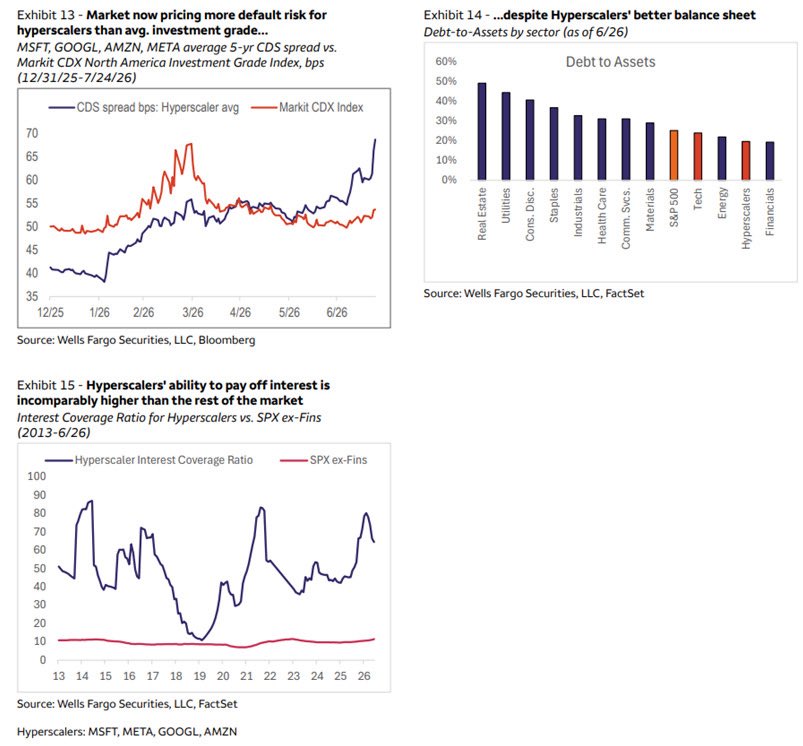
Market is overreacting to hyperscale credit spreads widening from my perspective. TL;DR Spot pricing for renting GPU compute materially above contracted rates implies hyperscalers are underearning while operating cash flow acceleration is an underestimated source of funds for AI capex.
The fact that spot prices for GPU rentals are at least 2x higher than contracted rates is the missing piece from the discussion about hyperscaler credit, which is the only fundamental factor behind this selloff. Multiple private companies are planning on spending at least 2x more per GPU for compute as contracts roll-off and some have spoken about this publicly.
As contracts roll-off, hyperscale growth rates are going to continue to accelerate as their installed bases of compute reprice higher. Hyperscale operating cash flow growth using a mix of estimates and actuals is modeled to accelerate from 31% in the first quarter of 2026 to 50% in the second quarter. This acceleration should continue for the rest of the year and this is not in estimates which incorrectly model a deceleration in the third quarter from my perspective.
Some math. Consensus estimates are probably for 25-35 gigawatts added by hyperscale and neoclouds in CY28 (using a range as standing up datacenters is hard and a lot of the neos plus labs are still private). At 60b per gigawatt, that is 1.5 to 2.2 trillion in capex. Consensus estimates for hyperscale/neo operating cash flow is 1.3 to 1.4 trillion. I think this gets revised up materially as contracts reprice and growth accelerates so the 100b to 700b that would hypothetically need to be plugged by debt goes away. And their credit profiles materially improve. Not to mention the said 100b to 700b would be less than 1 turn of incremental leverage on consensus EBITDA estimates. And obviously the Nvidia and Broadcom “credit wrappers” help improve creditworthiness as well given their FCF profiles.
OpenAI, Cursor/Grok and the various Open Source inference clouds have accelerated materially over the last two months per public data and Anthropic continues to grow insanely fast while likely generating FCF. This - along with the fact that spot prices for GPU rentals are so far ahead of contract - are the missing pieces from the BofA chart on hyperscale FCF vs. semiconductor FCF.
Hyperscalers are underearning and anyone who signed a contract for GPU compute in 2024 and 2025 is overearning. Operating cash flow will be enough to fund capex but as contracts reprice and cloud growth continues to accelerate then spreads likely come in as well.
Would also note that CDS markets are easy to manipulate - was a huge feature of the GFC - short the stock and then buy the CDS. So I would not put attach much signal to CDS.
Net, net I’m not that concerned about the widening spreads in hyperscale credit. The real risk is that bringing power online and energizing all these GPUs is really hard but we are getting better at this every day.
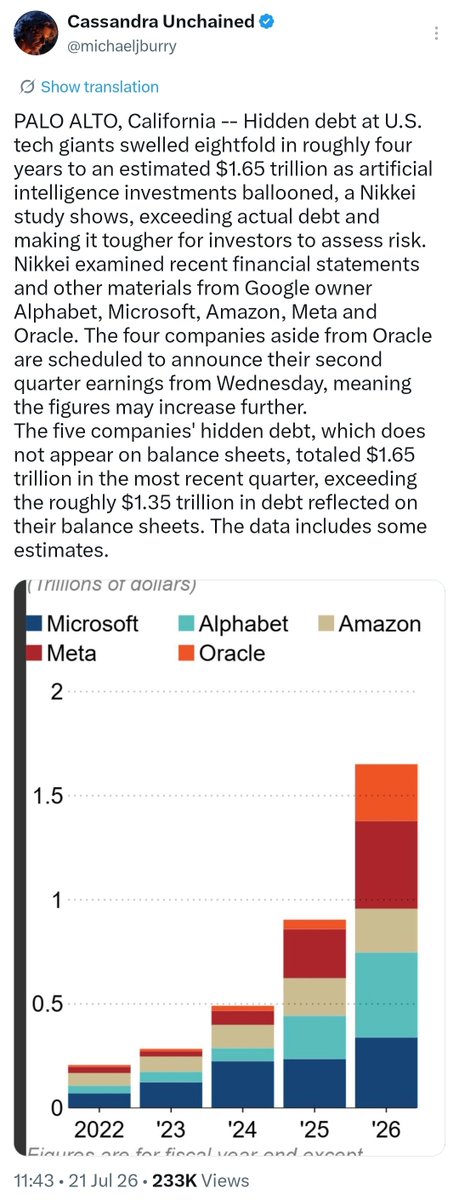
The “hidden debt” narrative points to two deeper AI accounting blind spots gaining regulatory attention.
This accounting catch-up could become a defining AI risk in 2027 when 2026 audit reports place today’s aggressive infrastructure buildout under greater scrutiny.
The SEC’s recently acknowledged that “current auditing standards weren't designed with today’s technology or AI or digital assets in mind”. Recent Big 4 guidance’s also placing greater emphasis on AI infrastructure capitalization, valuation and financing structures.
The hidden debt warning may be only the balance sheet problem.
But the deeper risk is how this capital ultimately impacts P&L:
1. Capex
Surging AI capex and increasingly complex data center builds are demanding greater judgment on whether adjacent labour, software, and other upgrade/maintenance costs should be capitalized or expensed. This effectively increases risks of spending misclassification and overstated earnings.
It’s a particular concern for neoclouds like $CRWV $NBIS, where material weaknesses in controls covering fixed assets/PPE and insufficient accounting personnel possessing financial reporting expertise remain unresolved.
2. Depreciation
The validity of 5-6yr GPU/server useful life is also coming under increased regulatory scrutiny.
Under ASC 360, GPUs generally can’t be tested for impairment on their own because they can’t generate FCF without servers, networking, power, cooling, etc. Recoverability is instead assessed within the lowest-level asset group (e.g., cluster or data center) where independent CFs are first identified.
This creates a major accounting blind spot.
A cluster’s undiscounted cash flows could pass ASC 360 impairment test b/c newer GPUs and supporting infrastructure keep the asset group profitable. Yet this obscures the fact that older GPUs could lose substantial pricing power and economic productivity within 3-4 years (under a generous scenario).
Hence, passing the impairment test doesn’t validate extended depreciation for GPUs or eliminate accelerated depreciation risk. The SEC’s explicitly warned AI issuers that eventual impairment isn’t a substitute for applying an appropriate useful life assumption in the first place.
The tightening accounting backdrop shows AI demand doesn’t need to collapse for valuations to compress. The AI buildout’s likely already proving more leveraged and costly than headline balance sheet and EPS imply - and increasingly beyond what neoclouds can afford.
3 emerging direct beneficiaries of intensifying memory-offload demand:
1. $CRDO - the Weaver gearbox enables faster and more efficient XPU-to-local memory connectivity, preserving scarce HBM capacity for the most bandwidth-sensitive workloads. The broadening ramp in FY28 could be an inflective growth catalyst.
2. $ALAB - Leo controllers enable CXL-based memory expansion beyond what's on the core compute. This directly alleviates memory performance and capacity bottlenecks, improving compute utilization and costs. Initial deployment through $MSFT Azure in 2027 could improve support for current ALAB premium.
3. $MXL - Panther V offloads storage-intensive processing tasks from the GPU, effectively freeing compute capacity and reducing GPU idle time. This also improves time to first token and increases agentic inference scale efficiencies. Panther III revenue's expected to double in 2026, validating a strong demand backdrop ahead of Panther V's 2027 ramp.
Dylan Patel of SemiAnalysis says a worse GPU with better storage and memory now beats the best chip without them, so buying the newest GPU alone no longer wins inference. So, an AMD GPU with more memory can outperform Nvidia in some cases.
"So what we have is we have over $80 million of compute, GPUs from Nvidia, AMD, TPUs from Google, Trainium from Amazon, and we run this benchmark constantly on the newest inference engine, newest drivers, newest PyTorch version, whatever it is."
"Every day it runs on an automated CI, and we run it on all the latest Chinese models, from GLM, Zhipu, Moonshot, Kimi, Alibaba, all these models we run."
"Initially, when we were benchmarking the difference between these chips and different engines, different schemes for parallelism, we were just running it fixed context length."
"But now with Agent X, we've analyzed over $5 million worth of Claude Code traces. This is real production traffic that people have donated to us as well as internally generated. Now we know what the actual agent workload looks like."
"And then as we implement that and run those benchmarks, it turns out yes, the chip you're using is very important, but now even more important is how are you handling this memory offload?"
"And so while an Nvidia GPU is faster than an AMD GPU in most cases, because AMD GPUs have more memory, they actually end up outperforming in some cases."
"Or you can have a worse GPU, but a much better storage solution, and now you can outperform what the best GPU can do without those solutions. So just buying the newest and latest GPU alone doesn't get you the best inference economics."
"Actually, you need to layer in all these other innovations including storage and memory."
[ Who's the top player on your chart? ]
"That really is a difficult multivariable problem. And generally that means you need to have, yes, you need to have the best GPU, a GB300, but you also need to have the best storage solutions. And so I won't spoil who's the best right here, but I will say that storage solutions matter a lot and memory solutions matter a lot, as does your front-end networking. That matters a lot."
Why are neoclouds still pressured after $META expands data center capex and reassures tight compute supply?
The SEC is putting AI GPU useful lives as a priority on its radar.
During the December 2025 AICPA & CIMA Conference, SEC Chair Paul Atkins and SEC Chief Accountant Kurt Hohl highlighted useful life assumptions of AI-related data center assets as a key emerging accounting and auditing issue. The issue raised by SEC regulators is also being reflected across recent Big 4 audit guidance for technology industries.
Regulators emphasized that eventual impairment is not a valid substitute for establishing appropriate useful life assumptions in the first place. In other words, data center assets could pass ASC 360’s recoverability test based on expected undiscounted cash flows over their remaining life. But that doesn’t validate an extended useful life if observable industry trends show most economic benefits are consumed within a shorter period.
This distinction is a central risk to the neocloud model.
Neoclouds like $NBIS and $CRWV employ extended compute-asset useful lives despite growing uncertainty over the LT economics of redeploying aging GPUs after customer contracts expire (< 6yrs). Current regulatory focus implies that the larger risk is no longer imminent impairment, but rather materially understated annual depreciation. For mostly unprofitable neoclouds, this represents an emerging significant risk area that warrants heightened auditor examination.
Recent industry trends reinforce this risk. TSMC’s raised capex reflects capacity expansion for more powerful and efficient chips. This accelerates the cost, performance and availability gap between GPU generations, reducing customers’ willingness to pay for legacy compute sitting on neocloud balance sheets.
Even Amazon, despite greater flexibility to redeploy compute across internal workloads, is no stranger to how quickly useful life assumptions can change. After extending server useful lives to 6 years in 2024, it shortened a subset back to 5 years in 2025 and recognized $920 million in accelerated depreciation, citing rapid AI/ML tech advances. Given neoclouds’ majority dependence on 3P customer willingness to pay, this highlights an asymmetrical risk if similar revisions become necessary.
Regulators are drawing the line on ambiguity over useful life assumptions in the rapidly evolving AI industry. For neoclouds, compute scarcity no longer equates to guaranteed recoverability over a 5-6yr accounting life – especially when tech advances are occurring exponentially faster than reported depreciation schedules imply.
Why are neoclouds still pressured after $META expands data center capex and reassures tight compute supply?
The SEC is putting AI GPU useful lives as a priority on its radar.
During the December 2025 AICPA & CIMA Conference, SEC Chair Paul Atkins and SEC Chief Accountant Kurt Hohl highlighted useful life assumptions of AI-related data center assets as a key emerging accounting and auditing issue. The issue raised by SEC regulators is also being reflected across recent Big 4 audit guidance for technology industries.
Regulators emphasized that eventual impairment is not a valid substitute for establishing appropriate useful life assumptions in the first place. In other words, data center assets could pass ASC 360’s recoverability test based on expected undiscounted cash flows over their remaining life. But that doesn’t validate an extended useful life if observable industry trends show most economic benefits are consumed within a shorter period.
This distinction is a central risk to the neocloud model.
Neoclouds like $NBIS and $CRWV employ extended compute-asset useful lives despite growing uncertainty over the LT economics of redeploying aging GPUs after customer contracts expire (< 6yrs). Current regulatory focus implies that the larger risk is no longer imminent impairment, but rather materially understated annual depreciation. For mostly unprofitable neoclouds, this represents an emerging significant risk area that warrants heightened auditor examination.
Recent industry trends reinforce this risk. TSMC’s raised capex reflects capacity expansion for more powerful and efficient chips. This accelerates the cost, performance and availability gap between GPU generations, reducing customers’ willingness to pay for legacy compute sitting on neocloud balance sheets.
Even Amazon, despite greater flexibility to redeploy compute across internal workloads, is no stranger to how quickly useful life assumptions can change. After extending server useful lives to 6 years in 2024, it shortened a subset back to 5 years in 2025 and recognized $920 million in accelerated depreciation, citing rapid AI/ML tech advances. Given neoclouds’ majority dependence on 3P customer willingness to pay, this highlights an asymmetrical risk if similar revisions become necessary.
Regulators are drawing the line on ambiguity over useful life assumptions in the rapidly evolving AI industry. For neoclouds, compute scarcity no longer equates to guaranteed recoverability over a 5-6yr accounting life – especially when tech advances are occurring exponentially faster than reported depreciation schedules imply.
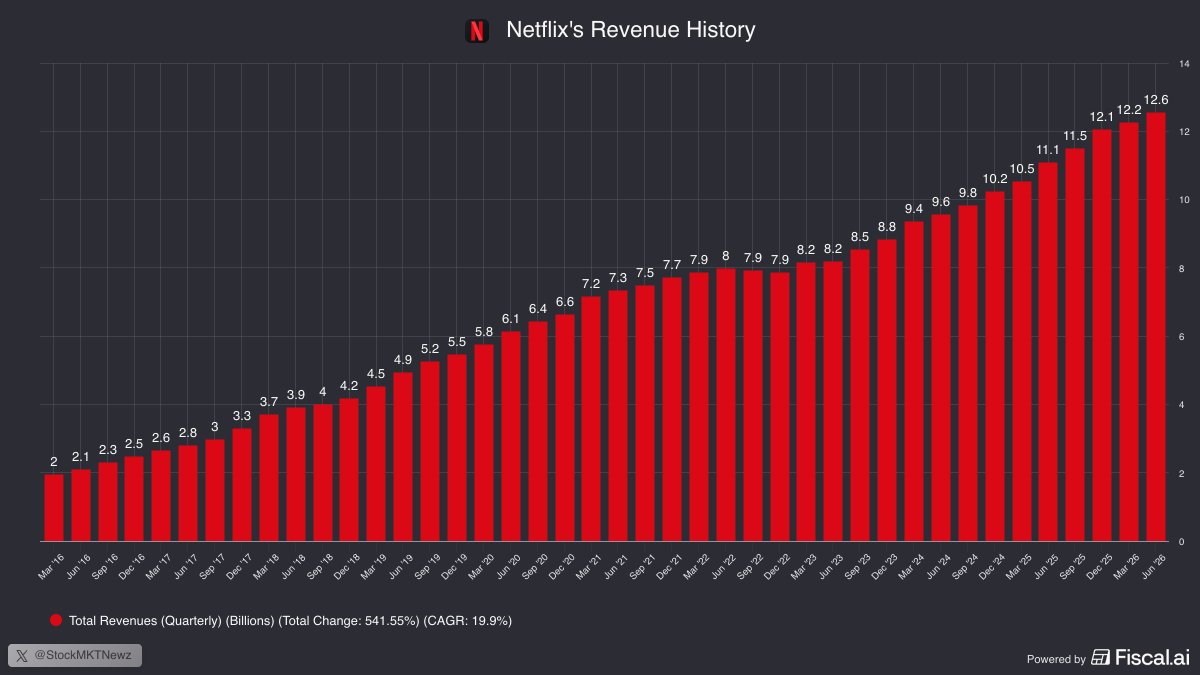
$NFLX is still a FCF powerhouse. Despite its massive 1B+ MAUs, it continues to deliver double-digit CAGR and sustained margin expansion at scale.
$12.5B FCF (+32%) expected in FY26 on +12% revenue and +10% content spend growth. This scale is hard to ignore - especially as Q4's concentrated live sports slate restores engagement-rich and highly monetizable growth.
@StockMarketNerd $NFLX is trying to get the message across that view hour/member is no longer correlated to the extent of growth and profitability. It’d be obvious market has misread in hindsight when the Q4 weighted sports slate catalyzes outsized growth.
@jntsrgn@StockMarketNerd Live sports helps with the scrolling problem imo, while driving higher customer acquisition and monetization per dollar of content spend.
@stockmom Yes. Unmatched FCF growth reinforced by a Q4 concentrated live sports pipeline that’s poised to generate outsized engagement and monetization. The opportunity would be obvious when looking back in hindsight once $NFLX recovers.
A lot of past churn is likely to come back to $NFLX at lower cost given the current strategy.
Live sports is a valuable example by driving outsized customer acquisition, engagement and ad opportunity per $ of content investment. Original titles, especially non-English scripted content (Chinese/Korean/Japanese) are also gaining global traction. This is increasingly reversing the previous woke problem.
@KobeissiLetter The bar just got lowered again when $NFLX is preparing for its strongest lives sports slate in Q4. This should drive outsized engagement and monetization, and catalyze a V shape recovery.
Market is hugely discounting the Q4 weighted live sports programming lineup which could catalyze a V shape rebound.
$NFLX will be showing 4 NFL games, and hold exclusive rights to the Mayweather vs Pacquaio II match. There are engagement + monetization powerhouses at lower per $ content spend vs originals. I think the lowered guidance packs a huge margin for upside surprise to both ad sales and overall growth.
@HedgeyeComm I think $NFLX narrowed FY26 guide has reset the bar lower. This could be well-positioned for upside surprise given Q4's concentrated live sports pipeline is still positioned to drive outsized engagement gains on lower marginal cost vs. core originals.