Gavin Baker says the physics PhDs calling orbital data centers impossible on X have not out-thought the 10,000 SpaceX engineers who treat it as solved
"It's very hard for me to engage. There are all these people on X and they're like, I am a physics PhD and this is impossible."
"There's a friend, another investor, who actually is a physics PhD, who I had many arguments about it with him, and he's like, I am a PhD and this is impossible. And then he goes to the SpaceX day and talks to the SpaceX engineers, and he's like, well, I was wrong."
"So let's say you're an astrophysics PhD. You are brilliant, you're hanging 100 IQ points on me. Have you thought about this for an hour? Have you thought about it for 10 hours?"
"Because you have 10,000 of the world's smartest engineers at SpaceX who've thought about this each for hundreds if not thousands of hours. And the sum of that, working with very sophisticated engineering tools, is it's a solved problem."
_______
For more on Gavin Baker: https://t.co/jNYTxqrBAr
Gavin Baker re $SPCX: Investors should start to consider Grok when they think about SpaceX, very few of them talk about Grok at all
"I talk to a lot of investors about SpaceX. And what's just amazing to me is everyone will have a nuanced view on Starlink."
"Maybe they're a skeptic on Starlink direct-to-cell. I think the plan to use these distributed Starlink effectively almost as, we'll call them, small cells, femtocells, is interesting."
"Everybody will have a nuanced view on orbital compute -- whether they're bullish or bearish, they will have a view. They'll have a view on terrestrial compute."
"Very few of these investors talk about Grok at all."
"And it is Pareto dominant on a lot of measures."
"And we have an existence proof that Anthropic went from, whatever it is, $1 billion to $50 billion really fast."
"And if Anthropic is worth, with the $2 trillion per the FT, $3 or $4 trillion, maybe the numbers settle out -- I said I thought that was a market-clearing price, I didn't say that's where I thought it was worth."
"Maybe people should start to consider Grok when they think about SpaceX."
SemiAnalysis's Dylan Patel predicts OpenAI and Anthropic could reach $600–700 billion in combined revenue by December 2027--and raises the possibility of $1.5 trillion by year-end
“As far as AI’s impact on the U.S. economy, if AI revenue is only $3 trillion in 2031, then, yeah, we’ll have big problems.
“But I’m of the belief that we can get to $600 billion or $700 billion across OpenAI and Anthropic alone by December of next year.
“I’m of the opinion that you can get to $1.5 trillion, maybe even by the end of 2027, with just those two companies. So that’s the end of 2027. Then the payback is clear, right? You know, where they’re getting that from.
“Ultimately, the capacity that people are building out is matched to what they think business is coming to. There’s always going to be a mismatch, if we’re in the building phase, between how much infrastructure you’re spending on and the AI revenue, because today’s AI revenue is really based on the infrastructure you spent on in prior years.”
Citrini warns that if combined AI lab ARR lands at $300 billion instead of the $500 billion being underwritten, "that’s a disaster"
“I think really right now the biggest fear that investors have, I don’t think we’re at the very end, but I think the biggest fear is, zoomed out, what we’ve seen is model capability improves and then lab ARR goes up, and that has pretty consistently been the case. And you could argue that since Astra or Fable you have this big jump in capability without a truly commensurate increase to ARR, or a moderate increase in ARR."
"And if you’re relying on the combined lab ARR to be $500 billion, and that’s where you’re underwriting your assumptions of what gets funneled back into infrastructure, if it ends up being 300, then that’s a disaster.”
Citrini says Charles River $CRL is his highest-conviction long after China stopped exporting lab monkeys and began trying to import them
“China originally cut off the supply, they stopped exporting monkeys, and now they’re actually trying to get demand internationally. They’re trying to bring monkeys in. I think again people will have ethical concerns with this, but at the end of the day, the way that medical progress for humans is made is through animal testing, specifically in monkeys."
"And right now you’re at a point where there’s a real shot at making progress towards these simulations, and that requires more testing, and so every kind of animal test moves that closer. We lay out the whole thesis on CRL, but that’s our highest conviction long from this.”
Citrini says Charles River $CRL is his highest-conviction long after China stopped exporting lab monkeys and began trying to import them
“China originally cut off the supply, they stopped exporting monkeys, and now they’re actually trying to get demand internationally. They’re trying to bring monkeys in. I think again people will have ethical concerns with this, but at the end of the day, the way that medical progress for humans is made is through animal testing, specifically in monkeys."
"And right now you’re at a point where there’s a real shot at making progress towards these simulations, and that requires more testing, and so every kind of animal test moves that closer. We lay out the whole thesis on CRL, but that’s our highest conviction long from this.”
Citrini says the real preclinical bottleneck is monkeys, which take four years to breed and are harder to scale than memory supply
“There’s a huge shortage of monkeys and the the you can’t really, that’s probably the most important thing for pre-clinical testing."
"And I know a lot of people are going to be like morally opposed to this, but I’ll just say one thing, which is for the, you know, the medicine is closer than ever before to a world where it really is, I say closer than ever before, that doesn’t mean this is going to happen tomorrow or within the next two years or what, but closer to a world where in silica or on on a computer you can simulate, say, like toxicology studies, right, and and reduce the need for animal testing."
"I know that sounds counterintuitive because it’s, okay, well, why are you like investing in this company that that does animal testing? Well, the reason for that is in order to get closer to that world, what you need is more data, right? Like you need, you need more experimental data from animal testing, and monkeys are irreplaceable, right?"
"Unless you want to do them in humans. If you want to get as close as possible to humans, obviously the answer is monkeys. And it’s it’s harder to expand the capacity of monkeys than it is to increase the supply of memory, right? Like the the the time it takes, I think it’s four years to to breed these these monkeys.”
Citrini says the real preclinical bottleneck is monkeys, which take four years to breed and are harder to scale than memory supply
“There’s a huge shortage of monkeys and the the you can’t really, that’s probably the most important thing for pre-clinical testing."
"And I know a lot of people are going to be like morally opposed to this, but I’ll just say one thing, which is for the, you know, the medicine is closer than ever before to a world where it really is, I say closer than ever before, that doesn’t mean this is going to happen tomorrow or within the next two years or what, but closer to a world where in silica or on on a computer you can simulate, say, like toxicology studies, right, and and reduce the need for animal testing."
"I know that sounds counterintuitive because it’s, okay, well, why are you like investing in this company that that does animal testing? Well, the reason for that is in order to get closer to that world, what you need is more data, right? Like you need, you need more experimental data from animal testing, and monkeys are irreplaceable, right?"
"Unless you want to do them in humans. If you want to get as close as possible to humans, obviously the answer is monkeys. And it’s it’s harder to expand the capacity of monkeys than it is to increase the supply of memory, right? Like the the the time it takes, I think it’s four years to to breed these these monkeys.”
Google VP Bill Jia says the agent era needs more memory plus CPUs, flash and hard drives, so every component stays scarce
“I think memory will still be very scarce. Because this agent thing has happened. Before, because it was only, I mean, mainly still in inference, in this raw inference. In raw inference, what it lacks is accelerator, like GPU and TPU, this ASIC, what it lacks is accelerator and memory. That was before, at this raw inference stage."
"After the agentic era, it needs a lot of CPU too, it needs even more memory, and it also needs a lot of flash and hard drive, storage. Like what I said just now, in the future agents will definitely bring better, I mean, enterprise oriented and consumer oriented new product, so the demand will be very large. So I think for all of these components, I think they’ll all still be fairly scarce.”
_______
Link and breakdown of the Google VP interview: https://t.co/rkn3TArfVy
Google VP Bill Jia says the agent era needs more memory plus CPUs, flash and hard drives, so every component stays scarce
“I think memory will still be very scarce. Because this agent thing has happened. Before, because it was only, I mean, mainly still in inference, in this raw inference. In raw inference, what it lacks is accelerator, like GPU and TPU, this ASIC, what it lacks is accelerator and memory. That was before, at this raw inference stage."
"After the agentic era, it needs a lot of CPU too, it needs even more memory, and it also needs a lot of flash and hard drive, storage. Like what I said just now, in the future agents will definitely bring better, I mean, enterprise oriented and consumer oriented new product, so the demand will be very large. So I think for all of these components, I think they’ll all still be fairly scarce.”
_______
Link and breakdown of the Google VP interview: https://t.co/rkn3TArfVy
Dylan Patel says Anthropic aims to build its chip in half the time OpenAI took, and explains how, without chip designers’ margins, a gigawatt costs about $20 billion, not $60 billion
“I mean, that’s certainly the trend, is all of these companies are trying to make chips, right? OpenAI showed, I think for the first time ever in the industry, that you can make a first-generation chip that’s really good. They let us into the lab. We tested on our open-source InferenceX benchmark, running all these open-source Chinese models, and the performance was better than Blackwell. And that’s a first-generation chip, and they utilized AI heavily in the design and programming process."
"And Anthropic is starting their chip program, and they want to do it in half the time that OpenAI did. So they want to get a chip. I mean, these are aggressive goals, but if models are able to help them, you know, really accelerate this process. You’ve got Google selling TPUs externally, you’ve got Amazon’s Trainium, really quite good now and fully usable in PyTorch and such, Meta’s very aggressive roadmap, Microsoft, et cetera."
"If you look at the, you know, I said it went from $40 billion to build a gigawatt to 60. If you remove all the margin out of the chip design houses, right, the NVIDIA and Broadcom, Marvell, et cetera, you’re actually at like $20 billion a gigawatt."
"And so, if you were able to do that, then you could pay for five gigawatts with one gigawatt worth of compute running inference. And so obviously the economics here are very aligned. And as Stacy said, these companies just have to run like crazy, right? You can’t afford to be 2x performance per dollar per year, because you’re going to get completely smashed by these other companies, right?”
_______
Link and breakdown of the full panel with Dylan Patel and Stacy Rasgon (free): https://t.co/KzVGrzetwj
Bill Nygren explains how 20 colleagues and an assigned devil’s advocate attack every new idea, then flip sides when it is time to sell
“It’s a it’s a relatively intimidating setting. You’ve got about 20 investment professionals basically trying to shoot holes in your idea. But the the goal is that we find more of our mistakes before we lose client money in them than than we do, you know, have them end up in the portfolio."
"We assign someone the job of being devil’s advocate and presenting the opposite case so that we’ve got these two people arguing with each other in front of all of us and the rest of us all asking questions."
"Basically all the questions are negative at this point because the analyst is already presenting this as: this is going to be a potentially very good idea. So we’re all focused on why might it not be a good idea."
"Now later in the process after we’ve owned a stock and the analyst is saying it’s time to sell it, everything reverses. So all of us then are saying, are you sure you’re being aggressive enough on the growth rate? Is there a reason we don’t think this can obtain an average multiple for its industry?"
"So the questions are all pushing the other direction. So the analyst is is always at odds with everyone else in the room.”
Silicon Data CEO Carmen Li says the GPU forward curve has flipped to contango, so the market expects compute prices to keep rising over the next 36 months
“So, the yellow line was last year, right? The horizontal line is the duration, and the dollar amount is the Y axis. So, last year was complete downward sloping curve for the yellow line, right? Meaning the longer term contract you signed, the cheaper, you know, was per GPU per hour."
"And this year, starting early this year, the whole curve shift up and became contango. If you see the red line, right?"
"So, translate to people not getting enough discount for longer term contract. Implies that people assume the price going to rise down the line."
"And now you see the price, the whole curve keeps shifting up, got flattened, right? So, meaning people are now either get penalized or get, you know, awarded by signing long term contract."
"This is reserved contract we observe. And if you look at implied forward rates, this is the implied forward rates, right? Because we don’t have a future trading. So, this is calculated based on our term structure. And we use similar methodology as Treasury futures curve."
"So, you can see a market consensus view is the price could go up in the future, next 36 months.”
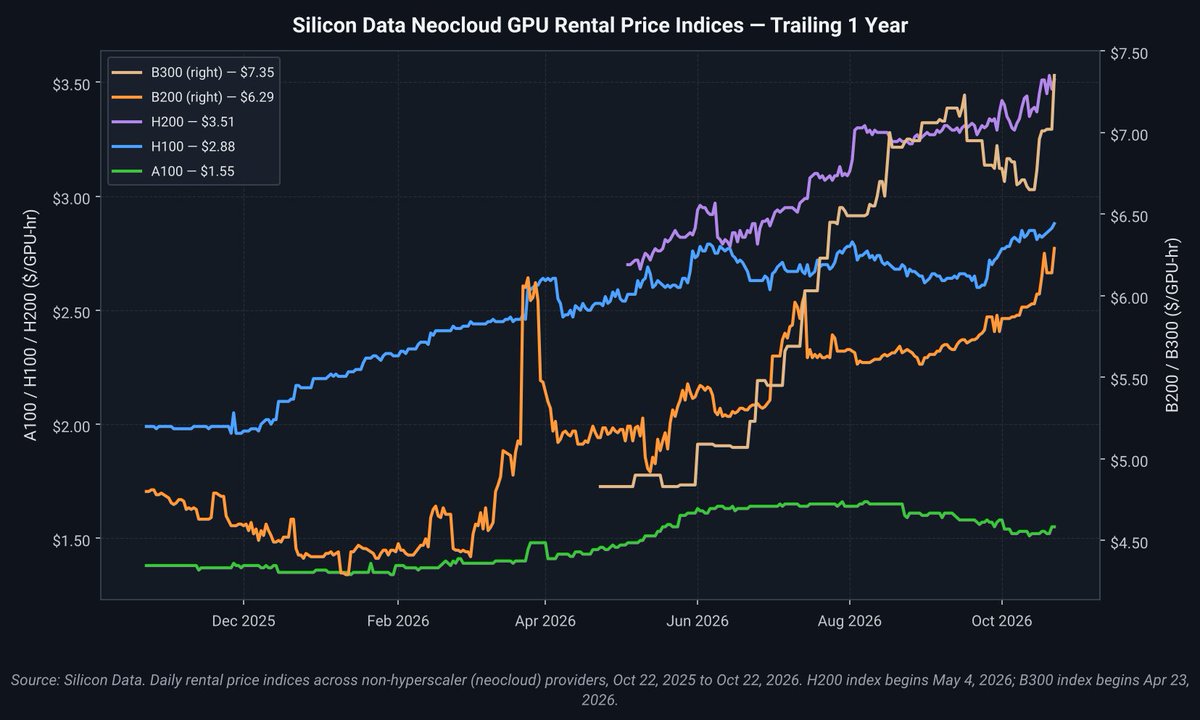
Another day, another round of on-demand GPU rental indices surging across the board and reaching ATHs. Even the A100 index, which recently saw some softness, seems to be inflecting a little.
Another day, another round of on-demand GPU rental indices surging across the board and reaching ATHs. Even the A100 index, which recently saw some softness, seems to be inflecting a little.
Dylan Patel says Anthropic aims to build its chip in half the time OpenAI took, and explains how, without chip designers’ margins, a gigawatt costs about $20 billion, not $60 billion
“I mean, that’s certainly the trend, is all of these companies are trying to make chips, right? OpenAI showed, I think for the first time ever in the industry, that you can make a first-generation chip that’s really good. They let us into the lab. We tested on our open-source InferenceX benchmark, running all these open-source Chinese models, and the performance was better than Blackwell. And that’s a first-generation chip, and they utilized AI heavily in the design and programming process."
"And Anthropic is starting their chip program, and they want to do it in half the time that OpenAI did. So they want to get a chip. I mean, these are aggressive goals, but if models are able to help them, you know, really accelerate this process. You’ve got Google selling TPUs externally, you’ve got Amazon’s Trainium, really quite good now and fully usable in PyTorch and such, Meta’s very aggressive roadmap, Microsoft, et cetera."
"If you look at the, you know, I said it went from $40 billion to build a gigawatt to 60. If you remove all the margin out of the chip design houses, right, the NVIDIA and Broadcom, Marvell, et cetera, you’re actually at like $20 billion a gigawatt."
"And so, if you were able to do that, then you could pay for five gigawatts with one gigawatt worth of compute running inference. And so obviously the economics here are very aligned. And as Stacy said, these companies just have to run like crazy, right? You can’t afford to be 2x performance per dollar per year, because you’re going to get completely smashed by these other companies, right?”
_______
Link and breakdown of the full panel with Dylan Patel and Stacy Rasgon (free): https://t.co/KzVGrzetwj
Bernstein’s Stacy Rasgon says memory is 70 to 80% of an AI rack’s silicon and asks what happens if pricing never collapses, since AI memory takes three to four times the wafers per gigabyte as standard DRAM
“I think on the memory side is really interesting. You know, the memory stocks are all trading at two, three, four times price to forward earnings, and pricing has gone through the roof."
"I mean, I look at like, I don’t cover the memory stocks, by the, it’s a colleague of mine, but you take a look at like a SanDisk that, you know, they guided to a quarterly EPS that’s higher than the stock price was, you know, 24 months ago. It’s like really amazing, because pricing has gone through the roof, and they’re all trading at, you know, single digit PEs, because that’s how you trade things at the peak of a cycle, and everybody’s worried that, especially as you get into '28, supply does start to come online, and they’re worried that the pricing collapses."
"And I sit here and I always wonder, like, what happens if it doesn’t."
"You can look inside these racks. Look inside an AI rack. 70%, 80% or so of the silicon area inside that rack is memory. It’s mostly DRAM. You know, there are other issues when you’re making high bandwidth memory, the memory that goes into the AI chips. There’s something called a trade ratio, but it takes three or four times as many wafers to make a gigabyte of high bandwidth memory as it does to make a gigabyte of standard DDR5 DRAM that would go into a PC or go into a smartphone. So you’re sucking up wafers from that. I mean, we need a we need a a ton of memory.”
_______
Link and breakdown of the full panel with Dylan Patel and Stacy Rasgon (free): https://t.co/KzVGrzf1lR
Elon Musk explains how to build AI satellites on the moon from lunar silicon and aluminum, and says 500 to 1,000 terawatts a year cannot be launched from Earth
“Well, the lunar soil is 20% silicon or something like that. So you can mine the silicon on the moon, refine it, and create the solar cells and the radiators on the moon. So get the radiators out of aluminum. So there’s plenty of silicon and aluminum on the moon to make the cells and the radiators. The chips you could send from Earth because they’re pretty light. But maybe at some point you make them on the moon, too."
"Like I said, it does seem like a sort of a video game situation where it’s difficult but not impossible to get to the next level. I don’t see any way that you could do 500 to 1,000 terawatts per year launched from Earth.”
NASA Artemis lead explains how SpaceX is rebuilding Starship between flights at a "blistering" pace he calls "unthinkable" in standard industry history
Jeremy Parsons (Artemis lead): “And so as many of you know, SpaceX launched their first orbital flight with Starship Flight 14 in late September, and that was using their version 3 Starship. It had important upgrades from their previous version, and really, I mean, was a pretty phenomenal flight all in all."
"The SpaceX and NASA teams have conducted a data review of the flight. They’re making excellent progress towards Flight 15, which I think will absolutely be awesome to see, because it could likely be a return to launch site and a catch of both the booster and Starship. Both vehicles have already been cryo-proofed. Improvements are being worked to address lessons learned from Flight 14."
"As you know, SpaceX takes a test, learn, improve approach. And so we’re seeing lots of hardware, lots of quick changes, and an absolute blistering pace of production."
"As an example, SpaceX identified the root cause of multiple Raptor engine relight failures on boost back and landing. They implemented several quick fixes for Flights 13 and 14 to improve their chances to reach more test objectives, and then they already have permanent hardware improvements coming for Flight 15, when they start flying an improved version of the Raptor."
"These sorts of changes in this timeline would be unthinkable in standard industry history.”
NASA Artemis lead explains how SpaceX is rebuilding Starship between flights at a "blistering" pace he calls "unthinkable" in standard industry history
Jeremy Parsons (Artemis lead): “And so as many of you know, SpaceX launched their first orbital flight with Starship Flight 14 in late September, and that was using their version 3 Starship. It had important upgrades from their previous version, and really, I mean, was a pretty phenomenal flight all in all."
"The SpaceX and NASA teams have conducted a data review of the flight. They’re making excellent progress towards Flight 15, which I think will absolutely be awesome to see, because it could likely be a return to launch site and a catch of both the booster and Starship. Both vehicles have already been cryo-proofed. Improvements are being worked to address lessons learned from Flight 14."
"As you know, SpaceX takes a test, learn, improve approach. And so we’re seeing lots of hardware, lots of quick changes, and an absolute blistering pace of production."
"As an example, SpaceX identified the root cause of multiple Raptor engine relight failures on boost back and landing. They implemented several quick fixes for Flights 13 and 14 to improve their chances to reach more test objectives, and then they already have permanent hardware improvements coming for Flight 15, when they start flying an improved version of the Raptor."
"These sorts of changes in this timeline would be unthinkable in standard industry history.”
Bolivian President says Starlink will make information “open to everyone,” with a connection even “in the deepest ravine,” as 4,700 antennas go to schools nationwide
Rodrigo Paz (President): “…it’s the same kind of network we are building through this system of Starlink antennas, to create a network of information and communication and to decentralize the power that some hold when only a few keep the information. Now information will be open to everyone.”
“It’s more than 4,000 antennas, 4,700 antennas if I’m not mistaken, nationwide for every department, but especially for rural municipalities, because you don’t only need a road to communicate, you need information to make decisions...”
"...It doesn't matter where in the country you are, in the deepest ravine, you'll have a connection there. It's not one satellite, it's many satellites, thousands of satellites that are going to serve Bolivia."
Ryan Serhant reveals he sent one wealthy prospect a personal note every other week for five years, using Google Alerts to just say congrats, before selling him a $16 million place and then a $73 million one
“Personal note every other week about the market, about a new listing, about a new sale, about an alert that I’d find."
"One of the big unlocks for me in this process was when Google created Google Alerts, so you could set up anyone’s name, anyone’s company, and you would get an email digest once an hour or half a day or twice a day, whatever you want, with anyone’s name, letting them know, which would then be a good key indicator for me of like, oh, they just bought a company, or they just did this, they just did that."
"And I never ask anything. Never ask, never do anything. Just congrats, crushing it. Super simple."
"Because at some point in time, maybe, if and when they decide that they’re going to do something in real estate, my name will be in their brain for sure. Unless they told me not to. This is not a 100% success ratio, but it is far greater than the not. So I followed up with him for five years, then sold him a place for $16 million, then $73 million, then $33 million, and so on and so forth.”
Bernstein’s Stacy Rasgon says memory is 70 to 80% of an AI rack’s silicon and asks what happens if pricing never collapses, since AI memory takes three to four times the wafers per gigabyte as standard DRAM
“I think on the memory side is really interesting. You know, the memory stocks are all trading at two, three, four times price to forward earnings, and pricing has gone through the roof."
"I mean, I look at like, I don’t cover the memory stocks, by the, it’s a colleague of mine, but you take a look at like a SanDisk that, you know, they guided to a quarterly EPS that’s higher than the stock price was, you know, 24 months ago. It’s like really amazing, because pricing has gone through the roof, and they’re all trading at, you know, single digit PEs, because that’s how you trade things at the peak of a cycle, and everybody’s worried that, especially as you get into '28, supply does start to come online, and they’re worried that the pricing collapses."
"And I sit here and I always wonder, like, what happens if it doesn’t."
"You can look inside these racks. Look inside an AI rack. 70%, 80% or so of the silicon area inside that rack is memory. It’s mostly DRAM. You know, there are other issues when you’re making high bandwidth memory, the memory that goes into the AI chips. There’s something called a trade ratio, but it takes three or four times as many wafers to make a gigabyte of high bandwidth memory as it does to make a gigabyte of standard DDR5 DRAM that would go into a PC or go into a smartphone. So you’re sucking up wafers from that. I mean, we need a we need a a ton of memory.”
_______
Link and breakdown of the full panel with Dylan Patel and Stacy Rasgon (free): https://t.co/KzVGrzf1lR
Dylan Patel explains why he thinks substrates are "the biggest bottleneck of all the bottlenecks," ahead of memory and optics, and bigger than power, land, or tools
“Yes, I think on the semiconductor side, the biggest constraint, of course, besides memory, is substrates, PCB materials, substrate materials, all of these components were severely under-invested in. Much of the supply chains that create the materials in Japan, those firms are sort of a lot more conservative and unwilling to invest heavily in capacity."
"And so we’ve seen, you know, tremendous bottlenecks there in terms of what can be made over the next two years, you know, both for accelerators as well as CPUs and every other component in the supply chain. So substrates is, I think, the biggest bottleneck of all the bottlenecks, including, you know, land, power, shell, semiconductors, tools."
"I’d say the next bottleneck would be, of course, memory. And then following that, there’s a lot of bottlenecks around the desire to ramp optics to a really, really large degree, right, with co-package optics or near-package optics. There’s humongous constraints in ramping that. You know, we just simply cannot ramp, you know, even if everyone wanted to do CPO in 2028, or even one major company wanted to do CPO in 2028, they could not satisfy their volumes in terms of lasers, in terms of fiber attach, in terms of all these different components that go into it.”
_______
Link and breakdown of the full panel with Dylan Patel and Stacy Rasgon: https://t.co/KzVGrzf1lR
Dylan Patel explains why he thinks substrates are "the biggest bottleneck of all the bottlenecks," ahead of memory and optics, and bigger than power, land, or tools
“Yes, I think on the semiconductor side, the biggest constraint, of course, besides memory, is substrates, PCB materials, substrate materials, all of these components were severely under-invested in. Much of the supply chains that create the materials in Japan, those firms are sort of a lot more conservative and unwilling to invest heavily in capacity."
"And so we’ve seen, you know, tremendous bottlenecks there in terms of what can be made over the next two years, you know, both for accelerators as well as CPUs and every other component in the supply chain. So substrates is, I think, the biggest bottleneck of all the bottlenecks, including, you know, land, power, shell, semiconductors, tools."
"I’d say the next bottleneck would be, of course, memory. And then following that, there’s a lot of bottlenecks around the desire to ramp optics to a really, really large degree, right, with co-package optics or near-package optics. There’s humongous constraints in ramping that. You know, we just simply cannot ramp, you know, even if everyone wanted to do CPO in 2028, or even one major company wanted to do CPO in 2028, they could not satisfy their volumes in terms of lasers, in terms of fiber attach, in terms of all these different components that go into it.”
_______
Link and breakdown of the full panel with Dylan Patel and Stacy Rasgon: https://t.co/KzVGrzf1lR
Bernstein's Stacy Rasgon says SpaceX renting compute at $50 billion a gigawatt shows how the AI buildout’s financing could "get covered and then some," if demand keeps outrunning supply
“And it’s a lot of money. So I think these are all broad concerns. Right now, you know, though I think at least for the next year or two, which is as far out, frankly, even than I can look, we’re probably okay."
"But I do think it’s pretty clear that we need to have revenues grow to the point where this becomes less of a concern, and maybe that happens."
"SpaceX reported earnings, was this this week, last week, I can’t remember. And I mean, he’s renting out, clearly he’s renting out in the spot market, and so things are very, very constrained. The only thing we’re hearing is nobody has enough compute. But he’s renting capacity out short-term contracts, but you know, $50 billion a gigawatt, something like, at those kinds of rates."
"I don’t think it’s actually that hard to imagine a scenario where this stuff gets covered and then some."
"But again, it gets to the question like how sustainable are those, and that has broader questions. It really depends on what does demand actually look like relative to supply, and how long does a supply demand mismatch last?”
_______
Link and breakdown of the full panel with Stacy Rasgon and Dylan Patel: https://t.co/KzVGrzf1lR