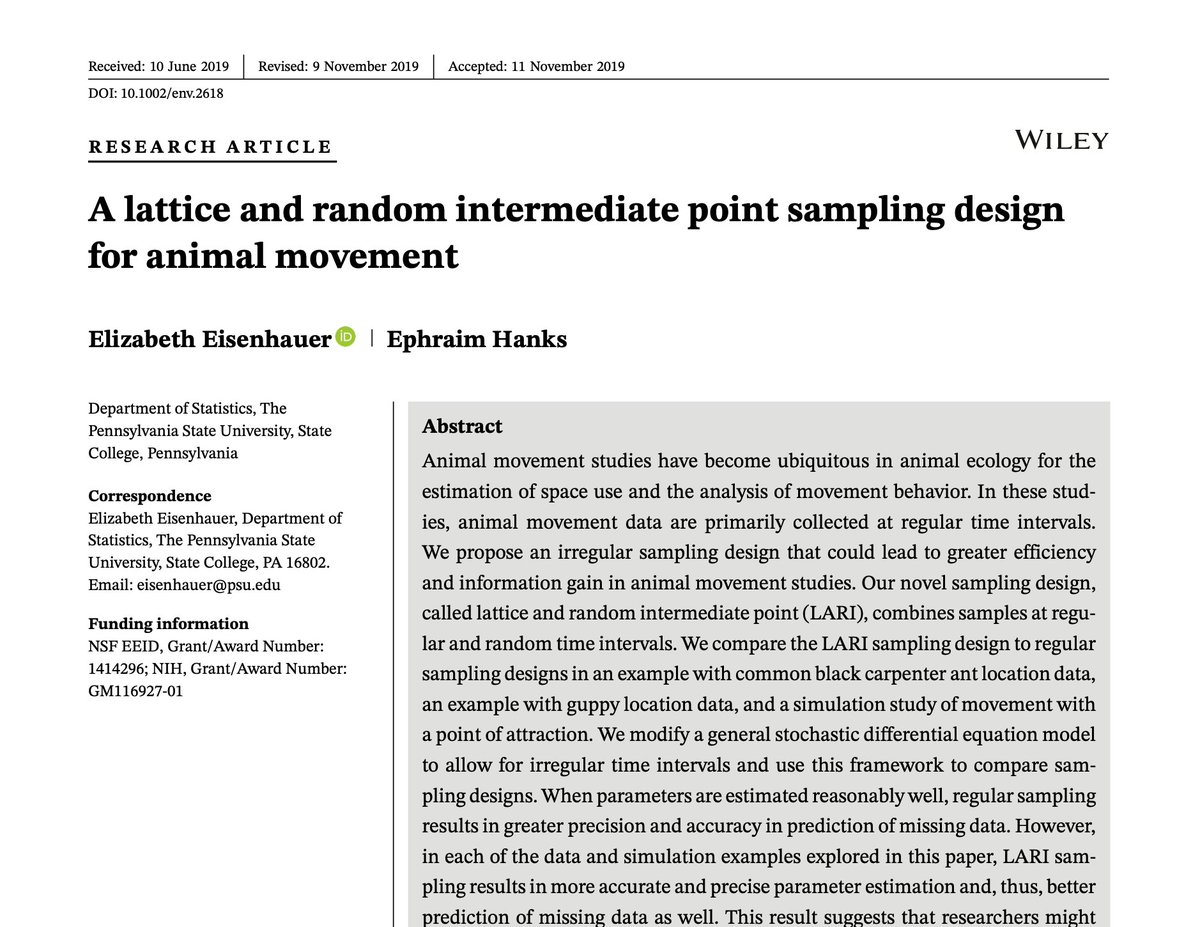
My first first-authored paper is officially published!! It's about sampling design for animal movement studies. Essentially, we proposed an irregular design that we found improved understanding of movement behavior compared to regular sampling. Full text is on ResearchGate!
Here is an updated link to my shared Dropbox. It's mostly for DiD but also has other recent projects. I'm currently cleaning up some of the Stata do files and I'll be posting.
I posted the first public version of my nonlinear DiD paper.
https://t.co/q1AnkhEF97
Likert scores are not integers and they cannot be subdued by pretense. Stop pretending and meet me in the warm 3rd circle of stats hell and learn about ordered categorical models. Lecture: https://t.co/n8QZ1e46hv
🚨 New Research (with the amazing @gpaolacci) 🚨
In our paper (https://t.co/gdcVor4Cze, accepted at Management Science), we show that probabilistic outcomes are valued less, even conditional on their realizations.
What does it mean? Consider the following two questions:
1/N
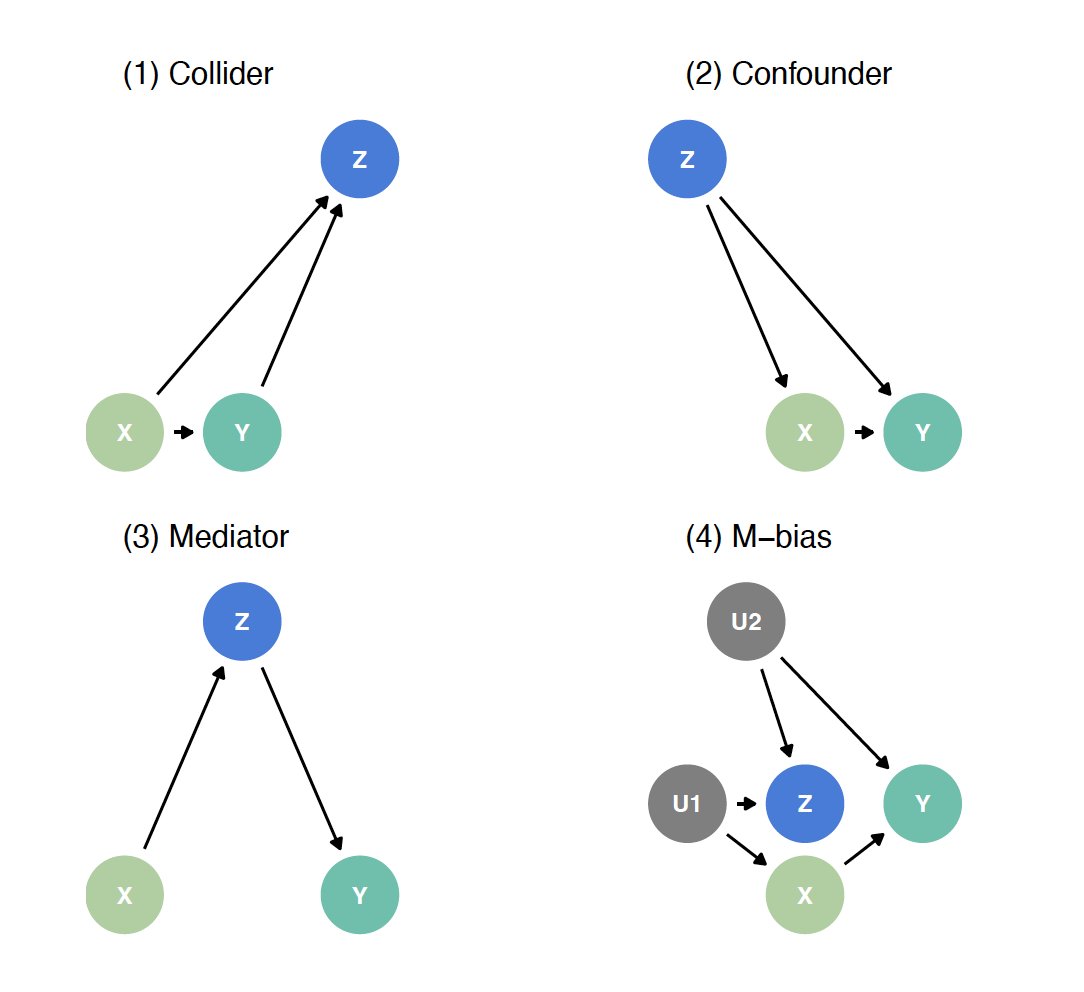
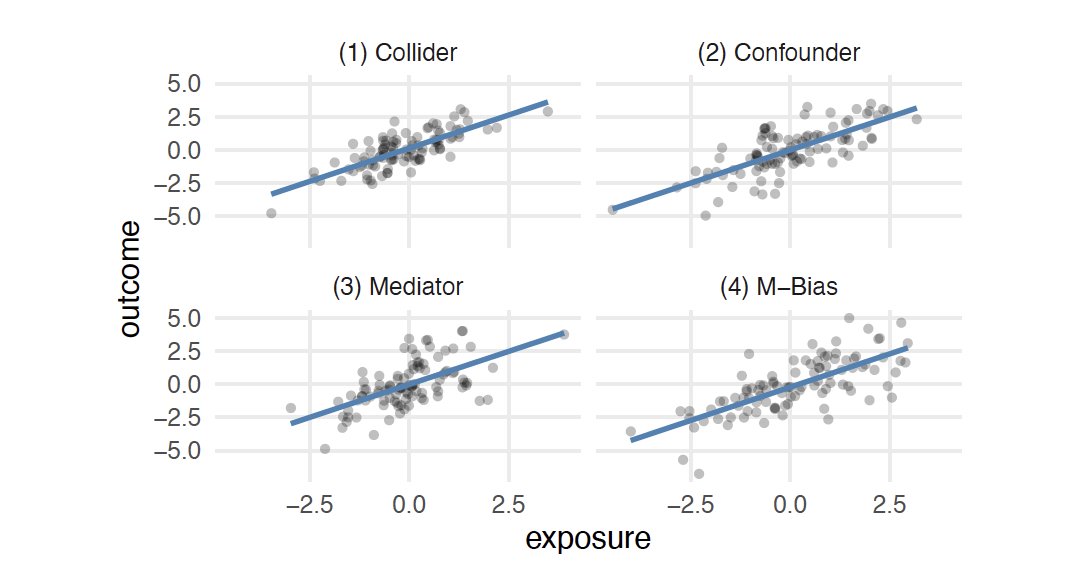
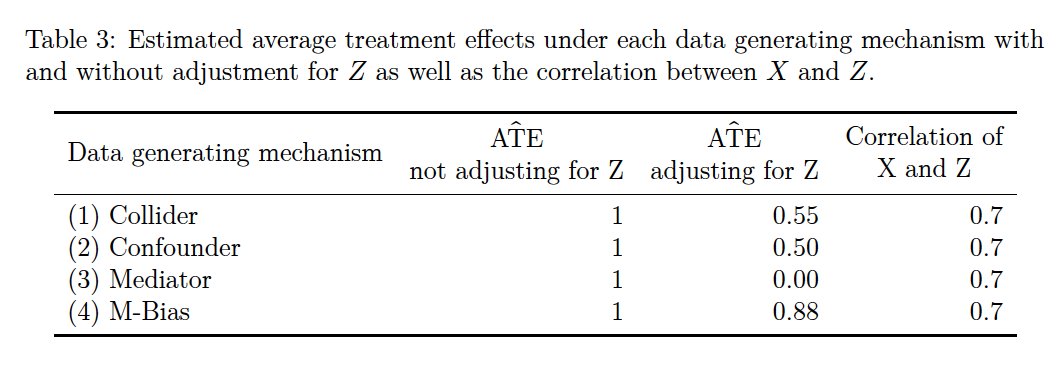
📣Our 🆕 paper Causal Inference is Not Just a Statistics Problem is out! @malco_barrett, @travisgerke, and I show that you can have 4 data sets with identical summary stats & visuals but very different data generating mechanisms-statistics alone can't tell you what to adjust for!
I don't understant how people still use t.test(), aov(), wilcox.test() and kruskal.test() in 2023 & put them into R books, when there is ggbetweenstats() available from {ggstatsplot} package? It's time to move on! R progressed!
https://t.co/6LARpMiaCe
#rstats#rstudio#r4ds
Everyone needs to know about `easystats` in R
It is so much fun to use and then share with students
Teaching on regression and just used the check_model() function and look at this beautiful figure
Do you teach intro stats? Consider using or contributing short example videos from real researchers that show stats concepts here: https://t.co/wVW6LrA43C
I used these last year and students had good things to say in my evals. I'll leave some example comments from them 👇👇
Is there a list somewhere out there for open source/access teaching/learning resources for statistics? Currently trying to create a document organizing all these resources for when I start teaching next semester #stats ☺️
When they found “large variation” as a result of the study, that is a green flag for me. Every study I have ever done talked about the variation in the data. There is always variation. #rstats
NEW PAPER in #ornithology compares the foraging ranges of #seabirds and finds large variation among colonies and individuals - with greater foraging ranges in larger colonies: https://t.co/qoOnalkspK
The scientist who gets credit does tend to be the scientist who can best communicate, unless you are lucky enough to have a loyal friend like Thomas #Bayes had in Richard Price
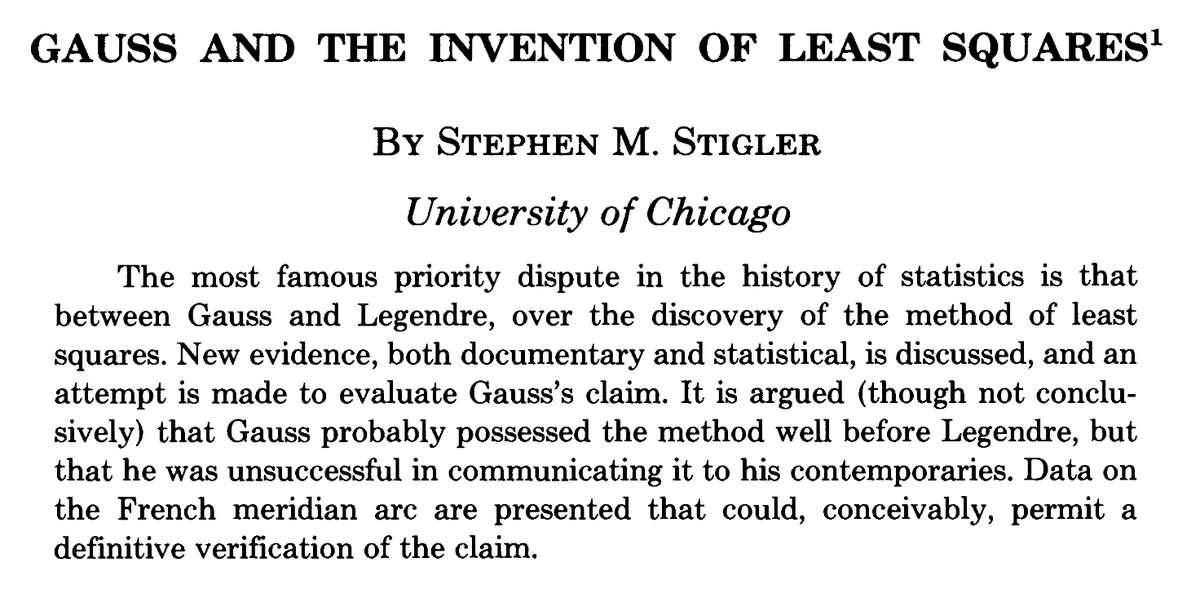
When I wrote my stats book of course I wanted to cite Gauss (1809) for least squares. Which sent me down a rabbit hole terminating in trying to remember my high school Latin. As usual Stigler has a useful summary, including importance of Laplace. https://t.co/4YLQCkDwTZ
“…and also an old-fashioned statistical perspective under which it is difficult to combine information from different sources” … Gelman refers to something that seems not unlike what therapists call “black-and-white thinking”
“I share the long-term concern (see Krantz 1999, for a review) that the use of p-values encourages and facilitates a sort of binary thinking in which effects and comparisons are either treated as zero or are treated as real…”
The 2024 American Causal Inference Conference (ACIC) will be held in Seattle on May 14-17, 2024. Abstract, Invited Session, and Short Course submission deadline is Jan 10. Submit at: https://t.co/8Wm1XeoDtB. Please spread the word! 📢
Hi #EconTwitter!
Are you an applied economist, searching for an in-depth guide on statistical tools for causal inference?
Check out👇this insightful online book by @SylvainCF (@TSEinfo). From the basics of encoding causality to advanced #econometric methods, it's got you covered.
Key features: 🔹 Emphasis on intuitive understanding (though the math's there!) 🔹 Numerical examples & simulations to bring clarity.
Have fun! ⭐️
Link: https://t.co/zFZ56FleTb
Join us for a virtual conversation and Q&A with current Statistics Ph.D. students from the Departments of Statistics at UW, UC Berkeley, and UMich Ann Arbor on Wed., Nov. 1, 2023 at 5:00 PM PT / 8:00 PM ET. See details here: https://t.co/0QaRRbu8uz
This is a great summary of my book/course. Except there is no slapping. Plenty of art, but no slapping.
Seriously statistical workflow is a neglected topic and we (statisticians) owe researchers more
#SoonInAJPH "COVID-19 Information, Trust, and Risk Perception Across Diverse Communities in the United States: Initial Findings from a Multistate CEAL Alliance" CEAL developed new infrastructure to address impacts of COVID-19 on underserved communities.@LizStats, @ErikaLThompson