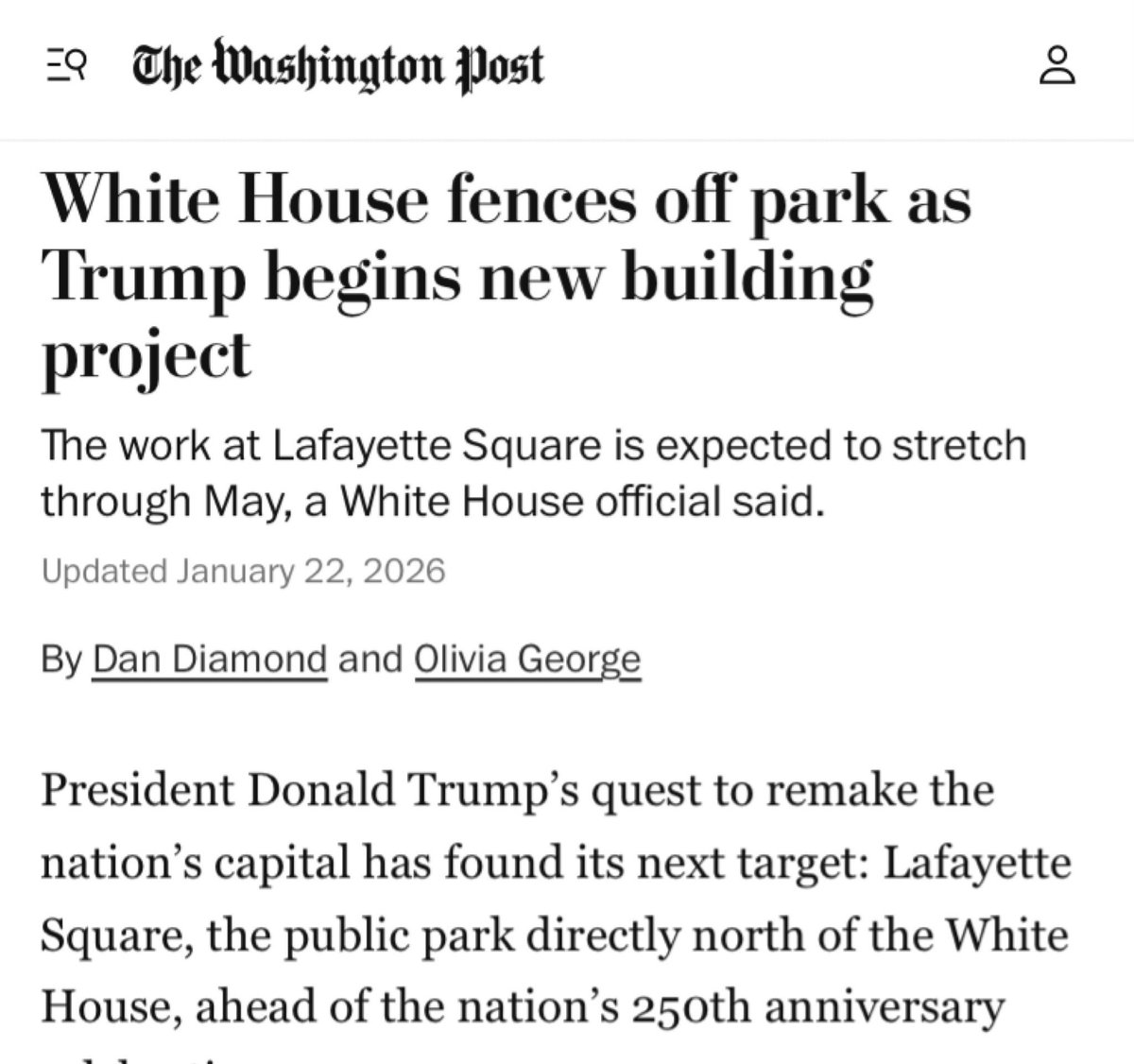
📰The @WashingtonPost newsroom published 20+ scoops and exclusives in April.
Check out some of that reporting from just this past week:
https://t.co/NuTm36h9hX
https://t.co/Yw4ptOrePj
https://t.co/jcYEiSl0TG
https://t.co/UghLnkVmcS
https://t.co/S1WWYjK5AR
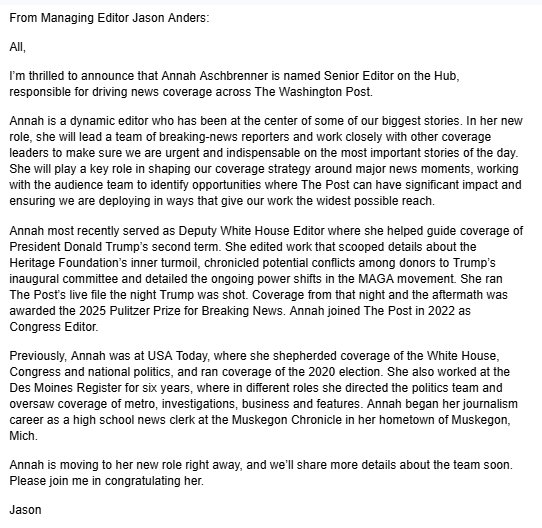
🚨NEW: @AnnahBackstrom is named Senior Editor for The Washington Post.
She will be responsible for driving news coverage across The Post, shaping strategy around major news moments and leading The Post's breaking news team.
⬇️Announcement from Managing Editor Jason Anders
Claims that "staffers were abandoned in foreign countries and war zones and are having to crowd source to get home" are entirely inaccurate.
The Washington Post is actively supporting employees impacted by last week’s restructuring, including transition support for our international employees.
https://t.co/hen6eMCzqT
@saikatc Claiming that our "international staff was left stranded in other countries" is irresponsible and inaccurate.
The Washington Post is actively supporting employees impacted by last week’s restructuring, including transition support for our international employees.
From @WashingtonPost Executive Editor @murraymatt:
Dear All,
As we shared in our live stream earlier, the company is taking actions today to place The Washington Post on a stronger footing and better position us in this rapidly changing era of new technologies and evolving user habits.
These moves include substantial newsroom reductions impacting nearly all news departments. For the immediate future, we will concentrate on areas that demonstrate authority, distinctiveness, and impact and that resonate with readers: politics, national affairs, people, power and trends; national security in DC and abroad; forces shaping the future including science, health, medicine, technology, climate, and business; journalism that empowers people to take action, from advice to wellness; revelatory investigations; and what’s capturing attention in culture, online, and in daily life.
We will meet with leaders in each department today and tomorrow to review the impacts on their teams.
Today’s news is painful. These are difficult actions. We are proud of, and grateful for, the many valued colleagues whose talents and passion have contributed to The Post over many years.
But we take them with clarity of purpose. The need has never been more urgent to reposition The Post. A more flexible, sustainable model will help us better navigate unprecedented volatility, competition, technological change, news-consumption habits, and cost pressure.
As you know, we have grappled with financial challenges for some time. They have affected us in multiple rounds of cost cuts and buyouts, along with periodic constraints on other kinds of spending.
We have concluded that the company’s structure is too rooted in a different era, when we were a dominant, local print product. This restructure will help to secure our future in service of our journalistic mission and provide us stability moving forward.
We are far from alone in reevaluating our model or rethinking how we operate. The ecosystem of news and information, on- and off-platform, is changing radically. News consumers enjoy more variety, voices, platforms, and options than ever before. In just the last five years, multiple startups—and even individuals—have created meaningful products that draw attention and generate impact at low cost.
Platforms like Search that shaped the previous era of digital news, and which once helped The Post thrive, are in serious decline. Our organic search has fallen by nearly half in the last three years. And we are still in the early days of AI-generated content, which is drastically reshaping user experiences and expectations.
We are producing much great journalism of which we can be proud. As we discuss every day in the news meeting, some of our best work attracts readers and generates subscriptions and engagement.
Unfortunately, some does not. Some areas, such as video, haven’t kept up with changes in how consumers get news and information. Significantly, our daily story output has substantially fallen in the last five years. And even as we produce much excellent work, we too often write from one perspective, for one slice of the audience.
If we are to thrive, not just endure, we must reinvent our journalism and our business model with renewed ambition. We already have taken important and, in some cases, long overdue steps toward reinvention—creating the Print desk, transforming digital workflows, and embedding Audience Strategy editors in every department. Today’s moves will put us in position to find and develop better ways to connect Post journalism to news consumers in the ways they want it.
From this foundation, we aim to build on what is working, and grow with discipline and intent, to experiment, to measure and deepen what resonates with customers.
We can’t be everything to everyone. But we must be indispensable where we compete. That means continually asking why a story matters, who it serves and how it gives people a clearer understanding of the world and an advantage in navigating it.
Some of you have heard me ask how we can shrink the gap between some of what we create in our newsroom during the day and what we — and our children, families, and friends — consume at night.
Today’s actions are about addressing those questions, forcefully, to reinvent The Washington Post for this new era. This work is difficult, but it is essential. The Post is a necessary institution, and it must remain relevant.
Even amid challenges, The Washington Post retains great strengths. We have a deep pool of talented journalists and leaders, strong standards, institutional backing, a proud legacy, and millions of customers.
Most important, our central purpose remains as it ever was: To produce riveting and distinct journalism of the highest caliber that breaks news, explains the world with authority and fairness, empowers people with knowledge, and helps them live better-informed lives.
Matt
Statement from The Washington Post:
“The outrageous seizure of our reporter’s confidential newsgathering materials chills speech, cripples reporting, and inflicts irreparable harm every day the government keeps its hands on these materials. We have asked the court to order the immediate return of all seized materials and prevent their use. Anything less would license future newsroom raids and normalize censorship by search warrant.”
https://t.co/XjLWTorHno
"We are nothing if we don't have great news, period."
🔉Our CTO @khosla_vin spoke with @bmorrissey for the latest episode of The Rebooting: https://t.co/QAGu95fXH4
🎧📰 Introducing our latest customer audio offering: “Your Personal Podcast,” a personalized, AI podcast experience only available in The Washington Post app.
App users will be able to shape their own briefing, select their topics, set their lengths, pick their hosts and soon even ask questions using our Ask The Post AI technology.
🚀 NEW: The Washington Post launches Ripple
Ripple is editorially independent from Post journalism, leveraging the convening power of The Post to curate and elevate opinion writing from a range of local and national partners who will continue to be added on a rolling basis.
⬇️ read the note from CTO @khosla_vin and CSO Suzi Watford
https://t.co/xYz0MUkKKN
🚨@PostOpinions editor Adam O'Neal announces new opinion journalists, reporting to @jameshohmann:
- @dominicjpino joins from @NRO
- @KateAndrs joins from @TheSpectator
- @carinemhajjar joins from @GlobeOpinion
All three will start next month and regularly appear on our growing video podcast network, as well as contribute unsigned editorials, bylined pieces and social video.
New with @JosephWulfsohn -- Adam O'Neal speaks with Fox News Digital for his first interview as WaPo opinion editor
Editorial overhaul: Washington Post's new opinion chief feels the weight of the challenges ahead https://t.co/LttZ7OI7yc
🎥What's the #1 movie on @paramountplus right now?
"Bodyguard of Lies," a documentary based on our investigative reporter @CraigMWhitlock's 2019 Afghanistan Papers investigation.
Watch the trailer: https://t.co/Y7gzYycQUC




![WashPostComms's tweet photo. Overheard:
"Great exclusive!"
"Yeah! ... Wait, which one?"
[👀 @washingtonpost since yesterday morning... ] https://t.co/aNEvtMxG9o](https://pbs.twimg.com/media/G4ms8quWcAIzcxv.jpg)


