Rachel Carson was 55 and being treated for breast cancer while she wrote Silent Spring. She told almost nobody she was ill.
Her reasoning was strategic. If the chemical industry learned she was ill, they would say her illness was what had made her write it.
She was right about how they would fight. The pesticide industry spent more than 250,000 dollars trying to discredit her, over a million in today's money. A major manufacturer dismissed her as a fanatic defending a cult. Others called her hysterical, overemphatic, a bird and bunny lover, a spinster who kept cats and was therefore suspect. A trade magazine ran a cartoon of industry men giving evidence with a witch on a broomstick flying past behind them.
Rachel Carson had no doctorate and no university behind her. She had spent years reading the studies nobody was assembling and putting them in one place.
When she appeared before a government committee in 1963 to give evidence, she had lost her hair and was wearing a wig. She died the following year, less than two years after publication, at 56.
DDT was banned in the United States in 1972. Five other pesticides she named have been banned or restricted since. The agency that did it was created in 1970, and she is generally credited with the movement that produced it.
She did not see any of it. She spent her last two years being called hysterical by men who were selling the thing she was right about.
https://t.co/FGQC8NUHPR
"The settler views the Earth as a mere footprint—a grid of lines and numbers to be conquered and claimed. But to the First Peoples, the land is our heartbeat. Our songs, dances, and ancient words were whispered to us by the wind and the rivers.
The Earth taught us the sacred law of balance: that all true growth begins within the spirit and flows outward.
We do not walk upon Nature; we flow with it. For every tree, stream, and winged creature is a relative, and whatever wound we inflict upon the Earth, we bleed ourselves."
A simple strip of wildflowers can dramatically reduce the need for chemical pesticides. So why aren’t they standard on every farm?
Farmers are increasingly planting colorful wildflower strips within and around their fields because these habitats attract beneficial insects that naturally control crop pests.
Ladybugs are the most familiar example. Both adult ladybugs and their larvae are voracious predators of aphids, small sap-sucking insects that damage crops. A single ladybug can eat dozens of aphids a day, while its larvae can consume hundreds before reaching adulthood.
Yet ladybugs are just the beginning. Wildflower strips also draw in hoverflies, lacewings, parasitic wasps, and predatory beetles, all highly effective natural enemies of common pests such as aphids, whiteflies, thrips, and caterpillars.
This approach is known as conservation biological control. Rather than releasing predators into fields, farmers create permanent habitats that support and boost populations of beneficial insects already present in the landscape.
The flowers supply essential nectar and pollen that many of these insects need as adults. Research shows that access to such resources significantly increases their lifespan, reproductive success, and pest-hunting efficiency.
Some parasitic wasps offer an especially impressive form of control: they lay eggs inside aphids or caterpillars, and their developing larvae consume the pest from the inside out.
Multiple studies confirm that fields with wildflower strips support far higher numbers of beneficial insects and achieve stronger natural pest suppression compared to conventional fields.
Beyond pest control, these strips provide additional benefits: they support pollinators, enhance biodiversity, reduce soil erosion, and create valuable wildlife habitat within agricultural areas.
Scientists are now fine-tuning which flower species work best for different crops and climates, aiming to design the most effective and practical wildflower strips possible.
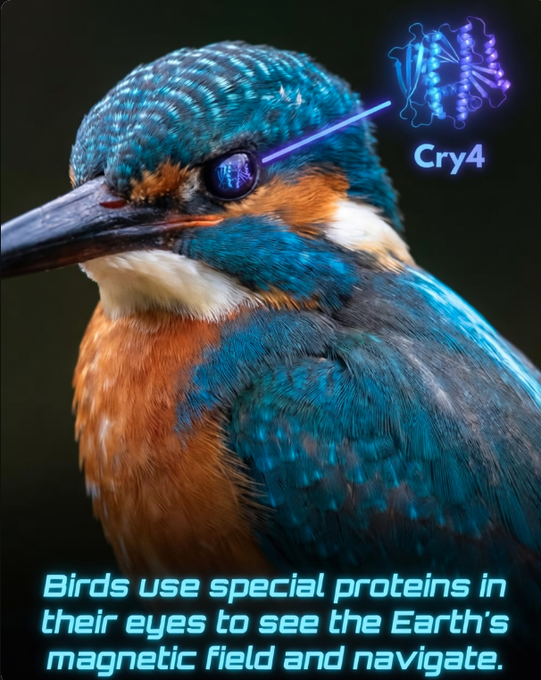
Birds can literally see the Earth’s magnetic field thanks to specialized light-sensitive proteins in their eyes.
Migratory birds possess one of nature’s most remarkable superpowers: the ability to navigate thousands of miles with incredible precision. At the center of this ability is a protein called Cry4 (cryptochrome 4), found in the retinas of their eyes.
When blue light enters the bird’s eye, it triggers a quantum reaction in the Cry4 proteins known as the radical pair mechanism. This ultra-sensitive process responds to the orientation and strength of the Earth’s magnetic field, essentially turning the bird’s visual system into a biological compass.
Scientists believe birds don’t just sense magnetism — they may actually see it. The quantum fluctuations likely appear as subtle visual patterns, shadows, or color gradients overlaid on their normal vision, much like an augmented reality heads-up display.
This extraordinary adaptation allows migratory birds to cross oceans, deserts, and mountain ranges with pinpoint accuracy, relying on the strange rules of quantum mechanics to guide them on their epic journeys.
Reitero mi llamamiento para que cesen los repetidos actos de violencia contra la población civil palestina en Cisjordania y pido con urgencia a la comunidad internacional que vele por el avance de la solución de dos Estados, en pro de una paz justa y duradera.
To those on the fence.
You built a career inside a system you're now questioning.
You earned degrees, credentials, years of experience — real competence, real skill — inside an architecture you're starting to suspect was never designed for your benefit.
And now you're watching the cracks spread.
The institutions losing credibility by the week.
The narratives unraveling.
The trust dissolving.
And part of you is terrified that if the old structure was fabricated, then everything you built on top of it was wasted.
It wasn't.
Your skill is real.
Your experience is real.
The competence you developed inside that system belongs to you — not to the system.
Here's what most people haven't realized yet:
Trust in the old institutions isn't coming back.
It's not a cycle. It's a collapse. And what emerges on the other side will need to be rebuilt by people who actually know how things work — not theorists, not commentators, not influencers who've never built anything.
By people with real experience.
The first movers who understand both the old architecture and why it failed — they're not starting from zero.
👉 They're starting from the highest ground available.
You didn't waste twenty years inside the machine.
You earned the credential to replace it.
You are more powerful than you know.
📡🧬🔥
———
🔁 Share this with someone who probably needs to hear it.
"When a man honors the animal nations—our four-legged and winged relatives—he heals his own spirit. For how we walk alongside these creatures, and the way we treat them, ripples outward as a direct reflection of how we care for ourselves, our people, and the entire circle of life.”
@martinmbauer Thanks a lot for sharing, I imagine spacetime knots, rotating 4-dimensional structures that intersect in the gravitational well formed by the neutron.
https://t.co/ifW1lfiSTx
https://t.co/lRmhySb8Ho
Robin Williams met Koko the gorilla in 2001 while she was grieving the loss of her longtime companion, Michael.
She had not smiled in over six months, but Williams made her smile again.
When the actor died in 2014, Koko was told, “We have lost a dear friend, Robin Williams.”
She later signed “cry lip” and "became very gloomy, bowing her head and shivering her lips."
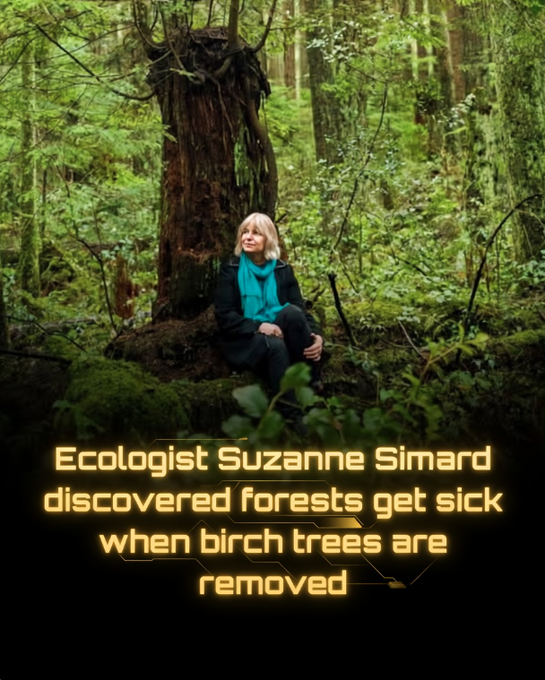
In the 1990s, Canadian ecologist Suzanne Simard made a groundbreaking discovery that challenged everything we thought we knew about how forests work. While studying managed forests in British Columbia, she noticed something puzzling: when birch trees were removed to promote the growth of valuable Douglas firs, the firs did not flourish as expected, they actually struggled and grew more slowly.
Determined to understand why, Simard traced the movement of nutrients using radioactive carbon isotopes. What she found was astonishing. Trees were actively sharing resources through vast underground fungal networks known as mycorrhizae. These delicate, thread-like fungi connect the roots of different trees across the forest floor, forming a complex web that allows the exchange of carbon, water, nutrients, and even chemical signals, sometimes between entirely different species.
She discovered that older, larger trees often serve as central "hubs" or "mother trees," supporting younger saplings by redistributing vital resources and helping the entire ecosystem remain resilient. When these key trees are removed, the underground network weakens, and the health of the remaining forest declines.
Simard’s research overturned the traditional Darwinian view of forests as battlegrounds of ruthless competition. Instead, she revealed a far more sophisticated reality: forests operate as highly cooperative systems where trees communicate, support one another, and even warn neighboring trees about threats like drought, disease, or insect attacks.
What appears to the human eye as a silent, still forest is, in truth, a vibrant, interconnected living network, built not on isolation and rivalry, but on deep connection and mutual aid.
Watch this octopus, filmed by EVNautilus at a depth of around 1,600 meters (5,250 feet), stretch its tentacles to form a huge balloon.
Nature is amazing. Protect it.
#ActOnClimate#climate#biodiversity#oceans#GreenNewDeal