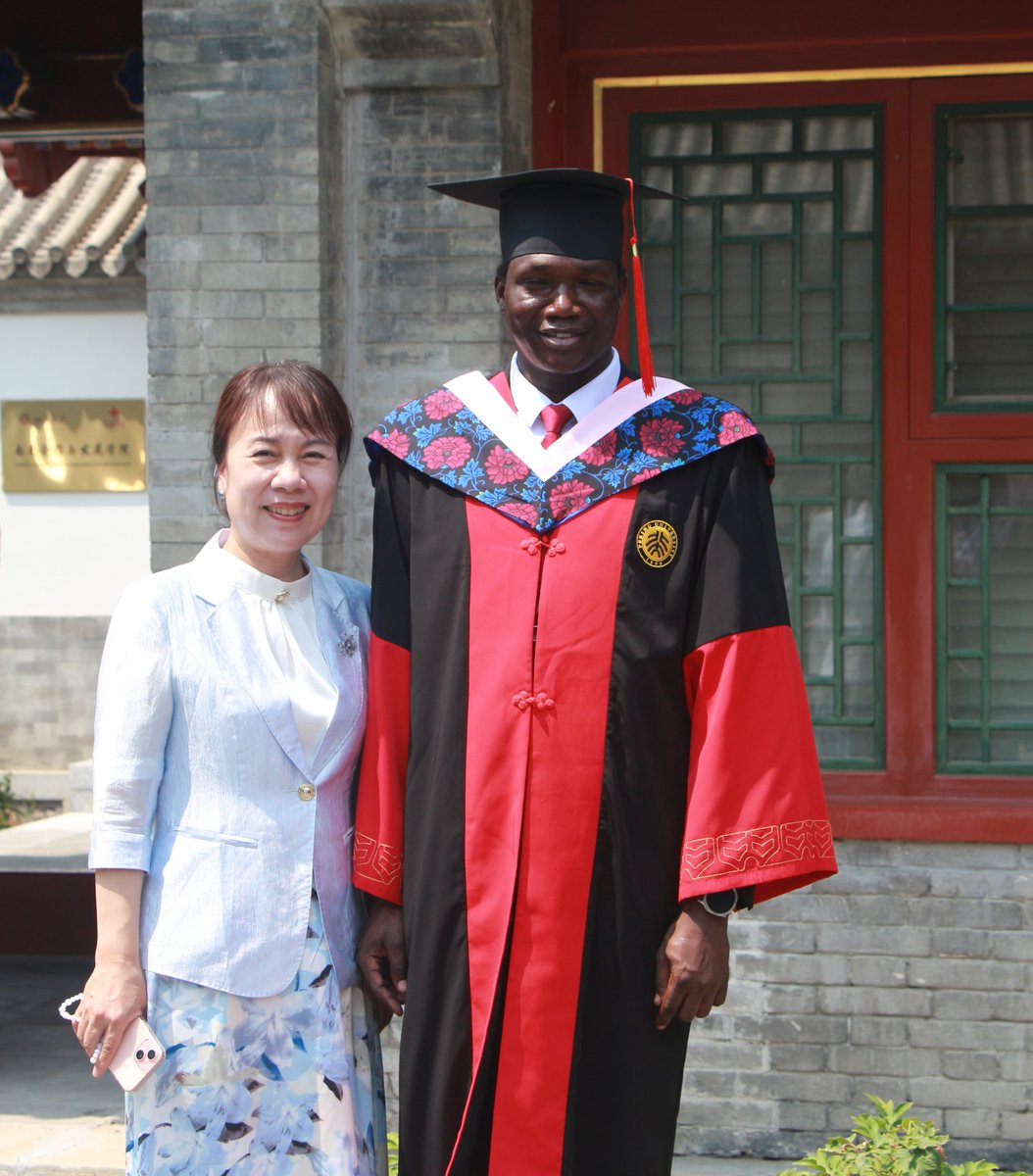
I officially graduated with my PhD in Theoretical Economics from Peking University's Institute of South-South Cooperation and Development (ISSCAD).
Three years ago, I arrived at ISSCAD as a practitioner, carrying years of professional experience but still searching for deeper understanding. Today, I leave as a researcher with the tools, the networks, and most importantly, the confidence to tackle the development challenges that matter most to me and humanity.
This achievement belongs to many people:
To Peking University, the National School of Development, and ISSCAD—thank you for trusting me with this opportunity. You've shown me what genuine South-South partnership looks like: investment in capacity; commitment to building researchers and thinkers, not just markets. You've set a model the world should follow.
To my supervisor, Prof. Xiaoyan Lei—thank you for believing in my research vision, for pushing me to think deeper and write clearer, and for showing me what rigorous scholarship rooted in local knowledge. Your mentorship transformed not just my dissertation, but how I think.
To my professors and the faculty of ISSCAD and NSD—your seminars challenged my assumptions, your feedback sharpened my thinking, and your examples showed me that development economics can be both rigorous and humane.
To my classmates—we arrived from different countries, speaking different languages, carrying different experiences. We leave as a cohort bound by rigour, purpose, and a shared commitment to bring evidence-based policymaking to our nations. I'm proud to be part of this generation.
To my family—you made countless sacrifices to bring me here. This degree is as much yours as it is mine. Thank you for believing in the power of education.
To my friends—near and far—who checked in, celebrated my small wins, and reminded me why this mattered when the work felt overwhelming. Your support kept me grounded.
I return home with three things:
Rigorous tools to understand complex development problems;
a global network of brilliant researchers committed to policy making; and
a deep conviction that evidence-based thinking, rooted in local context and genuine partnership, can change policy and lives
The work is just beginning.
感谢你们。 Thank you. Asanteni Sana.
West Pokot Boy → Police Officer → PhD, Economics-Peking University 🎓
Today, I had the profound honour of standing in not just as a guest, but as family—representing the family and friends of Lodis Akol Michael from West Pokot County-Kenya at his PhD graduation from the National School of Development at Peking University. His loved ones could not make the long journey to Beijing, and so in that moment, I carried their presence—their pride, their hopes, and their deep connection to him.
Lodis journey is one that commands deep respect. He is a Kenyan police officer who served our country with dignity and commitment for seventeen years, dedicating his life to public service across different regions.
His academic journey abroad began at Tsinghua University, where he pursued his Master’s degree in International Development and Governance. At Tsinghua—an institution known globally for academic rigor and excellence—he immersed himself in the study of development, institutions, and governance systems. That experience did more than equip him academically; it broadened his worldview and strengthened his resolve to contribute meaningfully to society. From there, he advanced to Peking University’s National School of Development, where he pursued and completed his PhD in Theoretical Economics, engaging deeply with complex issues of institutional design, economic systems, and societal transformation.
As we celebrated him today, it became very clear that this achievement is not his alone. It is a moment of pride for our country, for West Pokot, and for all who believe in the power of perseverance, service, and education. Standing there as his family, I felt the depth of his journey—from serving our country with honour to standing among the world’s leading scholars. Congratulations, Dr. Lodis Michael. Your journey reflects the strength of our people, and your achievement will continue to inspire many across our country and beyond.
Kenya possesses ports, educated workforce, geographic positioning, natural capital. What remains uncertain is political will. The window for positioning Kenya as a development hub—not merely a transit point—remains open. But not indefinitely. Choices must be made now.
Just completed an 18-city traverse across China (May 17-June 12, 2026)—Beijing, Chengdu, Kunming, Chongqing, Liuzhou, Pearl River Delta, Xi'an, Yantai, Qingdao, Linyi, Guilin, Yangshuo, Rongshui. Not tourism. Applied development economics. A thread on what I learned: 🧵
(4) Cultural diversity need not impede development—China has integrated minorities into growth while preserving identity. Kenya treats ethnic distinctiveness as political threat. (5) Conviction matters—people invest energy in communities where they feel belonged.